Psilocybin Set & Setting
19 patients changed the field
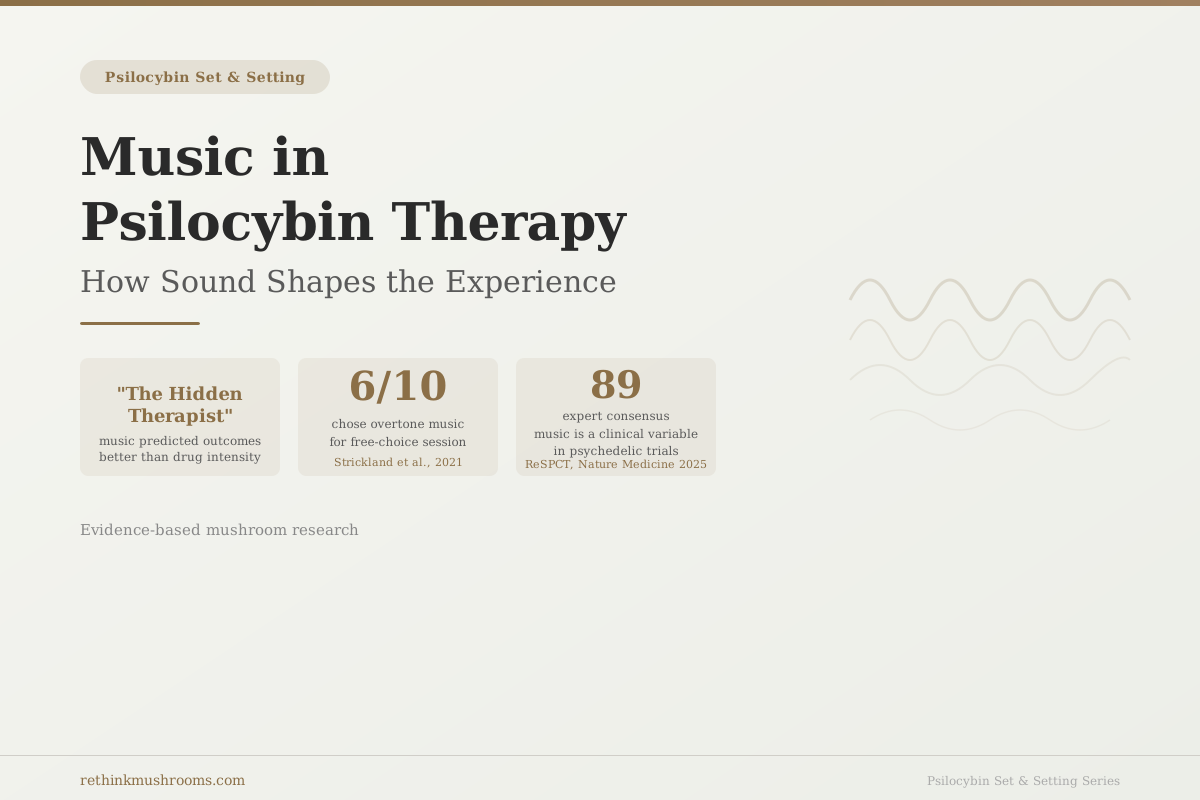
In 19 treatment-resistant depression patients, how much they liked and resonated with the music during their psilocybin session predicted depression reduction better than how much drug they received.
Kaelen et al., Psychopharmacology, 2018
6 of 10
participants chose overtone music over classical for their free-choice third session
30 factors
in the 2025 ReSPCT guidelines; music program is one of them
89 experts
from 17 countries reached consensus that music is a key clinical setting variable
Kaelen et al., Psychopharmacology, 2018
 View as image ↗
Most people assume the dose of psilocybin determines the experience. A 2018 study of 19 treatment-resistant depression patients challenged that assumption directly.
Mendel Kaelen and colleagues at Imperial College London examined what predicted depression reduction one week after a psilocybin session. The answer was not drug intensity. It was how patients responded to the music: whether they liked it, whether it resonated emotionally, and whether they felt open to letting it move them.[1]
The researchers called it "the hidden therapist."
Music in psilocybin therapy effects are now a recognized line of clinical research. This article covers what the research shows about how sound shapes therapeutic outcomes, what the only randomized genre comparison found, and how the field has formalized music as a clinical variable. It is part of the Psychedelic Safety and Integration series.
Key Takeaways
- In 19 treatment-resistant depression patients, how much they liked and resonated with the music predicted depression reduction one week after psilocybin therapy better than the overall drug intensity; this led to the term "the hidden therapist" (Kaelen et al., Psychopharmacology, 2018)
- Three specific factors characterized a positive music response that predicted outcomes: liking (preference), resonance (emotional fit), and openness (willingness to be moved by it); all three predicted depression outcomes independently
- A randomized comparison of two musical genres found overtone-based music (Tibetan bowls, drone instruments, non-lyrical) produced higher mystical experience scores than Western classical music; 6 of 10 participants chose it for a free-choice third session (Strickland et al., 2021)
- A 2017 analysis found that the quality of the acute psilocybin experience predicts therapeutic outcomes for treatment-resistant depression; because music shapes that acute experience, this connects music response directly to long-term benefit
- The 2025 international ReSPCT guidelines, produced by 89 experts across 17 countries and published in Nature Medicine, formalized music program as one of 30 essential non-pharmacological factors to report in all psychedelic clinical trials (Pronovost-Morgan et al., 2025)
- Overtone music's potential advantage may stem from its lack of linguistic content: without words, the music does not trigger specific memories or cultural associations, allowing the mind to turn inward
The Hidden Therapist: How Music Response Predicted Depression Outcomes Better Than Drug Intensity
Kaelen and colleagues published "The Hidden Therapist: Evidence for a Central Role of Music in Psychedelic Therapy" in Psychopharmacology in 2018.[1] The sample was 19 patients with treatment-resistant depression who received psilocybin as part of a clinical study. After each session, patients completed standardized measures of how they experienced the music and standardized measures of depression severity.
The finding was straightforward to describe and surprising in context. How patients experienced the music (liking, resonance, openness) predicted how much their depression improved one week later. Drug intensity, a standard measure of how intense the psychedelic state felt, did not predict depression outcomes in the same way.
This is counterintuitive. Clinical research tends to treat drug intensity as a proxy for therapeutic effect. In this case, the intensity of the pharmacological state was less predictive of outcomes than whether the patient felt moved by the music.
The implication Kaelen drew from this is significant: music is not background ambiance in psilocybin therapy. It is an active therapeutic ingredient with a measurable relationship to clinical outcomes. The term "hidden therapist" captures this: music is doing something clinical, but it has been hiding in plain sight because no one had measured it that way before.
The study had 19 patients. This is not a large sample, and the finding should be treated as a signal requiring replication rather than a settled fact. What makes it worth taking seriously is that it was not a post-hoc surprise. Kaelen's group had previously developed the specific music scales they used, and the finding held across multiple measures of music experience.
The Three Factors That Made Music Therapeutic: Liking, Resonance, and Openness
The Kaelen study did not simply find that "music helps." It identified three specific psychological components of music experience that each independently predicted better depression outcomes.
Liking was the most straightforward: patients who rated the music as aesthetically pleasing did better. This suggests that music selection matters practically: a patient who finds the music irritating or emotionally neutral is less likely to benefit from it.
Resonance was deeper than preference. Resonance captured whether the music felt emotionally meaningful or fitting to what the patient was experiencing internally during the session. A patient could like music as music but not feel that it resonated with the content of their psilocybin experience. Resonance predicted outcomes separately from liking.
Openness was the willingness to be moved by the music rather than to evaluate or resist it. This is a psychological orientation: some patients approach novel sounds analytically; others allow the sound to elicit emotion. The latter predicted better outcomes.
These three components map onto something clinicians and guides had described informally for years: the importance of surrendering to the music rather than fighting it. Kaelen's work gave that clinical intuition an empirical structure. Therapists now have specific dimensions to prepare patients for, rather than a vague instruction to "let the music take you."
For more on how the full context of a psilocybin session is structured to optimize these responses, see Set and Setting: Why Context Determines the Psilocybin Experience.
Overtone vs. Classical: The Only Randomized Genre Comparison
Strickland, Garcia-Romeu, and Johnson published the only randomized study comparing musical genres in psilocybin sessions in ACS Pharmacology and Translational Science in 2021.[2]
Ten participants enrolled in a smoking cessation study and received psilocybin in two separate sessions. Each session used a different musical genre. Half started with Western classical (the most common genre in clinical psilocybin research: orchestral pieces, opera, composed contemporary). Half started with overtone-based music (Tibetan bowls, singing bowls, drone instruments, non-lyrical ambient). On a third session, participants could choose freely between the two genres.
The results: sessions with overtone-based music produced higher scores on standard mystical experience measures. Six of the ten participants chose overtone music for their free-choice third session, and the overtone sessions were associated with 66.7% smoking abstinence versus 50% for classical. The sample was ten people, so the outcome difference is not statistically powerful. The mystical experience difference was more consistent.
Why might overtone music produce different effects? Strickland's team offered one hypothesis: overtone music lacks linguistic content. Classical music, even without vocals, carries cultural associations for many Western listeners (romantic period classical may evoke specific emotional memories; familiar composers carry biographical associations). Overtone music with no melody, no familiar harmonic structure, and no lyrics may provide less material for analytical processing, leaving the mind freer to turn inward.
This fits the "openness" factor from Kaelen's work. Music that offers less surface-level content to evaluate may naturally promote the surrender orientation that predicts better outcomes.
The major limitation is sample size. This study should be understood as a well-designed pilot, not a definitive guide to genre selection.
Why Session Quality Predicts Outcomes, and What Music Does to Session Quality
The mechanism connecting music to long-term therapeutic outcomes is not mysterious once the link is laid out.
A 2017 analysis found that the quality of the acute psilocybin experience predicts therapeutic efficacy for treatment-resistant depression.[4] Specifically, higher scores on mystical experience scales and measures of psychological insight during the session predicted how much patients' depression improved afterward. Patients who described a deeply moving, meaningful session had better outcomes than those whose sessions were less emotionally engaged.
Music directly shapes that acute experience. The session is four to eight hours long. Music plays continuously throughout. How the patient relates to that music determines, in part, whether the session deepens into a meaningful internal exploration or remains at the surface. Kaelen's finding, Strickland's genre comparison, and the 2017 outcome analysis all fit together: music shapes session quality, session quality shapes therapeutic outcome.
This is why clinicians describe music selection as a clinical decision, not an aesthetic one. The wrong music, or a patient who is not prepared to engage with the music, does not ruin a session. But the right music, attended with openness and resonance, is a measurable contributor to outcomes.
The practical consequence of this finding is that preparation for a psilocybin therapy session now routinely includes orienting the patient to the music they will hear, explaining the role it is intended to play, and explicitly practicing a surrender orientation rather than an evaluative one. Therapists at major research centers walk patients through the session arc, including what the music will sound like at each phase, so that encountering unfamiliar sounds during the experience does not produce anxiety.
For the neural mechanisms through which music and the broader psilocybin experience interact during sessions, see Functional Connectivity Changes Under Psilocybin: fMRI Evidence.
What Clinical Trials Actually Play, and How Music Became a Formalized Clinical Variable
The practical question for anyone learning about psilocybin therapy is: what does the music actually sound like?
Major research centers have developed their own curated playlists. The Johns Hopkins program uses a playlist developed over decades of protocol refinement: largely Western classical and world music, organized by session phase. Music during the onset phase tends to be calm and supportive (slower tempo, minimal dissonance). As the experience deepens, music becomes more complex and emotionally rich. The peak includes pieces designed to evoke awe and expansion. The return phase uses familiar, grounding music. The arc is intentional: music mirrors the intended trajectory of the session.
Bill Richards, a psychologist at Johns Hopkins with over 50 years of experience with psychedelic therapy, articulated the underlying principle: music should support the internal journey without directing it to specific content. Familiar music with strong emotional associations (a favorite song, a piece tied to memory) can hijack attention outward. Clinical music selection typically avoids this.
The 2025 international Delphi consensus, published in Nature Medicine and involving 89 experts from 17 countries, formalized music program as one of 30 key non-pharmacological factors that should be reported in all psychedelic clinical trials.[3] The ReSPCT (Reporting Standards for Psychedelic Clinical Trials) guidelines do not prescribe specific playlists, but they establish that music selection is a clinical decision that affects research reproducibility and patient outcomes. Trials that do not report their music program are omitting a variable that has been shown to predict results.
This formalization changes the field's relationship with music from art to protocol. It is no longer acceptable for a clinical trial to report its drug dose and therapy structure while leaving the musical environment undocumented.
For a comprehensive look at what the full clinical environment for psilocybin therapy includes, see The Therapeutic Environment: What Clinical Trials Get Right. For preparation guidance including how to approach the music aspect of a session, see How to Create Optimal Set and Setting: Evidence-Based Guidelines.
The Bottom Line
Music in psilocybin therapy is an active therapeutic ingredient, not background ambiance. A 2018 study found that how patients experienced the music (liking, resonance, openness) predicted depression outcomes better than drug intensity, coining the term "the hidden therapist." A randomized comparison found that overtone-based music produced higher mystical experience scores than Western classical in psilocybin sessions. A 2017 analysis established that session quality predicts therapeutic outcomes, connecting music response to long-term benefit through a coherent chain. In 2025, an international consensus of 89 experts formalized music program as one of 30 key non-pharmacological variables to report in clinical trials. The research base is small but the findings are consistent and mechanistically coherent.
Frequently Asked Questions
Sources & References
- 1RTHM-00967·Kaelen, Mendel et al. (2018). “The hidden therapist: evidence for a central role of music in psychedelic therapy..” Psychopharmacology.Study breakdown →PubMed →↩
- 2RTHM-01440·Strickland, Justin C et al. (2021). “Set and Setting: A Randomized Study of Different Musical Genres in Supporting Psychedelic Therapy..” ACS pharmacology & translational science.Study breakdown →PubMed →↩
- 3RTHM-02164·Pronovost-Morgan, Chloé et al. (2025). “An international Delphi consensus for reporting of setting in psychedelic clinical trials..” Nature medicine.Study breakdown →PubMed →↩
- 4. Source details for this reference are not yet available.