Psilocybin Set & Setting
30 factors of set and setting, standardized
In 2025, 89 experts from 17 countries reached the first scientific consensus on which non-pharmacological variables matter in psilocybin research: 30 factors across four domains, published in Nature Medicine.
Pronovost-Morgan et al., Nature Medicine, 2025
89 experts
reached the 2025 ReSPCT consensus
17 countries
represented in the expert panel
4 domains
physical, procedural, therapeutic, experiential
Pronovost-Morgan et al., Nature Medicine, 2025
 View as image ↗
The phrase "set and setting" has been used in psychedelic communities since the 1960s. For most of that time, the guidance was philosophical: be in a good headspace, be in a comfortable place. What that means practically, and what evidence exists to back it up, is a different and newer question.
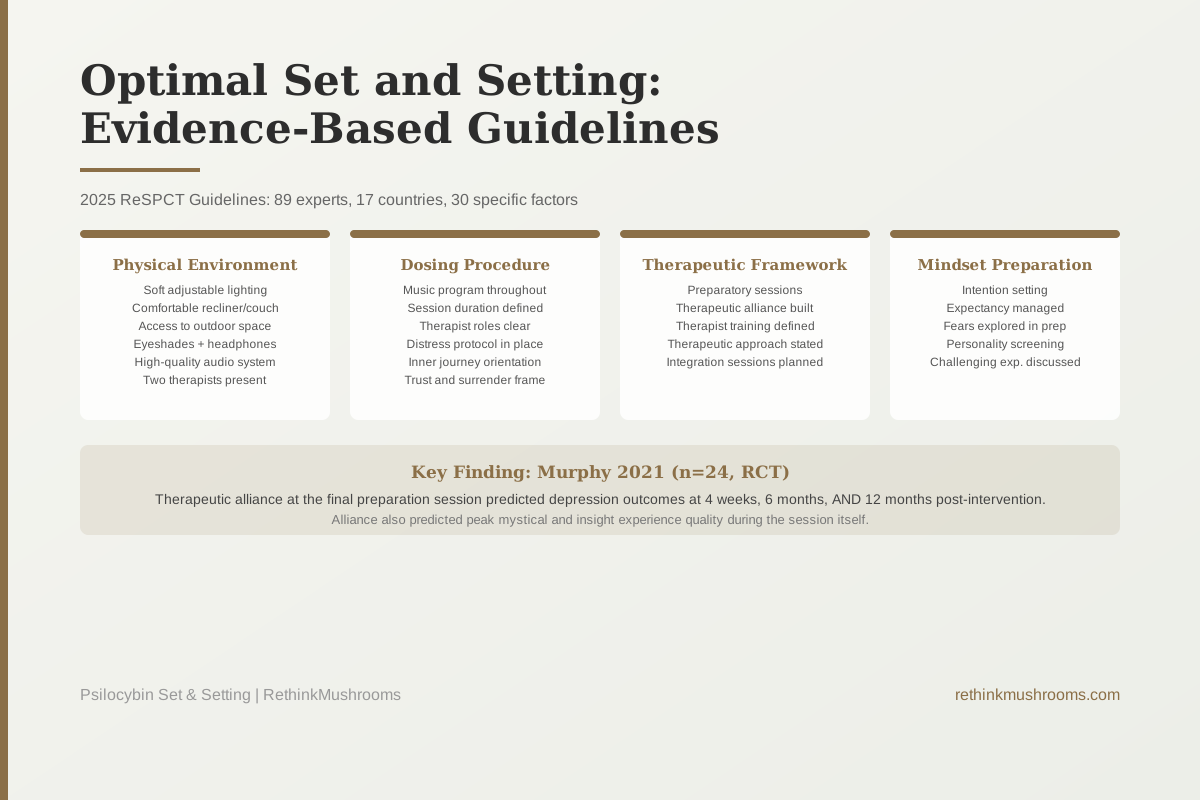
In 2025, an international panel of 89 experts from 17 countries produced the first scientific consensus on which specific non-pharmacological variables matter in psilocybin research. The result, called the ReSPCT guidelines and published in Nature Medicine, identified 30 specific factors across four domains: physical environment, dosing session procedure, therapeutic framework, and subjective experience support.[1] For the first time, the field has a structured, evidence-anchored answer to "what does optimal set and setting actually require?"
This article covers the four domains with the research behind each. For broader safety context, see How Safe Is Psilocybin? The Complete Safety Research.
Key Takeaways
- The 2025 ReSPCT guidelines (Pronovost-Morgan et al., Nature Medicine, 89 experts, 17 countries) established 30 specific non-pharmacological setting factors across four domains as the first scientific consensus standard for psilocybin research environments
- In the psilocybin arm (n=30) of a double-blind RCT comparing psilocybin-assisted therapy with escitalopram, the strength of the therapeutic alliance measured before dosing predicted the quality of the acute experience (emotional breakthrough and mystical-type experience) and depression severity six weeks later (Murphy et al.), the strongest evidence that the therapist relationship is mechanistically predictive rather than peripheral
- Positive expectations are a measurable component of "set": in a 2021 prospective study that followed people through a psychedelic microdosing regimen (n=81), higher positive expectations predicted greater improvements in mental health and well-being
- Higher neuroticism, a stable personality trait, is associated with more challenging experiences with psilocybin, making personality awareness a practical preparation variable
- The 2016 Challenging Experience Questionnaire characterized seven factors of difficult experiences (grief, fear, death, insanity, isolation, physical distress, and paranoia), establishing what poor set and setting increases the risk of
- Most of the 30 ReSPCT factors represent expert consensus informed by accumulated trial experience rather than individually randomized interventions. They reflect what major clinical programs do, not what isolated RCTs have individually proven
Context
ModerateThese findings come from supervised clinical trials, not a guide for personal use
Concern
Every result described here was produced in controlled research settings with medical screening, trained therapists, and integration support. Psilocybin is a Schedule I controlled substance in the United States and is illegal in most jurisdictions. Unsupervised use carries risks that the clinical protocols below are specifically designed to manage.
What the research says
Read this as an explanation of what the evidence says about setting in research, not as instructions to follow. It is not medical advice. Anyone considering psilocybin for a health condition should consult a qualified clinician and look into regulated access such as approved clinical trials.
ReSPCT guidelines (Pronovost-Morgan et al., Nature Medicine, 2025) and the general psilocybin safety literature
The 2025 Scientific Standard: Four Domains, 30 Specific Factors
The ReSPCT guidelines came from a Delphi consensus process: an iterative method where experts rate the importance of specific items across multiple rounds until stable agreement is reached. The 89 experts included researchers, therapists, and clinical coordinators from major psilocybin research centers across 17 countries.[1]
The stated purpose was not to create a prescription for how psilocybin sessions should run, but to standardize the reporting of setting variables so that studies can be compared. Right now, one research team's "setting" might include preparation sessions, curated music, two therapists, a specific room layout, and a post-session integration protocol; another team's "setting" might be minimal. If the outcomes differ, there is no way to know whether psilocybin works differently or the context did.
The four ReSPCT domains are:
- Physical environment: the actual room, including lighting, furniture, access to outdoor space, and available equipment
- Dosing session procedure: what happens during the session, including music program, session duration, therapist presence, and protocols for distress
- Therapeutic framework and protocol: the wider context around the session, including preparatory meetings, therapeutic approach, and therapist training
- Subjective experience support: practices to shape the internal experience, including intention setting, the "inner journey" orientation, and integration support afterward
The 2025 ReSPCT consensus
From 770 Suggestions to 30 Reporting Factors
89 experts from 17 countries ran a four-round Delphi process. What started as 770 suggested setting variables was distilled into 30 factors, grouped into four domains, that any psilocybin trial should now report.
The four domains
Physical environment
The room: lighting, furniture, outdoor access, equipment
Dosing session procedure
Music program, duration, therapist presence, distress protocols
Therapeutic framework & protocol
Preparation meetings, therapeutic approach, therapist training
Subjective experiences
Intention setting, inner-journey orientation, integration
What is consensus vs. what is measured
The 30 factors are expert-consensus reporting standards — not 30 individually randomized interventions. A few of the variables they cover, though, have separately been measured as predictors of outcome in trials:
Therapeutic alliance before dosing
Murphy et al.Mystical-type quality of the acute experience
Roseman et al.Positive expectations (microdosing sample)
Kaertner et al.Sources: Pronovost-Morgan et al., Nature Medicine 2025 (RTHM-02164); Murphy et al., Front Pharmacol (RTHM-01410); Roseman et al., Front Pharmacol (RTHM-00907); Kaertner et al., Sci Rep 2021 (RTHM-01371)
An honest note: most of these factors have not been tested as isolated variables in randomized trials. What exists is evidence that outcomes differ substantially across research programs, that specific factors like therapeutic alliance and music quality have been measured as predictors of outcome, and that expert consensus has converged on what the higher-performing programs do. The 30 factors represent the best available distillation of that experience.
The Physical Space: What Clinical Trials Put in the Room
The physical environment in major psilocybin trials is not a medical treatment room. It is designed to feel calm, comfortable, and free of clinical associations.
What consistently appears across major protocols: soft adjustable lighting (clinical overhead lighting is avoided), a comfortable couch or recliner large enough to fully recline, access to an outdoor space or garden for patients who want fresh air, natural objects or artwork available for visual focus, a bathroom accessible without leaving the room, water and light snacks available, and a high-quality audio system for music playback.
Eyeshades and headphones are used in most major protocols. The reasoning is that blocking visual input and providing music guides attention inward rather than outward, which correlates with deeper engagement with the experience. The ReSPCT guidelines include music program as one of the 30 key factors.[1]
Two therapists are present in most clinical trial protocols, typically one of each gender. This reflects both safety considerations and therapeutic support: one can maintain the space while the other attends to the patient.
The principle behind these physical choices is reducing anything that produces anxiety or breaks the immersive quality of the session. An uncomfortable room, intrusive sounds, or unfamiliar people can become amplified during the experience. The physical design attempts to remove those potential stressors before they become problems.
For more on how clinical trials structure the physical environment, see The Therapeutic Environment: What Clinical Trials Get Right.
The Therapeutic Relationship: The Factor That Shapes the Session and Its Outcome
The most striking piece of evidence in this space comes from Murphy and colleagues, published in Frontiers in Pharmacology.[2]
The study was a two-arm, double-blind randomized controlled trial comparing psilocybin-assisted therapy with the antidepressant escitalopram for moderate-to-severe depression (N=59). This analysis focused on the psilocybin arm (n=30), in which patients received two 25 mg doses of psilocybin three weeks apart, with psychological preparation, in-session support, and integration therapy. The researchers measured therapeutic alliance at the final preparation session, before the first dose.
The result: the strength of the alliance before dosing predicted the quality of the acute psychedelic experience — specifically emotional breakthrough and mystical-type experience during the sessions — and predicted depression severity six weeks after treatment. A stronger alliance ran through to a better outcome by way of a more productive session.
Murphy et al. (2021) · Frontiers in Pharmacology
- Population
- Psilocybin arm (n=30) of a 2-arm double-blind RCT (N=59) in moderate-to-severe depression
- Intervention
- Two 25 mg psilocybin doses, three weeks apart, with preparation, in-session support, and integration
- Comparator
- Escitalopram arm (used to test specificity)
- Finding
- Therapeutic alliance measured before dosing predicted emotional breakthrough and mystical-type experience during the sessions, and predicted depression severity six weeks after treatment.
positive Observational within an RCT: alliance was measured, not randomized, so the path is predictive rather than proof of a causal lever.
Murphy et al., Frontiers in Pharmacology (RTHM-01410)
This finding is worth dwelling on. The psilocybin session itself lasted about six hours. The experience during the session was shaped substantially by the quality of the relationship patients had built with their therapists before they ever took the drug. The therapist relationship was not just support after the fact. It was an active determinant of what happened during the session, which in turn tracked with how patients' depression scores looked weeks later. The trial also found the influence ran both ways: an emotional breakthrough during the first session strengthened the alliance heading into the second.
Practically, this means preparation sessions are not bureaucratic checkboxes. They are where a significant portion of the therapeutic work occurs. A strong working alliance, characterized by trust, agreed-upon goals, and a collaborative bond, is something that is built before the session, not assumed during it.
For a deeper look at the ethical dimensions of this relationship, see Ethics in Psychedelic Therapy: Navigating Power and Vulnerability.
Preparing the Mindset: Expectations and Personality Awareness
"Set" describes the mental state a person brings into a session. It is partly stable (personality, history) and partly modifiable (expectations, intentions, acute state).
The modifiable piece has measurable effects. A 2021 prospective study that followed people through a psychedelic microdosing regimen (n=81) found that those with more positive expectations reported greater improvements in mental health and well-being.[3] Because that study tracked a microdosing sample rather than a full-dose clinical session, its specific numbers do not transfer directly. But expectancy is a well-established mechanism in clinical research generally: what someone believes will happen shapes how they respond. In the context of psilocybin, this suggests that helping patients arrive with realistic but hopeful expectations is not just good clinical practice. It is a plausible preparatory lever, not merely bedside manner.
The stable personality piece matters too. A 2017 study analyzing two online surveys of people who had taken psilocybin found that higher scores on the personality dimension called neuroticism were associated with more challenging and difficult experiences.[4] Neuroticism refers to a tendency toward emotional instability, anxiety, and negative emotional reactivity. It is a common trait that varies widely across the normal population. This finding does not mean that people with higher neuroticism cannot benefit from psilocybin or should be excluded. It means they are more likely to require more thorough preparation, stronger therapeutic alliance, and possibly different session structure to support them through difficult moments.
Practical preparation practices used in clinical protocols include: setting clear intentions for the session (what the patient hopes to explore), working through anticipated fears with the therapist beforehand, understanding what challenging experiences might feel like and how to work with rather than resist them, and having an agreed approach for difficult moments during the session.
Why Preparation Matters: What Challenging Experiences Actually Look Like
A 2016 study developed and validated a questionnaire specifically designed to characterize difficult psilocybin experiences.[5] The Challenging Experience Questionnaire identified seven factors of challenging content that can arise: grief, fear, death (confronting mortality), insanity (fear of going permanently insane), isolation (a sense of being alone and beyond help), physical distress (nausea, bodily tension), and paranoia.
These experiences are not necessarily harmful outcomes. In therapeutic contexts, encounters with grief or fear are often part of the work. The difference between a challenging experience that becomes therapeutically meaningful and one that becomes a lasting problem is substantially a function of what the person brought into the session (their preparation) and what support was available during it.
The data on challenging experiences is one reason preparation is not optional in responsible therapeutic use. Arriving unprepared removes the context that allows difficult material to be worked with rather than just endured. Without understanding what might arise, without having built trust with the therapist, and without having set intentions, the same content that might be therapeutic becomes overwhelming.
The Session Structure: How Protocols Support the Experience
During the session itself, clinical protocols provide a consistent framework that functions as part of the setting.
The approach used by major research centers has several characteristic features. Patients start the session, put on eyeshades and headphones, and turn attention inward. Music plays throughout, typically four to six hours of carefully curated material that moves from building intensity to a peak and then resolves into quieter, integrative pieces. Therapists are present but typically quiet during the experience, available for support if needed but not actively directing the internal experience.
A key instruction given to patients before the session is often described as "trust and surrender," a frame for approaching whatever arises in the experience, including difficult content, with openness rather than resistance. This frame was developed from clinical experience and represents one of the ways therapeutic preparation continues to operate during the session.
Quality of the session experience matters for outcomes. A 2017 study of patients with treatment-resistant depression found that the quality of the acute experience — particularly mystical-type, "oceanic" states — predicted therapeutic outcomes for depression.[6] Because set and setting directly shape the quality of the experience, they are not just contextual features. They are levers that clinical protocols use to increase the probability of a therapeutically productive session.
Music is one of the most-discussed session variables. The ReSPCT guidelines include music program as one of the 30 key factors, and separate research has linked patients' emotional response to music during the session to their clinical outcomes. For the music evidence in depth, see Music in Psilocybin Therapy: How Sound Shapes the Experience.
What the Evidence Adds Up To
Taken together, the research in this area supports a picture of psilocybin therapy in which the non-pharmacological context is not decoration around the drug effect. It is an active component of the intervention.
Therapeutic alliance before dosing predicts the quality of the session and depression outcomes weeks later. Quality of the session experience predicts therapeutic outcomes in treatment-resistant depression. Expectations track with outcomes. Personality variables predict session difficulty. Patients' response to music during the session tracks with their outcomes.
The 30-factor ReSPCT framework reflects this evidence by treating setting as a multidimensional variable that requires systematic attention and reporting. The field is moving away from "psilocybin caused this outcome" and toward "psilocybin in this context caused this outcome." That distinction matters enormously for how results are interpreted and replicated.
For post-session context, which extends the "setting" concept into integration, see Integration Best Practices: Evidence-Based Approaches.
The Bottom Line
The 2025 ReSPCT guidelines (Pronovost-Morgan et al., Nature Medicine, 89 experts from 17 countries) established 30 non-pharmacological setting factors across four domains as the first scientific consensus standard for psilocybin research environments. A central finding in this space is Murphy and colleagues' demonstration that, in the psilocybin arm (n=30) of a double-blind RCT, therapeutic alliance measured before dosing predicted the quality of the acute experience and depression severity six weeks later. Expectations, personality traits, and session structure also have measured effects on outcomes. Most of the 30 factors represent informed expert consensus rather than individually randomized evidence, but the accumulated clinical experience that produced them is substantial.
Frequently Asked Questions
Sources & References
- 1RTHM-02164·Pronovost-Morgan, Chloé et al. (2025). “An international Delphi consensus for reporting of setting in psychedelic clinical trials..” Nature medicine.Study breakdown →PubMed →↩
- 2RTHM-01410·Murphy, Roberta et al. (2021). “Therapeutic Alliance and Rapport Modulate Responses to Psilocybin Assisted Therapy for Depression..” Frontiers in pharmacology.Study breakdown →PubMed →↩
- 3RTHM-01371·Kaertner, L S et al. (2021). “Positive expectations predict improved mental-health outcomes linked to psychedelic microdosing..” Scientific reports.Study breakdown →PubMed →↩
- 4RTHM-00460·Barrett, Frederick S et al. (2017). “Neuroticism is associated with challenging experiences with psilocybin mushrooms..” Personality and individual differences.Study breakdown →PubMed →↩
- 5RTHM-00417·Barrett, Frederick S et al. (2016). “The Challenging Experience Questionnaire: Characterization of challenging experiences with psilocybin mushrooms..” Journal of psychopharmacology (Oxford.Study breakdown →PubMed →↩
- 6RTHM-00907·Roseman, Leor et al. (2017). “Quality of Acute Psychedelic Experience Predicts Therapeutic Efficacy of Psilocybin for Treatment-Resistant Depression..” Frontiers in pharmacology.Study breakdown →PubMed →↩