Mycoprotein (Quorn) — Nutrition, Satiety, Cholesterol & Safety
>milk for muscle synthesis
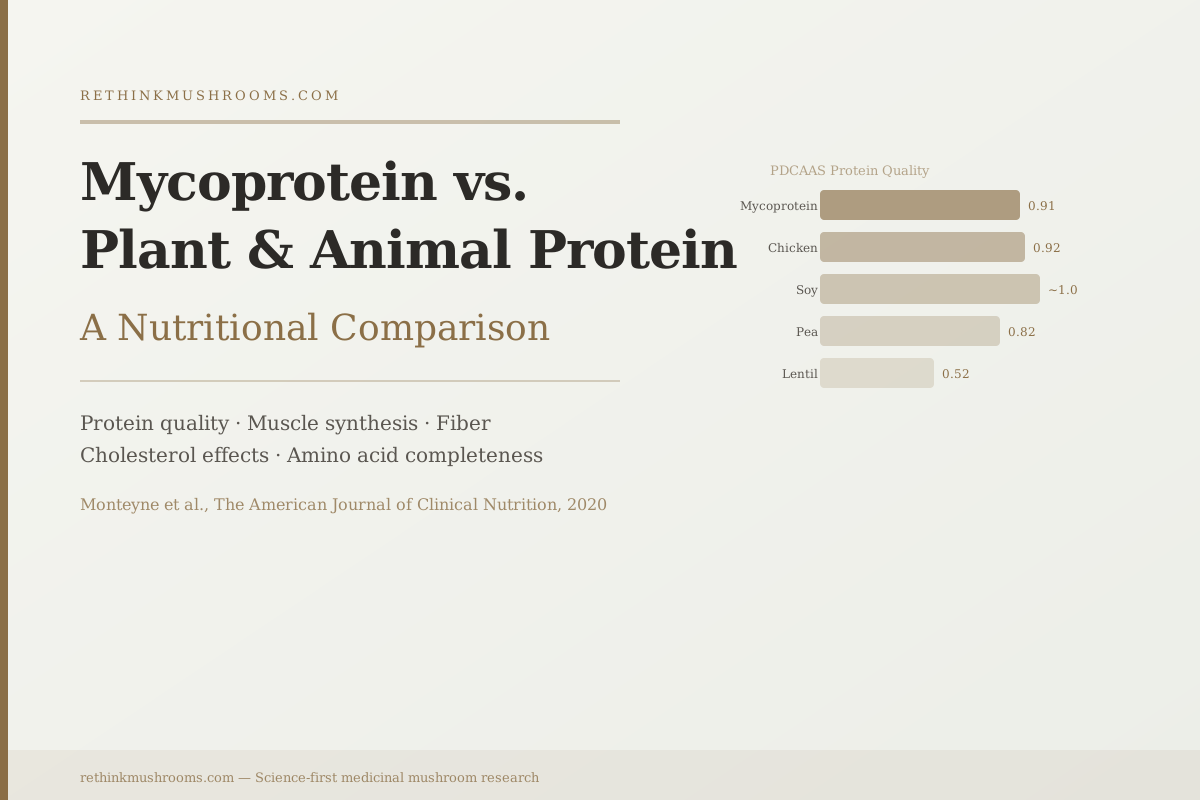
A 2020 randomized controlled trial found mycoprotein raised muscle protein synthesis rates more than a leucine-matched dose of milk protein, in both rested and exercised muscle of resistance-trained young men — a result that complicates the assumption that dairy is the automatic benchmark for muscle building.
Monteyne et al., The American Journal of Clinical Nutrition, 2020
45% / 25%
protein and dietary fiber by dry weight in mycoprotein — a combination no animal protein and few plant proteins deliver in one ingredient
41% EAA
essential amino acids as a share of total protein — close to the 45% composition of human muscle, and above most plant proteins
-0.55 mmol/L
pooled reduction in total cholesterol across 9 trials (95% CI -0.85 to -0.26), with no detectable change in LDL, HDL or triglycerides
Monteyne et al., The American Journal of Clinical Nutrition, 2020
 View as image ↗
In 2020, researchers at the University of Exeter ran a randomized controlled trial with an unusual result. Twenty resistance-trained young men received either a bolus of mycoprotein (70g, containing 31.5g protein) or a bolus of milk protein (31g, containing 26.2g protein). Both drinks were matched to deliver exactly 2.5g of leucine, the amino acid that acts as the primary trigger for muscle building. In both rested and exercised muscle, mycoprotein raised muscle protein synthesis rates more than the milk protein did.[1]
Milk protein, particularly whey, has been the clinical benchmark for muscle protein synthesis for decades. This was not a case of mycoprotein matching dairy. On the trial's primary comparison, it exceeded it.
That finding frames the comparison this article makes: mycoprotein is not a compromise protein or an environmental-concession swap for meat. It has a distinct nutritional profile with specific advantages and specific limitations against both animal and plant protein sources. Understanding those tradeoffs requires looking at what mycoprotein actually is, how protein quality is measured and why the published numbers disagree, and what the evidence supports on the outcomes that matter most.
For the broader story of how fungal fermentation became a protein category in its own right, see mycoprotein: the fungal protein revolutionizing food.
Key Takeaways
- Monteyne et al. (2020) found mycoprotein raised muscle protein synthesis rates more than a leucine-matched dose of milk protein in both rested and exercised muscle — though this was a parallel-group trial with only ten men per arm, and the absolute post-meal synthesis rate difference did not reach statistical significance on its own[1]
- Mycoprotein is roughly 45% protein and 25% dietary fiber by dry weight, and its essential amino acids make up 41% of total protein — close to the 45% composition of human muscle itself[2]
- Published PDCAAS values for mycoprotein range from 0.91 to 0.996 depending entirely on which protein digestibility figure the calculation uses — treat any single quoted score with caution
- Mycoprotein contains no saturated fat, no cholesterol, and no phytates (the mineral-binding compounds in legumes that reduce zinc and iron absorption)
- A meta-analysis of 9 trials found mycoprotein lowered total cholesterol by -0.55 mmol/L (95% CI -0.85 to -0.26), but found no detectable effect on LDL, HDL or triglycerides, across a mean follow-up of only 13 days[3]
- A longer 4-week home-based trial did move LDL, by 10%, in overweight adults with raised cholesterol who swapped meat and fish for mycoprotein products[4]
- Against chicken at matched calories, mycoprotein lowered post-meal insulin in a dose-dependent way, but did so without changing GLP-1, PYY or gastric emptying — so the mechanism behind its appetite effect remains unresolved[5]
- Mycoprotein's clearest limitation is allergenicity in people already sensitised to airborne moulds, via a shared fungal allergen[6]
What Mycoprotein Actually Is: The Starting Point for Any Fair Comparison
Mycoprotein is not a mushroom. It is a food ingredient made from Fusarium venenatum, a filamentous fungus naturally found in soil. Through fermentation, this fungus grows as a dense mat of individual fungal filaments (called hyphae) that, when harvested and processed, form a fibrous, meat-like texture. The Quorn brand is the primary commercial source.
The nutritional profile is genuinely unusual. Finnigan and colleagues summarized the evidence in a 2019 symposium review: by dry weight, mycoprotein is typically 45% protein and 25% fiber.[2] No animal protein source contains meaningful dietary fiber. Plenty of plant foods are high in fiber, but few deliver that much fiber and that much protein in the same ingredient.
The same review reports the figure that turns out to be the most stable way to judge mycoprotein's protein quality: essential amino acids make up 41% of its total protein.[2] That is higher than most commonly consumed plant proteins, below whey (up to 52%), and close to the 45% composition of human skeletal muscle itself.
Where things get murkier is the headline protein quality score.
Measurement Provenance
Why Mycoprotein’s Protein Score Has Two Published Answers
PDCAAS multiplies a protein’s amino acid profile by how much of it the body actually absorbs. The amino acid half of that calculation is not in dispute for mycoprotein. The absorption half is — and the two published values differ by nearly a tenth of the entire scale purely because of it.
0.91
Assumed digestibility (~78%)
The legacy figure, widely reproduced in nutrition reference tables. Puts mycoprotein just below chicken and beef.
0.996
Ileostomy-measured digestibility
Direct measurement of what actually leaves the small intestine rather than an assumed absorption figure. Puts mycoprotein at the PDCAAS ceiling, above beef and soy.
The measure that does not depend on a digestibility assumption is the amino acid composition itself — essential amino acids as a share of total protein:
Whey protein
Human skeletal muscle
Mycoprotein
Mycoprotein sits below whey but close to the composition of human muscle tissue itself, and above most commonly consumed plant proteins. This is a measured composition, not a modelled score — which is why it is the more stable number to reason from.
Sources: essential amino acid composition from Finnigan et al. (2019), Curr. Dev. Nutr. [ref 2]. The 0.996 PDCAAS figure and its ileostomy basis are reported in Derbyshire (2022), Foods 11(5):647 — funded by Marlow Foods, the manufacturer of Quorn. The 0.91 figure is the older reference-table value derived from an assumed ~78% digestibility.
You will find mycoprotein's PDCAAS quoted as 0.91 in some reference tables and as 0.996 in others. Both numbers are in circulation, both are defensible, and the gap between them is not a disagreement about mycoprotein's amino acids. It is a disagreement about how much of the protein is absorbed. The lower figure assumes digestibility around 78%. The higher figure comes from ileostomy work that measures what actually leaves the small intestine and finds absorption close to complete. The higher figure is also the one reported in analyses funded by Quorn's manufacturer, which is a reason to hold it loosely rather than a reason to dismiss it.
Fact check
Does mycoprotein have a settled protein quality score?
The claim
“Mycoprotein has a PDCAAS of 0.91, which makes it comparable to chicken and clearly better than legumes.”
A single legacy reference-table value, reproduced across nutrition writing without the digestibility assumption it rests on.
What research shows
OverstatedPublished PDCAAS values for mycoprotein span 0.91 to 0.996. The spread comes from the digestibility input, not from disagreement about its amino acid profile. Quoting either endpoint as the score presents a modelling choice as a measurement.
The underlying conclusion still holds in both cases — mycoprotein is a complete protein whose quality sits in the range normally occupied by animal proteins, well above cereal proteins and most legumes. The precise ranking against chicken specifically is not something the current data can settle.
Finnigan et al. (2019), Curr. Dev. Nutr. [ref 2]; Derbyshire (2022), Foods 11(5):647 (Marlow Foods-funded)
Mycoprotein contains all nine essential amino acids, including the branched-chain amino acids (leucine, isoleucine, valine) that signal muscle cells to begin building new protein. The distinction that matters is leucine density specifically. In the Monteyne trial, delivering 2.5g of leucine required 31.5g of mycoprotein protein but only 26.2g of milk protein — which means, arithmetically, that mycoprotein carries roughly 7.9% leucine by protein weight against milk's 9.5%.[1] Why mycoprotein still outperformed milk on muscle protein synthesis despite that lower density is a question the trial raises without answering.
Mycoprotein vs. Animal Protein: What Fungi Do That Meat Does Not
The comparison between mycoprotein and animal proteins (meat, poultry, fish) runs along several dimensions. On some they are comparable. On others they diverge sharply.
Muscle protein synthesis
Monteyne et al. (2020) · The American Journal of Clinical Nutrition
- Population
- 20 resistance-trained healthy young men (age 22 ± 1 y, BMI 25 ± 1 kg/m²), randomized, double-blind, parallel-group — 10 per arm
- Intervention
- A single bolus of 70g mycoprotein (31.5g protein, 2.5g leucine) after unilateral resistance exercise, with the untrained leg serving as a rested control
- Comparator
- 31g milk protein (26.2g protein, 2.5g leucine) — matched for leucine, not for total protein
- Finding
- Muscle protein synthesis rates rose after both drinks, but rose further after mycoprotein (rested: 0.025 to 0.057%/h; exercised: 0.024 to 0.072%/h) than after milk (rested: 0.036 to 0.052%/h; exercised: 0.035 to 0.056%/h), with a significant treatment × time interaction. The increase from baseline was significantly greater for mycoprotein (Δ0.040 vs Δ0.018%/h). Absolute post-meal synthesis rates, however, only trended higher for mycoprotein (0.065 vs 0.054%/h, P = 0.093).
preliminary Ten men per arm, all young, resistance-trained and male. A parallel-group design means the two groups were different people, so baseline differences between arms cannot be ruled out — and mycoprotein's baseline synthesis rate was in fact lower, which inflates the change-from-baseline comparison that carries the headline. Not replicated, and not tested in older adults, women, or over any period longer than a single meal.
Monteyne et al., The American Journal of Clinical Nutrition, 2020
The result is real and it is interesting, but it is one meal, in ten men per group, measured over four hours.[1] The most plausible explanation offered is that mycoprotein's fibrous hyphal structure slows protein absorption and extends the anabolic signal, in the way slow-digesting casein prolongs muscle protein synthesis relative to fast-digesting whey. That explanation is a hypothesis the trial generated, not a mechanism it demonstrated.
It has not been replicated, and it has not been tested in older adults, who respond differently to protein because of anabolic resistance — a blunting of the muscle protein synthesis response to feeding that develops with age.
Cholesterol and saturated fat
Animal proteins, particularly red and processed meats, carry saturated fat and dietary cholesterol. Mycoprotein carries neither. This is the outcome where the mycoprotein evidence base is deepest.
Shahid et al. (2023) · The American Journal of Clinical Nutrition
- Population
- 9 randomized controlled trials, 178 participants total, mean follow-up 13 days
- Intervention
- Mycoprotein intake versus a non-mycoprotein control arm, across blood lipids, glucose, insulin, blood pressure and body weight
- Finding
- Total cholesterol fell by -0.55 mmol/L (95% CI -0.85 to -0.26; P < 0.001) versus control. No clear effect was found on HDL cholesterol, LDL cholesterol or triglycerides (all P > 0.05). Postprandial glucose was unchanged at every timepoint. Postprandial insulin fell by -76.51 pmol/L at 30 minutes (95% CI -150.75 to -2.28; P = 0.043), with no detectable effect at 60, 90 or 120 minutes.
mixed The total cholesterol signal is consistent and statistically robust. The authors themselves flag that the evidence base is limited by small sample sizes and short intervention periods — a mean of 13 days is not long enough to characterise a lipid intervention. That LDL did not move while total cholesterol did is a genuine loose end.
Shahid et al., The American Journal of Clinical Nutrition, 2023
The pooled total cholesterol reduction of -0.55 mmol/L is the number most often quoted for mycoprotein, and it holds up.[3] What usually gets dropped alongside it is that the same analysis found no detectable movement in LDL, HDL or triglycerides, and that the contributing trials averaged less than two weeks.
A longer trial has since addressed part of that gap. Pavis and colleagues randomized 72 overweight adults with raised cholesterol to receive home deliveries of either mycoprotein-containing products or meat and fish controls for four weeks in a free-living setting.[4] Total cholesterol fell 5% in the mycoprotein group and did not change in controls; LDL cholesterol fell 10% and non-HDL cholesterol fell 6%, both by 0.3 mmol/L. HDL and triglycerides were unaffected in both groups. This is the study that supplies the LDL movement the meta-analysis could not detect, and it did so in people's own homes rather than a metabolic ward.
- Cell & Lab Studiescompleted
Fibre-mediated interruption of cholesterol and bile acid reabsorption in the small intestine is a well-characterised mechanism for viscous and fermentable fibres generally
- Animal Studiescompleted
Established background for dietary fibre and lipid handling; not the load-bearing evidence for mycoprotein specifically
- Case Reports & Early Seriescompleted
Superseded by controlled trials — the cholesterol question moved past this rung some time ago
- Small Human Trialscompleted
Multiple short randomized controlled trials, mostly laboratory-controlled feeding studies lasting days rather than weeks
- Large Randomized Trialscurrent
Pavis 2024: 72 participants, 4 weeks, free-living, in overweight and hypercholesterolaemic adults — total cholesterol -5%, LDL -10%. Larger and longer than anything before it, but still modest by cardiovascular trial standards, and no trial has measured cardiovascular events
- Meta-Analyses & Systematic Reviewscompleted
Shahid 2023 pooled 9 trials and 178 participants: total cholesterol -0.55 mmol/L, but no detectable effect on LDL, HDL or triglycerides, at a mean follow-up of 13 days
For lowering blood cholesterol, mycoprotein has climbed further than almost any other fungal food claim: pooled trial evidence plus a four-week free-living randomized trial with a matched meat-and-fish comparator. What remains missing is duration and hard outcomes. No trial has run long enough, or in enough people, to show that the lipid change translates into fewer cardiovascular events.
Shahid et al. 2023 [ref 3]; Pavis et al. 2024 [ref 4]
Replacing meat protein with mycoprotein therefore does two things at once: it removes a source of saturated fat and adds a fermentable fibre load. For the fuller cardiovascular picture, see mycoprotein and cholesterol: cardiovascular research.
Insulin response and appetite
This is the comparison most often misreported, so it is worth stating precisely what was measured.
Mycoprotein vs. Chicken — Same Calories
The Insulin Response Falls Step by Step With Dose
Fifty-five overweight and obese adults ate meals matched for calories, containing either mycoprotein at one of three amounts or chicken. Reduction in post-meal insulin, measured as incremental area under the curve, scaled with how much mycoprotein the meal contained.
44 g mycoprotein · Low
−8%88 g mycoprotein · Medium
−12%132 g mycoprotein · High
−21%Only at this amount did the next meal shrink: energy intake three hours later fell 10% (280 kJ / 67 kcal) versus chicken.
What did not change
- Blood glucose
- GLP-1
- Peptide YY (PYY)
- Gastric emptying rate
- Resting energy expenditure
This is the finding most summaries drop. The appetite effect is real, but the gut hormones normally invoked to explain fullness — GLP-1 and PYY — did not move, and neither did the rate at which the stomach emptied. The mechanism is therefore still unresolved.
Source: Bottin et al. (2016), British Journal of Nutrition 116(2):360-74 [ref 5]. Insulin P = 0.004; energy intake P = 0.009.
Bottin and colleagues gave 55 overweight and obese adults test meals matched for calories, containing either mycoprotein at one of three amounts (44g, 88g or 132g) or chicken.[5] Every mycoprotein meal reduced post-meal insulin compared with chicken, and the reduction scaled with dose: 8%, 12% and 21% lower incremental area under the curve for the low, medium and high amounts respectively (P = 0.004). At the highest mycoprotein content only, participants went on to eat 10% less (280 kJ, or 67 kcal) at a free-choice meal three hours later (P = 0.009).
The negative findings are as informative as the positive ones. Blood glucose did not differ. GLP-1 and PYY — the gut hormones usually invoked to explain fullness — did not differ. Gastric emptying rate did not differ. Neither did resting energy expenditure. Whatever produces mycoprotein's appetite effect, the trial ruled out the most popular explanations for it.
What animal protein does better
Animal proteins, particularly beef and chicken, deliver more leucine per gram of protein than mycoprotein does. Because the muscle-building response has a leucine threshold, a meal has to clear that threshold to trigger it. Animal proteins clear it easily and in a smaller serving. Mycoprotein clears it too, but needs modestly more total protein to do so — which for someone eating to a fixed calorie or volume budget is a genuine practical difference, and for older adults with anabolic resistance may be a more consequential one. No trial has tested mycoprotein in that population.
Mycoprotein vs. Plant Protein: The Completeness Advantage
Plant proteins divide into two groups for this comparison: legume proteins (soy, pea, lentil) and cereal proteins (wheat, rice). Mycoprotein compares differently to each.
Against legumes. Soy is the plant protein closest to mycoprotein on amino acid completeness — it contains all essential amino acids and its isolate scores at or near the PDCAAS ceiling. Pea and lentil proteins fall well below both, limited primarily by their sulfur-containing amino acids. On composition, mycoprotein sits with soy at the top of this group rather than with pea and lentil.
The advantage mycoprotein holds over legumes, including soy, is the absence of phytates. Phytates are compounds in legume and grain cell walls that bind minerals — zinc, iron, calcium — and reduce their absorption from the gut. People relying heavily on legumes as their primary protein source can see meaningfully lower mineral absorption as a result. Mycoprotein, as a fungal product, contains no phytates, so minerals eaten alongside it are more bioavailable than the same minerals eaten alongside an equivalent quantity of legumes.
The fibre comparison is closer than it first appears, though the fibre type differs. Mycoprotein's fibre is fungal cell wall material, principally chitin and beta-glucans. Legume fibre is largely pectin, resistant starch and hemicellulose. Both feed gut bacteria and contribute to satiety, but through different fermentation routes and at different sites in the colon.
Against cereal proteins. Cereal proteins (wheat gluten, rice protein) have incomplete essential amino acid profiles, being low in lysine, and score below both legumes and mycoprotein on every protein quality metric. Mycoprotein's complete profile gives it an unambiguous advantage here.
What plant proteins have over mycoprotein is familiarity, availability and price. Legumes and grains are inexpensive, globally distributed and embedded in food cultures everywhere. Mycoprotein reaches consumers largely through a single brand's product line, at a price well above commodity legumes.
For the comparison of fungal cholesterol-lowering approaches — shiitake's eritadenine mechanism versus mycoprotein's fibre mechanism — see eritadenine in shiitake: the unique cholesterol-lowering nucleoside.
The Three-Way Comparison
The table below summarizes the comparison across four reference protein sources. Protein quality is given as a qualitative band rather than a single score, for the reason set out above.
| Attribute | Mycoprotein | Soy protein | Chicken | Beef |
|---|---|---|---|---|
| Protein quality band | High — complete profile; published PDCAAS 0.91–0.996 depending on digestibility input | High — complete profile; isolate at or near the ceiling | High | High |
| Essential amino acids as % of protein | 41% (Finnigan 2019) | Lower than mycoprotein | Higher than mycoprotein | Higher than mycoprotein |
| Fiber | ~25% of dry weight | Moderate | None | None |
| Saturated fat | None | Minimal | Moderate | High |
| Phytates | None | Present | None | None |
| Total cholesterol lowering | Yes — pooled RCT evidence (Shahid 2023) | Not demonstrated in equivalent head-to-head trials | None | None |
| LDL lowering | Yes at 4 weeks (Pavis 2024); not detected in pooled short trials | Not demonstrated in equivalent trials | None | None |
| Muscle protein synthesis | Greater than leucine-matched milk in one small trial (Monteyne 2020) | Not directly compared | Standard reference | Standard reference |
| Main caveat | Mould-allergy cross-reactivity; industrially processed | Phytate content | Saturated fat | Saturated fat |
For a comparison of whole mushrooms as a meat substitute rather than processed mycoprotein, see king oyster mushroom as a meat substitute: texture and nutrition.
Where Mycoprotein Falls Short — and the Allergenicity Question
Mycoprotein is not optimal on every dimension. A fair comparison acknowledges the limitations.
Leucine density. Despite outperforming milk protein in the Monteyne trial, mycoprotein carries less leucine per gram of protein than dairy whey. For older adults, who may need higher leucine doses to overcome age-related loss of sensitivity, this could matter. It has not been tested in that group.
Processing. Unlike a piece of chicken or a bowl of lentils, mycoprotein is an industrial fermentation product requiring substantial processing infrastructure. For people prioritising minimally processed foods, that is a relevant consideration no nutritional comparison table captures.
Allergenicity. This is the real limitation, and it is specific rather than general.
Who should not eat mycoprotein
ModerateCross-reactive allergy in people sensitised to airborne moulds
Concern
The mycoprotein allergen identified in the primary case work is Fus c 1, a 60S acidic ribosomal protein P2. This protein is highly conserved across fungal species and is a described allergen in other moulds, which is why sensitisation acquired through the airway can translate into a reaction to a fungal food eaten by mouth. In the index case, a mould-allergic asthmatic patient had a severe hypersensitivity reaction to ingested mycoprotein confirmed by double-blind placebo-controlled food challenge. Around 35% of sera from Fusarium-sensitised subjects showed IgE reactivity to the recombinant allergen.
What the research says
Reactions concentrate in people already sensitised to airborne fungi. For people without mould allergy, confirmed IgE-mediated reactions are uncommon — though how uncommon is genuinely contested, as the section below sets out.
Particularly relevant for: People with known mould allergy, fungal sensitisation, or a history of reacting to fermented or fungal foods
What to do
If you have a diagnosed mould allergy or have reacted to fungal foods before, talk to your doctor or an allergist before adding mycoprotein products to your diet. This article is not medical advice.
Hoff et al. (2003), J Allergy Clin Immunol 111(5):1106-10 [ref 6]; Xing et al. (2022), J Immunol Res [ref 7]
The allergen responsible was identified by Hoff and colleagues in 2003, working from the serum of a mould-allergic asthmatic patient whose reaction to mycoprotein was confirmed by double-blind placebo-controlled food challenge.[6] Screening a Fusarium culmorum cDNA library with that patient's IgE enriched a clone, Fus c 1, whose sequence closely matched the 60S acidic ribosomal protein P2 — a protein conserved across species and already described as a minor allergen in other moulds. Roughly 35% of sera from Fusarium-sensitised subjects reacted to the recombinant protein, and it accounted for 65% of the IgE reactivity to whole mycoprotein.
That mechanism sits inside a broader pattern. Xing and colleagues reviewed allergic cross-reactivity between airborne fungi and fungus-derived foods, describing what they term fungus food allergy syndrome: sensitisation acquired through the respiratory tract producing reactions to edible mushrooms, mycoprotein and fungally fermented foods, with symptoms ranging from oral allergy syndrome to anaphylaxis.[7]
How common is it? This is where the published numbers stop agreeing.
Reading the Safety Numbers
Two Sources, Two Denominators, No Shared Answer
You will see mycoprotein described both as “one reaction in nine million packages” and as the subject of more than 1,700 adverse-event reports. Both are accurately reported. They are not measuring the same quantity, and neither one is a population allergy rate.
Manufacturer-linked surveillance
Finnigan et al., 2019 [ref 2]
1 in 683,665
packages — any reported illness
1 in 8.99M
packages — possible true (IgE) allergy
Instrument · Complaints reported to the company, divided by packages sold
What it gets right: Has a real denominator — total packages sold is known.
What it cannot tell you: Depends on people bothering to contact the manufacturer, which captures a small and unknown fraction of reactions. Funded by Marlow Foods; the lead author is the company’s Chief Scientific Officer.
Independent self-report registry
Jacobson & DePorter, 2018 [ref 8]
1,752
adverse reactions submitted
312
allergic reactions within 4h — 1 fatal
Instrument · Open web questionnaire run by a consumer advocacy organisation
What it gets right: Captures reactions that never reach the manufacturer, and documents that 60.3% of allergic responders reacted again on re-exposure.
What it cannot tell you: No denominator at all. It counts reports, not exposures, and a complaints website selects for people who had a bad experience — so it cannot produce a rate.
The honest summary is narrower than either headline: confirmed IgE-mediated allergy to mycoprotein is uncommon, it concentrates in people already sensitised to airborne moulds, and the total burden of adverse reactions is genuinely uncertain because no study has counted reactions against a known number of exposures in a population that was actually followed up.
Sources: Finnigan et al. (2019), Curr. Dev. Nutr. [ref 2]; Jacobson & DePorter (2018), Ann. Allergy Asthma Immunol. 120(6):626-630 [ref 8].
The frequently quoted figure of roughly one reaction per nine million packages comes from the Finnigan review, and it is real — but it refers specifically to possible IgE-mediated reactions.[2] The same source reports one reported illness of any kind per 683,665 packages, a rate more than thirteen times higher. Quoting the first number as the overall reaction rate, as is common, understates the second by an order of magnitude.
Against that, Jacobson and DePorter analysed 1,752 self-reported adverse reactions submitted to a web questionnaire run by a consumer advocacy organisation.[8] Of these, 312 people described allergic reactions within four hours of eating, including urticaria and anaphylaxis; 45.8% of those began within an hour, and one was fatal. Notably, 188 of the 312 (60.3%) reported reacting again on repeated consumption — a re-exposure pattern that is difficult to explain as coincidence. A further 1,692 people reported gastrointestinal symptoms within eight hours.
Neither source settles the question. The manufacturer-linked data has a denominator but relies on people contacting the company. The registry captures reactions the company never hears about but has no denominator at all, and a complaints website inevitably selects for people who had a bad experience. What can be said is narrower than either headline: confirmed IgE-mediated allergy is uncommon and concentrates in the mould-sensitised, while the total burden of adverse reactions remains genuinely uncertain. For the full picture, see mycoprotein safety: allergy risks and allergenicity.
A Note on Who Funds This Research
Reading the mycoprotein literature well requires knowing where it comes from. The 2019 symposium review that supplies much of the compositional data in this article was funded by Marlow Foods, and its lead author is Marlow Foods' Chief Scientific Officer; several co-authors received travel funds, meals or honoraria from the company.[2] The analysis reporting the higher PDCAAS value was likewise funded by Marlow Foods. Marlow Foods manufactures Quorn.
This does not make the data wrong. Compositional figures like protein and fibre content are straightforward measurements, and the cholesterol meta-analysis and the four-week trial were conducted and published independently of that framing. But it does mean the most flattering numbers in circulation — the near-ceiling protein score, the one-in-nine-million allergy rate — trace disproportionately to sources with a commercial interest in the answer, while the least flattering trace to a consumer advocacy organisation with its own priors. Where this article could rely on a figure that does not depend on either party's methodology, it has.
The Bottom Line
Mycoprotein has a distinct nutritional profile: roughly 45% protein and 25% fibre by dry weight, essential amino acids at 41% of total protein (close to human muscle composition), no saturated fat, no cholesterol and no phytates. Its most robust evidence is for lowering blood cholesterol — a pooled reduction of -0.55 mmol/L in total cholesterol across 9 short trials, with a 10% LDL reduction in a longer four-week free-living trial. A 2020 randomized trial found it raised muscle protein synthesis more than leucine-matched milk protein, but that result rests on ten men per arm over a single meal and has not been replicated. Against chicken at matched calories it lowers post-meal insulin dose-dependently, though without moving the gut hormones usually credited for satiety. Its published PDCAAS ranges from 0.91 to 0.996 depending on the digestibility assumption used, so any single quoted score should be treated with caution. The clearest limitation is cross-reactive allergy in people sensitised to airborne moulds. This article is educational and is not medical advice; talk to a doctor before making dietary changes for a medical reason.
Frequently Asked Questions
Sources & References
- 1RTHM-01254·Monteyne, Alistair J et al. (2020). “Mycoprotein ingestion stimulates protein synthesis rates to a greater extent than milk protein in rested and exercised skeletal muscle of healthy young men: a randomized controlled trial..” The American journal of clinical nutrition.Study breakdown →PubMed →↩
- 2RTHM-01056·Finnigan, Tim J A et al. (2019). “Mycoprotein: The Future of Nutritious Nonmeat Protein, a Symposium Review..” Current developments in nutrition.Study breakdown →PubMed →↩
- 3RTHM-01785·Shahid, Maria et al. (2023). “The effect of mycoprotein intake on biomarkers of human health: a systematic review and meta-analysis..” The American journal of clinical nutrition.Study breakdown →PubMed →↩
- 4RTHM-01966·Pavis, George F et al. (2024). “A four-week dietary intervention with mycoprotein-containing food products reduces serum cholesterol concentrations in community-dwelling, overweight adults: A randomised controlled trial..” Clinical nutrition (Edinburgh.Study breakdown →PubMed →↩
- 5RTHM-00764·Bottin, Jeanne H et al. (2016). “Mycoprotein reduces energy intake and postprandial insulin release without altering glucagon-like peptide-1 and peptide tyrosine-tyrosine concentrations in healthy overweight and obese adults: a randomised-controlled trial..” The British journal of nutrition.Study breakdown →PubMed →↩
- 6RTHM-00105·Hoff, Michael et al. (2003). “Immediate-type hypersensitivity reaction to ingestion of mycoprotein (Quorn) in a patient allergic to molds caused by acidic ribosomal protein P2..” The Journal of allergy and clinical immunology.Study breakdown →PubMed →↩
- 7RTHM-00802·Xing, Haiyan et al. (2022). “Recent Advances in the Allergic Cross-Reactivity between Fungi and Foods..” Journal of immunology research.Study breakdown →PubMed →↩
- 8RTHM-00964·Jacobson, Michael F et al. (2018). “Self-reported adverse reactions associated with mycoprotein (Quorn-brand) containing foods..” Annals of allergy.Study breakdown →PubMed →↩