Mushroom Protein & Meat Alternatives
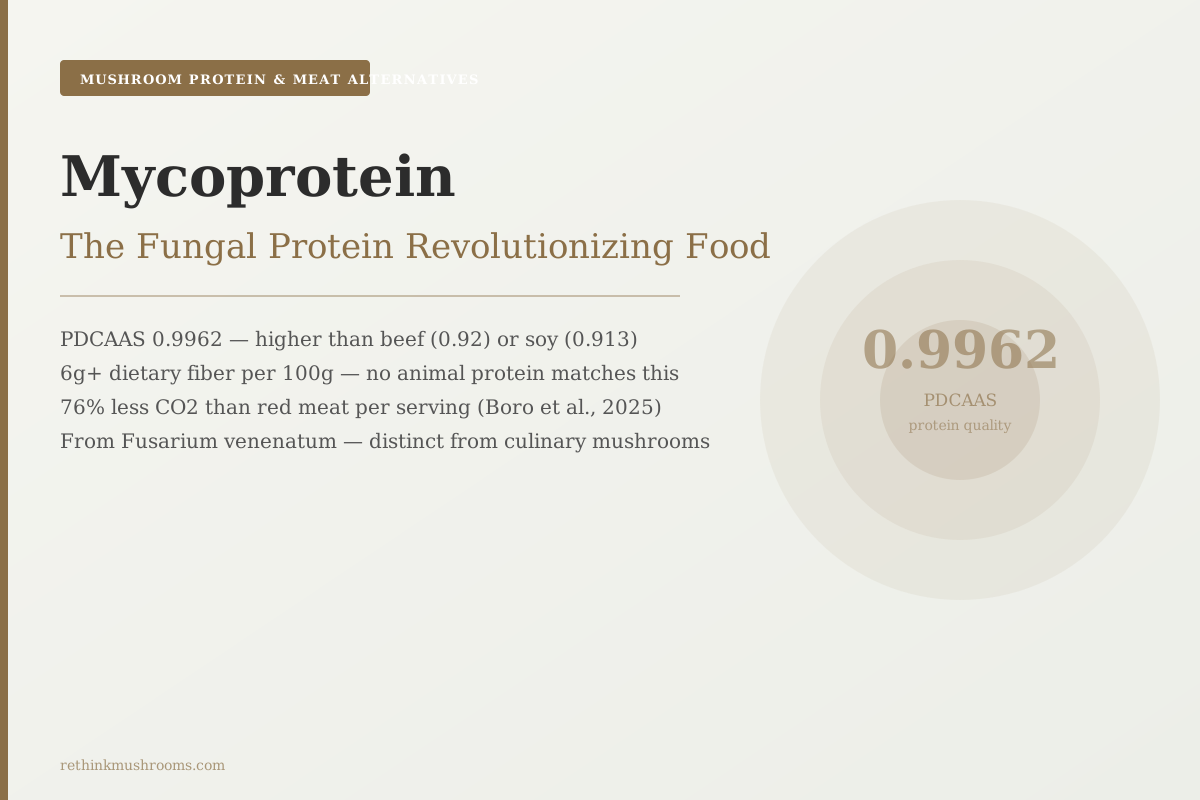
0.9962 PDCAAS
Mycoprotein achieves a protein quality score of 0.9962 — higher than beef (0.92) and soy (0.913) — while simultaneously delivering over 6g of fiber per 100g. No animal protein does both.
Finnigan et al., Current Developments in Nutrition, 2019
6g+
dietary fiber per 100g of mycoprotein (vs 0g in chicken or beef)
14.5%
of human greenhouse-gas emissions come from meat production — the pressure behind fungal alternatives (Boro et al., 2025)
1985
year mycoprotein was first commercialized as Quorn in the UK
Finnigan et al., Current Developments in Nutrition, 2019
 View as image ↗
Mycoprotein is a protein-rich food derived from Fusarium venenatum, a filamentous fungus discovered in the English countryside in the 1960s. Produced through continuous fermentation, it achieves a protein quality score of 0.9962 out of a possible 1.0, higher than beef at 0.92 and soy protein at 0.913. It contains more than 6 grams of dietary fiber per 100 grams. No conventional protein source, animal or plant, combines high protein quality with meaningful fiber content in the same food.
Understanding mycoprotein requires one important clarification first: it is not the same as eating culinary mushrooms. Fusarium venenatum is a fungus, related to but distinct from portobello, oyster, or lion's mane mushrooms. Mycoprotein is produced industrially through fermentation, not grown and harvested as a whole food. That distinction shapes what the nutrition research means and what the honest trade-offs are.
This article is part of our complete guide to mushroom nutrition and cooking. Here we examine what mycoprotein is, what the protein quality data shows, how it compares to meat and other plant proteins, and where the evidence on muscle building and health effects actually stands.
Key Takeaways
- Mycoprotein comes from Fusarium venenatum, a filamentous fungus grown through continuous fermentation, not from the culinary mushrooms typically associated with health food stores
- Protein quality (PDCAAS) = 0.9962, compared to beef at 0.92 and soy isolate at 0.913; all nine essential amino acids are present in proportions that closely match human requirements (Finnigan et al., 2019)
- More than 6 grams of dietary fiber per 100g is a feature no animal protein matches; this fiber has shown cholesterol-lowering, glucose-moderating, and satiety effects in clinical data (Finnigan et al., 2019)
- The fibrous, meat-like texture of mycoprotein comes from the branching thread-like structure of fungal mycelium, which Berger et al. (2022) showed has different metabolite profiles from mushroom fruiting bodies — explaining both mycoprotein's textural advantage and its nutritional distinction
- Mycoprotein's fermentation-based production carries a significantly lower carbon and water footprint than beef or chicken (Finnigan et al., 2019); with livestock meat responsible for up to roughly 14.5% of human-caused greenhouse-gas emissions, fungal protein is positioned as a more sustainable alternative (Boro et al., 2025)
- Mycoprotein is an industrially produced food, not a whole food; Quorn's patents have now expired, expanding production to new manufacturers
What Mycoprotein Is Made From: Not a Mushroom, Technically a Fungus
In 1967, British scientist Arnold Spicer identified Fusarium venenatum growing in a soil sample from a Buckinghamshire field. The fungus grew rapidly, produced substantial protein, and when processed and fermented under controlled conditions, created a fibrous material with a texture surprisingly close to muscle fiber.
It took nearly two decades to navigate regulatory approval — the process required demonstrating safety for human consumption, which involved extensive testing and consultation with UK food authorities. In 1985, the product launched in the UK under the brand name Quorn.
Fusarium venenatum is a member of the fungal kingdom, as are culinary mushrooms like portobello or oyster. But the family resemblance ends there. Portobello and oyster mushrooms are Basidiomycetes, forming the familiar cap-and-stem fruiting bodies. F. venenatum is an Ascomycete that grows as mycelium, the thread-like network of filaments (called hyphae) that constitutes most of a fungus's body. Those hyphae are what give mycoprotein its structural character.
Berger and colleagues published a 2022 comparative analysis of metabolites between fungal mycelium and fruiting bodies.[2] Their analysis found that protein content, amino acid composition, and secondary metabolites differ significantly between the two forms. Fruiting bodies generally have higher protein density per gram of dry matter. What industrial fermentation of F. venenatum achieves is not replicating fruiting body composition, but optimizing the mycelial growth conditions to maximize protein yield and structural quality. The result is a food where the protein profile comes from controlled fermentation, not from what a mushroom naturally produces in the wild.
The hyphal structure matters for texture. When F. venenatum hyphae are harvested, heat-treated to reduce nucleic acid content (a regulatory requirement), and processed, the interlinked fibrous structure creates a material that tears along grain-like planes, similar to how muscle fiber separates. This is why mycoprotein products have a texture that soy or pea protein isolates cannot replicate without extensive processing and added binders.
The Protein Quality Score That Beats Beef: PDCAAS 0.9962 Explained
PDCAAS stands for Protein Digestibility-Corrected Amino Acid Score. It measures two things together: how well a protein's amino acid profile matches what the human body actually needs, and how much of that protein actually gets absorbed through digestion. A score of 1.0 represents a perfect match to human requirements with complete absorption. Cow's milk scores 1.0. Eggs score 1.0.
Finnigan and colleagues published a comprehensive review of mycoprotein research in Current Developments in Nutrition in 2019.[1] Their review confirmed a PDCAAS of 0.9962 for mycoprotein — essentially equivalent to milk and eggs. For comparison: beef scores 0.92, soy protein isolate scores 0.913, whole mushroom species score between 0.35 and 0.70 depending on species.
Protein Quality
PDCAAS: Mycoprotein Sits Beside Milk and Eggs
Protein Digestibility-Corrected Amino Acid Score measures how closely a protein’s amino acid profile matches human needs and how much is absorbed. It is capped at 1.00. Mycoprotein’s 0.9962 is essentially the ceiling — above beef and soy, and far above whole mushrooms.
Milk / egg
reference ceiling
Mycoprotein
Fusarium venenatum
Beef
Soy protein isolate
Whole mushrooms
species-dependent
Whole-mushroom scores are limited by their first-limiting amino acid (typically methionine/cysteine) and by protein trapped behind chitin cell walls — barriers mycoprotein’s fermentation and heat treatment remove.
Source: Finnigan et al. (2019), Curr. Dev. Nutr. [ref 1]; milk/egg = canonical PDCAAS reference of 1.00.
What drives the high score: mycoprotein contains all nine essential amino acids in proportions that closely match human requirements. It is particularly well-supplied with leucine, the amino acid that acts as the primary trigger for muscle protein synthesis. When the body detects leucine above a certain threshold in the bloodstream after a meal, it activates the cellular machinery that builds muscle tissue. Mycoprotein's leucine content is high enough to reliably trigger this response.
The PDCAAS comparison matters in context. The difference between 0.9962 and 0.92 is small in absolute terms, but it represents a gap in amino acid matching and digestibility that is meaningful for people relying heavily on a specific protein source. Whole mushrooms at 0.35-0.70 have a larger gap — relevant for the amino acid profiles article — primarily because their limiting amino acid (typically methionine or cysteine) is present in proportions below human requirements, and because raw mushroom protein is partially trapped behind chitin cell walls, reducing digestibility.
Mycoprotein has no chitin barrier equivalent. The heat treatment in its production process denatures cell walls, leaving protein fully accessible to digestion.
Fiber Plus Protein: What Mycoprotein Offers That Meat Never Can
Animal protein contains zero dietary fiber. This is not a criticism of animal protein, just a structural fact of animal biology. Plant proteins contain some fiber, but the protein source and fiber are often in different parts of the plant and processing often separates them. Soy protein isolate contains almost no fiber. Pea protein isolate contains almost no fiber.
Mycoprotein contains more than 6 grams of dietary fiber per 100 grams of product, almost entirely from fungal cell wall components including beta-glucans.[1] This fiber is not a product additive; it is structurally embedded in the mycelium itself.
Finnigan's 2019 review documented the clinical effects of this fiber alongside mycoprotein's protein content. The findings covered three areas:
Cholesterol reduction: The beta-glucan fiber in mycoprotein binds bile acids in the digestive tract and prevents their reabsorption, which forces the liver to synthesize new bile acids from blood cholesterol. This reduces circulating LDL cholesterol. The mechanism is identical to that behind oat beta-glucan, which has received regulatory approval for cholesterol-lowering health claims.
Glucose moderation: Fiber slows the digestion and absorption of carbohydrates from a meal. Eating mycoprotein with other foods blunts the post-meal blood glucose and insulin response compared to eating the same amount of protein without fiber.
Satiety: High fiber intake increases feelings of fullness after eating. The combination of protein-driven satiety (both protein and leucine independently promote satiety signaling) and fiber-driven satiety makes mycoprotein one of the more filling foods by weight among protein sources.
No animal protein source achieves these effects simultaneously with high-quality protein delivery. This combination is the strongest nutritional argument for mycoprotein over conventional protein sources, regardless of environmental considerations.
Is Mycoprotein Good for Building Muscle? What the Research Shows
Finnigan's 2019 review addressed the muscle protein synthesis question directly, drawing on clinical studies comparing mycoprotein to animal protein for supporting muscle tissue maintenance and growth.[1] The data showed mycoprotein supports muscle protein synthesis at rates comparable to animal protein, which Finnigan's team attributed to the high PDCAAS and leucine content.
This finding matters because muscle protein synthesis, the process by which the body builds and repairs muscle tissue, is driven by dietary protein quality and leucine availability. A protein that scores 0.9962 on quality and has high leucine content should, in theory, stimulate muscle building effectively. The clinical data reviewed by Finnigan confirmed that theory: mycoprotein-based meals produced muscle protein synthesis responses similar to meat-based meals of equal protein content.
Since Finnigan's 2019 review, research groups have continued investigating mycoprotein for muscle building applications. The direction of findings has been consistent with the earlier work: mycoprotein's amino acid profile makes it a genuinely competitive protein source for muscle maintenance and building, not just a protein-equivalent in nutritional scoring.
The honest calibration: most of the direct comparison data involves relatively short observation windows — days to weeks. Longer-term studies comparing athletes or active people eating primarily mycoprotein versus animal protein for months are limited. The protein quality data strongly suggests equivalence, but long-term muscle outcomes over a full training cycle are less studied.
How Mycoprotein Differs from Culinary Mushrooms and Other Plant Proteins
The single most important distinction for anyone researching mycoprotein: it is not what you eat when you eat a portobello burger or oyster mushroom stir-fry.
Culinary mushrooms are whole foods. They contain protein, fiber, beta-glucans, ergothioneine, B vitamins, and dozens of other compounds in natural proportions shaped by how the mushroom grows. Eating a culinary mushroom delivers all of these together. Berger's 2022 analysis confirmed that the metabolite profiles of fruiting bodies are richer and more complex than those of mycelium, the part of the fungus that mycoprotein comes from.[2] Fruiting bodies contain higher concentrations of many bioactive compounds than mycelium does. Mycoprotein, optimized for protein yield and texture, trades that bioactive complexity for protein efficiency.
Against soy and pea protein, mycoprotein's advantages are:
- Higher PDCAAS (0.9962 vs. soy 0.913 vs. pea lower still)
- Structural fiber that soy and pea isolates do not have
- Meat-like texture from the hyphal matrix, which soy and pea proteins must approximate through processing, binders, and fat addition
- Lower allergenic load: soy is one of the eight major allergens; Finnigan's review documented that mycoprotein's actual allergic reaction incidence is exceptionally low[1]
Against whole mushrooms, mycoprotein's advantages are protein concentration and quality. The trade-off is the whole food bioactive profile that culinary mushrooms offer. This is not a case where one is "better" in all respects. They serve different purposes: culinary mushrooms for whole food nutrition and bioactives, mycoprotein for protein-equivalent replacement of animal protein.
For a comparison of specific culinary mushroom protein data by species, see our article on mushroom protein quality by species. For how mushrooms work as practical meat substitutes in cooking, see mushrooms as meat alternatives.
Sustainability Credentials and the Expanding Market
Boro and colleagues published the most recent comprehensive review of edible mushrooms as meat analogues in Food Research International in 2025.[3] Their review frames the environmental case against conventional meat directly: livestock production is responsible for up to roughly 14.5% of human-caused greenhouse-gas emissions, and edible fungi — grown without grazing land and with far lower water demands — are positioned as one of the more promising sustainable protein alternatives.
For mycoprotein specifically, the production footprint is substantially lower than beef or chicken. Fermentation-based production uses controlled indoor growing conditions, no grazing land, and a fraction of the water that livestock production requires. Finnigan's review documented that mycoprotein's carbon and water footprint were significantly below both beef and chicken.[1]
The market context has shifted since Finnigan wrote in 2019. Quorn's core mycoprotein patents have expired, opening the production process to other manufacturers. Boro's 2025 review addressed this: new companies are entering the fungal protein space, some using F. venenatum, others exploring different fungal species. The expansion of the category beyond a single branded product changes the competitive landscape and may drive both innovation and price reduction.
A note on what "sustainable" means here: mycoprotein is more sustainable than animal protein in emissions and water terms. It is less sustainable than eating whole culinary mushrooms directly, which require even less processing. The sustainability argument is strongest when comparing mycoprotein to beef or pork; the comparison to direct whole mushroom consumption is less clear.
For more on the comparison between mushroom-based products and other meat alternatives, see mushroom-based meat versus Impossible and Beyond Burgers.
The Bottom Line
Mycoprotein, derived from the fungus Fusarium venenatum through continuous fermentation, achieves a protein quality score of 0.9962 — rivaling milk and eggs, outperforming beef and soy. The simultaneous delivery of high-quality protein and over 6g of dietary fiber per 100g is unique among protein foods. The honest context: mycoprotein is an industrially produced food, not a whole food; it is nutritionally distinct from culinary mushrooms; and its long-term muscle building data, while pointing in the right direction, comes mostly from shorter-duration studies.
Frequently Asked Questions
Sources & References
- 1RTHM-01056·Finnigan, Tim J A et al. (2019). “Mycoprotein: The Future of Nutritious Nonmeat Protein, a Symposium Review..” Current developments in nutrition.Study breakdown →PubMed →↩
- 2RTHM-00743·Berger, Ralf G et al. (2022). “Mycelium vs. Fruiting Bodies of Edible Fungi-A Comparison of Metabolites..” Microorganisms.Study breakdown →PubMed →↩
- 3RTHM-02059·Boro, Sibo et al. (2025). “Edible mushrooms as meat analogues: A comprehensive review of nutritional, therapeutic, and market potential..” Food research international (Ottawa.Study breakdown →PubMed →↩