Mushroom Protein & Meat Alternatives
0.9962 PDCAAS
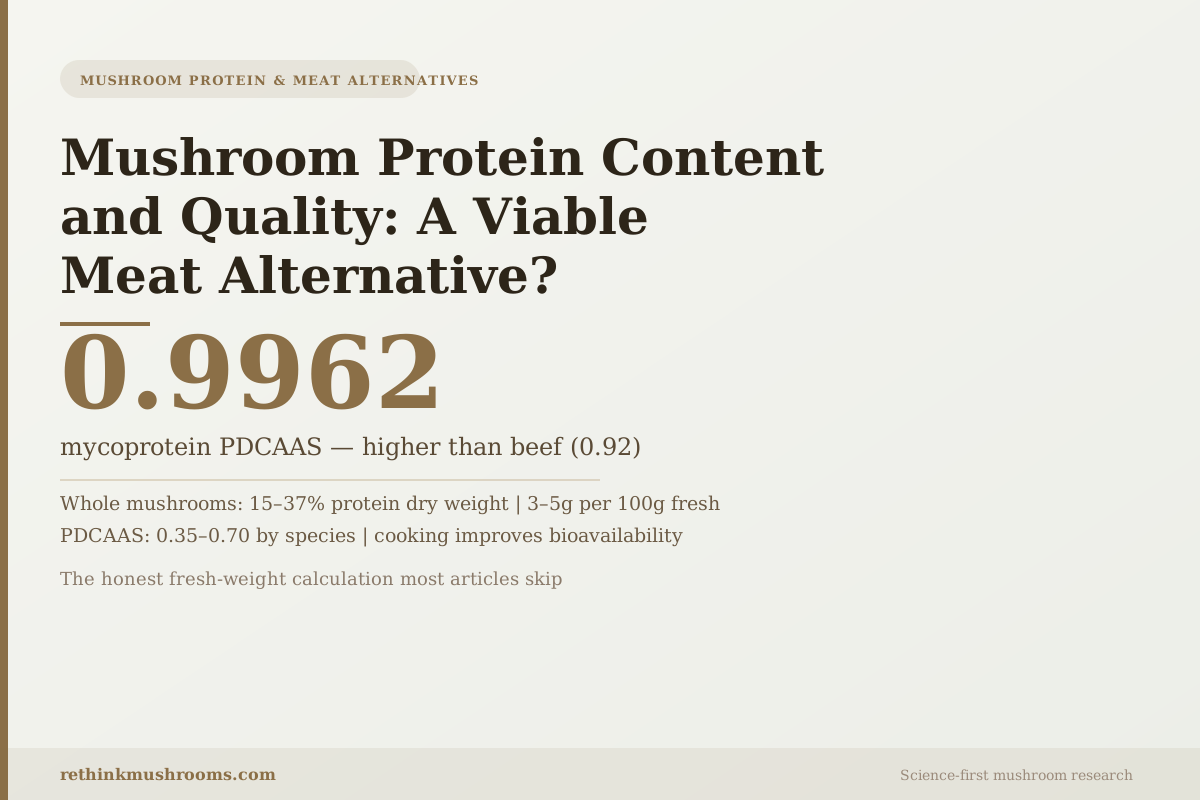
Mycoprotein, the fungal protein behind Quorn, achieves a PDCAAS protein quality score of 0.9962, higher than beef (0.92) and soy (0.913), rivaling milk protein and making it the strongest case for fungi as a meat protein equivalent.
Finnigan et al., Curr Dev Nutr, 2019
15–37%
mushroom protein by dry weight depending on species
3–5g
protein per 100g of fresh oyster mushroom (85%+ water)
76%
less CO2 than red meat per calorie-equivalent serving
Finnigan et al., Curr Dev Nutr, 2019
 View as image ↗
Mushroom protein claims often look impressive until you check the fine print. A figure like "oyster mushrooms contain 30% protein" is technically accurate, but it is a dry-weight figure, and fresh mushrooms are 85 to 92 percent water. In practice, 100 grams of fresh oyster mushroom delivers about 3 to 5 grams of protein. A 100-gram chicken breast delivers roughly 31 grams. The numbers are not comparable.
That honest starting point changes the question. Mushrooms are not a direct protein substitute for meat in terms of protein per serving weight, and no study claims they are. What the research does show is more specific: mushroom protein quality on a dry-weight basis is competitive with legumes, improving species can match legumes' amino acid profiles, cooking substantially improves digestibility, and one category of fungal protein, mycoprotein, genuinely rivals animal protein by every quality measure. A 2025 comprehensive review confirmed that mushrooms are best understood as complementary protein sources and excellent meat analogues for culinary, sustainability, and micronutrient reasons, rather than as gram-for-gram protein replacements.[4]
This is a cluster article in the complete guide to mushroom nutrition. For the broader environmental and culinary case for replacing meat with mushrooms, see Mushrooms as Meat Alternatives: Nutrition and Sustainability.
Key Takeaways
- Fresh mushrooms are 85–92% water: 100g fresh oyster mushroom contains approximately 3–5g protein, compared to ~31g in 100g chicken; the fresh-weight comparison is unfavorable
- On a dry-weight basis, mushroom protein density is 15–37% depending on species, genuinely competitive with many legumes
- Oyster mushroom contains all 9 essential amino acids but has a PDCAAS of 0.44, lower than beef (0.92) and soy (0.913), due to limiting sulfur amino acids and reduced digestibility from chitin cell walls
- Cooking mushrooms significantly improves protein digestibility by breaking down chitin; raw mushroom protein is far less bioavailable than cooked
- Mycoprotein (Fusarium venenatum, used in Quorn) achieves a PDCAAS of 0.9962, exceeding beef and soy, with a full essential amino acid profile and 6g+ fiber per 100g
- Mushrooms excel as partial meat replacements for their micronutrient profile (ergothioneine, B vitamins, zinc, and selenium), nutrients not present in chicken or beef
The Fresh Weight Reality: Why Most Mushroom Protein Claims Are Misleading
The first thing needed for an honest mushroom protein comparison is an adjustment for water content.
Fresh culinary mushrooms are 85 to 92 percent water. The protein figures most commonly cited in mushroom nutrition articles come from dry-weight analysis, which concentrates all the nutrients proportionally. Divide that dry-weight figure by the water content factor, and the protein content per gram of fresh mushroom drops substantially.
Effiong and colleagues' 2023 comprehensive nutritional assessment of oyster mushroom found protein content of 22 to 37 percent on a dry-weight basis depending on variety.[2] At an average water content of 87 percent for fresh oyster mushroom, that 22 to 37 percent dry-weight figure translates to approximately 2.9 to 4.8 grams of protein per 100 grams fresh weight.
Barros and colleagues' multi-species analysis of Portuguese wild mushrooms similarly documented protein content figures in the 15 to 40 percent range on a dry-weight basis across species.[1]
The practical implications for anyone eating whole mushrooms as a protein source: a 200-gram serving of cooked oyster mushroom (a large portion) provides roughly 6 to 10 grams of protein. A single 150-gram chicken breast provides about 47 grams. You would need roughly half a kilogram of fresh mushrooms to approach the protein in one chicken breast.
This is not a criticism of mushrooms as food. It is the accurate starting point for any comparison.
Dry-Weight Protein Density: Where Mushrooms Compete With Legumes
The dry-weight comparison tells a different story, and it matters for anyone eating dried mushrooms, using mushroom powder supplements, or comparing mushrooms to other plant protein sources rather than to meat.
On a dry-weight basis, mushroom protein content (15 to 37 percent by species) is directly comparable to:
- Lentils: approximately 25 to 28 percent protein by dry weight
- Chickpeas: approximately 19 to 22 percent
- Almonds: approximately 21 percent
- Quinoa: approximately 14 to 17 percent
Oyster mushroom sits at the high end of this range. Shiitake, with lower water content than oyster when fresh, provides 10 to 17 percent protein dry weight. Enoki mushrooms fall around 19 percent.
For anyone consuming mushrooms in dried, powdered, or concentrated form, these figures are the relevant comparison. A tablespoon of dried shiitake powder (roughly 5 to 7 grams) provides a meaningful protein contribution comparable to a similar weight of legume powder.
A 2025 comprehensive review of mushrooms as meat analogues confirmed this positioning: mushrooms are legitimately competitive as plant-based protein sources when compared on equivalent dry-weight terms, particularly the species with higher protein density like oyster and king trumpet.[4]
Protein Quality: What PDCAAS Actually Measures (and How Mushrooms Score)
Protein quantity is one thing; protein quality is another. The standard measure of protein quality is PDCAAS: the Protein Digestibility-Corrected Amino Acid Score. It combines two factors: how well the amino acid profile matches human requirements, and how much of that protein the body can actually absorb. A score of 1.0 is the maximum.
Whole mushrooms score 0.35 to 0.70, depending on species. This is lower than beef (0.92), chicken (0.91), soy (0.913), and eggs (1.0). It is comparable to some legumes and better than most grains.
Two factors limit mushroom protein quality.
The first is amino acid limiting. Mushrooms contain all 9 essential amino acids. That statement is accurate and worth noting. But "contains" does not mean "in the right proportions." Oyster mushroom's limiting amino acids are methionine and cysteine, the sulfur-containing amino acids that are present but at lower concentrations than human requirements.[2] The PDCAAS calculation penalizes for this.
The second is digestibility. Mushroom cell walls contain chitin, a structural polysaccharide that the human digestive system cannot easily break down. When chitin is intact, it physically reduces how much of the surrounding protein the gut can extract. Raw mushroom protein is substantially less bioavailable than the amino acid content alone would suggest.
Barros and colleagues' multi-species analysis confirmed this protein quality variation across wild mushroom species, with different amino acid profiles and different limiting amino acid patterns across the species tested.[1]
By species, PDCAAS scores range from approximately 0.36 for portobello-type Agaricus species to 0.44 for oyster mushroom to 0.70 for some less common species like Tricholoma terreum. For comparison, soy protein isolate scores 0.913 and animal proteins range from 0.91 to 1.0.
Cooking Substantially Improves Mushroom Protein Bioavailability
The chitin limitation is not fixed. Cooking breaks down chitin, and the effect on protein digestibility is significant.
Heat application, whether sautéing, roasting, boiling, or steaming, disrupts chitin's structural integrity in mushroom cell walls, releasing bound protein and making amino acids more accessible to digestive enzymes. A 2025 review of mushroom meat analogues noted that cooking mushrooms before consumption is important specifically for improving protein utilization, not just for flavor and texture.[4]
The practical implication: the PDCAAS figures for raw mushroom protein are pessimistic relative to what a person eating cooked mushrooms actually absorbs. The cooked protein quality is meaningfully better than the raw figures, though still below animal protein scores.
For a full review of how different cooking methods affect bioactive compounds and protein availability in mushrooms, see How Cooking Affects Mushroom Bioactives: What the Research Shows.
Mycoprotein: When Fungal Protein Rivals Animal Protein
The picture changes entirely when you move from whole culinary mushrooms to mycoprotein.
Mycoprotein is not made from culinary mushrooms. It is produced by continuous fermentation of Fusarium venenatum, a naturally occurring soil fungus, which produces a dense protein-rich biomass with a fibrous, meat-like texture derived from the physical structure of its fungal filaments (hyphae). First commercialized as Quorn in the UK in 1985, mycoprotein is now the leading fungal protein product globally.
Finnigan and colleagues' 2019 comprehensive review documented mycoprotein's nutritional profile:[3]
- PDCAAS: 0.9962, higher than beef (0.92) and soy (0.913) and comparable to milk protein
- Complete amino acid profile: all 9 essential amino acids in proportions that closely match human requirements, with notably high leucine content (the key amino acid for triggering muscle protein synthesis)
- Fiber content: 6 grams or more per 100 grams, a nutritional benefit that no animal protein provides
- Low in saturated fat
- Supports muscle protein synthesis at rates comparable to animal protein, according to trials from the University of Exeter
The review also documented additional benefits: mycoprotein consumption is associated with reduced LDL cholesterol (likely via the fiber mechanism), improved satiety, and moderated post-meal blood glucose response.
Mycoprotein is a processed food produced industrially, which distinguishes it from whole culinary mushrooms. For anyone prioritizing protein quality and quantity comparable to animal sources, specifically for muscle building, vegetarian athletes, or complete protein replacement, mycoprotein represents a different category than eating portobello mushrooms.
For the full story on mycoprotein, its production, and how it compares to other meat alternatives including Impossible and Beyond Burger, see Mycoprotein: The Fungal Protein Revolutionizing Food and Mushroom-Based Meat: Beyond Impossible and Beyond Burgers.
What Mushrooms Offer Beyond Protein: The Micronutrient Argument
Framing mushrooms solely as protein sources misses the nutritional case for eating them as partial meat replacements.
Mushrooms contain several nutrients that are either absent or present in far lower amounts in meat:
Ergothioneine is an unusual antioxidant amino acid that mushrooms produce in significant quantities and that the human body cannot synthesize. No other common food provides ergothioneine at mushroom concentrations. It accumulates in high-stress tissues (red blood cells, liver, kidneys) and is being studied for its role in cellular protection.
B vitamins: Mushrooms are one of the few non-animal, non-fortified sources of vitamin B12 precursors and are substantial sources of B2 (riboflavin), B3 (niacin), and B5 (pantothenic acid). Shiitake and oyster mushrooms are particularly high in niacin.
Zinc and selenium: Both minerals are present in meaningful concentrations in mushrooms and are often associated with animal foods rather than plant foods.
Fiber: Culinary mushrooms provide beta-glucans and chitin, which function as prebiotic dietary fiber. Animal proteins provide zero fiber.
Boro and colleagues' 2025 comprehensive review emphasized this multi-nutrient profile as a key part of the case for mushrooms as meat analogues: the nutritional exchange is not simply "lower protein for a plant food" but "different protein quantity and quality plus substantial micronutrient additions."[4]
This shifts the comparison. When mushrooms replace red meat in a meal, they simultaneously reduce saturated fat intake, add prebiotic fiber, add ergothioneine, and reduce total calories, while accepting a trade-off in protein quantity and quality. Whether that trade-off is favorable depends on the overall diet pattern, not any single meal.
For the metabolic health implications of regularly eating mushrooms instead of red meat, see Mushroom Consumption and Metabolic Syndrome Risk: Epidemiological Evidence. For the flavor science behind why mushrooms satisfy umami cravings, see Umami in Mushrooms: The Science of Mushroom Flavor.
Best Mushroom Species for Protein Content
For anyone prioritizing protein among culinary mushroom choices, species selection matters. Based on dry-weight protein content across published nutritional analyses:
Oyster mushroom (Pleurotus ostreatus): 22 to 37 percent protein dry weight, the widest range of any common species depending on variety and growing conditions. The most studied species for protein quality. PDCAAS approximately 0.44.[2]
Enoki mushroom (Flammulina velutipes): approximately 19 percent protein dry weight.
Shiitake (Lentinula edodes): 10 to 17 percent protein dry weight, lower than oyster but with a distinctive amino acid profile high in glutamate and aspartate, which contributes to its strong umami flavor profile.
Portobello/Crimini (Agaricus bisporus): 15 to 33 percent protein dry weight, with a PDCAAS around 0.36, somewhat lower than oyster due to a less favorable amino acid ratio.
Barros and colleagues' multi-species analysis documented this species-level variation and noted that the combination of protein content and amino acid completeness differs meaningfully across species, a factor often overlooked when comparing "mushroom protein" as a category rather than species by species.[1]
For a full species-by-species breakdown of amino acid profiles and PDCAAS scores, see Mushroom Protein Quality: Amino Acid Profiles by Species.
The Honest Verdict: When Mushrooms Work as a Protein Source
A useful summary for practical decision-making:
Mushrooms work well as protein sources when:
- Used as part of a varied diet that includes other protein sources (legumes, eggs, dairy, or meat)
- Eaten cooked (cooking significantly improves digestibility)
- Consumed as dried or powdered mushroom products, where the dry-weight protein density is relevant
- You're prioritizing the full nutritional package (fiber, ergothioneine, B vitamins) alongside protein
- You're using mycoprotein specifically and need animal-protein-equivalent quality
Mushrooms work less well as protein sources when:
- Expected to replace meat gram-for-gram in fresh form without increasing portion size substantially
- Consumed raw (lower digestibility from intact chitin)
- Used as a sole protein source for high-protein requirements (athletes, muscle building) without supplementation from higher-quality sources or mycoprotein
The 2025 review by Boro and colleagues concluded that mushrooms are most effectively positioned as "complementary protein sources that enhance the overall nutritional profile of meals rather than as standalone complete protein replacements", a characterization supported by the protein quantity and quality data.[4]
That framing is also the most honest one. Mushrooms bring a combination of qualities, including sustainability, micronutrient density, fiber, umami flavor, and meaningful protein contribution, that makes them genuinely valuable in a diet containing reduced meat. The claim that they can replace meat protein quantity and quality in fresh form, at equivalent serving sizes, does not match the data.
The Bottom Line
The protein case for mushrooms requires distinguishing fresh weight from dry weight, protein content from protein quality, and whole culinary mushrooms from mycoprotein. On a fresh weight basis, mushrooms are a modest protein source: 3 to 5 grams per 100 grams of fresh oyster mushroom. On a dry-weight basis, mushroom protein density is competitive with legumes at 15 to 37 percent. Protein quality (PDCAAS 0.35 to 0.70 depending on species) is lower than animal protein, partly due to limiting sulfur amino acids and chitin cell walls that reduce digestibility, though cooking substantially improves bioavailability. Mycoprotein is a different category entirely, with a PDCAAS of 0.9962 that exceeds beef and soy. The strongest case for mushrooms as meat alternatives is not protein equivalence but the combination of meaningful protein contribution, unique micronutrients, prebiotic fiber, and significant sustainability advantages.
Frequently Asked Questions
Sources & References
- 1. Source details for this reference are not yet available.
- 2. Source details for this reference are not yet available.
- 3. Source details for this reference are not yet available.
- 4. Source details for this reference are not yet available.