Mushroom Protein & Meat Alternatives
14.5% of emissions
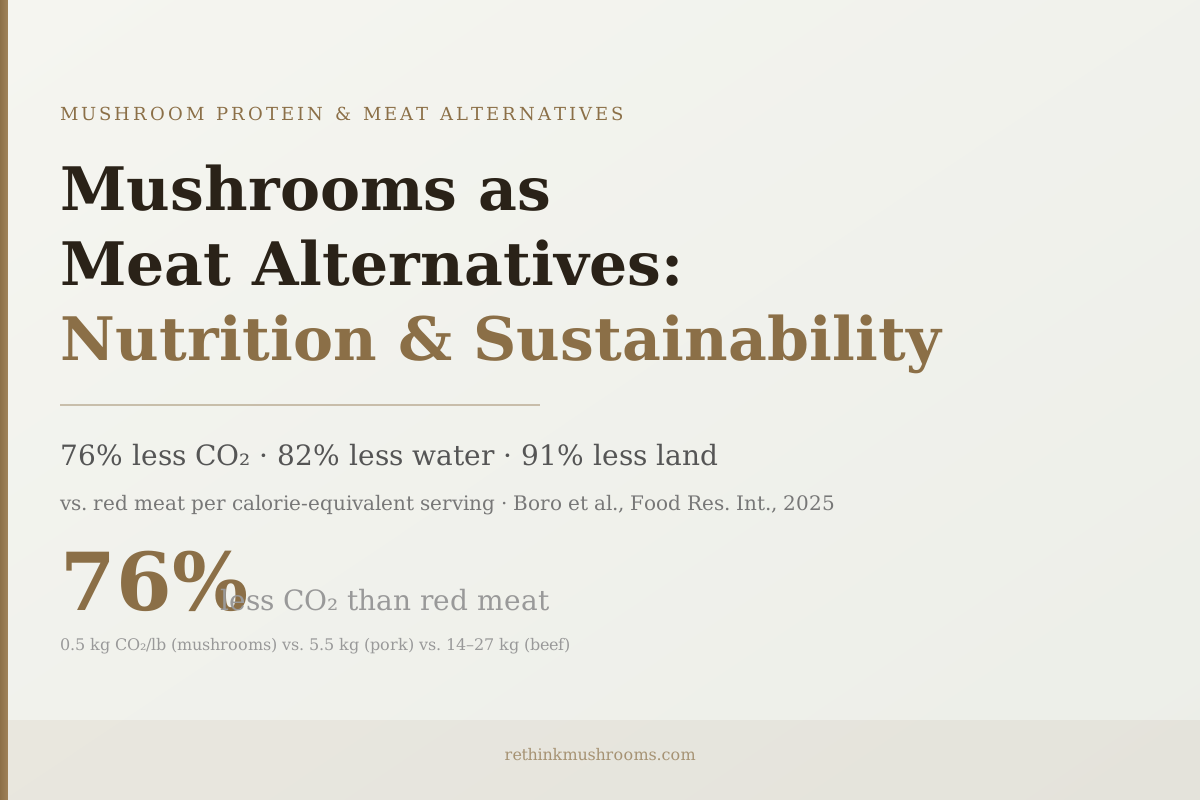
Meat production carries health, environmental and ethical costs, with human-caused greenhouse gas emissions running as high as 14.5%. Mushrooms are a genuinely credible answer on flavour, texture and sustainability — and a genuinely limited one on protein. This article separates the two.
Boro et al., Food Research International, 2025
17.06%
crude protein in oyster mushroom, measured on a dried sample
91.01%
water content of the same mushroom when fresh
45% / 25%
protein and fiber in mycoprotein by dry weight
Boro et al., Food Research International, 2025
 View as image ↗
In 2025, a comprehensive review published in Food Research International by Boro and colleagues laid out the case for edible mushrooms as meat analogues: the nutritional profile, the therapeutic claims, the texture and flavour science, and the commercialisation problems still in the way.[1] Their starting point is the one most people already accept — meat production carries health, environmental and ethical costs, with human-caused greenhouse gas emissions reaching as high as 14.5%, and red meat consumption itself associated with health problems.
What follows from that is where the conversation usually goes wrong. Mushrooms are frequently sold as a high-protein meat replacement. The measured data says something more specific and more useful: they are an excellent partial replacement, unmatched among plant-based options on flavour and texture, and weakest exactly where the marketing is loudest. This is part of the broader guide to mushroom nutrition and species differences.
Key Takeaways
- Boro and colleagues position mushrooms as meat analogues on the strength of natural umami flavour, meaty texture, protein, essential amino acids, polysaccharides (beta-glucan and chitin), vitamins, minerals and antioxidants — and note mushrooms are the only vegetative source of vitamin D[1]
- Measured oyster mushroom composition is 17.06% crude protein and 23.63% crude fiber on a dried sample — but the fresh mushroom is 91.01% water, which is the single fact that makes most mushroom protein claims misleading[2]
- The same analysis found oyster mushroom contains far more non-essential (564.17 mg/100 g) than essential (67.83 mg/100 g) amino acids, a ratio of 0.11 — the clearest statement of the protein-quality limitation in the literature[2]
- Adding dried oyster mushroom to the diet of rats reduced the digestibility of protein and fat and lowered apparent energy availability, dose-dependently — mushroom protein is not simply lower, it is also less available[3]
- Where mushrooms work best is partial substitution: replacing pork back fat in sausages with king oyster cut fat and energy while raising protein and dietary fiber, with all preparations judged sensorially acceptable[4]
- Mycoprotein is a different category. In a randomized trial in 20 resistance-trained men, leucine-matched mycoprotein raised muscle protein synthesis more than milk protein in both rested and exercised muscle[5]
What the Sustainability Case Actually Rests On
The environmental argument for mushrooms is strong, and it is strongest when stated precisely.
The Boro review frames the problem at the production end: meat products are popular for their protein content and sensory qualities, but their production poses health, environmental and ethical challenges, with human-caused greenhouse gas emissions running up to 14.5%. That is the pressure driving the search for alternatives, and it is the number worth anchoring to, because it is the one the literature actually supports.[1]
Beyond that headline figure, the sustainability case for mushrooms is structural rather than statistical. Mushrooms are grown on agricultural by-product substrates rather than on pasture, in stacked indoor production rather than across grazing land. They do not require the feed-conversion chain that sits behind every kilogram of beef. These are facts about how the two foods are produced, and they do not depend on any single life-cycle figure.
For mycoprotein specifically, Finnigan and colleagues state the environmental position directly: its production method yields a significantly reduced carbon and water footprint relative to beef and chicken.[6]
What Mushrooms Actually Provide
The nutritional case is strong in some dimensions and genuinely limited in others. Both halves are load-bearing.
Boro and colleagues catalogue the positive side: protein, essential amino acids, polysaccharides including beta-glucan and chitin, vitamins, minerals, polyphenols and antioxidants, alongside natural umami flavour and a meaty texture. They also make a claim no other vegetable food can: mushrooms are the only vegetative source of vitamin D.[1]
The most thoroughly measured single species is the oyster mushroom. Effiong and colleagues assessed the nutritional quality of Pleurotus ostreatus in 2023 and reported a full proximate breakdown: 43.42% carbohydrate, 23.63% crude fiber, 17.06% crude protein, 8.22% ash and 1.21% lipid, with a moisture content of 91.01% in fresh samples and 6.46% in dried.[2]
Those two numbers — 17.06% protein and 91.01% water — need to be held together, and almost never are.
What Is Actually In An Oyster Mushroom
17% Protein — But Only After You Remove The Water
Measured proximate composition of Pleurotus ostreatus. These are dried-sample percentages. The same mushroom, fresh, is more than nine-tenths water — which is why dry-weight protein figures and what lands on your plate are two different numbers.
Carbohydrate
Crude fiber
Crude protein
Ash (minerals)
Lipid (fat)
Moisture, as reported
The dried sample used for the composition figures above was 6.46% moisture.
What that means fresh (derived)
Calculated from the authors’ own two figures. Not a value the paper reports directly.
Source: Effiong et al. (2023), Frontiers in Nutrition 10:1279208 [ref 2]. Composition and moisture values are as reported by the authors; the fresh-weight protein figure is derived from those two reported values and is shown as an approximation.
The mineral and vitamin profile is real and worth having. The same analysis found potassium, iron and magnesium as the highest minerals present (12.25 mg, 9.66 mg and 7.00 mg respectively), alongside vitamin A, vitamin C at 16.46 mg/100 g, vitamin E at 21.50 mg/100 g, and B vitamins led by riboflavin at 92.97 mg/kg.[2] The crude fiber figure of 23.63% is the one red meat cannot answer at all: meat contains no dietary fiber. For what that fiber does downstream, how mushrooms influence the Firmicutes/Bacteroidetes ratio covers the microbial side of the swap.
The Protein Gap, Stated Honestly
Here is where the popular framing breaks down.
Fresh mushrooms are overwhelmingly water. At 91.01% moisture, the protein that shows up impressively in a dry-weight table collapses on a fresh-weight plate. Working from Effiong's own two figures, 100 g of fresh oyster mushroom carries on the order of 1.6 g of protein. No amount of framing turns that into a portion of meat.
The amino acid profile compounds it. The same study found oyster mushroom contained substantially more non-essential amino acids (564.17 mg/100 g) than essential ones (67.83 mg/100 g) — a ratio of 0.11. Lysine was the highest essential amino acid at 23.18 mg/100 g, while acidic amino acids dominated the total profile at 77.87%.[2] Essential amino acids are the ones the body cannot make and must obtain from food; a profile weighted this heavily toward non-essential amino acids is not a profile that substitutes for meat gram for gram.
And there is a third layer that rarely gets mentioned. Regula and colleagues fed rats semisynthetic diets supplemented with 4% and 8% dried oyster mushroom powder and measured apparent digestibility directly. Adding the mushroom reduced the digestibility of the diet and of the protein and fat it contained, and decreased apparent energy availability — with the size of the effect depending on how much mushroom was added. It also considerably shortened passage time through the digestive tract.[3]
Regula, Suliburska & Siwulski (2016) · International Journal of Medicinal Mushrooms
- Population
- Laboratory rats fed modified AIN-93M semisynthetic diets
- Intervention
- Diets supplemented with 4% and 8% dried Pleurotus ostreatus powder
- Comparator
- Unsupplemented semisynthetic control diet
- Finding
- Dried oyster mushroom did not harm body weight gain or feeding efficiency, but it reduced the apparent digestibility of the diet, its protein and its fat, and lowered apparent energy availability. The effect scaled with the amount added. Passage time through the digestive tract was considerably reduced.
narrow-scope An animal balance study, not a human trial. It measures availability rather than health outcomes, and the shortened transit time is consistent with the high fiber load.
Regula et al. (2016), International Journal of Medicinal Mushrooms 18(8):681-688 [ref 3]
Read carefully, that result cuts both ways. It confirms that mushroom protein is less available than the composition table implies. It also describes exactly what a high-fiber food does — speeding transit and reducing the energy extracted from a meal — which is a benefit in most Western dietary contexts and a problem in an under-nutrition one.
Protein Claims
Are Mushrooms a High-Protein Meat Replacement?
The claim
“Mushrooms are a high-protein food that can replace meat gram for gram.”
Dry-weight protein percentages quoted without the moisture content beside them, and comparisons drawn against other foods measured fresh.
What research shows
OverstatedOyster mushroom measures 17.06% crude protein on a dried sample, but the fresh mushroom is 91.01% water — leaving roughly 1.6 g of protein per 100 g fresh. The amino acid balance is weighted toward non-essential amino acids at a ratio of 0.11, and added dried mushroom reduced protein digestibility in an animal balance study.
None of this makes mushrooms a poor food. It makes them a poor one-to-one protein swap. As a partial replacement, a fiber and micronutrient contribution, and a flavour and texture substitute, the evidence is genuinely good — and mycoprotein is a separate case that does hold up on protein.
Effiong et al. (2023), Frontiers in Nutrition [ref 2]; Regula et al. (2016), Int J Med Mushrooms [ref 3]
For a deeper analysis of protein quality by species, mushroom protein quality: amino acid profiles by species covers the comparative data.
Where Mushrooms Clearly Win: Partial Replacement
The strongest evidence in this whole topic is not about replacing a steak. It is about replacing part of one.
Wang and colleagues manufactured five batches of pork sausage — one control formulated with pork back fat, and four in which that fat was replaced with Pleurotus eryngii (king oyster) prepared raw, boiled, deep-fried or fried. They then measured physicochemical, technological and sensory properties, nitrite content and amino acid profile.[4]
Fat content and energy value fell. Protein, moisture, total dietary fiber, cooking loss and water-holding capacity all rose. Every batch was judged acceptable on sensory characteristics, with the deep-fried preparation rated best. Raw and fried king oyster reduced residual nitrite in the finished sausage. Boiled king oyster was the only treatment that raised essential amino acid content; the others raised non-essential amino acids.
Partial Replacement, Measured
When King Oyster Replaced The Fat In A Pork Sausage
Five batches of sausage: one control made with pork back fat, four with that fat replaced by Pleurotus eryngii prepared raw, boiled, deep-fried or fried. This is what moved, in both directions.
Moved in the intended direction
- ↓Fat content
The point of the swap
- ↓Energy value
Fewer calories per sausage
- ↑Protein
Higher than the pork-fat control
- ↑Total dietary fiber
A nutrient pork back fat contributes none of
- ↑Water-holding capacity
Technological quality measure
The trade-offs
- ↑Cooking loss
Increased — more mass lost during cooking than the control
- ↑Moisture
Increased, which is what drives the cooking-loss and texture trade-off
Sensory: all five batches were judged acceptable. The best-rated was the deep-fried preparation.
The preparation mattered as much as the swap: raw and fried P. eryngii lowered residual nitrite in the finished sausage, while boiled P. eryngii was the only treatment that raised essential amino acid content — the others raised non-essential amino acids. One mushroom, four preparations, four different nutritional outcomes.
Source: Wang et al. (2019), Journal of Food Science 84(11):3091-3098 [ref 4]. All directions are as reported by the authors relative to the pork-back-fat control. The study reports directions of change rather than a single headline percentage.
This is the shape of the real opportunity. Replacing the fat fraction of a processed meat product with mushroom improves its nutritional profile on several axes at once without asking the mushroom to carry the protein load — which, as the section above establishes, it cannot.
Mycoprotein: A Genuinely Different Case
Mycoprotein is not a culinary mushroom, and conflating the two is the most common error in this space.
It is produced by fermenting Fusarium venenatum, a naturally occurring fungus, into a protein-rich food with a meat-like texture. Sold as Quorn, it is consumed in 17 countries including the United States. Finnigan and colleagues summarise its profile: high in protein and fiber, low in fat, cholesterol, sodium and sugar, with roughly 45% protein and 25% fiber by dry weight and 6.0 g of dietary fiber per 100 g. Its essential amino acid content sits at 41% of total protein, which the authors note compares favourably with human muscle at 45%.[6]
That last comparison is the substantive protein-quality claim, and unlike a scorecard it can be checked against an outcome.
Monteyne and colleagues did exactly that. Twenty resistance-trained healthy young men received either 31 g of milk protein or 70 g of mycoprotein, matched at 2.5 g of leucine, after unilateral resistance exercise, with the opposite leg serving as a rested control. Using stable isotope infusion and muscle biopsies, they measured how quickly muscle protein was actually being built over the following four hours. Rates rose after milk protein — and rose further after mycoprotein, in both the rested and the exercised leg, with a significant treatment-by-time interaction.[5]
The Human Muscle Trial
A Fungal Protein Outperformed Milk Protein On Muscle Building
Twenty resistance-trained young men received either milk protein or mycoprotein, matched for leucine at 2.5 g. Muscle biopsies measured how fast muscle protein was actually being built over the next four hours, in both a rested and an exercised leg.
Rested muscle
Milk protein
Mycoprotein
Exercised muscle
Milk protein
Mycoprotein
Why this matters: protein quality scores estimate how usable a protein should be. This trial measured what actually happened in muscle tissue. Mycoprotein started from a lower basal rate and still finished higher than milk protein in both legs, with the treatment-by-time interaction reaching significance (P < 0.05). It is one trial, in twenty young men, and it required a larger total food portion to deliver matched leucine.
Source: Monteyne et al. (2020), American Journal of Clinical Nutrition 112(2):318-333 [ref 5]. Randomized, double-blind, parallel-group trial, n = 20. Values are mixed muscle fractional synthetic rates as reported by the authors.
Two honest caveats. The mycoprotein portion was more than twice the weight of the milk portion to deliver matched leucine, so this is a statement about the food as eaten, not about gram-for-gram protein density. And it is a single trial in twenty young men — a strong result, not a settled literature.
Beyond muscle, Finnigan and colleagues note mycoprotein may help maintain healthy blood cholesterol, support glucose and insulin control, and increase satiety.[6] For how it compares to other products on the shelf, mycoprotein: the fungal protein revolutionizing food covers the market picture.
Mycoprotein
LowMycoprotein Sensitization and Allergy
Concern
Because mycoprotein is a fungal product, it is possible for some susceptible consumers to become sensitized and subsequently develop a specific allergy to it.
What the research says
A systematic evidence review cited by Finnigan and colleagues indicates that the incidence of allergic reactions remains exceptionally low across a food consumed in 17 countries.
Particularly relevant for: People with existing mould allergies may wish to introduce mycoprotein cautiously.
What to do
Stop eating it and speak to a clinician if you experience reactions after eating mycoprotein-containing foods. This article is general information, not medical advice.
Finnigan et al. (2019), Current Developments in Nutrition 3(6):nzz021 [ref 6]
The Umami and Texture Advantage
This is the part of the case that needs no statistical defence, because it is the reason mushrooms end up in the pan in the first place.
Boro and colleagues identify natural umami flavour and meaty texture as core reasons edible mushrooms serve as meat alternatives — properties intrinsic to the food rather than engineered into it.[1] Isolated soy and pea proteins reach a comparable result through extrusion, colouring and flavouring. Mushrooms arrive with the savoury character already present. The chemistry behind that response is covered in umami in mushrooms: the science of mushroom flavor.
Texture follows the same logic. The chitin-containing cell wall structure Boro and colleagues describe is what gives a portobello cap its bite, a king oyster stem its firmness, and shredded oyster mushroom its resemblance to pulled meat. The Wang sausage study is the food-science demonstration of this holding up under formal sensory evaluation.[4]
Choosing by Job, Not by Protein
Given the evidence above, species choice should follow the culinary job rather than a protein table.
Portobello (Agaricus bisporus, mature): cap size and firmness make it the default burger substitute. Its contribution is textural and it absorbs marinade well.
Oyster (Pleurotus ostreatus): the most thoroughly characterised species nutritionally, and the best documented for fiber and micronutrient contribution.[2] Shredded, it approximates pulled meat.
King oyster (Pleurotus eryngii): the firmest common culinary species and the only one with published evidence behind its use as a fat replacement in a processed meat product.[4] Preparation method measurably changes the nutritional result.
Shiitake (Lentinula edodes): best where concentrated savoury depth is the goal — stocks, braises and sauces — rather than bulk or protein.
Mycoprotein (Quorn): the option to reach for when protein equivalence is the actual requirement.[5]
What You Gain, and What Still Needs Solving
Swapping some red meat for mushrooms is not a trade of a better food for a worse one. It is a trade of one nutritional profile for a different one: less protein density and lower protein availability, in exchange for substantial dietary fiber, a broad mineral and B-vitamin contribution, and the only vegetative source of vitamin D.[1][2] For the population-level picture, mushroom consumption and metabolic syndrome risk covers the epidemiology.
The Boro review is also clear that the category is not finished. Commercialisation challenges remain around scalability, cost-effectiveness, shelf-life stability and consumer perception.[1] These are the real barriers between mushrooms as a promising analogue and mushrooms as a default one — not the nutritional questions, which are already reasonably well characterised.
The accurate framing, then, is complementary rather than substitutive. Mushrooms earn their place in a meal on flavour, texture, fiber and micronutrients, and in processed products by displacing fat rather than protein. When protein equivalence is genuinely the requirement, mycoprotein is the fungal answer — and it has a human muscle trial behind it. For the head-to-head against other alternatives, mushroom-based meat: beyond Impossible and Beyond Burgers breaks down each option.
The Bottom Line
Boro and colleagues (Food Research International, 2025) position edible mushrooms as meat analogues on natural umami flavour, meaty texture, essential amino acids, beta-glucan and chitin, vitamins and minerals, noting mushrooms are the only vegetative source of vitamin D, against meat production driving human-caused greenhouse gas emissions of up to 14.5%. The nutritional reality is more specific than the marketing: oyster mushroom measures 17.06% crude protein and 23.63% crude fiber on a dried sample but is 91.01% water when fresh, with far more non-essential (564.17 mg/100 g) than essential (67.83 mg/100 g) amino acids, and added dried mushroom reduced protein and fat digestibility in an animal balance study. Where mushrooms clearly work is partial replacement — king oyster substituted for pork back fat cut fat and energy while raising protein and fiber with acceptable sensory results. Mycoprotein is a separate case: leucine-matched, it raised muscle protein synthesis more than milk protein in a randomized trial of 20 resistance-trained men.
Frequently Asked Questions
Sources & References
- 1RTHM-02059·Boro, Sibo et al. (2025). “Edible mushrooms as meat analogues: A comprehensive review of nutritional, therapeutic, and market potential..” Food research international (Ottawa.Study breakdown →PubMed →↩
- 2RTHM-00823·Effiong, Magdalene Eno et al. (2023). “Assessing the nutritional quality of Pleurotus ostreatus (oyster mushroom)..” Frontiers in nutrition.Study breakdown →PubMed →↩
- 3RTHM-00443·Regula, Julita et al. (2016). “Bioavailability and Digestibility of Nutrients from the Dried Oyster Culinary-Medicinal Mushroom, Pleurotus ostreatus (Agaricomycetes): In Vivo Experiments..” International journal of medicinal mushrooms.Study breakdown →PubMed →↩
- 4RTHM-00593·Wang, Liyan et al. (2019). “Production of Pork Sausages Using Pleaurotus eryngii with Different Treatments as Replacements for Pork Back Fat..” Journal of food science.Study breakdown →PubMed →↩
- 5RTHM-01254·Monteyne, Alistair J et al. (2020). “Mycoprotein ingestion stimulates protein synthesis rates to a greater extent than milk protein in rested and exercised skeletal muscle of healthy young men: a randomized controlled trial..” The American journal of clinical nutrition.Study breakdown →PubMed →↩
- 6RTHM-01056·Finnigan, Tim J A et al. (2019). “Mycoprotein: The Future of Nutritious Nonmeat Protein, a Symposium Review..” Current developments in nutrition.Study breakdown →PubMed →↩