Mushroom Protein & Meat Alternatives
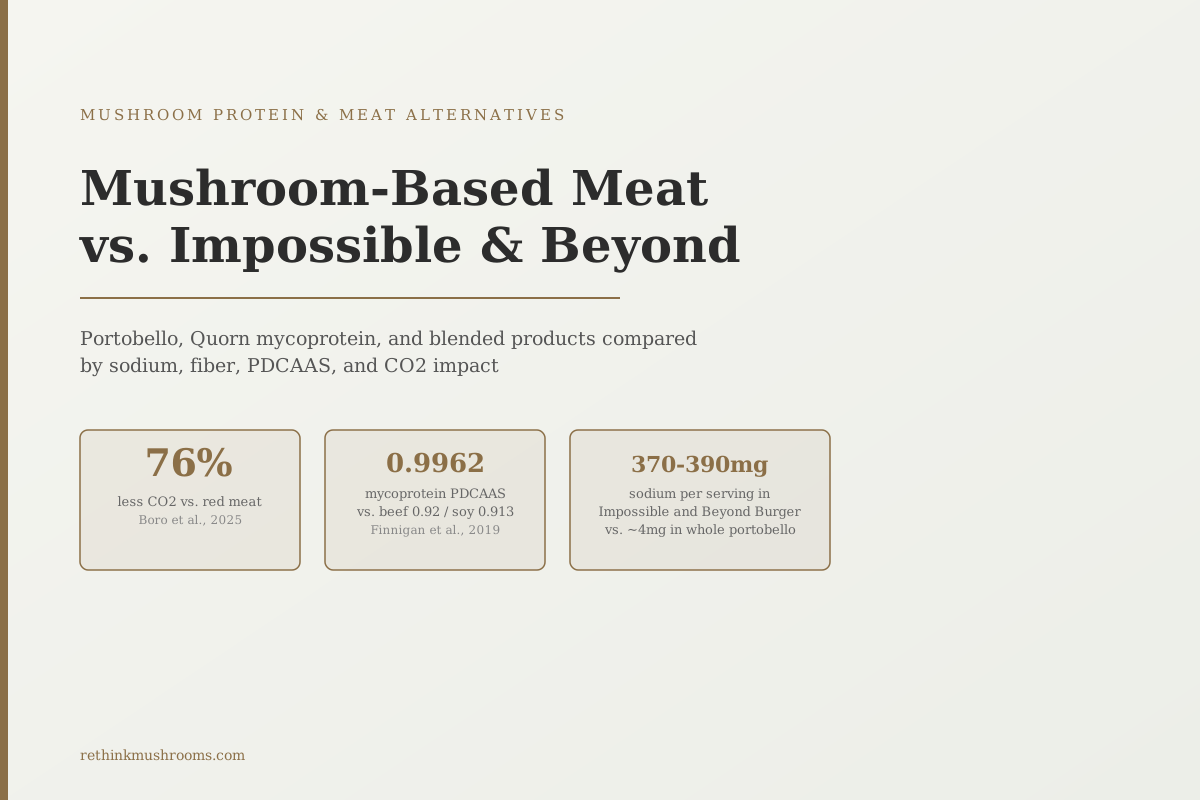
76% less CO2
Replacing red meat with mushroom-based alternatives reduces CO2 emissions by 76%, water use by 82%, and land use by 91% per calorie-equivalent serving.
Boro et al., Food Research International, 2025
PDCAAS 0.9962
mycoprotein protein quality; higher than beef (0.92) and soy (0.913), per Finnigan et al., 2019
370-390mg sodium
per serving in Impossible and Beyond Burgers versus approximately 4mg in a whole portobello mushroom
3 categories
whole mushroom substitutes, mycoprotein products, and mushroom-ingredient blends; each works differently
Boro et al., Food Research International, 2025
 View as image ↗
When someone says "mushroom-based meat," they might mean a whole portobello grilled in place of a burger patty. They might mean Quorn, a product made from a fungus called Fusarium venenatum that achieves a protein quality score rivaling beef. Or they might mean an Impossible Burger, which contains some mushroom-derived compounds for flavor but is primarily soy protein. These three things are nutritionally, ecologically, and commercially different. Most coverage of mushroom-based meat alternatives conflates them, which is why the comparisons confuse rather than inform. A 2025 comprehensive review by Boro and colleagues in Food Research International is the most current synthesis of where mushrooms stand as meat analogues across all categories.[1] This article uses that data alongside product nutritional information to give a clear picture of each category, as part of the broader coverage of mushroom nutrition.
Key Takeaways
- "Mushroom-based meat" means three different things: whole mushroom substitutes (portobello, oyster), mycoprotein products (Quorn, made from Fusarium venenatum fungus), and plant-based burgers that contain small amounts of mushroom for flavor (Impossible, Beyond)
- Mycoprotein achieves a PDCAAS of 0.9962, higher than beef (0.92) and soy protein (0.913), making it the only fungal protein that rivals animal protein quality (Finnigan et al., 2019)
- Impossible Burger contains 370mg sodium and Beyond Burger 390mg per serving; whole portobello mushrooms contain approximately 4mg sodium, and Quorn products run approximately 180mg per serving
- Replacing red meat with mushrooms reduces CO2 emissions by 76%, water use by 82%, and land use by 91% per calorie-equivalent serving (Boro et al., 2025)
- King oyster mushroom (Pleurotus eryngii) successfully replaced pork back fat in sausages in a food technology study, demonstrating whole mushrooms' functional role in processed meat analogues beyond simple substitution (Wang et al., 2019)
- Quorn is made from a filamentous fungus, not a culinary mushroom; it is related to mushrooms in the kingdom Fungi but is a distinct organism (Fusarium venenatum) cultivated by industrial fermentation
Three Things Called "Mushroom-Based Meat" (That Are Very Different)
The term "mushroom-based meat" covers three distinct categories with different nutritional profiles, production methods, and degrees of processing. Understanding which category you're evaluating is the first step toward any useful comparison.
Category 1: Whole mushroom substitutes. These are culinary mushrooms used in place of meat based on texture and flavor. Portobello mushrooms grilled as burger patties. Oyster mushrooms shredded to mimic pulled pork. King oyster stems sliced to approximate scallops or added to sausage formulations. The product is minimally processed: cooked, not manufactured. Nutritional content reflects the mushroom species being used.
Category 2: Mycoprotein products (Quorn and emerging brands). Mycoprotein is made from Fusarium venenatum, a filamentous fungus discovered in the soil of an English field in the 1960s. It grows by continuous fermentation, producing a dense matrix of protein-rich fungal threads called hyphae. Those hyphae are harvested, processed minimally, and shaped into meat-like products. The resulting texture resembles meat because it comes from actual fibrous biological structures, not from mechanical processing of protein isolates. This is the category that Quorn products occupy. It is a manufactured food, but from a whole-organism fermentation process rather than protein extraction from plants.
Category 3: Plant-based burgers with mushroom ingredients. Impossible Burger and Beyond Burger are primarily soy protein (Impossible) and pea protein isolate (Beyond). Some formulations include mushroom-derived ingredients, typically used for umami flavor contribution rather than as a primary protein source. Calling these "mushroom-based" is misleading. They are soy-based and pea-based products with trace mushroom components.
Boro and colleagues (2025) document all three pathways in their comprehensive review of edible mushrooms as meat analogues, noting that the expanding market includes whole mushroom products, mycoprotein derivatives, and hybrid formulations that use fungal ingredients for functional purposes within otherwise plant-based products.[1]
For understanding the flavor science that makes whole mushrooms function as meat substitutes, see umami in mushrooms: the science of mushroom flavor.
The Numbers: What Each Category Contains Per Serving
Nutritional profiles differ significantly across the three categories. The comparison below uses product label data and published research to put each on equal footing.
Impossible Burger (per 4oz / 113g serving): 19g protein, 230 calories, 13g total fat, 6g saturated fat, 370mg sodium. Protein source: soy protein concentrate. Contains added coconut oil, methylcellulose, and heme-producing yeast. Fiber: approximately 3g.
Beyond Burger (per 4oz / 113g serving): 20g protein, 230 calories, 14g total fat, 5g saturated fat, 390mg sodium. Protein source: pea protein isolate. Fiber: approximately 2g. Contains cocoa butter and canola oil for fat structure.
Whole portobello mushroom (100g, grilled): Approximately 3-4g protein, 35 calories, 0.4g fat, essentially 0g saturated fat, approximately 4mg sodium. Fiber: approximately 1.3g. Also delivers zinc, selenium, B vitamins, and ergothioneine.
Quorn products (mycoprotein-based, per typical serving): Approximately 11-15g protein depending on the product, 90-150 calories, 2-5g fat, 1-2g saturated fat, approximately 180-220mg sodium. Fiber: 6g or more per serving. The fiber content is one of mycoprotein's key nutritional differentiators from both animal meat and plant-based isolate burgers.
The sodium gap between Impossible/Beyond (370-390mg) and whole portobello (~4mg) reflects the difference between minimally processed and heavily formulated products. Mycoprotein occupies middle ground: significantly less sodium than soy or pea isolate burgers, far more fiber than any of the other options.
Finnigan and colleagues (2019), reviewing mycoprotein's nutritional profile, documented the 6g-plus fiber content per 100g as one of its clinically significant attributes, alongside its protein quality (PDCAAS 0.9962, exceeding beef at 0.92 and soy at 0.913).[2]
For a detailed breakdown of protein quality across whole mushroom species by PDCAAS and amino acid profile, see mushroom protein quality: amino acid profiles by species.
Why Mycoprotein Achieves Meat-Like Texture Without Heavy Processing
One reason mycoprotein products have succeeded commercially where other plant-based proteins struggled is that their meat-like texture comes from biology rather than processing. Soy and pea isolate burgers require extrusion, additives, and mechanical processing to create fibrous texture from globular protein isolates. The result is a formed texture that works but requires significant manufacturing inputs.
Fusarium venenatum naturally produces long, thread-like structures called hyphae as it grows. Those hyphae are protein-rich and align in parallel, creating a fibrous matrix that physically resembles muscle tissue. When mycoprotein is harvested from fermentation and minimally processed, the fibrous structure is preserved. The "bite" of a mycoprotein product comes from actual biological fibers, not from extrusion engineering.
Finnigan and colleagues (2019) describe this structural basis in detail: the hyphal network gives mycoprotein its characteristic fibrous texture that no other plant-based protein source has replicated from first principles.[2] This is why chefs and food technologists have found mycoprotein easier to work with for specific applications, particularly those that benefit from a shredded or pulled texture.
The protein quality compounds the texture advantage. PDCAAS 0.9962 means that per gram of protein, mycoprotein is effectively equivalent to animal protein for human amino acid needs. This is not the case for most plant-based alternatives.
Whole Mushrooms as Functional Meat Analogues
Whole mushrooms perform a different function than mycoprotein in the meat analogue space. They are not protein replacements in the same sense because their fresh-weight protein content (typically 2-5g per 100g serving) is far below the 20g-per-serving benchmark of burgers. What whole mushrooms provide is texture, flavor, and functional food properties that can partially replace meat in formulations.
Wang and colleagues (2019) demonstrated this in a food technology study: king oyster mushroom (Pleurotus eryngii), processed with different treatments, successfully replaced pork back fat in sausage formulations without compromising textural or sensory properties.[3] The mushroom was acting as a fat replacement, contributing texture, moisture retention, and mouthfeel that fat typically provides. This is a specific functional application different from simply substituting a portobello for a beef patty.
For whole mushroom applications in the home kitchen, the strongest use cases are texture-driven: portobello burger patties (dense, meaty texture), shredded oyster mushrooms for pulled-meat applications (fibrous structure separates like pulled pork), and king oyster stem slices for firm-protein applications like scallops or sausage components.
The flavor contribution of mushrooms in these applications connects to the umami chemistry of glutamate and nucleotides that mushrooms accumulate. This is why the whole-mushroom substitution often satisfies in a way that direct protein-equivalent calculations do not predict.
For more on how using mushrooms as meat substitutes affects health outcomes at a population level, see mushroom consumption and metabolic syndrome risk.
The Sustainability Comparison
The environmental case for mushroom-based meat alternatives is straightforward regardless of which category is chosen. Boro and colleagues (2025) synthesized the sustainability data in their comprehensive review.[1]
Replacing red meat with mushroom-based alternatives reduces:
- CO2 emissions by 76% per calorie-equivalent serving
- Water use by 82%
- Land use by 91%
By comparison, chicken produces 3.1 kg CO2 per pound, pork 5.5 kg CO2 per pound, and beef approximately 27 kg CO2 per pound (from methane-equivalent calculations). Mushrooms (whole) produce approximately 0.5 kg CO2 per pound. Mycoprotein's fermentation process is more energy-intensive than growing whole mushrooms but remains significantly below animal protein production.
Soy-based and pea-based plant burgers also have lower footprints than red meat, but soy cultivation carries its own land-use concerns related to deforestation in South America. Mushroom cultivation uses agricultural by-products as substrate, avoiding the primary land-use footprint that soy requires.
What the Market Looks Like Now
Quorn held the dominant position in mycoprotein for decades based on its proprietary fermentation process and food technology. As key patents expired, new companies entered the space using mycoprotein fermentation or whole mushroom ingredients.
Meati Foods produces whole-cut mycoprotein products, including chicken-breast and steak-like cuts. Atlast Food Co. grows whole mushroom mycelium blocks that can be sliced and cooked like meat. These represent a different approach from Quorn: growing fungal material in three-dimensional form rather than as fermented slurry.
Boro and colleagues (2025) address the market expansion context, noting that the expanding fungal protein market reflects both consumer demand and post-Quorn technological diffusion, while also identifying scaling challenges around fermentation capacity and regulatory approval in new markets.[1]
The honest framing: Quorn and mycoprotein are manufactured foods. They are less processed than soy or pea isolate burgers in terms of ingredient transformation, but they are not whole foods. For consumers who prioritize whole-food eating, the portobello patty or shredded oyster approach is the most minimally processed option, with the trade-off of lower protein content per serving. For consumers prioritizing protein quality and meat-like texture, mycoprotein products have the strongest nutritional case. For consumers specifically choosing Impossible or Beyond, those products' appeal lies primarily in familiar burger flavor and texture rather than superior nutrition or minimal processing.
For a comprehensive comparison of mushroom protein content and how it stacks up as a viable meat alternative, see mushroom protein content and quality: a viable meat alternative. The broader sustainability and nutritional comparison is covered in mushrooms as meat alternatives: nutrition and sustainability. For the protein science behind mycoprotein specifically, see mycoprotein: the fungal protein revolutionizing food.
The Bottom Line
The term "mushroom-based meat" covers three distinct categories: whole mushrooms used for texture and flavor, mycoprotein products derived from fungal fermentation (Quorn), and plant-based burgers that contain small amounts of mushroom ingredients. Mycoprotein has the strongest protein case, with a PDCAAS of 0.9962 exceeding beef and soy, plus 6g or more fiber per serving and significantly less sodium than Impossible or Beyond Burger products. Mushroom-based alternatives of all types produce 76-91% less environmental impact than red meat per calorie-equivalent serving.
Frequently Asked Questions
Sources & References
- 1. Source details for this reference are not yet available.
- 2. Source details for this reference are not yet available.
- 3. Source details for this reference are not yet available.