Mushroom Protein & Meat Alternatives
0.44 PDCAAS
Oyster mushrooms (22–37% protein by dry weight) score 0.44 on the protein usability scale — the highest among commonly cultivated species, per Effiong et al. (2023).
Effiong et al., Frontiers in Nutrition, 2023
All 9 EAAs
every common culinary mushroom species contains all 9 essential amino acids the body cannot produce
0.36–0.70
PDCAAS protein quality range across whole culinary mushroom species — varies substantially by type
Methionine
the sulfur-containing amino acid present in the lowest ratio relative to human needs in most mushroom species
Effiong et al., Frontiers in Nutrition, 2023
 View as image ↗
Nutritional sites often describe mushrooms as "complete proteins" because they contain all nine essential amino acids, the nine the human body cannot manufacture on its own. Technically accurate. But the presence of all nine amino acids tells you only that a food has them, not how much, not in what ratios, and not how much your body can actually absorb from a cooked serving. These distinctions are the difference between a meaningful protein source and a marginal one.
Mushroom protein amino acid profiles vary significantly by species, and the honest picture requires looking at more than a simple yes-or-no on completeness. A 2023 study by Effiong and colleagues in Frontiers in Nutrition documented oyster mushroom protein at 22–37% dry weight with all nine essential amino acids present, but with methionine and cysteine, the sulfur-containing amino acids, as limiting factors — the amino acids present in the lowest ratio relative to what the body needs.[1] A 2008 multi-species chemical analysis by Barros and colleagues documented meaningful variation in protein content and amino acid composition across Portuguese wild mushroom species.[2] The complete mushroom nutrition species guide covers macronutrients across all commonly eaten species; this article focuses on protein quality and amino acid profiles specifically.
Key Takeaways
- All nine essential amino acids are present in every culinary mushroom species tested — but amino acid presence alone does not determine protein quality; quantity, ratio, and digestibility determine how much the body can use
- Oyster mushrooms contain 22–37% protein by dry weight with a PDCAAS of 0.44, the highest among the most common commercially grown species, per Effiong et al. (2023)
- The limiting amino acid in most mushroom species is methionine or its companion cysteine; pairing mushrooms with eggs, dairy, or legumes addresses this gap and improves the combined protein quality
- PDCAAS scores across whole culinary mushrooms range from approximately 0.36 to 0.70, compared to 0.92 for beef; raw mushroom protein is further limited by poor digestibility through intact cell walls
- Cooking mushrooms significantly improves protein digestibility by breaking down chitin, the structural carbohydrate in fungal cell walls that human enzymes cannot digest
- Fruiting bodies generally have higher protein density than mycelium, per Berger et al. (2022) — an important distinction when evaluating mushroom-based products and supplements
The "Complete Protein" Claim Is True But Misses the Point
"Complete protein" has a specific definition in nutrition: a food that contains all nine essential amino acids. By that definition, mushrooms qualify. The definition turns out to matter less than most people expect.
The reason is that "complete" means each of the nine essential amino acids is present at detectable levels. It does not mean they're present in the right amounts, in the right ratios, or in a form the body can readily absorb. A food could qualify as a complete protein while providing negligible amounts of two or three of those amino acids.
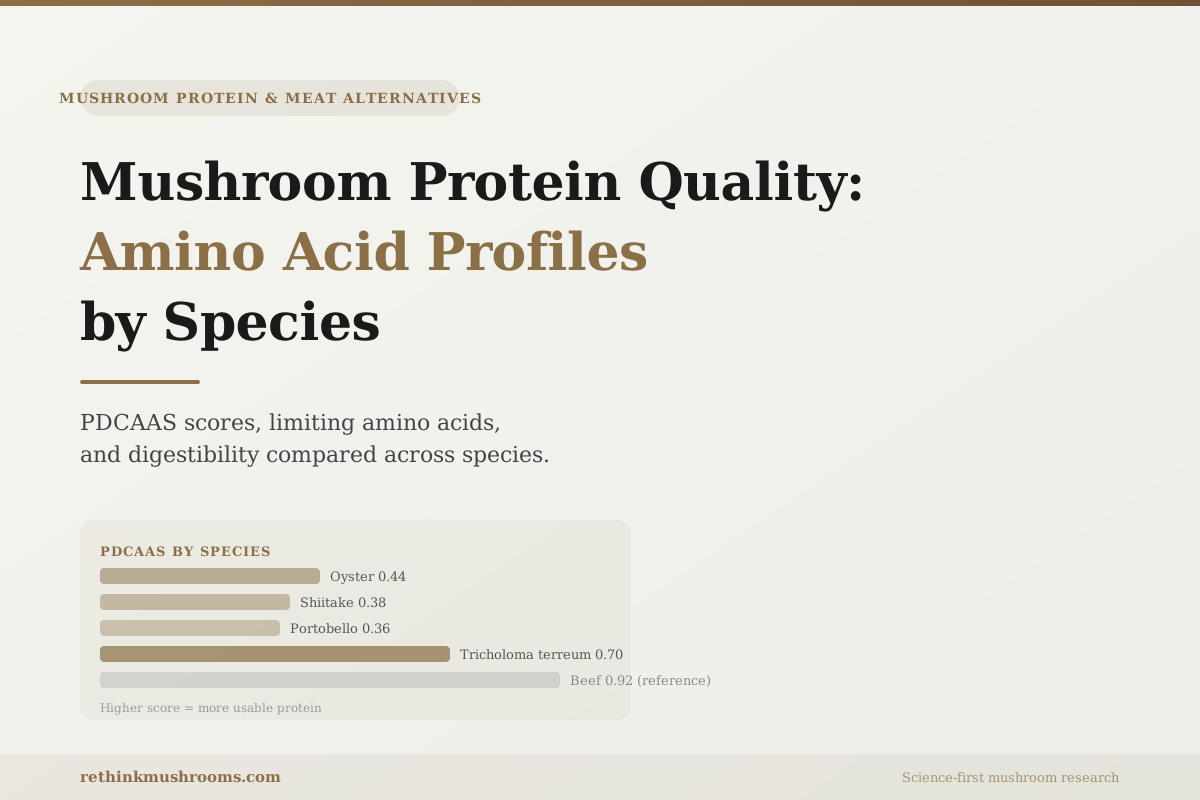
The measurement that captures what actually matters is called PDCAAS, short for Protein Digestibility-Corrected Amino Acid Score. A PDCAAS score runs from 0 to 1 and combines two factors: how closely the amino acid ratio in a food matches what the human body actually needs, and how much of the protein survives digestion and enters circulation. A score of 1.0 is a perfect match; milk and eggs reach this level. Beef scores 0.92. Soy protein scores 0.913. Whole culinary mushrooms score between 0.36 and 0.70, depending on species.
These are not embarrassing numbers. Legumes typically range from 0.67 to 0.78. Wheat is around 0.40. Mushrooms sit in the middle of the plant-protein range, with oyster mushrooms and a few less commonly cultivated species performing close to legumes on this measure.
What makes mushrooms nutritionally interesting is the combination they offer alongside protein: fiber, micronutrients including zinc, selenium, and B vitamins, and ergothioneine, an antioxidant found in meaningful quantities almost nowhere else in the food supply. A 2025 comprehensive review of edible mushrooms as meat analogues by Boro and colleagues in Food Research International framed mushrooms as uniquely positioned among protein alternatives precisely because of this combination, not because of protein quality alone.[4]
For the bigger picture of how mushrooms function as meat alternatives for nutrition and sustainability, the combination of protein, micronutrients, and environmental footprint is the full argument.
Mushroom Protein Quality by Species: The PDCAAS Rankings Few Sites Publish
Most nutritional content on mushrooms treats species interchangeably. For protein quality, they're not interchangeable. Nutritional analyses across species, particularly Bano et al. (2002) in Plant Foods and Human Nutrition and work compiled in the Ayimbila 2023 review, document meaningful species-level variation in protein quality scores:
| Species | Protein (dry weight) | PDCAAS | Primary limiting amino acid |
|---|---|---|---|
| Oyster (Pleurotus ostreatus) | 22–37% | 0.44 | Methionine, cysteine |
| King trumpet (Pleurotus eryngii) | 15–25% | ~0.44 | Methionine |
| Enoki (Flammulina velutipes) | ~19% | not established | n/a |
| Shiitake (Lentinus edodes) | 10–17% | 0.38 | Methionine |
| Portobello / Button (Agaricus bisporus) | 15–33% | 0.36 | Methionine |
| Tricholoma terreum | limited cultivation | 0.70 | Lysine |
| Mycoprotein (Fusarium venenatum) | 45%+ | 0.9962 | None |
PDCAAS data: Bano et al. 2002 and Ayimbila 2023 comparative review. Oyster mushroom data: Effiong et al. 2023.[1] Mycoprotein shown for context; see the mycoprotein article for full data.
Three findings stand out in this table. First: the most commonly eaten mushroom worldwide, portobello and button (both Agaricus bisporus), has the lowest PDCAAS of the cultivated species. The mushroom people eat most often is not the most efficient protein choice. Second: oyster mushroom's higher PDCAAS combined with its substantially higher protein content makes it the strongest whole-mushroom protein source available at most grocery stores. Third: Tricholoma terreum reaches 0.70, genuine legume territory, with a different limiting amino acid (lysine rather than methionine). It's not widely cultivated commercially, which limits its practical relevance, but it demonstrates that mushroom protein quality has more range than the common species suggest.
Mycoprotein is included at the bottom for reference, not comparison — it's produced from a different fungal organism using industrial fermentation, and is covered separately in the mycoprotein and mushroom-based meat product context.
Oyster Mushrooms: The Best Whole-Mushroom Protein Source, With One Important Gap
Oyster mushrooms (Pleurotus ostreatus) have the most thoroughly documented protein quality among commercially grown species. Effiong and colleagues' 2023 assessment in Frontiers in Nutrition found protein content ranging from 22 to 37 percent of dry weight, a range that reflects genuine biological variation between oyster mushroom varieties: pink, blue, golden, and pearl oysters differ meaningfully.[1]
All nine essential amino acids were confirmed present. The amino acid profile includes leucine, isoleucine, and valine, the branched-chain amino acids that play a key role in muscle protein building, in meaningful quantities. The gap is methionine and cysteine.
Methionine is an essential amino acid involved in protein synthesis and antioxidant defense. It's the building block the body uses to produce glutathione, one of its primary internal antioxidants. When methionine is present in low ratios relative to other amino acids, the body's ability to fully use the available protein is constrained. Cysteine is related: the body can synthesize it from methionine when methionine is sufficient, but in the presence of a methionine limitation, cysteine availability also becomes restricted.
The practical implication: oyster mushrooms combined with eggs (which are notably high in methionine), dairy, or legumes such as lentils and chickpeas produces a protein profile significantly stronger than either food alone. This is called protein complementation, combining foods to fill each other's amino acid gaps. Shiitake mushrooms are particularly high in glutamic acid and aspartic acid, the amino acids responsible for deep savory flavor, which is also why they're one of the strongest umami sources in plant-based cooking — a topic covered in depth in umami in mushrooms.
The Effiong study also documented oyster mushroom's high fiber content and favorable mineral and B vitamin profiles.[1] These dimensions are where mushrooms as protein sources genuinely compete with meat: the package of fiber, ergothioneine, and micronutrients alongside the protein is a combination meat does not replicate.
Wild Species and Within-Genus Variation: What 18 Chanterelles Reveal
Much of the amino acid data for mushrooms focuses on commercially cultivated species. Wild mushroom research shows how much the range can extend. Kumari and colleagues' 2011 analysis in Food Science and Technology International documented protein content and amino acid profiles across 18 wild Cantharellus (chanterelle) species from the northwestern Himalayas.[3]
The key finding: within a single genus, protein content and amino acid composition varied meaningfully from species to species. This is significant for how nutritional databases should be read. When a database reports "chanterelle: 16% protein dry weight," that figure is an average across species that may individually range well above or below it. The practical precision of species-level nutritional data is lower than database entries imply.
Barros and colleagues' 2008 multi-species analysis of Portuguese wild mushrooms found similar cross-species variation in both protein content and amino acid profiles across a Mediterranean context.[2] Their data also showed that wild species often have higher antioxidant activity than cultivated counterparts, a reminder that amino acid profiles are one dimension of nutritional quality and not always the most relevant one depending on why someone is eating mushrooms.
For culinary mushrooms purchased commercially, the species-level data converges on a practical conclusion: oyster and king trumpet mushrooms are the strongest choices for protein content and quality. Shiitake offers lower protein but higher glutamate-based amino acids and documented beta-glucan content. Portobello and button are nutritionally modest in protein but offer texture and versatility that explains their commercial dominance.
Why Raw Mushroom Protein Is Only Partially Available
PDCAAS scores already account for digestibility — but the digestibility number used in those calculations typically comes from processed or cooked mushrooms. The raw mushroom story is different.
Mushroom cell walls are built from chitin, a tough structural carbohydrate. Chitin is the same material that forms insect exoskeletons and crustacean shells. The human digestive system produces no enzyme capable of breaking chitin down. This means raw mushroom cells arrive at the small intestine largely intact, and the protein inside them passes through without being released for absorption.
Heat breaks down chitin. Cooking with moisture, including boiling, steaming, and sautéing with added liquid, disrupts the chitin matrix, rupturing cell walls and releasing protein content into the digestive environment. Dry heat also improves digestibility, though its effect varies with temperature and cooking time. The practical result: protein digestibility in cooked mushrooms is substantially higher than in raw mushrooms.
Nutritional analyses that report PDCAAS scores without specifying cooking preparation may be reporting under laboratory conditions where protein was chemically extracted, which bypasses the chitin barrier. For real-world protein absorption, cooked mushrooms substantially outperform raw, and the PDCAAS scores in the table above are best applied to their cooked form.
Cooking also affects mushroom bioactives beyond protein, including how beta-glucans, ergothioneine, and heat-sensitive vitamins respond to different cooking methods — covered in how cooking affects mushroom bioactives.
Mycelium vs. Fruiting Body: The Protein Difference That Matters for Products
Not all mushroom protein products use the part of the fungus that appears on a plate. Many mushroom supplements and some food products use mycelium, the thread-like root network the fungus extends underground, rather than the fruiting body, which is what we call the mushroom in the kitchen.
Berger and colleagues' 2022 comparative analysis in Microorganisms systematically examined the differences in chemical composition between mycelium and fruiting bodies across edible fungal species.[5] Among the measured variables: protein content. Fruiting bodies generally showed higher protein density than mycelium in the species compared. The amino acid profiles also differed. Treating mycelium and fruiting body as equivalent in nutritional content was not supported by the data.
This distinction matters in two practical contexts. First, for mushroom supplements marketed partly for protein or amino acid content: a product using mycelium will typically have lower protein density than a product using fruiting bodies, even if the mushroom species is the same. Second, for understanding mycoprotein: Quorn's mycoprotein is not derived from the fruiting bodies of culinary mushrooms but from Fusarium venenatum, a distinct fungal organism, grown as a mycelium-like mass through continuous fermentation. Its near-perfect PDCAAS score comes from this organism's specific amino acid composition combined with industrial processing, not from any characteristic shared with culinary mushroom fruiting bodies.
The Berger 2022 data adds an important nuance to the "mushroom protein" category: when a product lists a mushroom species by name, where in the fungal lifecycle the protein was harvested determines its nutritional character.[5] Fruiting body products and mycelium products of the same species are not the same nutritional product.
The Bottom Line
Mushrooms contain all nine essential amino acids, but protein quality varies substantially by species. PDCAAS scores for whole culinary mushrooms range from 0.36 for portobello to 0.70 for the less cultivated Tricholoma terreum, with oyster mushrooms (0.44) as the strongest commercially available option. Methionine and cysteine are the limiting amino acids in most species. Cooking is essential for protein absorption, as chitin cell walls block digestibility in raw mushrooms. Fruiting bodies have higher protein density than mycelium, which matters when evaluating mushroom-based supplements and food products.
Frequently Asked Questions
Sources & References
- 1. Source details for this reference are not yet available.
- 2. Source details for this reference are not yet available.
- 3. Source details for this reference are not yet available.
- 4. Source details for this reference are not yet available.
- 5. Source details for this reference are not yet available.