Cardiovascular Research
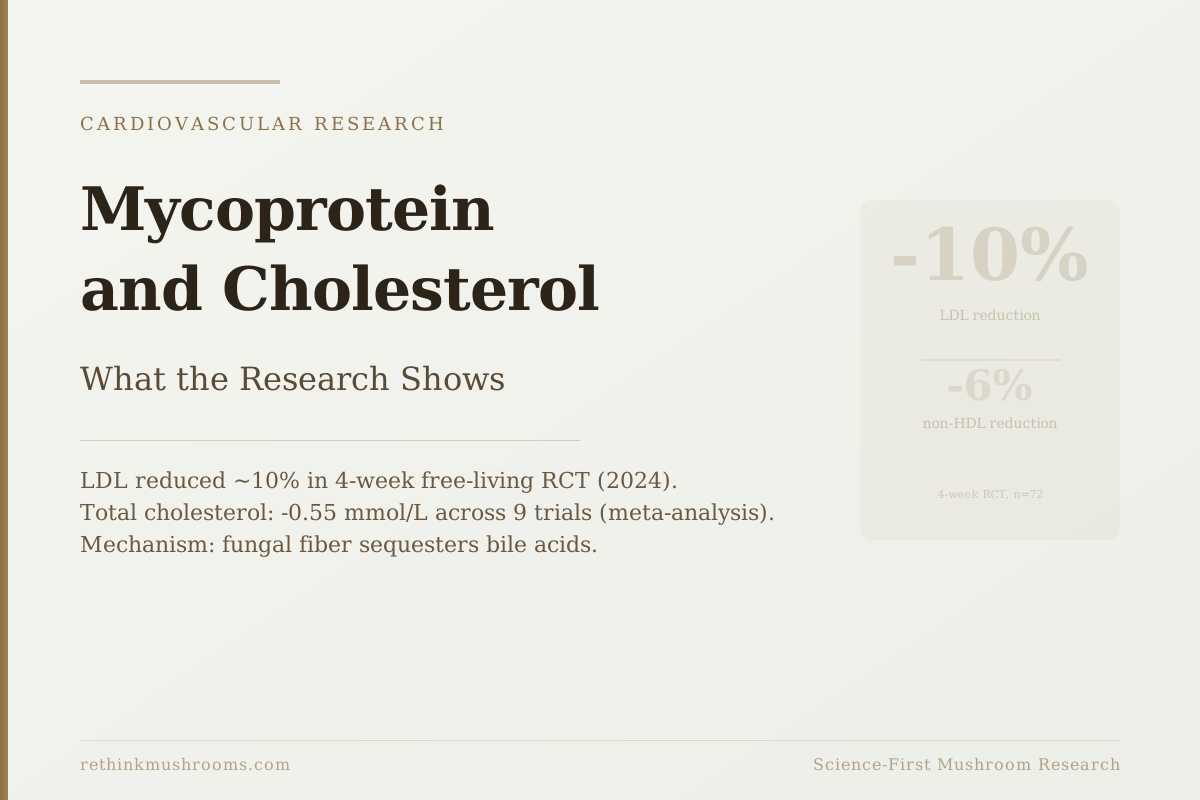
10%
LDL cholesterol reduction within the mycoprotein group after overweight, hypercholesterolaemic adults replaced meat and fish with mycoprotein for 4 weeks in a 2024 randomized controlled trial. In absolute terms, 0.3 mmol/L.
Pavis et al., Clinical Nutrition, 2024
-0.55 mmol/L
total cholesterol across 9 trials in 2023 meta-analysis
-6%
non-HDL cholesterol in the 2024 4-week free-living RCT
-21%
postprandial insulin (iAUC) at the highest mycoprotein dose vs. chicken (2016 RCT)
Pavis et al., Clinical Nutrition, 2024
 View as image ↗
A 2024 randomized controlled trial found that overweight adults with elevated cholesterol who replaced meat and fish with mycoprotein products for four weeks saw their LDL fall by 10% and their non-HDL cholesterol fall by 6% — both amounting to a drop of 0.3 mmol/L. The trial was run in a free-living setting, meaning participants ate at home rather than in a clinical facility, which makes the findings closer to what a real dietary change would produce. The mycoprotein cholesterol effect is not a recent discovery: a 2023 meta-analysis of nine clinical trials confirmed that mycoprotein intake reduces total cholesterol, and the 2024 result extends that evidence with the most real-world data yet.
It is also a smaller and more qualified body of evidence than the headline percentages suggest, and this article is as much about the qualifications as the findings. For an overview of mycoprotein as a food ingredient, what is mycoprotein: the fungal protein alternative covers the basics.
Key Takeaways
- A 2024 four-week RCT (n=72 overweight, hypercholesterolaemic adults) found LDL cholesterol decreased by 10 ± 3% and non-HDL cholesterol by 6 ± 2% — both a fall of 0.3 ± 0.1 mmol/L — within the mycoprotein group, while the meat-and-fish control group was unchanged on every lipid fraction[1]
- A 2023 systematic review and meta-analysis of 9 trials (178 participants, mean follow-up just 13 days) found mycoprotein reduced total cholesterol by -0.55 mmol/L (p less than 0.001) vs control, but found no clear effect on LDL, HDL or triglycerides when the trials were pooled[2]
- HDL cholesterol and triglycerides did not change in the 2024 trial, in either group — the effect is confined to the atherogenic fractions[1]
- A 2016 RCT found mycoprotein lowered postprandial insulin dose-dependently versus an isoenergetic chicken meal, by 8%, 12% and 21% (incremental AUC) at 44 g, 88 g and 132 g respectively — but glucose, GLP-1, PYY and gastric emptying were all unchanged, so the mechanism remains unidentified[3]
- The widely-repeated bile-acid-sequestration explanation is a plausible hypothesis, not a demonstrated finding: none of the human mycoprotein cholesterol trials measured bile acid excretion
What Mycoprotein Is and Why Its Fiber Architecture Matters for Cholesterol
Mycoprotein is a food ingredient made from Fusarium venenatum, a naturally occurring fungus. It is not a traditional mushroom — mushrooms are the fruiting bodies of fungal organisms, whereas mycoprotein is the filamentous mycelium of a different fungal species entirely. The material is produced by continuous fermentation, harvested as a dense mass of interwoven fungal filaments called hyphae, and heat-processed with a binder for texture. Sold as Quorn and consumed in 17 countries, it is high in protein and fiber and low in fat, cholesterol, sodium and sugar[4].
The fiber fraction is where the cholesterol story begins. Like all fungal cell walls, mycoprotein's fiber is built primarily from chitin and beta-glucan, arranged not as a loose powder or a dissolved gum but as a physically dense matrix of interwoven filaments. That architecture is what distinguishes mycoprotein from most protein foods: it delivers a substantial fiber load inside a meat-textured product.
For more on how the broader category of mushroom fiber affects cholesterol through different mechanisms, eritadenine in shiitake: the unique cholesterol-lowering nucleoside covers the shiitake-specific pathway, which is mechanistically distinct.
The 2024 RCT: LDL Down 10% in 4 Weeks in Free-Living Adults
The Pavis 2024 trial is the most significant mycoprotein cholesterol study in the current literature for one specific reason: it tested real-world conditions.[1]
Most diet intervention trials are conducted in metabolic wards or tightly controlled clinical settings where researchers control every meal. These designs produce clean data but may not reflect what happens when people eat differently at home. The Pavis trial used home food delivery: 72 participants were randomized to receive either mycoprotein-containing food products (n=33) or meat and fish control products (n=39), delivered to their homes for four weeks. They cooked and ate normally, just with different protein sources. Fingertip blood samples were collected before and after and returned by post.
Participants had to be both overweight (BMI above 27.5 kg/m²) and hypercholesterolaemic (total cholesterol above 5.0 mmol/L), meaning they had clinical risk factors rather than being healthy volunteers. This makes the results directly applicable to the people most likely to be asking about dietary cholesterol management.
Pavis et al. (2024) · Clinical Nutrition
- Population
- 72 community-dwelling adults with BMI above 27.5 kg/m² and total cholesterol above 5.0 mmol/L
- Intervention
- Home-delivered mycoprotein food products replacing meat and fish for 4 weeks (n = 33)
- Comparator
- Home-delivered meat and fish products (n = 39)
- Finding
- LDL fell 10 ± 3% and non-HDL fell 6 ± 2% (both −0.3 ± 0.1 mmol/L) within the mycoprotein group, and total cholesterol fell 5 ± 2% (5.4 → 5.1 mmol/L). The control group was unchanged on every lipid fraction. HDL and triglycerides moved in neither group.
positive The free-living design and at-risk population make this the most externally valid mycoprotein cholesterol trial to date. It remains small, four weeks long, and measured no cardiovascular outcome.
Pavis GF, et al. Clin Nutr. 2024;43(3):649-659. PMID 38306892.
The reported changes are within-group changes across the four weeks: total cholesterol, LDL and non-HDL all fell in the mycoprotein arm and were unchanged in the control arm. That is a meaningful contrast, but it is worth being precise that the abstract reports the lipid results this way rather than as a single between-group difference.
The Full Lipid Panel · Pavis 2024
What Moved, What Didn’t, and by How Much
Seventy-two overweight, hypercholesterolaemic adults ate either mycoprotein products (n = 33) or meat and fish products (n = 39) at home for four weeks. Every change below is a within-group change in the mycoprotein arm; the control arm did not move on any lipid measure.
−0.3 ± 0.1 mmol/L
The article headline. Note the absolute movement is 0.3 mmol/L — the percentage is large because the starting point was modest, not because the shift was.
−0.3 ± 0.1 mmol/L
Captures LDL plus every other atherogenic particle in one number. Same absolute fall as LDL.
5.4 → 5.1 mmol/L
The fraction the 2023 meta-analysis also found moved. This is the most replicated mycoprotein lipid result.
Unaffected in both arms
Mycoprotein did not raise "good" cholesterol. The benefit is confined to the atherogenic fractions.
Unaffected in both arms
No triglyceride effect at four weeks, in either group.
Also measured, between groups
These are the only between-group comparisons reported in the abstract.
Blood glucose
3.7 ± 0.2 mmol/L (mycoprotein) vs 4.3 ± 0.2 mmol/L (control) after the intervention
C-peptide
779 ± 76 pmol/L (mycoprotein) vs 1064 ± 86 pmol/L (control) — a marker of how much insulin the pancreas released
Non-HDL cholesterol is a broader measure that captures LDL and all other atherogenic (plaque-promoting) lipoproteins in a single number. Cardiologists increasingly prefer non-HDL as a cardiovascular risk metric over LDL alone because it includes remnant lipoproteins that LDL measurement misses.
The trial also found lower blood glucose (3.7 vs 4.3 mmol/L) and lower c-peptide (779 vs 1064 pmol/L) in the mycoprotein group after the intervention compared with control. C-peptide is released alongside insulin, so this is an independent signal pointing in the same direction as the postprandial insulin findings discussed below.
The 2024 trial is also notable for what it did not find: no change in HDL cholesterol or triglycerides in either arm. The effect was specifically on the atherogenic lipoprotein fractions.
Calibration
Is a 10% LDL Drop the Same as Taking a Statin?
The claim
“A 10% LDL reduction from a food puts mycoprotein in the same territory as cholesterol medication.”
Percentages travel better than absolute numbers, and 10% sounds close to the low end of what people assume drugs achieve.
What research shows
OverstatedThe 10% figure is a within-group change of 0.3 ± 0.1 mmol/L over four weeks in 33 people. Moderate-intensity statin therapy is conventionally defined as lowering LDL by roughly 30–50%, is taken for years rather than weeks, and has been tested against heart attacks and deaths — an outcome no mycoprotein trial has ever measured.
This does not make the dietary effect trivial. It makes it a dietary effect: real, measured in the right population, plausibly additive to other changes, and not a substitute for a treatment someone has been prescribed.
Mycoprotein figures: Pavis GF, et al. Clin Nutr. 2024;43(3):649-659 (PMID 38306892). Statin intensity ranges reflect standard clinical classification; no trial has compared mycoprotein against statin therapy.
What the 2023 Meta-Analysis Shows: 9 Trials on Mycoprotein and Cholesterol
The Pavis 2024 result does not stand alone. A 2023 systematic review and meta-analysis by Shahid and colleagues, published in the American Journal of Clinical Nutrition, pooled data from 9 randomized trials involving 178 participants to examine mycoprotein's effects on blood lipids, glucose, insulin, blood pressure and body weight.[2]
The meta-analysis found that mycoprotein intake reduced total cholesterol by -0.55 mmol/L (95% CI: -0.85 to -0.26; p less than 0.001) compared to control. It also found postprandial insulin reduced by -76.51 pmol/L at 30 minutes (p = 0.043), with no detectable effect at 60, 90 or 120 minutes, and no reduction in postprandial glucose at any timepoint.
Critically, the pooled analysis found no clear effects on HDL cholesterol, LDL cholesterol, or triglycerides (all p above 0.05). Only 4 of the 9 trials reported blood lipids at all, and the mean follow-up across the included trials was just 13 days.
This is the tension at the heart of the mycoprotein cholesterol literature: the pooled short-term trials show total cholesterol moving reliably but LDL not resolving clearly, while the single longest and most clinically relevant trial shows LDL moving. The most likely explanation is study design — most of the pooled trials were acute or very short, run in healthy volunteers, and not designed to detect a four-week lipid shift in people with elevated cholesterol.
The authors of the meta-analysis were explicit about this limitation, concluding that mycoprotein "may have important effects on blood lipids, but the evidence base is limited by the small sample sizes and short intervention periods of the contributing trials."
- Small human trialscompleted
Nine randomized trials, 178 participants total, mean follow-up 13 days — plus Pavis 2024 (n = 72, four weeks, free-living), the longest and most clinically relevant to date.
- Meta-analysis of those trialscurrent
Shahid 2023 pooled the nine earlier trials: total cholesterol fell -0.55 mmol/L, but LDL, HDL and triglycerides showed no clear pooled effect, and only 4 trials reported lipids.
- Large, long-duration RCTmissing
No trial has run long enough or recruited enough people to establish whether the lipid changes persist beyond a few weeks — and none has measured heart attacks, strokes or deaths.
Mycoprotein's cholesterol evidence is real, replicated for total cholesterol, and confined to small short trials. The strongest single result — a 10% LDL fall — comes from one four-week trial in 33 people. Cardiovascular outcomes remain entirely untested.
Shahid M, et al. Am J Clin Nutr. 2023;118(1):141-150 (PMID 37407163); Pavis GF, et al. Clin Nutr. 2024;43(3):649-659 (PMID 38306892).
How Fungal Fiber May Slow Cholesterol Absorption
The mechanism deserves more explanation than most nutrition coverage provides — including an explanation of how much of it is actually established.
Cholesterol enters the bloodstream through two routes. The first is dietary absorption from food. The second is recycling of bile acids, which are made from cholesterol and used in digestion. The liver produces bile acids from cholesterol, and healthy people reabsorb the large majority of them near the end of the small intestine. The remainder are excreted and must be replaced through new synthesis, which draws on the body's cholesterol supply.
The widely-repeated explanation for mycoprotein is that its dense fungal fiber matrix does the same thing: physically binding bile acids in the small intestine and interrupting their recycling. It is a reasonable hypothesis. Chitin and beta-glucan both have documented interactions with lipids in the gut, and mycoprotein delivers them in an unusually dense structural form.
But it is important to be clear that this is a hypothesis carried over from better-studied fibers, not a finding from these trials. Neither the Pavis 2024 trial nor the trials pooled in the 2023 meta-analysis measured bile acid excretion. Neither was designed to establish mechanism. Competing or complementary explanations remain open — including fermentation of mycoprotein fiber in the colon producing short-chain fatty acids that influence hepatic cholesterol production, and the simple fact that substituting mycoprotein for meat and fish also changes saturated fat and dietary cholesterol intake.
That last point is worth sitting with. The Pavis intervention was a substitution: participants stopped eating certain meat and fish products and started eating mycoprotein ones. Any lipid change reflects the whole swap, not an isolated property of fungal fiber.
The practical implication is unchanged, though: whatever the precise pathway, the effect appears to come from mycoprotein as a food replacing other foods, not from a specific micronutrient or supplement-style bioactive.
Beyond LDL: The Insulin Angle
A 2016 randomized controlled trial by Bottin and colleagues adds a second cardiovascular-relevant finding.[3]
Across two randomized controlled trials, 55 healthy overweight and obese volunteers consumed a test meal containing low (44 g), medium (88 g) or high (132 g) mycoprotein, or an isoenergetic chicken meal. Blood was drawn to measure glucose, insulin, PYY and GLP-1. Ad libitum energy intake at the next meal was assessed after 3 hours in part A (n=36), while gastric emptying, resting energy expenditure and substrate oxidation were recorded in part B (n=14).
All mycoprotein meals reduced insulin compared with chicken, and the effect scaled with dose: incremental AUC fell 8% at the low dose, 12% at the medium dose and 21% at the high dose (p = 0.004).
Dose Response · One Human RCT
More Mycoprotein, Less Insulin
Reduction in postprandial insulin (incremental AUC) versus an isoenergetic chicken meal, by mycoprotein dose, in 55 overweight and obese adults. The insulin effect scaled with dose; the reduction in next-meal energy intake (−10%) reached statistical significance only at the highest 132 g serving.
Insulin iAUC vs chicken
Insulin iAUC vs chicken
Insulin iAUC vs chicken · next-meal intake also −10% here
Elevated postprandial insulin is not solely a diabetes concern; chronically elevated post-meal insulin is associated with hepatic VLDL production (VLDL being a precursor to LDL) and with activation of lipogenic enzymes. Reducing the insulin excursion after meals is therefore plausibly relevant to the same lipid pathway the cholesterol findings sit in — though the Bottin trial measured insulin, not lipids, and did not test that link.
The trial also found next-meal energy intake was 10% lower (280 kJ, or about 67 kcal) after mycoprotein compared with chicken — but this reached significance only at the highest 132 g dose (p = 0.009).
Bottin et al. (2016) · British Journal of Nutrition
- Population
- 55 healthy overweight and obese adults across two randomized controlled trials
- Intervention
- A single test meal containing 44 g, 88 g or 132 g mycoprotein
- Comparator
- An isoenergetic chicken meal
- Finding
- Insulin incremental AUC fell dose-dependently versus chicken: −8% (44 g), −12% (88 g), −21% (132 g), p = 0.004. Next-meal energy intake fell 10% (about 67 kcal), but only at the 132 g dose.
mixed Glucose, PYY, GLP-1, gastric emptying rate and energy expenditure all showed no significant difference. The trial narrowed the list of candidate mechanisms without identifying one.
Bottin JH, et al. Br J Nutr. 2016;116(2):360-374. PMID 27198187.
The most useful thing about this trial is what it ruled out. GLP-1 — the same pathway targeted by semaglutide — and PYY, the two gut hormones most commonly invoked to explain satiety, were unchanged. So were glucose, gastric emptying rate and energy expenditure. Mycoprotein reduced insulin release and next-meal intake without moving any of the usual suspects, and the authors were direct that the mechanism remains to be elucidated.
This is worth stating plainly because the gap gets filled with confident guesses in secondary coverage. Slowed gastric emptying is the most common of them — and it is specifically contradicted by this trial, which measured gastric emptying and found no difference.
For the full satiety evidence picture, Quorn and satiety: why mycoprotein keeps you full longer covers the Bottin data in detail.
How Mycoprotein Compares to Other Fungal Cholesterol Approaches
Mycoprotein is not the only fungal food with cholesterol-lowering data. Shiitake mushrooms (Lentinula edodes) contain eritadenine, an adenosine analog investigated for effects on hepatic phospholipid and cholesterol metabolism. King Trumpet (Pleurotus eryngii) contains both beta-glucan and naturally occurring lovastatin and has been studied for lipid effects. These are proposed to operate through different pathways than a fiber-driven mechanism, though the comparative evidence bases differ substantially in size and quality.
For readers asking which fungal source is best for cholesterol management, the honest answer is that no study has compared them head to head. What can be said is that the mechanisms proposed for each are distinct, so there is no particular reason to think they would be redundant.
The data quality for mycoprotein cholesterol is reasonable by dietary intervention standards — a meta-analysis of 9 trials plus a four-week free-living RCT in clinical-risk adults is more than most single food ingredients have. It is also, by the meta-analysts' own assessment, limited by small samples and short durations. Both things are true, and the second is the one usually left out.
For the cross-species comparison, how shiitake lowers LDL cholesterol: clinical evidence and king trumpet and cholesterol: lipid-lowering research cover those species in the same depth. For the full mycoprotein nutritional comparison against other protein sources, mycoprotein vs. plant protein vs. animal protein covers that analysis. For safety and allergenicity, mycoprotein safety: allergy risks and allergenicity addresses the mold allergy cross-reactivity data.
Before You Change Anything
ModerateThis Is Research Information, Not Medical Advice
Concern
Cholesterol is usually being managed for a reason. A 10% LDL reduction observed over four weeks in 33 people is not a basis for stopping, reducing or delaying prescribed lipid-lowering therapy — and no mycoprotein trial has ever tested what happens when someone does that.
What the research says
Treat mycoprotein as a possible substitution within a diet, not as a replacement for treatment. If you take a statin or any other lipid-lowering medication, or you have a diagnosed cardiovascular condition, any change belongs in a conversation with the clinician who prescribed it.
Particularly relevant for: Anyone on lipid-lowering therapy or with diagnosed cardiovascular disease
What to do
Mycoprotein is also a recognised, if uncommon, food allergen with documented cross-reactivity in some people sensitised to moulds. Read the allergenicity evidence before making it a dietary staple.
Trial context: Pavis GF, et al. Clin Nutr. 2024;43(3):649-659 (PMID 38306892); Shahid M, et al. Am J Clin Nutr. 2023;118(1):141-150 (PMID 37407163). No mycoprotein trial has measured cardiovascular events.
The Bottom Line
Mycoprotein's cholesterol effect is real but modest and short-tested. A 2023 meta-analysis of 9 trials (178 participants, mean follow-up 13 days) found total cholesterol fell -0.55 mmol/L versus control, while finding no clear pooled effect on LDL, HDL or triglycerides. A 2024 free-living 4-week RCT in 72 overweight, hypercholesterolaemic adults found LDL fell 10 ± 3% and non-HDL 6 ± 2% — both 0.3 mmol/L — within the mycoprotein group, with HDL and triglycerides unchanged. The bile-acid-sequestration mechanism usually cited is a plausible hypothesis borrowed from better-studied fibers, not something these trials measured. A separate 2016 trial found postprandial insulin fell dose-dependently versus chicken, up to 21% at the highest dose, while explicitly ruling out GLP-1, PYY and gastric emptying as the explanation. No trial has tested cardiovascular outcomes.
Frequently Asked Questions
Sources & References
- 1RTHM-01966·Pavis, George F et al. (2024). “A four-week dietary intervention with mycoprotein-containing food products reduces serum cholesterol concentrations in community-dwelling, overweight adults: A randomised controlled trial..” Clinical nutrition (Edinburgh.Study breakdown →PubMed →↩
- 2RTHM-01785·Shahid, Maria et al. (2023). “The effect of mycoprotein intake on biomarkers of human health: a systematic review and meta-analysis..” The American journal of clinical nutrition.Study breakdown →PubMed →↩
- 3RTHM-00764·Bottin, Jeanne H et al. (2016). “Mycoprotein reduces energy intake and postprandial insulin release without altering glucagon-like peptide-1 and peptide tyrosine-tyrosine concentrations in healthy overweight and obese adults: a randomised-controlled trial..” The British journal of nutrition.Study breakdown →PubMed →↩
- 4RTHM-01056·Finnigan, Tim J A et al. (2019). “Mycoprotein: The Future of Nutritious Nonmeat Protein, a Symposium Review..” Current developments in nutrition.Study breakdown →PubMed →↩