Oyster Mushroom & Weight Management
85% fewer calories
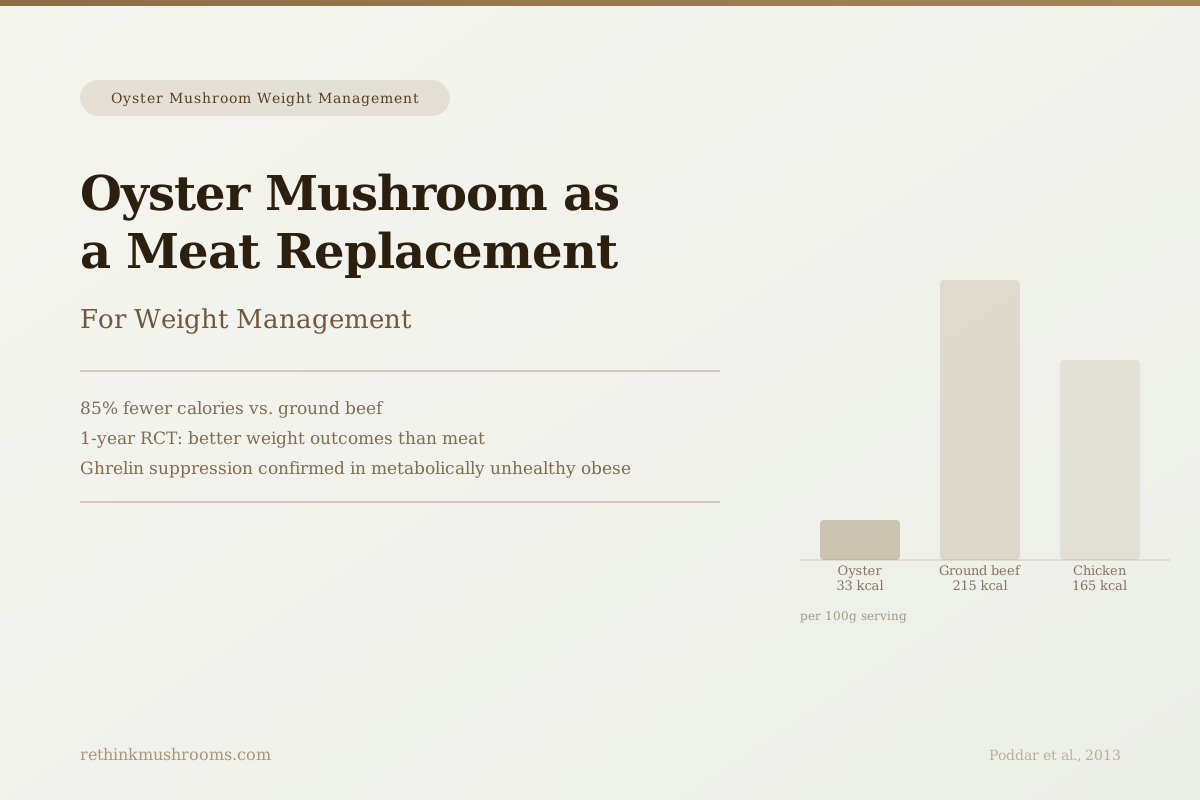
100g of oyster mushroom contains about 33 calories. 100g of ground beef contains about 215 calories. A 1-year randomized clinical trial found that people who substituted mushrooms for meat maintained greater weight loss and better body composition than those who continued eating meat.
Poddar et al., Appetite, 2013
1 year
duration of the only RCT testing mushroom-for-meat substitution for weight management
8g/day dried
oyster mushroom dose that reduced LDL and triglycerides in a clinical study (Abrams, 2011)
Ghrelin suppressed
king oyster mushroom enhanced hunger hormone suppression in people with metabolically unhealthy obesity (Kleftaki, 2022)
Poddar et al., Appetite, 2013
 View as image ↗
A 1-year randomized clinical trial found that people who substituted mushrooms for meat, replacing a daily meat serving with a mushroom serving, maintained greater weight loss and better body composition than people who kept eating meat. This is not a "mushrooms are healthy" claim backed by a three-week study in healthy college students. It is the most rigorous human evidence available for mushroom-based meat substitution, and it runs for a full year.
Oyster mushrooms are not the specific species studied in that trial, but they are the mushroom most people actually use as a meat replacement, because their texture and flavor make them work in meat's place. They are also the species with the most specific satiety hormone evidence: two separate randomized trials show them suppressing ghrelin (the hunger hormone) and increasing GLP-1 (a satiety hormone) in people who need weight management most.
This article covers the weight management case for oyster mushrooms as a meat replacement: the calorie math, the year-long outcome data, the satiety hormone findings, and the honest limitations. For the broader oyster mushroom overview, see what is oyster mushroom. For the satiety hormone deep dive, see Oyster Mushroom and Satiety Hormones: Why It May Help With Weight Loss.
Key Takeaways
- 100g of oyster mushroom provides approximately 33 calories; 100g of ground beef provides approximately 215 calories, an 85% calorie reduction per weight when substituting
- Poddar et al.'s 1-year randomized trial found mushroom-for-meat substitution produced better weight and body composition outcomes than continued meat eating (note: primarily white button mushrooms, not oyster specifically)
- Kleftaki et al. (2022) found king oyster mushroom enhanced ghrelin suppression, hunger reduction, and fullness in people with metabolically unhealthy obesity, explaining why lower-calorie mushroom meals maintain satiety
- Abrams et al. (2011) found 8g dried oyster mushroom daily significantly reduced total cholesterol, LDL, and triglycerides in HIV patients with cardiovascular risk, which replaces fatty meat's adverse lipid effects
- Du et al. (2024) found whole king oyster mushroom attenuated obesity in animals by improving lipid metabolism and restoring gut microbiota balance, with reduced Firmicutes/Bacteroidetes ratio
- A 2025 follow-up trial confirmed oyster mushroom delays gastric emptying but found no significant reduction in subsequent ad libitum energy intake; the satiety effects are real but don't always translate to eating less
The Calorie Case: 33 kcal Versus 215 kcal Per 100 Grams
The foundation of any meat substitution argument is calorie density, and the gap between oyster mushrooms and most animal proteins is significant.
One hundred grams of raw oyster mushroom provides approximately 33 calories, 3g of protein, and 2g of dietary fiber. One hundred grams of 85% lean ground beef provides approximately 215 calories, 17g of protein, and no dietary fiber. One hundred grams of chicken breast provides approximately 165 calories, 31g of protein, and no dietary fiber.
Per gram of food consumed, replacing meat with oyster mushrooms reduces calorie intake by 85% (vs. beef) to 80% (vs. chicken). This means that for a person eating 150g of protein at a meal (a typical dinner portion), switching from ground beef to oyster mushroom reduces calories from approximately 325 to 50 from that component of the meal alone.
The fiber difference matters independently of calorie counting. Oyster mushrooms provide beta-glucan fiber that slows gastric emptying and activates satiety signaling pathways. Ground beef provides no dietary fiber. A meal containing oyster mushroom therefore produces a different hormonal response than a meal containing the same calorie count from lean protein without fiber, a distinction the satiety research makes clear.
The protein gap is real and deserves honest framing. Oyster mushrooms have 2–4g of protein per 100g while lean meats provide 17–31g. For someone relying on a single meat substitute for all their protein, oyster mushrooms alone are insufficient. For someone who has other protein sources (legumes, eggs, dairy, other protein-rich foods) in the meal, the protein gap closes. This is the caveat the practical guidance must include.
The Only 1-Year RCT: What Happened When People Replaced Meat With Mushrooms
Poddar et al. published the longest and most rigorous human trial of mushroom-for-meat substitution in Appetite in 2013.[1]
The trial assigned participants to substitute mushrooms for meat in one daily meal for one year. The control group continued eating meat. At baseline, the groups were comparable in body weight and body composition. Over 12 months, participants in the mushroom substitution group showed better outcomes on body weight, body composition (fat mass relative to lean mass), and several cardiometabolic parameters compared to the meat-eating group.
The critical honest note: the study used primarily white button mushrooms (Agaricus bisporus), not oyster mushrooms specifically. White button and oyster mushrooms share the key properties relevant to weight management: high fiber content, high water content, high beta-glucan, low calorie density, and meaningful umami flavor that creates satisfaction at lower calorie counts. They are nutritionally comparable for this purpose.
The reason Poddar 2013 is the anchor for oyster mushroom meat replacement claims is that it is the only available 1-year controlled trial of mushroom-for-meat substitution in humans. No equivalent trial exists specifically for oyster mushrooms. The evidence transfers from the general category to the specific species because the mechanism is not species-specific. It is a function of mushroom physiology that oyster mushrooms share.
The study also found that the mushroom substitution group had better adherence to a prescribed diet over 12 months. Participants did not report feeling deprived or hungry compared to the meat group. This adherence finding is itself meaningful: a substitution that reduces calories but also reduces dietary satisfaction is hard to maintain. Mushrooms appear to maintain satiety adequately for most participants.
The Protein Tradeoff: What You Give Up and What You Get Back
The protein gap between oyster mushrooms and meat is the most common objection to mushroom-based meat substitution, and it deserves a direct answer.
A 150g serving of oyster mushrooms provides 4.5 to 6g of protein. The same weight of chicken breast provides 46g. Replacing a full chicken breast serving with oyster mushrooms every day would substantially reduce protein intake for someone not compensating elsewhere.
In practice, meat substitution in the research literature means replacing a portion of meat (typically 80-85g) with a serving of mushrooms in a mixed meal, not eliminating all protein from a meal. The Poddar trial used this partial-substitution approach. Participants continued getting protein from other meal components while removing the meat specifically.
What oyster mushrooms provide in exchange for the protein they lack: beta-glucan fiber that slows digestion and activates satiety hormone pathways, an umami flavor that maintains meal satisfaction, significantly lower calorie density, zero saturated fat (compared to 5–7g per 100g in ground beef), and, as Abrams et al.'s study shows, compounds that actively reduce the LDL and triglyceride levels that excess meat consumption tends to raise.[3]
The honest guidance from the research: oyster mushrooms work as a partial meat replacement for weight management when paired with adequate protein from other sources. They do not work as a total protein replacement if protein adequacy is a nutritional goal.
Satiety Hormones: Why Oyster Mushroom Meals Keep You Full Despite Lower Calories
The most surprising finding in this research area is that lower-calorie oyster mushroom meals can maintain satiety comparable to higher-calorie meat meals, not because of the calorie content, but because of specific hormonal effects on hunger signaling.
Kleftaki et al. (2022) enrolled people with metabolically unhealthy obesity and tested oyster mushroom meals against control meals in a randomized design.[5] The study found that oyster mushroom consumption improved postprandial blood glucose, enhanced subjective hunger suppression, improved fullness perception, AND enhanced ghrelin suppression compared to control.
Ghrelin is produced in the stomach and is the primary signal that drives hunger. When ghrelin rises, hunger rises. When ghrelin is suppressed, which normally happens after eating a large or calorie-dense meal, hunger fades. The Kleftaki study found that oyster mushroom meals suppressed ghrelin more effectively than control meals, despite providing fewer calories. This helps explain how lower-calorie oyster mushroom substitution can maintain satiety.
An important counterpoint: Johnen et al.'s 2025 trial (36 adults with overweight or obesity, a companion study from the same German research group) confirmed that oyster mushroom powder delayed gastric emptying in participants. However, this follow-up trial found no statistically significant reduction in how much participants ate at their next meal when food was provided freely. The gastric emptying delay is a consistent finding. Whether it translates to eating less in a real-world setting where the next meal is freely available is a different question, and the 2025 data suggests it may not, at least under those experimental conditions.
Both results are true. Oyster mushroom slows gastric emptying and affects ghrelin and GLP-1. Whether those hormonal effects are large enough to reduce total daily energy intake meaningfully is not yet established in controlled conditions.
Cardiovascular Effects: What Oyster Mushroom Does to the Lipids That Meat Raises
One reason meat substitution benefits weight management is not just the calorie reduction from replacing meat but the replacement of meat's adverse lipid effects with oyster mushroom's lipid-improving effects.
Saturated fat from red meat raises LDL cholesterol and triglycerides. Replacing that source of saturated fat with a food that actively lowers LDL and triglycerides produces a doubly beneficial effect on cardiovascular risk factors, which overlap significantly with the metabolic features that accompany excess body fat.
Abrams et al. (2011) demonstrated this in a vulnerable clinical population: HIV patients on antiretroviral therapy who already had elevated cardiovascular risk.[3] Eight weeks of daily oyster mushroom consumption (8g dried/day, equivalent to approximately 80g fresh) produced significant reductions in total cholesterol, LDL, and triglycerides. The study was co-authored by Paul Stamets and published in BMC Complementary and Alternative Medicine.
The mechanisms include oyster mushroom's lovastatin content (a natural HMG-CoA reductase inhibitor, the same drug class as atorvastatin and simvastatin), its beta-glucan content (which binds bile acids in the gut and reduces cholesterol reabsorption), and its fiber content (which reduces post-meal lipid absorption). For more on the cholesterol-lowering evidence specifically, see Oyster Mushrooms and Cholesterol: The Natural Statin Connection.
The Gut Microbiota Mechanism: How Replacing Fatty Meat Changes Your Microbiome
Beyond calorie reduction, oyster mushroom substitution appears to shift the gut microbial environment in ways that independently support weight management.
Du et al. (2024) fed whole king oyster mushroom to diet-induced obese animals and measured metabolic outcomes and gut microbiota composition over the treatment period.[2] The mushroom diet attenuated obesity development, reduced liver fat accumulation, and lowered triglycerides compared to the high-fat control diet. Crucially, the study documented changes in gut microbiota: the treated group showed a reduced Firmicutes/Bacteroidetes ratio, a microbiome shift consistently associated with leaner metabolic phenotypes in obesity research.
The gut microbiota connection adds another dimension to the meat substitution case. Diets high in saturated fat and red meat are associated with microbiome profiles that favor fat storage and inflammation. Oyster mushroom is high in prebiotic fiber that feeds gut bacteria associated with favorable metabolic profiles.
This is animal data, with the limitations that implies for human translation. But it provides a mechanistic basis for expecting that long-term oyster mushroom substitution affects more than just calorie intake. It appears to change the microbial ecology of the gut in ways that may independently contribute to better weight outcomes.
The Honest Limitation: What the Evidence Cannot Yet Confirm
The strongest weight management case for oyster mushroom meat replacement combines four types of evidence: direct calorie reduction, the Poddar 1-year RCT, satiety hormone data, and lipid-lowering clinical evidence. The weaknesses of each deserve equal attention.
Dicks and Ellinger's 2020 systematic review of all clinical trials on oyster mushroom and cardiometabolic outcomes concluded that the overall quality of evidence is low.[4] Most clinical studies are small, short-term, and uncontrolled. The Poddar RCT is 1 year but enrolled white button mushrooms. The Abrams HIV study is specific to a population on antiretroviral therapy. The Kleftaki ghrelin study is in metabolically unhealthy obese patients. Each finding is real, but the generalizability of each to a general weight management population is limited.
What would make the evidence more conclusive: a 12-month randomized trial specifically in overweight adults testing oyster mushroom substitution for red meat, measuring weight, body composition, and satiety hormones at multiple time points. That trial has not been done.
The evidence as it stands supports oyster mushroom meat substitution as a nutritionally rational strategy for weight management, not as a proven weight loss intervention with robust RCT backing in typical populations.
The Bottom Line
A 1-year RCT found mushroom-for-meat substitution produced better weight and body composition outcomes than continued meat eating, providing the strongest long-term human evidence available. Oyster mushrooms bring a 85% calorie reduction per weight versus ground beef, combined with ghrelin suppression and GLP-1 effects that maintain satiety despite lower calories, lipid-lowering activity that replaces meat's adverse cardiovascular effects, and prebiotic fiber that shifts gut microbiota toward favorable metabolic profiles. The main caveat: the 1-year RCT used white button mushrooms, not oyster specifically; the satiety data is from king oyster and doesn't consistently reduce ad libitum energy intake; and the overall clinical evidence base is rated low quality by the most recent systematic review.
Frequently Asked Questions
Sources & References
- 1. Source details for this reference are not yet available.
- 2. Source details for this reference are not yet available.
- 3. Source details for this reference are not yet available.
- 4. Source details for this reference are not yet available.
- 5. Source details for this reference are not yet available.