Oyster Mushroom & Weight Management
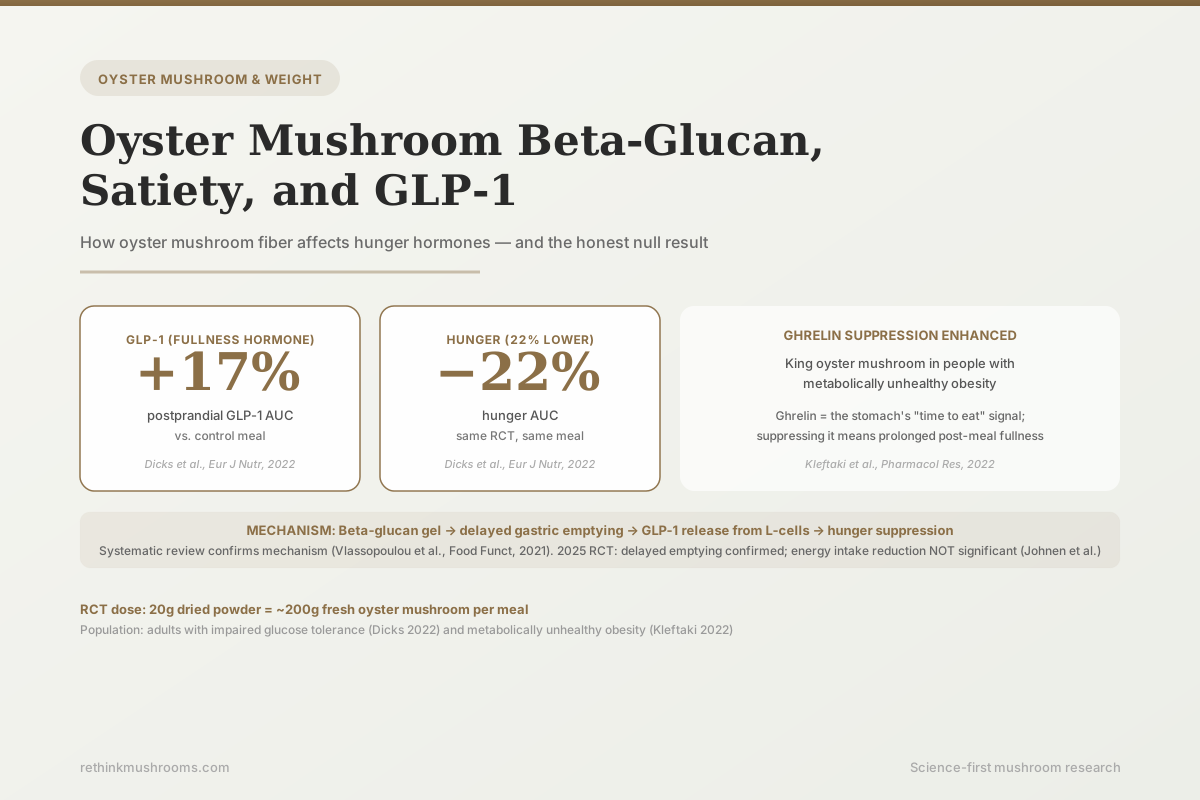
17% higher GLP-1
Adding 20g of oyster mushroom powder to a meal raised postprandial GLP-1 by 17% and reduced hunger by 22% versus control in adults with impaired glucose tolerance, in a double-blind RCT.
Dicks et al., Eur J Nutr, 2022
22% lower hunger
Hunger area under the curve was 22% lower after the oyster mushroom meal in the Dicks 2022 RCT
Ghrelin suppressed
King oyster mushroom enhanced ghrelin suppression in people with metabolically unhealthy obesity (Kleftaki et al., 2022)
Honest null result
A 2025 follow-up RCT found delayed gastric emptying but no significant reduction in ad libitum energy intake (Johnen et al.)
Dicks et al., Eur J Nutr, 2022
 View as image ↗
Most articles about oyster mushrooms and weight management explain them as "high fiber, low calorie." Both are true: fresh oyster mushrooms provide roughly 33 calories per 100g and around 1.5–2.5g of beta-glucan fiber. But the fiber story is more specific than that framing suggests. Beta-glucan, the soluble fiber that makes up most of the oyster mushroom's fiber content, has a documented mechanism for affecting two of the key satiety hormones: GLP-1 and ghrelin. This article covers what that mechanism is, what two RCTs found when they tested it, and why a third study adds honest context to what oyster mushroom fiber can and cannot deliver. For the broader weight management evidence, including the 1-year mushroom-for-meat RCT, see Oyster Mushroom for Weight Loss: Can It Help?. For the complete oyster mushroom overview, see our pillar guide to oyster mushrooms.
Key Takeaways
- Oyster mushroom beta-glucan forms a viscous gel in the small intestine that slows gastric emptying, triggering GLP-1 release from specialized intestinal cells and producing sustained fullness signaling to the brain
- Adding 20g oyster mushroom powder to a meal raised postprandial GLP-1 by 17%, lowered hunger by 22%, and reduced NEFA (a measure of liver fat production signal) by 14% versus a control meal in a double-blind RCT (Dicks et al., Eur J Nutr, 2022)
- Pleurotus eryngii (king oyster) consumption improved hunger suppression, fullness perception, and enhanced ghrelin suppression in people with metabolically unhealthy obesity; ghrelin is the primary hunger hormone produced by the stomach (Kleftaki et al., Pharmacol Res, 2022)
- A 2025 follow-up RCT in adults with overweight and obesity confirmed that oyster mushroom powder delays gastric emptying, but did not find a significant reduction in subsequent ad libitum energy intake (Johnen et al., J Funct Foods, 2025)
- A systematic review of 8 fungal beta-glucan RCTs confirmed the satiety, blood glucose, and cholesterol effects and identified the viscous gel-forming mechanism as the unifying explanation (Vlassopoulou et al., Food Funct, 2021)
- The dose used in the RCTs was 20g dried powder, equivalent to roughly 200g fresh oyster mushroom; a meaningful but achievable quantity per meal
What Beta-Glucan Does in the Gut: The Satiety Mechanism Chain
Oyster mushroom fiber and satiety are connected through a specific biological mechanism that begins in the small intestine, not the stomach.
Beta-glucan is a soluble fiber, meaning it dissolves in water and forms a gel rather than passing through unchanged. When beta-glucan from oyster mushrooms enters the small intestine, it absorbs water and creates a viscous layer along the intestinal wall. This gel has two direct physical effects.
First, it slows the rate at which the stomach empties its contents into the small intestine, a process called gastric emptying. Slower gastric emptying means food stays in the stomach longer, producing a sense of physical fullness from stomach distension. The longer something stays in the stomach, the longer the signal "I am still digesting" reaches the brain.
Second, the gel in the small intestine slows the absorption of glucose and fats. Nutrients have to cross the gel layer to reach the intestinal wall. This blunts the sharp post-meal blood sugar spike that follows refined carbohydrate meals.
Both of these physical effects trigger a hormonal response. The intestinal wall contains specialized cells called L-cells that release GLP-1 (glucagon-like peptide-1, a hormone that signals fullness to the brain, slows gastric emptying further, and stimulates insulin release) in response to nutrients and distension. When beta-glucan slows digestion and creates prolonged intestinal contact with nutrients, L-cell GLP-1 release is elevated and sustained.
A 2021 systematic review of randomized controlled trials on fungal beta-glucans by Vlassopoulou and colleagues confirmed this mechanism specifically.[1] Reviewing evidence from multiple RCTs, the authors identified beta-glucan's viscous gel-forming property as the mechanistic driver of satiety, blood glucose control, and cholesterol effects seen across studies. The same mechanism that slows glucose absorption also traps bile acids (digestive compounds made from cholesterol), reducing their reabsorption and thereby lowering circulating LDL.
This is the mechanistic foundation for what the oyster mushroom RCTs below found. The biology is not surprising given what beta-glucan does in the gut; the RCTs provide direct human measurement.
The Dicks 2022 RCT: GLP-1, Hunger, and Impaired Glucose Tolerance
The most specific satiety evidence for oyster mushrooms in humans comes from a 2022 double-blind randomized controlled crossover trial by Dicks and colleagues at the University of Bonn, published in the European Journal of Nutrition.[2]
The study enrolled adults with impaired glucose tolerance, a condition where blood sugar rises higher than normal after a meal but not high enough to qualify as diabetes. Participants ate a standardized test meal, either with or without 20g of oyster mushroom powder added (in crossover design, each participant received both conditions on separate days). Researchers measured satiety hormones, appetite ratings, and metabolic markers over several hours after the meal.
The results for the oyster mushroom powder condition versus control:
GLP-1: The area under the postprandial GLP-1 curve (a measure of total hormone level over time, not just a single reading) was 17% higher in the mushroom powder condition. GLP-1 is the same hormone pathway targeted by semaglutide (Ozempic, Wegovy). It signals fullness to the brain, slows gastric emptying, and reduces appetite. A 17% elevation from a dietary addition is a meaningful food-based effect, even though it is far smaller than the pharmacological doses achieved by GLP-1 receptor agonist drugs.
Hunger: Hunger ratings on a standardized scale were 22% lower in the area under the curve after the mushroom powder meal. Participants consistently rated themselves less hungry over the postprandial measurement period.
NEFA: Non-esterified free fatty acids in the blood (a signal for elevated liver fat production that drives LDL synthesis) were 14% lower in the oyster mushroom condition. This metabolic effect is separate from satiety but relevant to the cardiometabolic picture.
The study population matters here: participants with impaired glucose tolerance are metabolically challenged. Their baseline glucose and hormone responses are dysregulated, which makes them a relevant but not entirely generalizable population. Whether the same satiety hormone effects occur in healthy adults or in people with normal glucose tolerance is a separate question.
Ghrelin Suppression: The Second Satiety Hormone Affected
GLP-1 signals fullness. Ghrelin signals hunger. They operate at opposite ends of the appetite regulation system, and oyster mushrooms appear to affect both.
Ghrelin is produced primarily by the stomach and rises sharply before meals, signaling to the brain that it is time to eat. After eating, ghrelin levels should fall. In people with obesity, ghrelin suppression after meals is often blunted, meaning they receive a weaker "done eating" signal.
Kleftaki and colleagues published a 2022 RCT in Pharmacological Research testing king oyster mushroom (Pleurotus eryngii) in people with metabolically unhealthy obesity.[3] The study found that oyster mushroom consumption improved postprandial blood sugar, improved hunger suppression, improved fullness perception, and enhanced ghrelin suppression compared to the control condition.
The ghrelin suppression finding is more clinically specific than the general "reduces hunger" result. Suppressing ghrelin means the mushroom is affecting the hormonal signal that drives hunger, not just occupying stomach space. For people with obesity who have blunted post-meal ghrelin suppression, restoring that suppression is meaningful for appetite regulation.
The population again matters: this was metabolically unhealthy obese patients. The effect size in this population may not translate directly to lean adults or people with normal ghrelin function.
For a deeper look at how these two satiety hormones work together and how oyster mushrooms compare to pharmacological GLP-1 stimulation, see our companion article on oyster mushroom and satiety hormones.
The Honest Nuance: Delayed Gastric Emptying Does Not Always Mean Eating Less
In 2025, the same Bonn research group published a follow-up RCT testing oyster mushroom powder in a different population: adults with overweight and obesity (Johnen et al., Journal of Functional Foods, 2025). The study enrolled 36 participants who ate a standardized breakfast with or without 20g oyster mushroom powder, then had access to an ad libitum lunch where they could eat as much or as little as they wanted.
The results were mixed in an important way. The oyster mushroom powder did delay gastric emptying, confirming the mechanistic hypothesis. But participants did not eat significantly less at the subsequent ad libitum lunch compared to the control condition. The satiety hormone effects on GLP-1 and ghrelin, or the subjective hunger ratings, did not produce measurable differences in how much food participants consumed when given a free-choice meal.
This is a genuinely important nuance. Physiological satiety signals do not always override behavioral decisions about food intake, particularly in a controlled laboratory buffet setting. Delayed gastric emptying and elevated GLP-1 are real effects. Whether those effects translate to eating meaningfully less food in practice depends on the broader eating context.
The Dicks 2022 and Johnen 2025 studies together tell a coherent story: oyster mushroom beta-glucan reliably affects the biology of hunger and fullness, including hormones and gastric transit time. What is less certain is whether these physiological changes consistently translate to reduced energy intake in a real-world ad libitum eating context.
This is the honest picture that competitor articles, which report only the positive satiety hormone findings, are missing.
How Oyster Mushroom Fiber Compares to Other High-Fiber Foods
Oyster mushrooms are not the only food that affects GLP-1 and gastric emptying through soluble fiber. Oats, barley, and psyllium also contain beta-glucan and have similar mechanistic effects. The Vlassopoulou systematic review examined fungal beta-glucans specifically, finding effects consistent with the broader beta-glucan literature across food sources.
What makes oyster mushroom beta-glucan distinctive from, say, oat beta-glucan:
The structure of the beta-glucan polymer differs between fungi and cereal grains. Mushroom beta-glucan is predominantly a beta-1,3 structure with 1,6-branched side chains, while oat beta-glucan is primarily beta-1,3/1,4. Both form viscous gels, but the branched fungal structure may interact differently with intestinal receptors, including Dectin-1, which is involved in immune signaling in addition to fiber fermentation.
Oyster mushrooms also deliver their fiber alongside protein, polyphenols (including chrysin), ergothioneine, and other bioactive compounds that oat fiber products do not contain. The satiety and metabolic effects may therefore involve multiple mechanisms working together, not just the viscous fiber effect alone.
The fiber content of oyster mushrooms varies: fresh oyster mushrooms contain roughly 1.5–2.5g of beta-glucan per 100g, varying with species, growing conditions, and maturity. The 20g dried powder used in the RCTs is a concentrated form equivalent to roughly 200g of fresh mushroom, which is a substantial serving but achievable as a meal component.
For a complete breakdown of the nutrient compounds in oyster mushrooms, including all fiber fractions, see Oyster Mushroom Nutritional Profile: Complete Breakdown. For a species comparison looking at how maitake's weight management evidence differs mechanistically from oyster mushroom, see Maitake for Weight Loss.
What This Means in Practice
The cluster articles in this series cover the full weight management picture. For how mushrooms substitute for meat in a 1-year RCT, see Oyster Mushroom as a Meat Replacement. For the full metabolic syndrome evidence including blood glucose and cholesterol effects, see Oyster Mushroom and Metabolic Syndrome. For cholesterol specifically and the lovastatin mechanism, see Oyster Mushrooms and Cholesterol: The Natural Statin Connection.
On satiety specifically, the current evidence supports these practical conclusions:
Adding substantial amounts of oyster mushroom to meals, in the range of 150-200g fresh or 15-20g dried powder, produces measurable effects on satiety hormones including GLP-1 elevation and ghrelin suppression in clinical study conditions. These effects are genuine and biologically meaningful.
Whether those hormonal changes translate to eating meaningfully less food over time is less established. The Johnen 2025 null result on ad libitum intake is a real limitation. Foods affect behavior in complex ways that laboratory hormone measurements do not fully predict.
The beta-glucan mechanism is well-established. The question is whether dietary doses produce effects that are large enough to influence meal-to-meal eating decisions in the real world, without the pharmacological amplification that GLP-1 drug therapies provide.
The Bottom Line
Two 2022 RCTs document specific satiety hormone effects of oyster mushroom consumption: GLP-1 elevated by 17%, hunger reduced by 22% (Dicks et al.), and ghrelin suppression enhanced in metabolically unhealthy obese patients (Kleftaki et al.). Both findings are in specific populations. A 2025 follow-up RCT confirmed oyster mushroom powder delays gastric emptying but did not show reduced ad libitum energy intake in overweight and obese adults, adding important context. The beta-glucan gel-forming mechanism is established; translation to consistent real-world energy intake reduction remains to be confirmed.
Frequently Asked Questions
Sources & References
- 1. Source details for this reference are not yet available.
- 2. Source details for this reference are not yet available.
- 3. Source details for this reference are not yet available.