Oyster Mushroom Weight Management
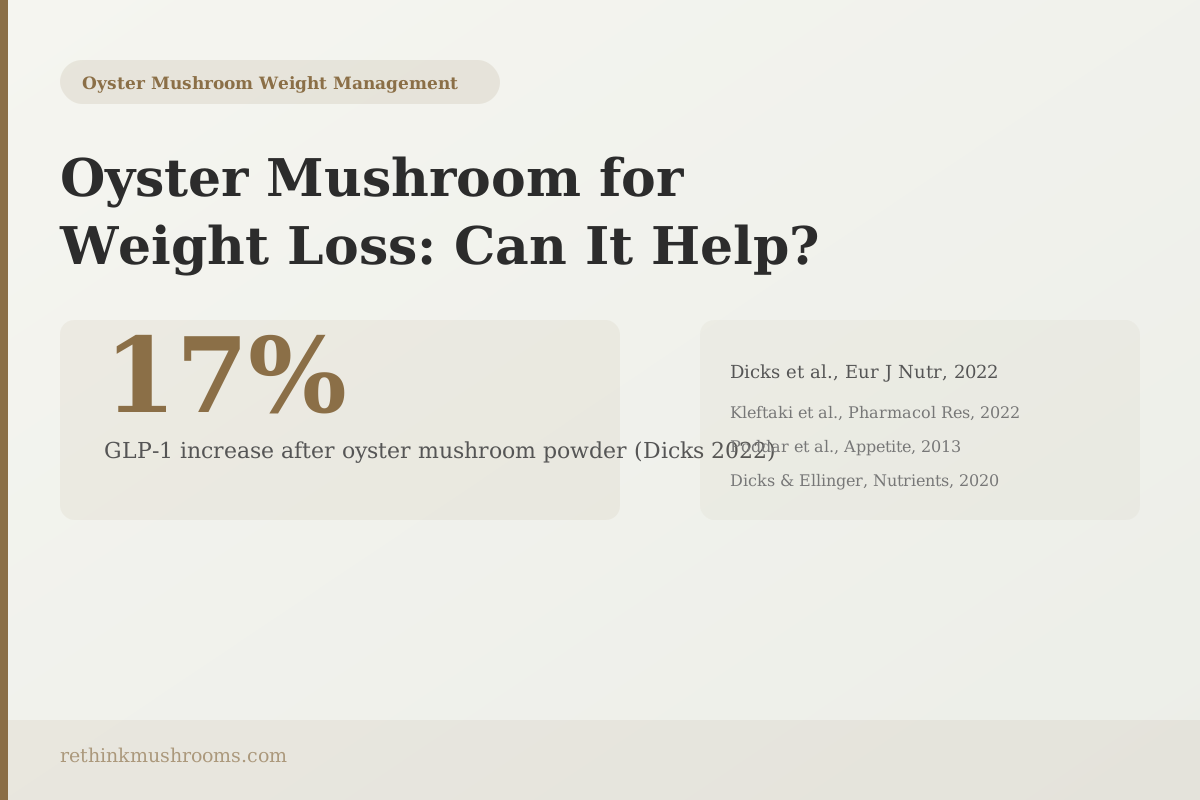
17% GLP-1 increase
A double-blind randomized crossover trial in 22 adults with impaired glucose tolerance found that fortifying a meal with 20g oyster mushroom powder raised GLP-1, the satiety hormone that signals fullness to the brain, by 17% over control and cut hunger ratings by 22%. Ghrelin, blood sugar and insulin did not budge.
Dicks et al., European Journal of Nutrition, 2022
Ghrelin lower
the hunger hormone fell after a P. eryngii meal in 19 adults with metabolically unhealthy obesity — though GLP-1 did not change in that trial (Kleftaki 2022)
Hunger -22%
hunger area under the curve was 22% lower after an oyster mushroom powder-fortified meal vs. control in the Dicks 2022 double-blind RCT (n=22)
No less eaten
when a 2025 trial measured how much 36 adults with overweight or obesity actually ate afterwards, the mushroom meal produced no reduction (Johnen 2025)
Dicks et al., European Journal of Nutrition, 2022
 View as image ↗
The framing most weight loss content uses for oyster mushrooms is: high fiber, low calorie, fills you up. That framing is not wrong, but it misses the more interesting finding from recent clinical research. Oyster mushrooms appear to affect appetite through specific hormones, the same hormones that are now the focus of the most commercially successful weight loss drugs in history.
Two randomized controlled trials published in 2022 measured this directly. One found oyster mushroom powder raising GLP-1 (a gut-released satiety hormone) by 17%.[2] The other found king oyster mushroom lowering ghrelin (the stomach's hunger signal) in people with obesity.[1] These are not general "immune boosting" findings. They are specific, measured hormonal effects from controlled trials in relevant populations.
One detail gets lost almost everywhere this research is summarized, and it matters: neither trial found both effects. In the trial where GLP-1 rose, ghrelin did not move. In the trial where ghrelin fell, GLP-1 did not move. Different mushroom species, different populations, one hormone each.
Then there is the harder result. A 2025 follow-up from the same Bonn research group measured the endpoint that actually determines whether any of this affects body weight: how much people went on to eat. It found that while oyster mushroom powder did delay gastric emptying, participants ate no less at the following meal (Johnen et al., Journal of Functional Foods 129:106907, doi:10.1016/j.jff.2025.106907).
The research is more nuanced than a yes-or-no answer. This article presents all of it, including the parts that cut against the headline.
Three Human Trials, Side By Side
No Single Trial Showed Both Hormones Moving
Each acute meal trial moved one appetite hormone and found no change in the other. The one trial that measured how much people actually ate afterwards found no reduction.
“No change” means the trial measured the endpoint and found no statistically significant difference from the control meal. “Not measured” means the trial did not report it — absence of a result, not evidence of no effect.
For the oyster mushroom overview, see the oyster mushroom guide. For the nutrient context behind the weight data, the oyster mushroom nutritional profile covers the calorie and fiber composition in detail.
Key Takeaways
- Dicks et al. (2022, European Journal of Nutrition) found that 20g oyster mushroom powder added to a meal produced GLP-1 AUC 17% higher (P=0.001), hunger AUC 22% lower (P=0.031), and non-esterified free fatty acids 14% lower (P=0.026) in 22 adults with impaired glucose tolerance — but glucose (the primary outcome), insulin, triglycerides and ghrelin did not differ from control
- Kleftaki et al. (2022, Pharmacological Research) found that P. eryngii (king oyster mushroom) lowered ghrelin (p=0.033), reduced hunger and improved postprandial blood sugar in 19 adults with metabolically unhealthy obesity — but GLP-1, insulin and PYY did not change in that trial
- No single trial has shown GLP-1 rising and ghrelin falling together; each 2022 trial moved one hormone and found no effect on the other, in different Pleurotus species
- A 2025 follow-up RCT (Johnen et al., Journal of Functional Foods, n=36) confirmed oyster mushroom powder delays gastric emptying but found no reduction in subsequent ad libitum energy intake — the physiological effect did not translate into eating less
- The Dicks & Ellinger 2020 systematic review (Nutrients) of eight clinical trials found P. ostreatus improved glucose and lipids but that body weight did not change, with risk of bias high or unclear in most trials
- Poddar et al. (2013, Appetite) conducted a 1-year RCT in which 73 obese adults substituting about a cup of white button mushrooms daily for red meat lost more weight (−7.03 lbs, 3.6%) with better body composition — a whole-diet substitution, and not oyster mushrooms
- Klümpen et al. (2025, Molecular Nutrition & Food Research) found the GLP-1 response to the mushroom-fortified meal depended on each person's baseline gut microbiota, which may explain why group averages hide large individual differences
The Two Hunger Hormones Oyster Mushroom Affects
To understand why the 2022 RCT findings are more specific than typical food-and-satiety claims, it helps to understand the two hormones involved.
GLP-1, short for glucagon-like peptide-1, is a hormone released by specialized cells in the small intestine when food passes through. GLP-1 signals fullness to the brain, slows gastric emptying (the rate at which food leaves the stomach), and reduces postprandial blood sugar spikes by stimulating insulin release. It is the hormone that the drug semaglutide (marketed as Ozempic and Wegovy) mimics at pharmacological doses. The two are related but not equivalent: semaglutide binds and activates the GLP-1 receptor directly and continuously, whereas food can only prompt the gut to secrete more of its own GLP-1 for a few hours after a meal. Same receptor at the end of the chain, very different magnitude and duration.
Ghrelin is nearly the opposite. Produced primarily by the stomach, ghrelin rises before meals and signals hunger. It also rises when caloric intake drops, which is one reason chronic dieting creates persistent hunger: ghrelin levels increase as the body tries to restore its energy intake. Suppressing ghrelin is a genuinely different mechanism from elevating GLP-1 — and, importantly, no oyster mushroom trial has yet demonstrated both in the same participants.
The beta-glucan fiber in oyster mushrooms is the likely mechanism for the GLP-1 effect. Beta-glucan forms a gel in the gut when it contacts water, and this gel slows the rate at which nutrients pass through the small intestine. As nutrients pass more slowly, they stimulate the intestinal cells that release GLP-1 for a longer period. The Kleftaki investigators attribute their own findings to this route, proposing that the bioactive polysaccharides delay gastric emptying and slow glucose absorption.[1] The delayed gastric emptying step was later measured directly and confirmed (Johnen 2025). The ghrelin mechanism is less precisely established; gastric distension from the gel is a plausible route, but it has not been demonstrated as the operative pathway in any oyster mushroom trial.
The 2022 RCT: GLP-1 Higher, Hunger Lower
Dicks et al.'s 2022 study in the European Journal of Nutrition was a double-blind, randomized controlled crossover trial in 22 participants (registration DRKS00015244).[2] Participants were adults with impaired glucose tolerance, a metabolic condition in which blood sugar rises higher than normal after meals but has not yet reached the threshold for type 2 diabetes. This population is clinically relevant because impaired glucose tolerance is a primary risk factor for type 2 diabetes and often accompanies excess body weight.
Twenty grams of oven-dried Pleurotus ostreatus powder — supplying 8.1 grams of beta-glucans — was added to a standardized test meal, and blood samples were taken over the following four hours. The meal with mushroom powder produced GLP-1 levels 17% higher over the measurement period than the same meal without it (P=0.001). Hunger ratings were 22% lower (P=0.031). Non-esterified free fatty acids (NEFAs), a marker of fat mobilization, were 14% lower (P=0.026).
What did not move is just as informative. Glucose area under the curve — the trial's primary outcome, the result the study was designed and powered to detect — showed no difference. Neither did insulin, triglycerides, GIP, or ghrelin. The trial's headline hormone finding was, strictly speaking, a secondary outcome in a study whose main hypothesis was not confirmed.
The Human Meal Trial
The Hormone Moved. The Blood Sugar Did Not.
22 adults with impaired glucose tolerance ate a meal fortified with 20 g of dried oyster mushroom powder (8.1 g beta-glucans) or the same meal unfortified, in a double-blind randomized crossover design with four hours of blood sampling. Glucose was the primary outcome.
What changed
- +17%GLP-1 (AUC)
The satiety and insulin-release hormone the mechanism predicted (P = 0.001)
- −14%Non-esterified fatty acids (AUC)
Lower circulating free fatty acids after the meal (P = 0.026)
- −22%Hunger (AUC)
Self-reported on visual analog scales (P = 0.031)
What did not change
- —Glucose (AUC)
The primary outcome — no difference vs control meal
- —Insulin (AUC)
No difference
- —Triglycerides (AUC)
No difference
- —GIP (AUC)
The other main incretin hormone — no difference
- —Ghrelin (AUC)
No difference
Why this matters: the trial engaged the proposed mechanism and still did not produce the outcome that mechanism is invoked to explain. A confirmed hormonal response is not the same as a blood sugar benefit, and this is the clearest illustration of that gap in the oyster mushroom literature.
Source: Dicks et al. (2022), European Journal of Nutrition [ref 6]. Double-blind randomized controlled crossover trial, n = 22, trial registration DRKS00015244. All figures are area-under-curve comparisons of the enriched versus control meal as reported by the authors.
A 17% increase in GLP-1 from a dietary addition is a specific, measured effect, not a general wellness claim. It does not produce the dramatic appetite suppression of pharmaceutical GLP-1 agonists, whose effects are orders of magnitude larger. But it documents that the food-based GLP-1 stimulus from oyster mushroom is real and measurable under controlled conditions.
Dicks et al. (2022) · European Journal of Nutrition
- Population
- 22 adults with impaired glucose tolerance (double-blind, randomized, crossover)
- Intervention
- Single meal fortified with 20g oven-dried P. ostreatus powder (8.1g beta-glucans)
- Comparator
- Identical unfortified meal
- Finding
- GLP-1 AUC +17% (P=0.001), hunger AUC −22% (P=0.031), NEFA AUC −14% (P=0.026). Glucose (primary outcome), insulin, triglycerides, GIP and ghrelin were unchanged.
mixed Well-designed and genuinely double-blind, but small (n=22), acute (a single meal), and null on its own primary endpoint. The GLP-1 result is real; it is not the result the trial set out to find.
Dicks et al. (2022), European Journal of Nutrition 61:687-701
For the full mechanistic explanation of the beta-glucan fiber pathway, the oyster mushroom fiber and satiety article covers how beta-glucan produces these hormonal effects and what fiber content to expect per serving.
Ghrelin Suppression in People With Obesity
Kleftaki et al.'s 2022 study in Pharmacological Research tested king oyster mushroom (P. eryngii) in 19 people with metabolically unhealthy obesity, defined as obesity plus at least one metabolic abnormality such as elevated blood sugar, high triglycerides, or hypertension.[1] It was an acute randomized crossover trial comparing a P. eryngii meal against a control meal matched for calories and macronutrients, with blood drawn at seven time points over three hours.
This is a more clinically severe population than the impaired glucose tolerance group in the Dicks study. After P. eryngii consumption, participants showed lower ghrelin over time (p=0.033), lower hunger (p=0.046), higher fullness (p=0.042), and a lower glucose response. Notably, insulin, PYY, glicentin — and GLP-1 — showed no difference from the control meal.
Ghrelin suppression in obese patients is particularly meaningful because obesity is associated with disrupted ghrelin signaling. People with obesity often experience less effective postprandial ghrelin suppression than people of healthy weight, which means their hunger signals do not diminish normally after eating. A food that produces measurable ghrelin suppression in this population is addressing one of the actual biological mechanisms that makes weight management difficult.
Here is where careful reading matters. It is tempting to add these two trials together and describe a "dual action" on the appetite axis — GLP-1 up and ghrelin down. The data do not support that summary. Dicks measured ghrelin and found no change. Kleftaki measured GLP-1 and found no change. The two results come from different mushroom species (P. ostreatus vs P. eryngii), different populations, and different laboratories. What we can say is that each of two species moved one appetite-relevant hormone in one small acute trial. What we cannot say is that oyster mushroom does both at once in the same person.
Fact Check
Is oyster mushroom a natural GLP-1 drug?
The claim
“Oyster mushroom works like a natural Ozempic — it raises GLP-1 and suppresses ghrelin, hitting appetite from both directions at once.”
Two separate 2022 trials, each reporting one hormone effect, get summarized together as though a single study found both.
What research shows
OverstatedOne trial found GLP-1 17% higher and explicitly reported ghrelin unchanged. A different trial, in a different species, found ghrelin lower and explicitly reported GLP-1 unchanged. Neither trial found both.
The GLP-1 effect is real but small. Semaglutide produces receptor activation orders of magnitude greater than a meal-sized fibre stimulus, and it is sustained rather than lasting a few postprandial hours. Sharing a mechanism is not the same as sharing an effect size.
Dicks et al. (2022), European Journal of Nutrition; Kleftaki et al. (2022), Pharmacological Research
For a deeper focus on these two hormonal mechanisms, the oyster mushroom and satiety hormones article covers both studies in detail.
The 1-Year Weight Loss Study
All of the hormone data above is measured over a few hours after a single meal. The longer-term weight question is addressed by Poddar et al.'s 2013 randomized clinical trial in the journal Appetite, which ran for a full year in 73 obese adults (64 women, 9 men).[3]
Participants in the mushroom arm (n=36) substituted approximately one cup of mushrooms per day in place of red meat, within a standardized weight-loss and maintenance program. The control group followed the same program while continuing to eat red meat. At 12 months, the mushroom group had lost more weight (−7.03 lbs, about 3.6% of body weight), with greater reductions in BMI, waist circumference, and percent body fat, plus lower blood pressure and improved lipid and inflammatory markers. Those who completed the full year still weighed an average of about 7 lbs less than at baseline.
Two caveats matter, and they are large ones. First, this study used white button mushrooms (Agaricus bisporus), not oyster mushrooms. Second, and more fundamentally, the intervention was not "add mushrooms" — it was "replace red meat with a lower-calorie food, every day, for a year, inside a structured weight-loss program." The result is strong evidence that a whole-diet substitution works. It is not evidence that oyster mushroom itself causes weight loss.
That said, oyster mushrooms are plausible substitutes on the dimensions that made the swap work: high water and fibre content, low calorie density relative to meat, and enough umami and texture to make the replacement palatable over months.
For readers considering oyster mushrooms specifically as a meat substitute, the oyster mushroom as a meat replacement article covers the nutritional comparison and practical substitution approaches.
An Honest Null Result: Gastric Emptying Without Less Eating
The 2025 follow-up by Johnen et al. in the Journal of Functional Foods (129:106907) was designed as a companion to the Dicks 2022 study — same Bonn research group, a higher-weight population of 36 adults with overweight or obesity, and a different endpoint: how much people actually ate at a subsequent meal (registration DRKS00031958).
The study confirmed that 20g oyster mushroom powder delayed gastric emptying, the same mechanical effect thought to drive GLP-1 stimulation. But when participants were then given access to food ad libitum — as much as they chose — the mushroom powder group did not eat significantly less than the control group. The physiological effect and the eating behaviour did not line up.
Johnen et al. (2025) · Journal of Functional Foods
- Population
- 36 adults with overweight or obesity (double-blind, randomized, crossover)
- Intervention
- Meal fortified with 20g P. ostreatus powder, then an ad libitum test meal
- Comparator
- Identical unfortified meal
- Finding
- Gastric emptying was delayed, confirming the mechanical effect. No reduction in subsequent ad libitum energy intake was detected.
null The most decision-relevant trial in this literature, and it is a null result on the endpoint closest to body weight. Published null findings on a popular food are rare and worth weighting accordingly.
Johnen et al. (2025), Journal of Functional Foods 129:106907, doi:10.1016/j.jff.2025.106907
This finding matters for honest reporting. Gastric emptying, GLP-1, and hunger ratings are physiological measurements. How much someone eats is a behavioural outcome shaped by habit, palatability, social context, portion norms, and individual variation. The Johnen result does not invalidate the hormone findings — it shows those hormonal shifts do not automatically translate into eating less, at least not within a single controlled test-meal setting.
There is a plausible reason the effect may be more variable than group averages suggest. Klümpen et al.'s 2025 analysis in Molecular Nutrition & Food Research revisited the original Dicks trial and asked whether participants' gut bacteria explained who responded.[7] It did: only participants with lower microbial evenness showed a greater GLP-1 response to the mushroom meal (p=0.012), and the presence of specific fibre-fermenting bacterial groups was associated with higher GLP-1. In other words, the beta-glucan stimulus appears to depend on having a microbiome equipped to ferment it. An average across 22 people can conceal a real effect in some and none in others — and it means the honest answer to "will this work for me" is currently unknown.
Du et al.'s 2024 study in Food Research International adds a mechanism that may matter more over longer periods: whole king oyster mushroom in a mouse model of diet-induced obesity attenuated weight gain by improving lipid metabolism and restoring gut microbiota balance.[4] This is a rodent study, and mouse obesity models translate to humans inconsistently. But the microbiome connection points to mechanisms operating over days to weeks rather than hours — the timescale a 4-hour postprandial study cannot see, and the one where the year-long substitution trial found its benefit.
What the Systematic Review Says About Evidence Quality
Dicks and Ellinger's 2020 systematic review in Nutrients examined the clinical trials on oyster mushroom and cardiometabolic outcomes and arrived at an honest conclusion.[5] Across the eight trials it included, P. ostreatus intake improved glucose metabolism (lower fasting and 2-hour postprandial glucose) and lipids (lower total cholesterol, LDL and/or triglycerides), and some trials found reduced blood pressure. In most of those trials, risk of bias was high or unclear because of methodological weaknesses or inadequate reporting.
For a weight-loss article, one sentence in that review deserves more attention than any other: body weight did not change. The review also notes that appetite sensations were not assessed in any of the included trials. The strongest synthesis of oyster mushroom clinical data available found real cardiometabolic benefits and no effect on the scale.
Khatun et al.'s 2007 clinical study in diabetic subjects is one of the trials that fed into this picture: over a 24-day protocol alternating mushroom and no-mushroom weeks, the 30 participants who completed it showed significantly lower fasting and 2-hour glucose (p<0.001), lower total cholesterol and triglycerides, and lower blood pressure.[6] It is small and unblinded, but it is genuine early human evidence of metabolic effects in a high-risk population. (This trial is frequently miscited as "Bakr 2007"; the first author is Khatun.)
Where The Chain Holds And Where It Breaks
Six Links Between Eating A Mushroom And Losing Weight
A weight-loss claim needs every link to hold. Human data supports the first four. The fifth was measured and did not hold. The sixth has not been shown for oyster mushroom on its own.
- Beta-glucan forms a gel in the gutSupported in humans
20 g of powder delivers about 8.1 g of beta-glucans — a viscous, gel-forming soluble fibre (Dicks 2022).
- The stomach empties more slowlySupported in humans
Directly measured and confirmed in 36 adults with overweight or obesity (Johnen 2025).
- Appetite hormones shiftPartly supported
GLP-1 rose 17% with P. ostreatus but ghrelin did not move (Dicks 2022). Ghrelin fell with P. eryngii but GLP-1 did not move (Kleftaki 2022). No trial moved both.
- People report feeling less hungrySupported in humans
Hunger AUC 22% lower (Dicks 2022); hunger lower and fullness higher (Kleftaki 2022).
- People actually eat less at the next mealTested — did not hold
Measured directly: no reduction in ad libitum energy intake despite the delayed gastric emptying (Johnen 2025).
- Body weight fallsNot shown for oyster mushroom
A systematic review of 8 P. ostreatus trials found body weight did not change (Dicks & Ellinger 2020). The one 1-year trial showing weight loss substituted white button mushrooms for red meat across the whole diet (Poddar 2013).
The overall picture is a chain that holds for four links and then stops. Beta-glucan gel forms, gastric emptying slows, one appetite hormone shifts per trial, and people report less hunger. Then the chain breaks: when measured directly, people did not eat less, and the pooled clinical evidence shows no change in body weight. The one trial that did produce weight loss did so through a year of daily red-meat substitution with a different mushroom species.
None of this justifies overclaiming, and much of the content circulating about oyster mushrooms and weight loss does exactly that. It also does not justify dismissal: the mechanism is real, the hormone effects are measured rather than asserted, and the microbiome data suggests the average may be hiding genuine responders. What is missing is a trial that gives people oyster mushrooms for months and weighs them at the end. Until that exists, the honest answer to the title question is: it may help a little, most plausibly by displacing more calorie-dense foods, and it has not been shown to move the scale on its own.
Research Gaps
What would it take?
What would it take to show that oyster mushroom actually causes weight loss?
A trial lasting months, not hours
Every human oyster mushroom appetite trial to date is acute — a single meal with 3-4 hours of follow-up. Body weight cannot be assessed on that timescale.
Body weight as a pre-registered primary outcome
No trial has set out to test oyster mushroom against body weight as its main question. The 2020 systematic review reported that body weight did not change across the clinical trials it examined.
A sample large enough to detect a few kilograms
Existing trials enrolled 19-36 participants. Detecting a realistic dietary effect on weight requires hundreds.
Total daily energy intake, not one test meal
Johnen 2025 measured ad libitum intake at a single subsequent meal and found no reduction. Whether any displacement effect holds across a full day or week is unmeasured.
Stratification by baseline gut microbiota
Klümpen 2025 showed the GLP-1 response depends on baseline microbial composition, so trials that ignore it may average real responders away to zero.
Replication outside one research group
Most human oyster mushroom appetite data comes from the same Bonn group. Kleftaki 2022 is independent, but used a different species.
Dicks & Ellinger (2020), Nutrients; Johnen et al. (2025), Journal of Functional Foods; Klümpen et al. (2025), Molecular Nutrition & Food Research
Safety
ModerateOyster mushroom is not a substitute for obesity or diabetes treatment
Concern
Because oyster mushroom is discussed alongside GLP-1 drugs, some readers may treat it as a natural alternative to prescribed weight-loss or glucose-lowering medication. The measured effects are small, acute, and have not produced weight change in clinical trials.
What the research says
Treat oyster mushroom as a food that fits well into a weight-management diet, not as a therapy. If you are taking a GLP-1 agonist, insulin, or another glucose-lowering medication, do not alter it based on dietary changes without your prescriber's input — the 2022 trials show shifts in postprandial glucose handling, which is relevant if your medication is titrated to your meals.
Particularly relevant for: Adults taking glucose-lowering or weight-loss medication; anyone with a diagnosed metabolic condition
What to do
Talk to your physician or a registered dietitian before using any food to replace or adjust prescribed treatment.
Dicks et al. (2022), European Journal of Nutrition; Kleftaki et al. (2022), Pharmacological Research
This article is educational and is not medical advice.
The cholesterol and lipid-lowering data, which connects to the cardiovascular risk downstream of obesity, is covered in the oyster mushrooms and cholesterol article, and weight management approaches across mushroom species are compared in the maitake for weight loss article.
The Bottom Line
Two 2022 human trials show oyster mushrooms produce specific appetite-hormone effects, but not the same ones: GLP-1 rose 17% and hunger fell 22% in 22 adults with impaired glucose tolerance while ghrelin stayed flat (Dicks 2022), and ghrelin fell in 19 adults with metabolically unhealthy obesity while GLP-1 stayed flat (Kleftaki 2022). No trial has shown both effects together. A 2025 follow-up in 36 adults confirmed delayed gastric emptying but found no reduction in how much people then ate (Johnen 2025), and a 2025 reanalysis found the GLP-1 response depends on baseline gut microbiota (Klümpen 2025). The 2020 systematic review of eight clinical trials found improved glucose and lipids but no change in body weight. The one trial showing weight loss ran for a year and substituted white button mushrooms for red meat daily (Poddar 2013). Oyster mushroom is a reasonable food for a weight-management diet; it has not been shown to cause weight loss on its own.
Frequently Asked Questions
Sources & References
- 1RTHM-01551·Kleftaki, Stamatia-Angeliki et al. (2022). “Pleurotus eryngii improves postprandial glycaemia, hunger and fullness perception, and enhances ghrelin suppression in people with metabolically unhealthy obesity..” Pharmacological research.Study breakdown →PubMed →↩
- 2RTHM-00753·Dicks, Lisa et al. (2022). “Fortifying a meal with oyster mushroom powder beneficially affects postprandial glucagon-like peptide-1, non-esterified free fatty acids and hunger sensation in adults with impaired glucose tolerance: a double-blind randomized controlled crossover trial..” European journal of nutrition.Study breakdown →PubMed →↩
- 3RTHM-00550·Poddar, Kavita H et al. (2013). “Positive effect of mushrooms substituted for meat on body weight, body composition, and health parameters. A 1-year randomized clinical trial..” Appetite.Study breakdown →PubMed →↩
- 4RTHM-00876·Du, Hengjun et al. (2024). “Dietary intake of whole king oyster mushroom (Pleurotus eryngii) attenuated obesity via ameliorating lipid metabolism and alleviating gut microbiota dysbiosis..” Food research international (Ottawa.Study breakdown →PubMed →↩
- 5RTHM-00614·Dicks, Lisa et al. (2020). “Effect of the Intake of Oyster Mushrooms (Pleurotus ostreatus) on Cardiometabolic Parameters-A Systematic Review of Clinical Trials..” Nutrients.Study breakdown →PubMed →↩
- 6RTHM-00115·Khatun, K et al. (2007). “Oyster mushroom reduced blood glucose and cholesterol in diabetic subjects..” Mymensingh medical journal : MMJ.Study breakdown →PubMed →↩
- 7RTHM-02111·Klümpen, Linda et al. (2025). “GLP-1 Responses to a Single Meal Fortified With Oyster Mushroom Powder in Adults With Impaired Glucose Tolerance Depend on the Gut Microbiota Composition Before the Meal..” Molecular nutrition & food research.Study breakdown →PubMed →↩