Oyster Mushroom (Pleurotus ostreatus)
17% higher GLP-1
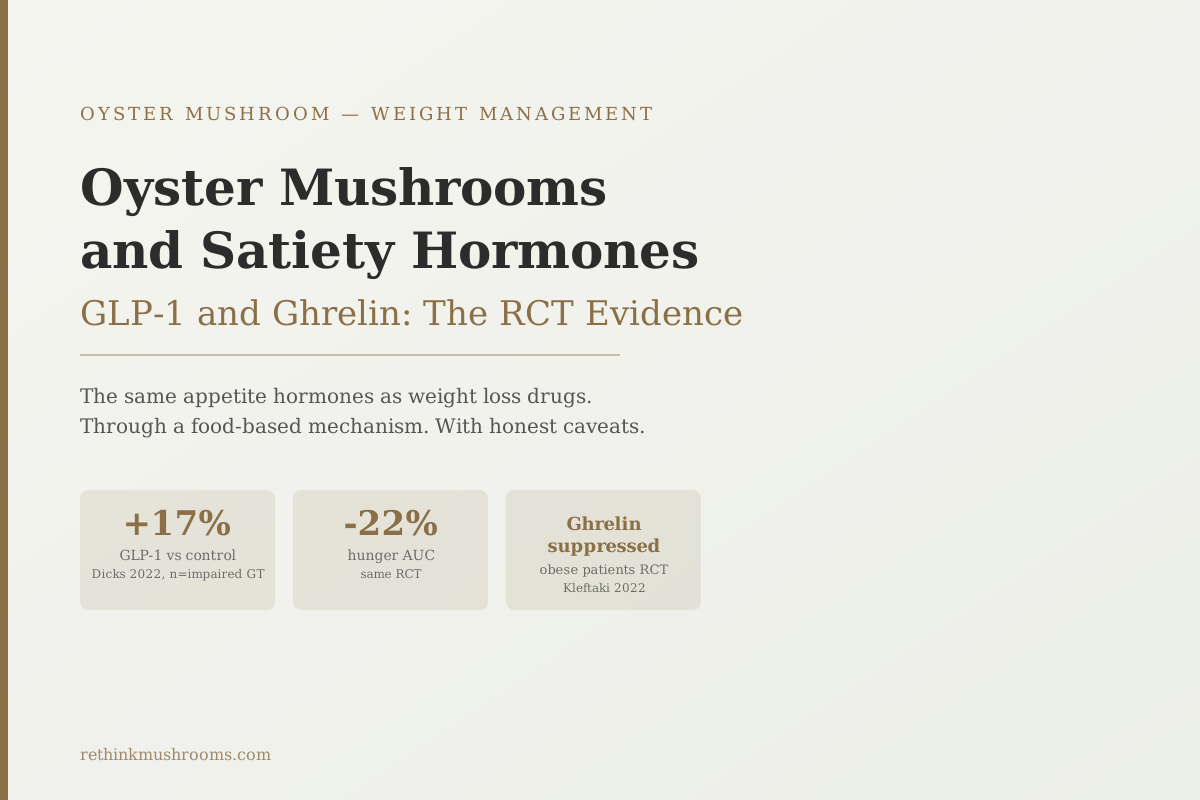
A double-blind randomized crossover trial found that a meal fortified with oyster mushroom powder produced 17% higher GLP-1 exposure and 22% lower hunger versus a control meal in adults with impaired glucose tolerance.
Dicks et al., European Journal of Nutrition, 2022
Ghrelin suppressed
postprandial ghrelin suppression enhanced in people with metabolically unhealthy obesity eating Pleurotus eryngii (Kleftaki 2022)
22% lower hunger
hunger area under the curve was 22% lower after the oyster mushroom powder meal versus control (Dicks 2022)
Both hormones
GLP-1 (signals fullness to the brain) and ghrelin (signals hunger from the stomach) are both affected — two independent satiety mechanisms
Dicks et al., European Journal of Nutrition, 2022
 View as image ↗
Glucagon-like peptide-1, known as GLP-1, has become the most discussed hormone in weight management. Semaglutide, sold as Ozempic and Wegovy, works by activating GLP-1 receptors to signal fullness to the brain, stimulate insulin release, and slow the emptying of the stomach. The drugs produce effects far larger than food does. But two human randomized controlled trials have now shown that oyster mushroom satiety hormones work through the same appetite pathways: GLP-1 elevated by 17%, hunger reduced by 22%, and ghrelin, the primary hunger hormone, significantly suppressed in people with metabolically unhealthy obesity.
This is a food-based mechanism, not a drug mechanism. The scale of effect is different. But the hormones being affected are the same, and the evidence is from blinded, controlled trials.
For an overview of oyster mushroom research across all health areas, see what is the oyster mushroom?. For the weight management picture including body composition evidence, see oyster mushroom for weight loss: can it help?.
Key Takeaways
- Dicks et al. (2022) in European Journal of Nutrition ran a double-blind randomized crossover trial: 20g oyster mushroom powder added to a meal in adults with impaired glucose tolerance produced GLP-1 area under the curve 17% higher, hunger 22% lower, and non-esterified free fatty acids 14% lower versus a control meal
- Kleftaki et al. (2022) in Pharmacological Research tested Pleurotus eryngii (king oyster) in a randomized trial of people with metabolically unhealthy obesity: postprandial ghrelin suppression was significantly enhanced, hunger perception improved, and fullness perception improved alongside reduced postprandial blood glucose
- GLP-1 and ghrelin operate through different mechanisms: GLP-1 is released from the gut after eating and signals the brain to reduce hunger; ghrelin is produced by the stomach between meals and drives hunger. Both being affected simultaneously by the same food is unusual and mechanistically notable
- Vlassopoulou et al. (2021) in Food Function, a systematic review of fungal beta-glucan RCTs, identified the mechanism: beta-glucan forms a viscous gel in the gut that slows gastric emptying, which triggers GLP-1 release from specialized gut cells
- A 2025 follow-up RCT by Johnen and colleagues (n=36, Journal of Functional Foods) confirmed delayed gastric emptying after oyster mushroom powder but found no significant reduction in ad libitum energy intake under controlled conditions — the hormonal effects don't always translate to eating meaningfully less
- The doses used in the RCTs (20g dried powder, approximately 200g fresh mushroom) are achievable as a daily dietary addition
What GLP-1 and Ghrelin Do — and Why They Matter for Weight
Before looking at what oyster mushrooms do to these hormones, it's worth being clear about what the hormones do on their own.
GLP-1 (glucagon-like peptide-1). GLP-1 is secreted by specialized cells called L-cells in the lining of the small intestine and colon. It's released in response to nutrients arriving in the gut after a meal. GLP-1's job is to signal "food has arrived" to several systems simultaneously: it tells the brain to reduce hunger, stimulates the pancreas to release insulin, and slows the rate at which the stomach empties its contents into the intestine. The result is a prolonged sense of fullness after eating.
GLP-1 levels rise naturally after meals and fall between them. In people with type 2 diabetes or obesity, the GLP-1 response is often blunted — the hormone is released in smaller amounts, the brain receives a weaker fullness signal, and hunger returns sooner after eating than it should.
Ghrelin. Ghrelin is produced primarily by the stomach lining and is the body's main hunger hormone. Ghrelin levels rise before meals, signaling the hypothalamus in the brain to stimulate appetite. After eating, ghrelin levels drop as the stomach stretches and nutrients arrive in the intestine. In people who have recently lost weight through dieting, ghrelin levels often remain elevated — the body's metabolic defense mechanism against weight loss.
These two hormones represent different points in the appetite cycle: GLP-1 signals fullness after eating; ghrelin signals hunger between meals. A food that affects both simultaneously is operating on two separate nodes of the appetite regulation system.
GLP-1 Elevated 17%: The 2022 Dicks Trial
Dicks and colleagues at the University of Bonn ran a double-blind randomized crossover trial testing oyster mushroom powder added to a standardized meal in adults with impaired glucose tolerance, a metabolic state associated with reduced GLP-1 response.[1]
The test condition: a standard meal fortified with 20g dried oyster mushroom powder. The control: the same meal without the powder. Participants consumed both conditions in randomized order with a washout period between, and blood was drawn at intervals after the meal.
The results:
GLP-1: The area under the curve (AUC), which captures the total GLP-1 response over the measurement period, was 17% higher in the oyster mushroom condition than the control condition. The L-cells lining the gut released more GLP-1 in response to the meal when oyster mushroom was present.
Hunger: On subjective hunger ratings taken at intervals after the meal, hunger AUC was 22% lower in the oyster mushroom condition. Less hunger over the postprandial period — consistent with the higher GLP-1 reading.
Non-esterified free fatty acids (NEFA): NEFA AUC was 14% lower with oyster mushroom. Non-esterified free fatty acids are fatty acids circulating in the blood; elevated NEFA is associated with insulin resistance and metabolic dysfunction. Reducing them postprandially has metabolic benefits beyond appetite.
The effect appeared in a population with impaired glucose tolerance — people whose metabolic response to food was already compromised. The fact that oyster mushroom improved GLP-1 response in this population is clinically relevant because impaired GLP-1 response is part of the pathology of metabolic dysfunction.
Ghrelin Suppressed: The Kleftaki 2022 Trial in Obese Patients
While the Dicks study focused on GLP-1, a contemporaneous randomized trial published in Pharmacological Research examined a different satiety endpoint in a different population.
Kleftaki and colleagues tested Pleurotus eryngii (king oyster mushroom) in people with metabolically unhealthy obesity, a subset of obese patients who have additional metabolic abnormalities like elevated blood glucose, insulin resistance, or dyslipidemia.[2]
The findings covered four separate outcomes:
Postprandial glycaemia (blood glucose after eating) improved significantly. Oyster mushroom consumption was associated with lower peak blood glucose and faster glucose clearance.
Hunger perception improved: participants reported feeling less hungry in the postprandial period.
Fullness perception improved: participants reported feeling fuller after the oyster mushroom meals.
Ghrelin suppression was enhanced: the drop in ghrelin that normally follows eating (as the stomach stretches and GLP-1 signals arrive at the brain) was larger in the oyster mushroom condition. Postprandial ghrelin levels were more suppressed, meaning the hunger signal stayed quieter for longer after eating.
The ghrelin finding is mechanistically distinct from the GLP-1 finding in the Dicks study. GLP-1 stimulation and ghrelin suppression both produce reduced hunger, but through different pathways. GLP-1 acts at the brain's appetite centers directly; ghrelin suppression removes a signal that would otherwise drive hunger. Both are occurring simultaneously with oyster mushroom consumption.
For the complete weight management picture including a 1-year body composition RCT, see oyster mushroom as a meat replacement for weight management. For the metabolic syndrome context including cholesterol and blood glucose data, see oyster mushroom and metabolic syndrome.
The Beta-Glucan Mechanism: How the Gut Processes Oyster Mushroom
Vlassopoulou and colleagues (2021) published a systematic review of randomized controlled trials on fungal beta-glucans in Food Function, synthesizing the mechanistic evidence across multiple species.[3] Oyster mushrooms are among the highest beta-glucan-containing culinary mushrooms, at approximately 1.5-2.5g per 100g fresh weight.
The mechanism the review identified for GLP-1 stimulation:
Beta-glucan, when it reaches the small intestine, forms a viscous gel. Unlike most dietary fibers, which simply bulk up stool, beta-glucan creates a thick solution that coats the intestinal wall and slows the rate at which the stomach empties its contents into the gut. This delayed gastric emptying does two things. First, it means nutrients arrive in the intestine more slowly, reducing the postprandial glucose spike. Second, the slower nutrient passage gives more time for L-cells to sense nutrients and secrete GLP-1 — they release more hormone per meal because the nutrient exposure lasts longer.
The ghrelin suppression mechanism is less precisely characterized. One proposed mechanism is mechanical: the viscous gel in the stomach creates physical distension that triggers stretch receptors and suppresses ghrelin secretion even beyond the normal post-meal drop. A second proposed mechanism involves the gut microbiota: beta-glucan fermentation produces short-chain fatty acids that have complex effects on appetite-regulating hormone release, including ghrelin.
For the fiber content and satiety mechanism in depth, see oyster mushroom fiber and satiety. For how mushroom polysaccharides affect gut hormone signaling, see how mushroom polysaccharides affect gut hormones that regulate appetite.
The 2025 Follow-Up: What Didn't Happen
Both 2022 trials measured postprandial responses to a single meal. They showed hormone effects — more GLP-1, less ghrelin, lower hunger ratings. But they didn't measure the next question: does this actually cause people to eat less?
Johnen and colleagues (Journal of Functional Foods, 2025), working from the same Bonn research group as the Dicks study, ran a follow-up double-blind crossover trial in 36 adults with overweight or obesity. The design was extended: participants ate an oyster mushroom powder-fortified meal, then had access to a buffet for ad libitum eating (eating as much as they chose), and researchers measured how much they actually consumed.
The gastric emptying delay was confirmed: the oyster mushroom meal slowed stomach emptying, consistent with the beta-glucan mechanism.
But ad libitum energy intake at the subsequent meal was not significantly reduced compared to the control condition.
This is a null result and it's important to report it honestly. The intermediate hormonal effects (delayed gastric emptying, plausibly elevated GLP-1) did not translate to measurably different food consumption in this controlled setting. The appetite hormone effects of oyster mushroom are real at the hormonal level — but they don't automatically produce reduced eating in an uncontrolled buffet environment.
This doesn't mean the effects are meaningless. Hormone levels matter even when they don't directly control behavior in a controlled eating environment. Over time, in a real dietary context where food choices are made daily, consistent differences in hunger and satiety signaling may influence behavior differently than a single-session buffet test can capture. But the Johnen result is honest context that competitor articles lack.
Comparing Food to Drug: Appropriate Framing
GLP-1 receptor agonist drugs produce much larger GLP-1 activation than oyster mushrooms. A 17% increase in postprandial GLP-1 AUC from food is a real physiological change; a pharmaceutical GLP-1 receptor agonist maintains continuous receptor activation at pharmacological doses 24 hours a day.
These are not comparable interventions. Framing oyster mushrooms as "natural Ozempic" overclaims what the data shows and misrepresents the magnitude of drug effects.
What the data does show is that oyster mushrooms stimulate the same hormonal pathways through food-based mechanisms, at lower magnitude but through a sustainable dietary route. The clinical value of food-based GLP-1 and ghrelin effects is best understood in the context of a consistent dietary pattern, not a single meal comparison. A daily portion of oyster mushrooms as part of a lower-calorie diet may contribute to the satiety hormone environment in ways that support adherence — not replace a drug.
The doses used in the RCTs (20g dried powder, equivalent to approximately 200g fresh oyster mushroom) are achievable as a daily dietary portion. For comparative appetite evidence on a different mushroom species using a different mechanism (leptin and PPARδ pathways), see maitake for weight loss.
The Bottom Line
Two human RCTs from the same German research group, published in 2022, show that oyster mushroom powder affects two separate satiety hormones: GLP-1 was elevated 17% and hunger was 22% lower in the Dicks trial in impaired glucose tolerance patients; ghrelin was suppressed and fullness perception improved in the Kleftaki trial in metabolically unhealthy obese patients. The mechanism is beta-glucan forming a viscous gel that slows gastric emptying and triggers GLP-1 from gut L-cells. A 2025 follow-up confirmed the gastric emptying effect but found no significant reduction in ad libitum food intake — hormonal effects at the meal level don't automatically produce measurably different eating behavior.
Frequently Asked Questions
Sources & References
- 1. Source details for this reference are not yet available.
- 2. Source details for this reference are not yet available.
- 3. Source details for this reference are not yet available.