Oyster Mushroom Safety
2 serious risk types
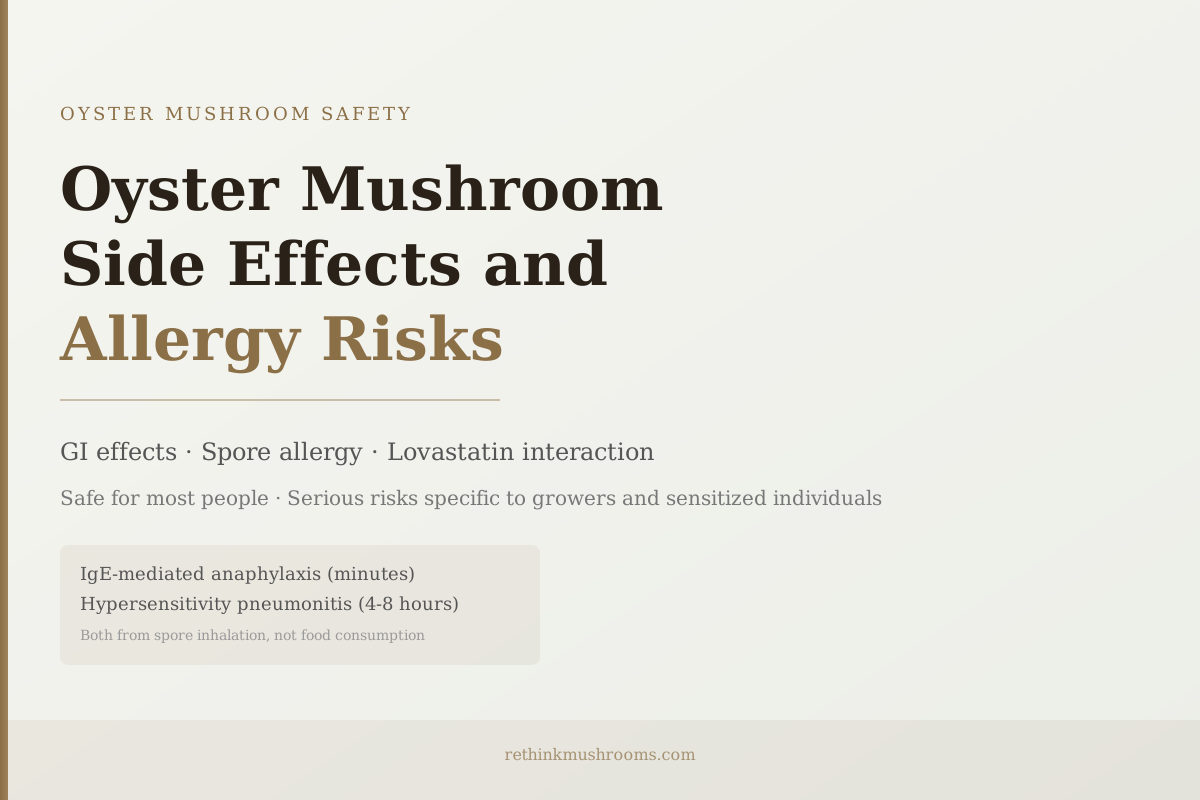
Two distinct serious adverse events are documented for oyster mushrooms: anaphylaxis from spore inhalation (IgE-mediated, within minutes) and hypersensitivity pneumonitis (non-IgE, delayed 4-8 hours). Both occur from spore exposure during growing, not from eating the mushroom.
Branicka et al., IJOEH, 2021; Mori et al., OEM, 1998
Mild GI
the most commonly reported side effect from eating oyster mushrooms; dose-dependent and transient
Spore allergy
separate from food allergy; growers face a different risk category than consumers
Lovastatin
naturally occurring statin compound in oyster mushrooms; potential interaction with statin medications at high extract doses
Branicka et al., IJOEH, 2021; Mori et al., OEM, 1998
 View as image ↗
Oyster mushrooms have a good safety record. Clinical trials testing oyster mushroom extracts in children and adults have reported few adverse events, and ordinary dietary consumption of cooked oyster mushrooms is not associated with meaningful harm in healthy people. The side effect profile that actually matters is specific: mild digestive symptoms at high doses, a genuine allergy risk for sensitized individuals, a distinct set of respiratory risks for growers (not eaters), and an underreported drug interaction concern for people on statin medications. This article covers all four with the data behind each. This article is part of the broader guide to oyster mushrooms.
Key Takeaways
- Oyster mushrooms are safe for most healthy people; GI effects (bloating, loose stools) are the most common side effects and are dose-dependent and reversible
- Clinical trials of Pleuran (purified oyster mushroom beta-glucan) in children over multiple seasons found no serious adverse events[4]
- Spore allergy is a distinct risk from food allergy: Pleurotus spore inhalation can cause immediate IgE-mediated anaphylaxis (minutes) or delayed hypersensitivity pneumonitis (4-8 hours); primarily relevant to mushroom growers, not consumers[1][2]
- Oyster mushroom beta-glucan (Pleuran) paradoxically can both trigger allergy (in sensitized individuals) and reduce allergic symptoms (in non-sensitized children with recurrent infections), through different immune mechanisms[3]
- Oyster mushrooms contain lovastatin, a naturally occurring statin compound; whole food dietary levels are likely low, but high-dose concentrated extracts may create an additive effect with prescription statin medications
- People most likely to need caution: growers with spore exposure, people with known fungal allergies, people taking statin drugs at high supplement doses; for most food consumers, risk is low
The Overall Safety Profile: What Clinical Trials Show
Before cataloguing specific concerns, it helps to set the context. Oyster mushroom products have been tested in clinical trials across a range of populations including children, elderly adults, diabetics, and HIV patients. In these trials, adverse events were either not reported or were mild and transient.
Jesenak and colleagues (2011) conducted a double-blind RCT of Pleuran (purified beta-glucan from Pleurotus ostreatus) in children over two seasons for respiratory infection prevention.[4] The study found significantly fewer respiratory infections in the treatment group and noted no serious adverse events. The same research group conducted multiple follow-up trials over several years with similar safety findings.
That pediatric safety data matters because children are generally a more sensitive population for supplement tolerability. If a concentrated oyster mushroom extract is well-tolerated without significant adverse events across multiple pediatric RCTs, the safety profile for healthy adult dietary consumption is strong.
Digestive Side Effects: The Most Common Concern
The most commonly reported side effect from oyster mushrooms, both from dietary consumption and supplemental use, is gastrointestinal: bloating, gas, loose stools, or stomach cramps. These effects are dose-dependent, reversible, and not reported consistently in clinical trials at typical doses.
The chitin in mushroom cell walls is the likely culprit. Chitin is an insoluble fiber that the human gut cannot digest well. At high intakes, undigested chitin can cause fermentation-related gas and bloating. Cooking significantly breaks down chitin, reducing this effect compared to raw mushroom consumption. Most people eating normally cooked oyster mushrooms in dietary amounts do not experience digestive issues.
People with irritable bowel syndrome or other gut sensitivities may be more likely to notice digestive effects from mushrooms generally. The high fiber content that makes oyster mushrooms beneficial for gut microbiome diversity can also trigger symptoms in people whose guts are sensitive to fermentable fibers.
At supplemental doses, starting low and increasing gradually is a reasonable approach to assess individual tolerance before committing to higher doses.
Allergy: When Oyster Mushroom Becomes a Problem
Allergic reactions to oyster mushrooms are real but uncommon. True food allergy to Pleurotus ostreatus flesh involves IgE antibodies that recognize proteins in the mushroom and trigger histamine release and allergic symptoms (hives, swelling, respiratory symptoms) within minutes to hours of eating.
People with known allergies to other fungi (shiitake, Aspergillus, Cladosporium) may have cross-reactive IgE antibodies that also recognize Pleurotus proteins. This cross-reactivity is not universal, but people with documented mold or fungal allergies testing positive on skin prick testing should be aware of the potential. For specific guidance on who should avoid Pleurotus species, oyster mushroom allergy: who should avoid Pleurotus species? covers the populations and mechanisms in more detail.
The Spore Problem: A Different Risk for Growers
The most serious allergic risks documented in the literature are not from eating oyster mushrooms. They are from inhaling the spores that Pleurotus releases during fruiting.
Branicka and colleagues (2021) documented the case of a 32-year-old woman who developed occupational anaphylaxis and work-related asthma after inhaling Pleurotus ostreatus spores during her first mushroom harvest.[1] The reaction occurred within minutes. IgE antibodies specific to oyster mushroom spore proteins were confirmed by testing. This is an immediate-type, IgE-mediated reaction, the same mechanism as a bee sting allergy or peanut allergy in terms of immune biology.
Mori and colleagues (1998) documented a different type of spore-related illness: hypersensitivity pneumonitis (also called mushroom worker's lung) in workers at a Pleurotus cultivation facility.[2] Multiple workers developed flu-like symptoms with breathing difficulty 4-8 hours after spore exposure. This is a Type IV delayed hypersensitivity reaction, a non-IgE immune mechanism distinct from immediate allergy. It resolved when exposure was reduced, but recurred with re-exposure.
These two conditions, IgE-mediated anaphylaxis and hypersensitivity pneumonitis, are the serious adverse events in the oyster mushroom safety literature. Both are from spore inhalation. Neither comes from eating the mushroom.
The populations most at risk:
- Commercial mushroom farmers with repeated harvest exposure
- Home growers, an increasingly common group, who harvest in enclosed spaces
- People sensitized to related fungi (mold allergies, other mushroom allergies)
Practical risk reduction for growers: ventilate the growing space during fruiting, wear respiratory protection during harvest, harvest before peak spore release if possible, and monitor for symptoms. For the spore allergy topic in full detail, oyster mushroom spore allergy: respiratory concerns covers both conditions and their management.
The Pleuran Paradox: How Oyster Mushroom Beta-Glucan Can Both Cause and Reduce Allergies
One of the most counterintuitive findings in oyster mushroom safety research involves beta-glucan (Pleuran) and allergy.
Jesenak and colleagues (2014) published an RCT testing Pleuran in children with recurrent respiratory tract infections.[3] Pleuran supplementation significantly reduced allergic symptoms in children who were not sensitized to Pleurotus. The beta-glucan modulated the immune system toward a more balanced response, reducing the excessive Th2 immune activity (the branch of immune response most active in allergies) and supporting Th1 activity. This is how Pleuran produces anti-allergic effects.
But the same compound, in sensitized individuals (those whose immune system has already developed IgE antibodies to Pleurotus proteins), can trigger allergic responses. The immune stimulation that produces therapeutic benefit in non-sensitized people is the same stimulation that amplifies existing allergic reactions in sensitized ones.
The practical implication: oyster mushroom beta-glucan is not universally safe or unsafe for people with allergies. In people without sensitization to Pleurotus, it may actually help modulate allergic conditions. In people with confirmed Pleurotus or related fungal sensitization, it is contraindicated. The distinction matters, and it is not made in consumer content anywhere.
The Lovastatin Interaction: An Underreported Drug Concern
Oyster mushrooms (Pleurotus ostreatus) contain lovastatin, a naturally occurring compound that inhibits HMG-CoA reductase, the same enzyme target as prescription statin drugs (atorvastatin, rosuvastatin, simvastatin). In whole fresh oyster mushrooms, lovastatin content is typically low, in the range of milligrams per 100 grams. Dietary consumption of cooked oyster mushrooms at ordinary serving sizes provides very little lovastatin compared to therapeutic pharmaceutical doses.
However, concentrated oyster mushroom extracts and high-dose supplements may contain substantially higher lovastatin levels per serving than fresh mushrooms. Someone taking a prescription statin medication and also taking high-dose oyster mushroom extract is taking two compounds with overlapping mechanisms. Theoretically, this could produce additive statin effects, raising the risk of statin-related adverse effects including myopathy (muscle pain and weakness) and, in severe cases, rhabdomyolysis.
This interaction has not been documented in clinical trials specifically because no trial has tested the combination systematically. The concern is pharmacological and theoretical rather than empirically proven. But it is a meaningful enough concern to warrant transparency.
For people on statin medications who want to add oyster mushroom supplements: the lovastatin content varies significantly by product and is often not disclosed on supplement labels. At whole-food dietary amounts, the risk is likely low. At high-dose concentrated extracts, discussing with a prescribing physician is prudent. The lovastatin content of oyster mushrooms and what it means for cholesterol and drug interactions is covered in lovastatin in oyster mushrooms: how much is actually there.
Who Needs to Be More Careful: A Practical Guide
Healthy adults eating cooked oyster mushrooms: Low risk. GI tolerance varies and can be tested by starting with small servings. No serious adverse events documented from dietary consumption in healthy populations.
People with fungal or mold allergies: More caution warranted. Cross-reactivity between Pleurotus allergens and other fungal allergens is possible. Testing via skin prick test or serum IgE before regular high-dose supplemental use is reasonable.
Home and commercial mushroom growers: Meaningful respiratory risk from spore inhalation. Ventilate grow spaces, use respiratory protection during harvest, and recognize the two distinct conditions (immediate and delayed) that spore exposure can cause.
People taking statin medications: Flag the lovastatin interaction concern for dietary supplement use at high doses. Food-level consumption is likely low risk; concentrated extracts warrant discussion with a physician.
Children: Well-studied in Pleuran form (purified beta-glucan extract) with good safety data across multiple pediatric RCTs. Whole-food oyster mushrooms in dietary amounts are safe for most children.
People with severely compromised immune systems: Immune-modulating compounds can theoretically cause unpredictable responses in people on immunosuppressive therapy (organ transplant recipients, certain autoimmune disease patients). The same immune activation that is therapeutic in healthy people may be contraindicated in someone being deliberately immunosuppressed. Consult with the treating physician before adding medicinal mushroom supplements.
The Bottom Line
Oyster mushrooms have a strong safety record for dietary consumption in healthy populations, with mild GI effects the most commonly reported side effect. Two serious adverse events are documented: IgE-mediated anaphylaxis and hypersensitivity pneumonitis from spore inhalation during cultivation. Oyster mushroom beta-glucan (Pleuran) paradoxically reduces allergic symptoms in non-sensitized individuals while being contraindicated in Pleurotus-sensitized individuals. The lovastatin content of oyster mushrooms creates a theoretical drug interaction with prescription statin medications at high supplement doses.
Frequently Asked Questions
Sources & References
- 1RTHM-01329·Branicka, Olga et al. (2021). “A case of anaphylactic reaction following oyster mushroom (Pleurotus ostreatus) inhalation..” International journal of occupational medicine and environmental health.Study breakdown →PubMed →↩
- 2RTHM-00061·Mori, S et al. (1998). “Mushroom worker's lung resulting from indoor cultivation of Pleurotus osteatus..” Occupational medicine (Oxford.Study breakdown →PubMed →↩
- 3. Source details for this reference are not yet available.
- 4. Source details for this reference are not yet available.