Oyster Mushroom Safety & Dosage
3g/day
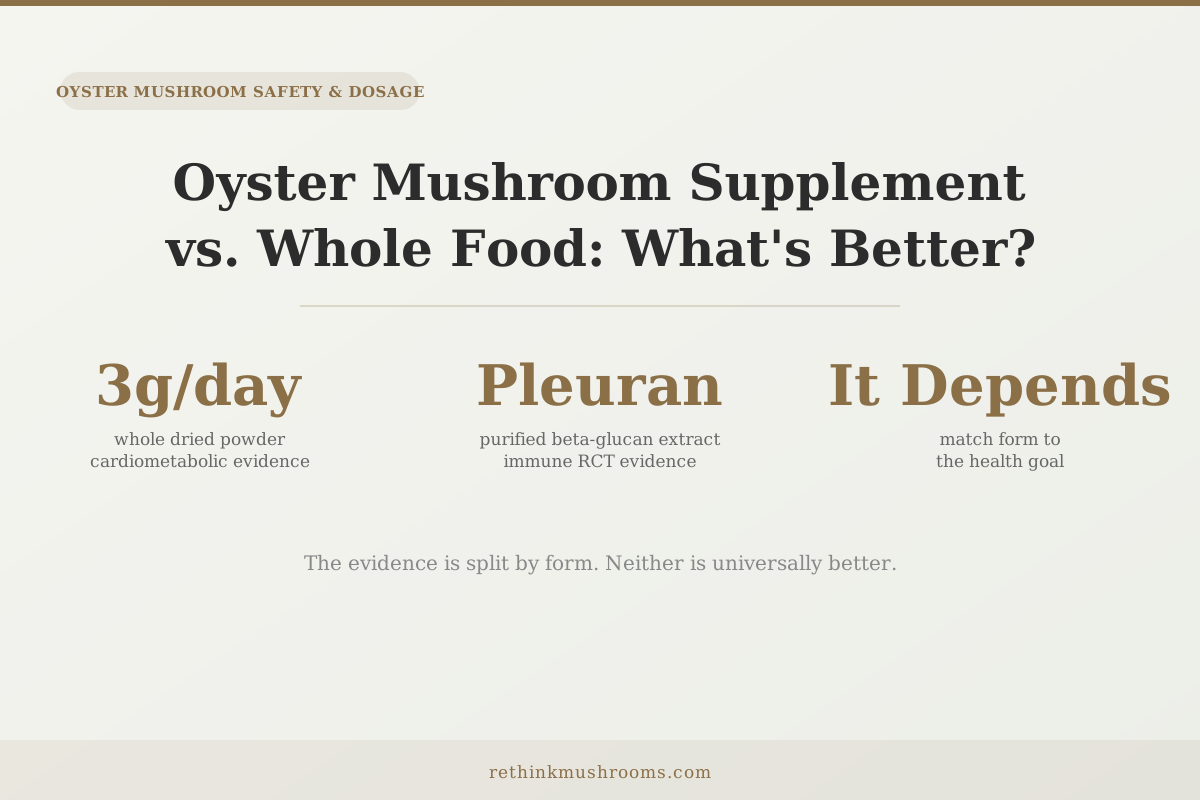
Cardiometabolic clinical trials used approximately 3 grams of dried oyster mushroom powder daily. Immune function trials used purified Pleuran extract. These are different forms with different evidence bases, which matters when choosing a form.
Dicks et al., Nutrients, 2020; systematic review of clinical trials
Pleuran RCTs
3+ human clinical trials on purified oyster mushroom beta-glucan extract
~1-2%
beta-glucan content in fresh oyster mushrooms by wet weight
20-40%
beta-glucan content in hot water extract supplements
Dicks et al., Nutrients, 2020; systematic review of clinical trials
 View as image ↗
Supplement companies almost universally claim their extract is better than eating whole mushrooms, citing concentration and standardization. Food advocates counter that whole food contains compounds lost in processing. Both arguments are partially true and partially misleading, because the honest answer depends on what health outcome you're interested in.
The clinical evidence for oyster mushroom splits clearly by form. The immune support evidence, including multiple randomized controlled trials showing reduced infection rates and immune cell activation, used purified Pleuran, a standardized beta-glucan extract from Pleurotus ostreatus. The cardiometabolic evidence, including a systematic review of human trials on blood glucose and cholesterol effects, mostly used dried whole mushroom powder or fresh mushroom. Neither form is uniformly better. The question is which form matches the health goal and which study's results you're drawing on.
For a species overview, what is oyster mushroom covers the broader research landscape. This article focuses specifically on the supplement vs. whole food comparison and what the clinical evidence actually used.
Key Takeaways
- The immune support evidence base (Pleuran RCTs in athletes, children, and COPD patients) used a purified, standardized beta-glucan extract, not whole mushroom food or basic dried powder
- The cardiometabolic evidence base (systematic review by Dicks 2020, covering glucose and lipid effects) mostly used dried whole mushroom powder or fresh mushroom at approximately 3g/day dried equivalent
- Pleuran contains approximately 20-40% beta-glucan by weight; fresh oyster mushrooms contain roughly 1-2% beta-glucan by wet weight; this concentration difference drives the form distinction
- Whole fresh mushrooms contain lovastatin and ergothioneine that are reduced or absent in hot water extracts, making whole food potentially more relevant for cholesterol-related and antioxidant applications
- A 2011 RCT in HIV patients showed oyster mushroom supplementation reduced total cholesterol, LDL, and triglycerides using a food-based preparation, not an extract
- Choosing a form based on the health evidence that matters to you is more useful than asking generically "which is better"
Why the Supplement vs. Whole Food Question Doesn't Have a Simple Answer
The "supplement vs. whole food" framing implies there is a single answer, but the answer depends entirely on which health outcome you care about and which study produced the evidence you're relying on.
Consider a parallel with another well-studied plant compound: fish oil vs. whole fish. Studies on isolated EPA and DHA as fish oil capsules have produced different results from studies on fish consumption in populations. The comparison is complicated because the preparation affects bioavailability, what else is present in the food matrix, and which dosage was studied. The same complication applies to oyster mushroom.
When someone reads that "oyster mushroom improves immune function," they need to ask: what form was used in that study? If the answer is Pleuran extract (purified beta-glucan), then the evidence applies to Pleuran extract. It does not automatically apply to eating fresh oyster mushrooms, which contain beta-glucan at roughly 1-2% of wet weight rather than the 20-40% concentration in an extract. The effect size may be different.
Conversely, when someone reads that "oyster mushroom reduces cholesterol," the studies underlying that claim mostly used whole dried mushroom powder or fresh mushroom, not extract. Taking an extract and expecting cardiometabolic benefits requires assuming the relevant compounds are present at equivalent doses, which may not be the case if some active compounds (like lovastatin) are lost during extraction.
What the Cardiometabolic Evidence Used: Whole Dried Oyster Mushroom
The most comprehensive synthesis of clinical evidence for oyster mushroom's cardiometabolic effects is the Dicks 2020 systematic review, published in the journal Nutrients, which covered all available clinical trials on blood glucose, lipid levels, and blood pressure outcomes.[1] The studies included in this review primarily used dried whole mushroom powder or fresh mushrooms, with doses in the range of 3 grams per day of dried equivalent.
Khatun and colleagues' 2007 randomized controlled trial is one of the specific studies underpinning this evidence: diabetic subjects consuming oyster mushrooms showed significantly reduced blood glucose and cholesterol compared to controls.[2] This used the whole mushroom as food, not an isolated extract.
Dinkova and colleagues published a separate 2011 RCT in HIV patients receiving antiretroviral therapy that showed oyster mushroom supplementation significantly lowered total cholesterol, LDL, and triglycerides.[3] Again, this was a food-based preparation.
What makes whole mushroom the form of choice for cardiometabolic benefits? Several reasons. Oyster mushrooms contain naturally occurring lovastatin, a compound in the same class as prescription cholesterol-lowering drugs. Hot water extraction processes used for supplement manufacturing typically do not concentrate lovastatin; it may be present in small amounts or absent from standard extracts. Ergothioneine, a unique antioxidant compound found in high concentrations in mushrooms, is also more fully present in whole food or dried powder than in hot water extracts.
This means the cardiometabolic evidence base largely applies to whole mushroom consumption: as food or as dried powder, not as beta-glucan extract. For those interested in the lovastatin content specifically, the article on lovastatin in oyster mushrooms covers the compound in detail.
What the Immune Evidence Used: Purified Pleuran Extract
The human clinical trials that show oyster mushroom's immune effects used Pleuran, a specific purified and standardized beta-glucan extract from Pleurotus ostreatus. This is not generic oyster mushroom powder. Pleuran is a defined compound: insoluble 1,3/1,6-beta-glucan extracted and purified to a specific beta-glucan concentration.
Three clinical trials by Jesenak and colleagues cover the Pleuran evidence base:
The 2010 RCT found that Pleuran supplementation enhanced cellular immune response in children, including increased NK cell activity.[4]
The 2011 RCT specifically focused on respiratory infections: children supplemented with Pleuran had significantly reduced frequency of upper respiratory tract infections compared to placebo, with measurable improvements in immune cell parameters.[5]
The 2014 RCT extended this to allergic conditions: Pleuran reduced allergic symptoms (IgE-mediated inflammation) in children with recurrent respiratory infections.[6]
Pleuran is sold under that trade name by a Slovak manufacturer (BioAktiv SK). When evaluating oyster mushroom supplements claiming immune benefits based on Pleuran research, the relevant question is whether the product actually uses Pleuran (the specific extract) or a different preparation. A generic dried oyster mushroom powder is not the same as Pleuran, and the Pleuran trial results do not automatically apply to it.
This does not mean general oyster mushroom supplements are ineffective for immune function. It means the specific clinical evidence referenced most often for immune effects applies to a specific form, and extrapolating to other forms requires assumptions about bioequivalence that haven't been directly tested.
What Changes When You Process Oyster Mushroom
The form of oyster mushroom matters because processing changes its compound profile. Understanding what is concentrated, preserved, and lost across different forms helps match the right product to the right evidence base.
Fresh and dried whole mushroom. Fresh oyster mushrooms contain the full compound matrix: beta-glucans (at roughly 1-2% of wet weight), lovastatin (a naturally occurring statin compound), ergothioneine (a potent antioxidant), ergosterol (a precursor to vitamin D), and various polyphenols. Drying concentrates most of these by a factor of roughly 10:1 by weight reduction. The evidence for cardiometabolic benefits (Dicks 2020 SR, Khatun 2007, Dinkova 2011) applies here.
Hot water extract. The standard process for making mushroom supplement extracts involves hot water extraction, which concentrates polysaccharides including beta-glucans. The resulting extract typically contains 20-40% beta-glucan by weight. What is not concentrated or is significantly reduced: lovastatin (a non-polysaccharide that is not water-soluble in the same way) and ergothioneine may also be affected by extraction conditions. The Pleuran RCT evidence is most relevant for this form, though Pleuran itself is a specific standardized product.
Dual extract. Some products add alcohol extraction after hot water extraction to capture triterpenoids. This is well-established for reishi, which has a rich and studied triterpene chemistry. Oyster mushroom triterpenoids have not been specifically identified as clinically important in the same way, so the "dual extract" designation adds less differentiation for oyster mushroom than for reishi.
Myceliated grain products. Some products are made from mushroom mycelium grown on grain, dried, and ground. These contain both mycelium and grain substrate, with variable and typically lower beta-glucan content than actual mushroom fruiting body. These products have the least clear relationship to the clinical trial evidence base for oyster mushroom.
Matching Form to Goal: A Practical Framework
Given the evidence split, here is how to match form to health goal based on what the research actually used:
For cardiometabolic goals (blood glucose, cholesterol, blood pressure): the evidence base used whole dried mushroom powder or fresh mushroom consumption at roughly 3 grams per day of dried equivalent. Whole food or dried powder is most directly supported by the available clinical data.
For immune function and respiratory infection frequency: the evidence base used Pleuran (specific purified beta-glucan extract). Look for products specifically labeled as containing Pleuran, or beta-glucan extracts with stated standardization and known concentration.
For anti-allergic effects in atopic conditions: same as immune function above, the Pleuran RCTs are the applicable evidence. The paradox noted in Jesenak 2014 is worth understanding: the same Pleuran that reduces allergic inflammation in non-sensitized people can cause allergic reactions in people who are sensitized to Pleurotus, so those with known mushroom or fungal allergies should be cautious regardless of form.
For dietary ergothioneine and lovastatin: whole mushroom or dried powder is the applicable form, since these compounds are present in meaningful amounts in the whole food but may be reduced in extracts.
One practical note on spore exposure: this is relevant specifically to whole mushroom growing and harvesting, not to buying dried powder or supplement. If you grow oyster mushrooms at home, the fruiting and harvest stage generates spores, and spore inhalation carries an allergy risk distinct from the mushroom-eating allergy risk. The article on oyster mushroom spore allergy covers the respiratory exposure risk for home growers.
The companion article on oyster mushroom dosage covers specific dose recommendations from the clinical trial data for each health application. For safety and allergy considerations when choosing a form, oyster mushroom side effects and allergy risks and oyster mushroom allergy and who should avoid cover the relevant cautions.
Reading Supplement Labels in the Context of Clinical Evidence
One challenge when applying clinical trial evidence to supplement purchasing decisions is translating between what trials measured and what supplement labels report.
The Pleuran immune RCTs measured outcomes (infection rate, NK cell count) using a specific standardized product. When a supplement label says "oyster mushroom extract" or "Pleurotus ostreatus extract standardized to 30% beta-glucan," it describes a different product without confirming it is the Pleuran used in trials. The beta-glucan percentage tells you about polysaccharide concentration but not the specific structural profile, the particle size, or the proprietary processing method that defined Pleuran.
This doesn't mean non-Pleuran oyster mushroom extracts are ineffective. It means the Pleuran trial evidence does not directly validate them. A consumer evaluating an oyster mushroom supplement's immune claims should look for whether the product specifically uses Pleuran (sometimes listed as a branded ingredient) and whether it cites the specific RCTs (Jesenak studies) as the evidence base.
For the cardiometabolic applications, the situation is more straightforward: the evidence used dried whole mushroom, so products that are genuinely dried whole oyster mushroom powder have the most direct relevance to the available clinical data.
The honest complexity is that the supplement industry often presents evidence selectively, citing whichever studies support the most compelling claims without being transparent about which form was tested. This article's purpose is to give readers the information to ask the right questions: which study, which form, which dose, which population.[1]
The connection between oyster mushroom's cholesterol-relevant compounds and the broader statin story is covered in the article on oyster mushrooms and cholesterol.
The Bottom Line
Oyster mushroom clinical evidence divides by form. The immune function evidence base comes from Pleuran RCTs using purified beta-glucan extract at 20-40% concentration. The cardiometabolic evidence comes from trials using dried whole mushroom powder at approximately 3g/day. Fresh and dried whole mushrooms contain lovastatin and ergothioneine that are not concentrated in hot water extracts. Choosing a form based on the specific health evidence that matters, rather than asking which is generically better, produces a more defensible decision.
Frequently Asked Questions
Sources & References
- 1. Source details for this reference are not yet available.
- 2RTHM-00115·Khatun, K et al. (2007). “Oyster mushroom reduced blood glucose and cholesterol in diabetic subjects..” Mymensingh medical journal : MMJ.Study breakdown →PubMed →↩
- 3. Source details for this reference are not yet available.
- 4. Source details for this reference are not yet available.
- 5. Source details for this reference are not yet available.
- 6. Source details for this reference are not yet available.