Oyster Mushroom Safety
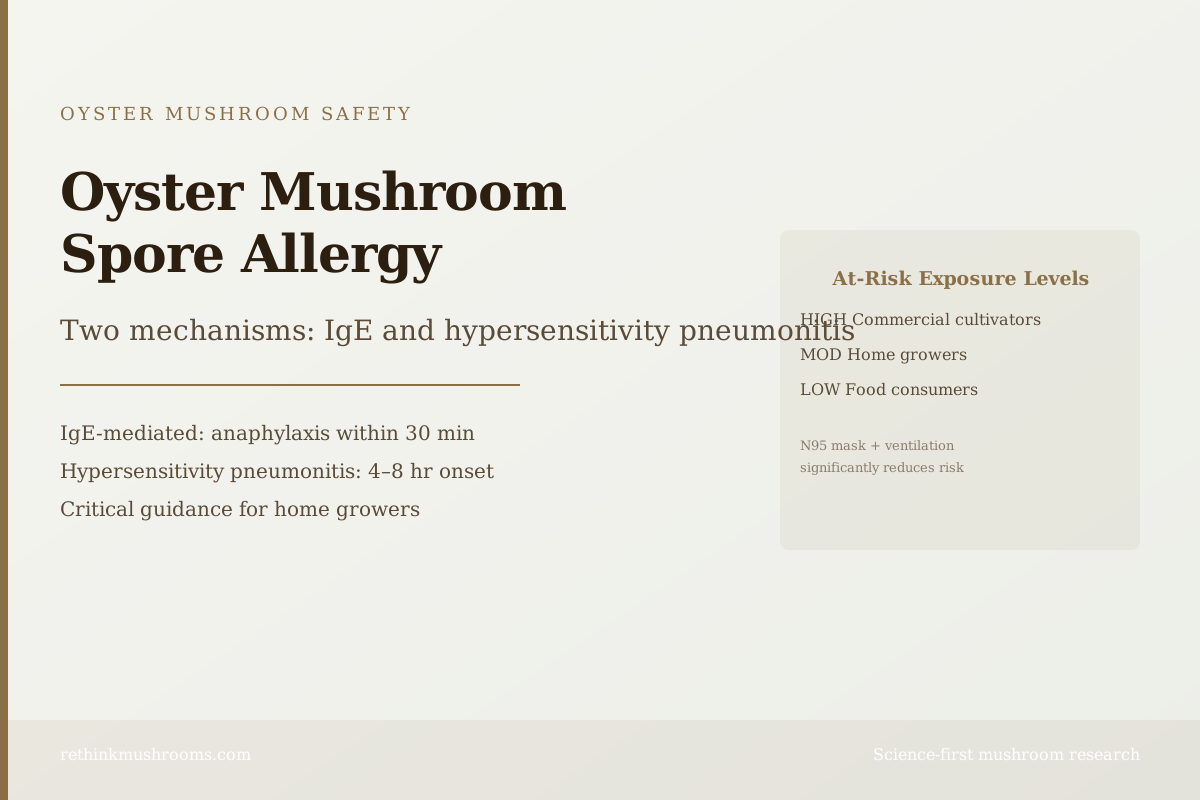
2 mechanisms: IgE-mediated and non-IgE hypersensitivity pneumonitis
Oyster mushroom spore allergy takes two biologically distinct forms that are often confused. Distinguishing them matters because the symptoms, timing, and management differ in important ways.
Branicka et al., Int J Occup Med Environ Health, 2021; Mori et al., Occup Environ Med, 1998
30 min
time to anaphylaxis after first spore exposure in the Branicka 2021 case report
4–8 hours
delayed onset of mushroom worker's lung symptoms after exposure
Home growers
a growing population with real spore inhalation risk during fruiting and harvest
Branicka et al., Int J Occup Med Environ Health, 2021; Mori et al., Occup Environ Med, 1998
 View as image ↗
Oyster mushroom spore allergy is not one condition but two, and the distinction between them matters for recognizing symptoms and responding appropriately. The first is an IgE-mediated immediate hypersensitivity reaction, the same biological mechanism as pollen or bee sting allergy, that can progress to anaphylaxis within minutes of exposure. The second is hypersensitivity pneumonitis, also called mushroom worker's lung, a delayed non-allergic reaction that causes flu-like respiratory symptoms four to eight hours after exposure through a completely different immune mechanism. Both conditions result from inhaling oyster mushroom spores, but the molecular biology, the timeline, and the clinical management differ significantly. This article covers what the research shows about oyster mushroom spore allergy risks, which populations are affected, and what home growers specifically need to know. For broader oyster mushroom safety information, the guide on oyster mushroom side effects and allergy risks covers the full safety picture.
Key Takeaways
- Oyster mushroom spore exposure can cause two distinct conditions: (1) IgE-mediated immediate allergy that can reach anaphylaxis within 30 minutes, and (2) hypersensitivity pneumonitis with flu-like symptoms appearing 4–8 hours later through a non-IgE mechanism
- In a 2021 case report, a 32-year-old woman developed anaphylaxis within 30 minutes of her first oyster mushroom harvest, confirmed by spore-specific IgE testing (Branicka et al.)
- In a 1998 outbreak study, commercial mushroom farm workers developed extrinsic allergic alveolitis (mushroom worker's lung) from Pleurotus spore inhalation; symptoms resolved when exposure stopped (Mori et al.)
- Risk is highest for occupational cultivators and home growers who regularly handle mushrooms during fruiting and harvest, when spore release is at its peak
- People who eat oyster mushrooms without growing them have minimal spore inhalation exposure and are not meaningfully at risk for spore-specific respiratory conditions
- Cross-reactivity between oyster mushroom spore allergens and common environmental mold allergens means people with mold allergies may have elevated risk of reacting to Pleurotus spores
The Two Types of Spore Reaction: How They Differ at the Cellular Level
The distinction between IgE-mediated spore allergy and hypersensitivity pneumonitis is not just academic. Confusing them leads to delayed diagnosis or inappropriate management. Here is what separates them at the biological level.
IgE-mediated immediate hypersensitivity follows the same pathway as pollen allergy or food allergy. On first exposure to oyster mushroom spores, the immune system produces antibodies of the IgE class that attach to mast cells throughout the body. These antibodies serve as recognition molecules: they bind to spore proteins with high specificity. On subsequent exposures, when spores arrive at sensitized mast cells, the IgE antibodies recognize the proteins and signal the mast cells to release histamine and other inflammatory chemicals. This process happens within seconds to minutes. The result is the classic allergic response: hives, runny nose, wheezing, and in severe cases, anaphylaxis. The Branicka 2021 case report documented exactly this sequence in a mushroom cultivator who developed anaphylaxis within 30 minutes of her first harvest.[1]
Hypersensitivity pneumonitis (also known as extrinsic allergic alveolitis or mushroom worker's lung) works through a fundamentally different immune pathway. It does not involve IgE antibodies or mast cells. Instead, repeated inhalation of spore antigens drives a Type IV delayed immune response, involving T lymphocytes that accumulate in the lung tissue around the airways. This process takes hours to develop. Symptoms typically appear four to eight hours after exposure, not minutes. They include fever, chills, shortness of breath, and fatigue that feel more like the flu than an allergic reaction. The lung damage, if exposure continues, can progress to fibrosis. The Mori 1998 outbreak among commercial Pleurotus cultivators documented this pattern: workers developed dyspnea and systemic symptoms hours after their shifts, with symptoms tied specifically to the fruiting period when spore release was highest.[2]
Two conditions. Same trigger. Completely different biological mechanisms and clinical presentations.
The Branicka 2021 Anaphylaxis Case: What IgE-Mediated Spore Allergy Looks Like
In 2021, Branicka and colleagues published a case report in the International Journal of Occupational Medicine and Environmental Health documenting what is likely the clearest published example of IgE-mediated oyster mushroom spore allergy.[1]
The patient was a 32-year-old woman working in home cultivation of Pleurotus ostreatus. During her first harvest, after approximately 30 minutes of exposure to spores released during the picking process, she developed a rapid-onset reaction including urticaria (hives), angioedema (swelling), and systemic anaphylaxis requiring emergency treatment.
The diagnosis was confirmed using spore-specific IgE testing, which detected elevated IgE antibodies against Pleurotus ostreatus spore proteins. This is the key diagnostic marker: measuring the antibody directly, not just the clinical reaction. The occupational medicine workup also confirmed work-related asthma sensitization tied to the spore exposure.
Several features of this case are important for home growers to understand. First, the reaction occurred during the first harvest. Sensitization to oyster mushroom spores can occur before any symptoms appear, meaning a person can be sensitized through earlier, smaller exposures without realizing it, and then experience a severe reaction on a subsequent harvest. Second, the exposure occurred through inhalation during harvest, not through eating. Food allergy to oyster mushroom flesh is a separate issue with a different clinical profile. Third, the severity reached anaphylaxis, confirming that oyster mushroom spore allergy is not limited to mild hay-fever-like symptoms.
The Mori 1998 Outbreak: Mushroom Worker's Lung From Pleurotus Cultivation
In 1998, Mori and colleagues published findings from an outbreak of extrinsic allergic alveolitis among workers in indoor Pleurotus ostreatus cultivation, published in Occupational and Environmental Medicine.[2]
Multiple workers developed what is called mushroom worker's lung: a hypersensitivity pneumonitis resulting from repeated occupational inhalation of mushroom spores. The clinical picture involved dyspnea (difficulty breathing), systemic symptoms resembling flu, and a delayed onset pattern with symptoms appearing hours after work shifts rather than during them. This delay is characteristic of the Type IV hypersensitivity mechanism.
The condition resolved in affected workers when spore exposure stopped, which is consistent with hypersensitivity pneumonitis generally: remove the trigger and the immune-mediated inflammation subsides. However, chronic continued exposure without intervention can lead to persistent lung damage.
This outbreak illustrates why hypersensitivity pneumonitis is considered an occupational hazard in commercial mushroom cultivation. The spore load in indoor growing environments during fruiting, when mushrooms release millions of spores per hour into the air, is far higher than what a home grower or consumer would encounter. But the principle is the same: sustained high-volume spore inhalation can sensitize the immune system to oyster mushroom spore antigens through a non-IgE pathway that produces lung inflammation rather than immediate allergic reactions.
Who Is Actually at Risk: Understanding Exposure Levels
The specific risk level for oyster mushroom spore allergy depends almost entirely on how much exposure to spores a person receives.
Commercial mushroom workers face the highest risk. Indoor commercial cultivation creates enclosed high-humidity environments where spore concentrations during fruiting can be extremely elevated. The Mori 1998 outbreak documented this occupational hazard. Commercial facilities with proper ventilation, air filtration, and respiratory protection substantially reduce this risk, but it is a recognized occupational health concern in the industry.
Home growers face a real but lower risk. Home cultivation typically involves smaller growing spaces and fewer mushroom blocks than commercial operations. But the relative spore concentration in a home room or tent during the fruiting stage, especially near harvest when spores are actively releasing, can still reach levels sufficient to sensitize or trigger reactions in susceptible individuals. The Branicka 2021 case occurred in a home cultivation context, making it directly relevant to this population.
People who eat oyster mushrooms without any cultivation involvement have minimal spore inhalation exposure. When oyster mushrooms are purchased from a store or harvested commercially and then cooked, the spore-related respiratory risk is essentially absent. The allergy concern for food consumers centers on proteins in the flesh itself, which is covered in the oyster mushroom allergy: who should avoid Pleurotus species article.
Practical Safety Guidance for Home Oyster Mushroom Growers
For people who grow oyster mushrooms at home, several straightforward practices meaningfully reduce spore inhalation exposure.
Ventilation during fruiting. Oyster mushrooms begin releasing spores as the caps fully develop and flatten. In enclosed spaces like a grow tent, spore concentration builds rapidly during this phase. Running a fan that directs air away from the growing area and out of the space reduces airborne spore concentration. If growing in a room rather than a tent, open windows or add an air purifier with HEPA filtration.
Respiratory protection during harvest. The highest spore release occurs during harvesting, when mushrooms are disturbed and the growing environment is opened. Wearing an N95 respirator (not a basic dust mask) during harvest provides meaningful protection. Basic cloth or surgical masks allow particle sizes typical of mushroom spores to pass through.
Harvest timing. Oyster mushrooms should ideally be harvested before the caps fully flatten and begin releasing maximum spores. At this stage the mushrooms are still high-quality, and spore output is lower than at peak maturity. Waiting for caps to fully open and curl increases both spore release and the risk of significant inhalation exposure.
Recognizing early symptoms. The two conditions require different response timelines. If symptoms appear within minutes of harvest exposure (hives, itching, wheezing, swelling), this suggests IgE-mediated allergy and requires immediate medical attention, as anaphylaxis can develop rapidly. If symptoms appear four to eight hours after exposure (fever, chills, shortness of breath, fatigue that resembles flu), this suggests hypersensitivity pneumonitis. Either condition warrants stopping exposure and medical evaluation.
Avoiding exposure after prior reactions. Once a person has had any reaction tied to spore inhalation, the risk of more severe reactions on subsequent exposures increases. Confirmed IgE-mediated sensitization to oyster mushroom spores means carrying an epinephrine auto-injector if continuing to grow mushrooms, or ceasing cultivation.
Cross-Reactivity With Mold Allergies: An Underreported Risk Factor
Oyster mushroom spore proteins belong to the broader family of fungal allergens. The allergens responsible for IgE sensitization to Pleurotus spores share structural features with allergens from other fungi and molds. This creates the possibility of cross-reactivity: a person sensitized to common environmental molds such as Alternaria, Cladosporium, or Aspergillus species may have pre-existing IgE antibodies that recognize Pleurotus spore proteins.
For practical purposes: someone who already has a documented mold allergy should approach oyster mushroom cultivation with elevated caution. This does not mean they will definitely react to Pleurotus spores, but the cross-reactive sensitization increases the probability of an IgE-mediated reaction compared to a person with no fungal allergy history.
This cross-reactivity dimension is largely absent from consumer content about oyster mushroom safety. It represents a specific risk factor that the mold-allergic home growing community should be aware of before starting cultivation.
When Spore Allergy Is Not a Food Allergy
It is important to distinguish oyster mushroom spore allergy from food allergy to oyster mushroom flesh. These are separate conditions involving different allergens and different exposure routes.
Spore allergy, as described in this article, results from inhaling spore proteins. The allergens are on the spore surface and are encountered through the respiratory tract. Most people who develop spore sensitization can still eat cooked oyster mushrooms without a reaction, because cooking denatures spore proteins and the ingestion route differs from inhalation.
Food allergy to oyster mushrooms involves proteins in the mushroom flesh, not spore surface proteins. Food allergic reactions to oyster mushrooms typically involve oral allergy syndrome, hives, or GI symptoms after eating, and are distinct from the respiratory reactions described in this article.
The broader picture of who should avoid oyster mushrooms as a food, including people on statin medications and those with broader fungal allergies, is covered in the companion article on who should avoid Pleurotus species. The pillar article on oyster mushrooms also provides safety context alongside the health evidence.
The Bottom Line
Oyster mushroom spore allergy takes two distinct forms: an IgE-mediated immediate hypersensitivity that can reach anaphylaxis within 30 minutes (documented in Branicka 2021), and hypersensitivity pneumonitis with delayed flu-like respiratory symptoms appearing 4–8 hours after exposure (documented in the Mori 1998 commercial cultivator outbreak). Risk is highest for commercial mushroom workers and home growers who regularly handle mushrooms during fruiting and harvest. Food consumers have minimal spore exposure risk. Home growers can reduce risk through ventilation, N95 respiratory protection during harvest, and early symptom recognition. People with existing mold allergies have elevated sensitization risk due to cross-reactive fungal allergens.
Frequently Asked Questions
Sources & References
- 1RTHM-01329·Branicka, Olga et al. (2021). “A case of anaphylactic reaction following oyster mushroom (Pleurotus ostreatus) inhalation..” International journal of occupational medicine and environmental health.Study breakdown →PubMed →↩
- 2RTHM-00061·Mori, S et al. (1998). “Mushroom worker's lung resulting from indoor cultivation of Pleurotus osteatus..” Occupational medicine (Oxford.Study breakdown →PubMed →↩