Oyster Mushroom Safety
30 min to her first reaction
A previously healthy, non-atopic mushroom farm worker developed breathing difficulty 30 minutes into her first Pleurotus ostreatus harvest, and was later diagnosed with occupational anaphylaxis and work-related asthma. Oyster mushroom allergy is rare, but it is on the clinical record.
Branicka et al., International Journal of Occupational Medicine and Environmental Health, 2021
Prick-to-prick
test that confirmed her oyster mushroom sensitivity, after standard allergy panels came back negative
4 groups
populations with a documented or plausible reason to limit Pleurotus exposure
1.39 mg/kg
highest lovastatin measured across tested mushroom species by validated LC-MS, roughly a thousandfold below a prescription dose
Branicka et al., International Journal of Occupational Medicine and Environmental Health, 2021
 View as image ↗
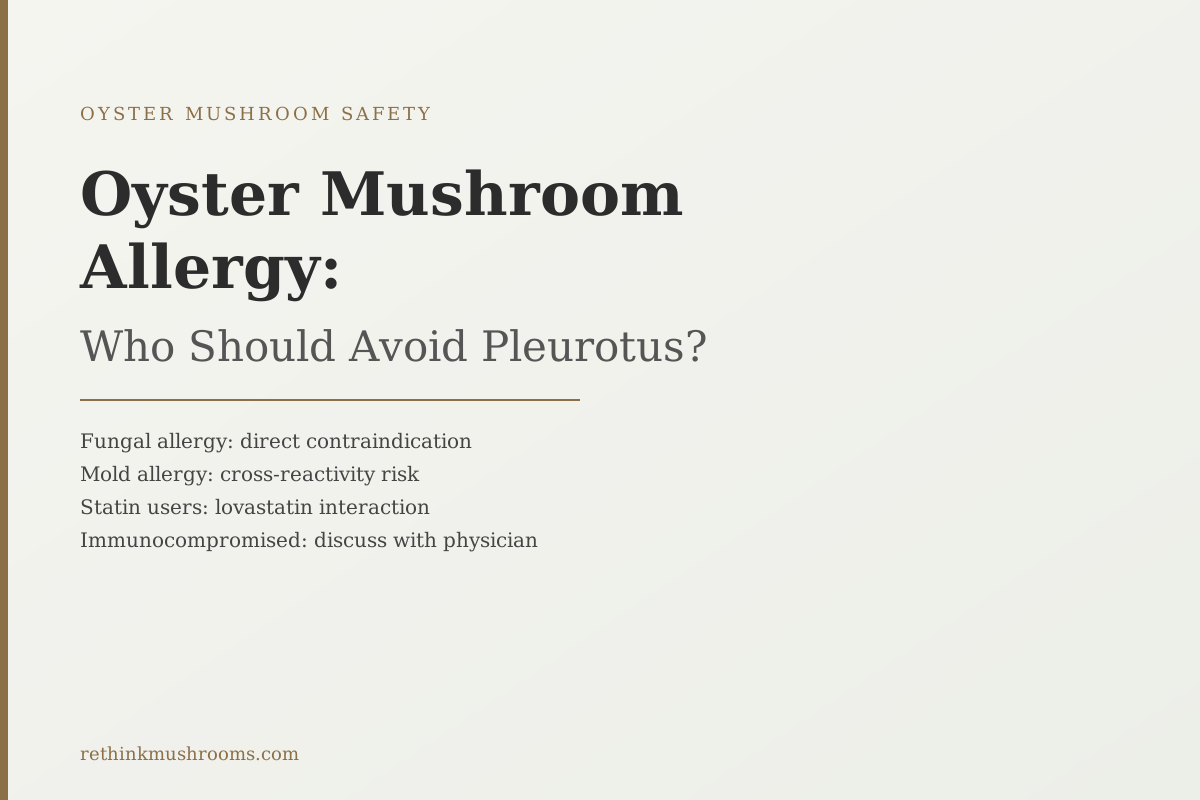
Oyster mushroom allergy is real, documented, and in at least one published case severe enough to be diagnosed as anaphylaxis. Most people eat oyster mushrooms without any adverse reaction. But four groups have reasons of varying evidential strength to approach Pleurotus species with care: people with a known fungal or mushroom allergy, people with mold allergies who may carry cross-reactive antibodies, people taking prescription statins who are considering concentrated oyster mushroom supplements, and immunocompromised individuals on immunosuppressive medication.
Those four reasons are not equally well supported, and this article does not treat them as if they were. The allergy concerns rest on published human cases and a documented cross-reactivity mechanism. The statin concern, once you look at how much lovastatin has actually been measured in oyster mushrooms with reliable methods, turns out to be considerably weaker than it is usually presented. For context on the broader safety picture, see Oyster Mushroom Side Effects and Allergy Risks. For the complete story on this species, see the guide to oyster mushrooms.
Key Takeaways
- A 2021 case report documented occupational anaphylaxis and work-related asthma in a previously healthy, non-atopic mushroom farm worker; her first reaction was breathing difficulty after 30 minutes of her first Pleurotus ostreatus harvest
- That diagnosis rested on a positive prick-to-prick test with oyster mushrooms (12 mm wheal) and modestly elevated total IgE, not on a spore-specific IgE assay; her standard inhalant and food allergy panels were all negative
- Two different immune mechanisms are documented: immediate hypersensitivity with rapid onset and anaphylaxis risk, and extrinsic allergic alveolitis (mushroom worker's lung), which in the 1998 report involved antibody precipitins against basidiospores rather than IgE
- Allergic cross-reactivity between airborne fungi and edible mushrooms is well described, and one mold-allergic patient developed anaphylactic shock after eating button mushrooms, with cross-reactivity to mold aeroallergens confirmed at the protein level
- The lovastatin concern is weaker than commonly claimed: validated LC-MS found at most 1.39 mg/kg dry weight across tested species, one study did not detect lovastatin in raw oyster mushrooms at all, and older ultraviolet methods that produced higher figures were shown to be invalid
- A pediatric randomized trial found that pleuran, a purified beta-glucan from oyster mushrooms, reduced blood eosinophilia and stabilized total IgE, which are laboratory markers of allergic inflammation rather than measured clinical symptoms
How Serious Can Oyster Mushroom Allergy Get? The Anaphylaxis Evidence
In 2021, Branicka and colleagues published a case report in the International Journal of Occupational Medicine and Environmental Health describing a 32-year-old woman who had opened an oyster mushroom farm with her husband.[1] She was, importantly, described as non-atopic and healthy beforehand. This was not someone with a known allergic history walking into a known trigger.
During her first harvest, after a 30-minute exposure, she developed dyspnoea (difficulty breathing). Similar episodes recurred on subsequent visits to the farm. A month later, while packing and sorting mushrooms, symptoms appeared after only 10 minutes and were more systemic: breathlessness accompanied by weakness, a rapid pulse, and itching with urticaria (hives) on her forearms. Spirometry performed immediately after one of these exposures showed reduced airflow.
The diagnostic workup is worth reading closely, because it is often reported inaccurately. Standard skin prick tests using commercial inhalant and food allergen panels were all negative. What was positive was a prick-to-prick test performed with the actual oyster mushrooms, producing a 12 mm wheal. Her total serum IgE was elevated at 78 IU/mL, a modest elevation rather than a dramatic one. There was no spore-specific IgE assay. On the combination of her occupational history, her symptom pattern, and those test results, she was diagnosed with occupational anaphylaxis and work-related asthma.
Two things follow. First, oyster mushroom sensitization can develop in someone with no prior allergic history, from occupational exposure itself. Second, commercial allergy panels can miss it entirely, which means a negative standard workup does not rule it out. The paper also notes that although Pleurotus spores are potent allergens, their main allergen, Pleo, has rarely been reported in the literature.
The honest limitation is that this is a single case report. It establishes that severe reactions can happen. It cannot tell us how often they happen, and the answer appears to be rarely, given how widely oyster mushrooms are grown and eaten. For the respiratory risks specific to spore inhalation during home growing, see Oyster Mushroom Spore Allergy: Respiratory Concerns.
Two Documented Mechanisms, Two Different Situations
The Branicka case represents one of two immunological routes by which oyster mushroom exposure has caused documented harm. They differ in timescale, in mechanism, and in who is affected.
Two Documented Routes · Pleurotus ostreatus
The Same Mushroom, Two Different Immune Reactions
These two are constantly merged into a single “mushroom allergy,” but they run on different clocks, show up in different tests, and affect different people. Only the left lane carries anaphylaxis risk. Only the right lane is an occupational lung disease.
Immediate hypersensitivity
[1]Branicka 2021 · single case report
Extrinsic allergic alveolitis
[2]Mori 1998 · outbreak in two workers
Onset after exposure
Immediate: Minutes — 30 min on first harvest, 10 min a month later
Alveolitis: Characteristically hours, not minutes
What was seen
Immediate: Dyspnoea, then weakness, rapid pulse and urticaria on the forearms; spirometry showed reduced airflow
Alveolitis: Extrinsic allergic alveolitis in two workers on an indoor cultivation site
What testing showed
Immediate: Standard inhalant and food panels all negative; prick-to-prick with oyster mushroom positive at a 12 mm wheal; total IgE 78 IU/mL
Alveolitis: High titre indirect fluorescent antibody and positive precipitins against P. ostreatus basidiospores
Antibodies involved?
Immediate: Immediate-type pattern; no spore-specific IgE assay was performed
Alveolitis: Yes — precipitins were demonstrated, so this is not an antibody-free reaction
Who is exposed
Immediate: Anyone who becomes sensitized, including people with no prior allergic history
Alveolitis: Occupational — repeated, sustained exposure to high spore concentrations indoors
Diagnosis reached
Immediate: Occupational anaphylaxis and work-related asthma
Alveolitis: Mushroom worker’s lung from basidiospore exposure
Worth correcting: hypersensitivity pneumonitis is often described as purely cell-mediated and antibody-free. Mori and colleagues demonstrated precipitating antibodies against basidiospores in these patients, so that description does not fit these cases. What separates it from immediate allergy is the mechanism and timescale, not the absence of antibodies.
Sources: Branicka et al. 2021 [1] (32-year-old non-atopic worker; 30 min then 10 min to symptoms; negative standard panels; 12 mm prick-to-prick wheal; total IgE 78 IU/mL; occupational anaphylaxis and work-related asthma); Mori et al. 1998 [2] (extrinsic allergic alveolitis in two indoor P. ostreatus cultivation workers; high titre indirect fluorescent antibody and positive precipitins against basidiospores). Timings, wheal size and IgE value are as reported in those papers. The “hours, not minutes” onset for alveolitis is general clinical characterisation, not a figure reported by Mori.
Immediate hypersensitivity is the Branicka 2021 pattern.[1] Symptoms arrive within minutes of exposure: breathlessness, urticaria, rapid pulse, and in the severe form, anaphylaxis. This is the same broad category as peanut or shellfish allergy. In her case the mechanism was inferred from the immediate timing and the positive prick-to-prick response rather than demonstrated with a spore-specific antibody test.
Extrinsic allergic alveolitis, also called hypersensitivity pneumonitis or mushroom worker's lung, is the second route. Mori and colleagues reported in 1998 that indoor cultivation of Pleurotus ostreatus led to an outbreak of extrinsic allergic alveolitis in two workers.[2] Their sera showed high titres of indirect fluorescent antibody and positive precipitins against P. ostreatus basidiospores. The authors concluded that mushroom workers should protect themselves from basidiospores, having established their pathogenicity.
It is worth correcting a common description here. Hypersensitivity pneumonitis is frequently summarized as a purely cell-mediated, non-antibody reaction. The Mori findings do not support that framing for these cases: precipitating antibodies against basidiospores were exactly what the investigators demonstrated. Hypersensitivity pneumonitis is generally understood to involve both antibody-mediated and cell-mediated immunity, which is what makes it mechanistically distinct from IgE-driven immediate allergy without being antibody-free. As a general clinical matter, this condition characteristically develops hours rather than minutes after exposure, which is why workers often fail to connect it to the workplace.
These conditions affect different people in different settings. Immediate hypersensitivity can affect anyone who becomes sensitized, including, as the Branicka case shows, someone with no allergic history. Extrinsic allergic alveolitis is an occupational disease of repeated, sustained exposure to high spore concentrations in enclosed cultivation environments. For someone cooking oyster mushrooms at home a few times a month, neither is a realistic concern.
Mold Allergies and Oyster Mushrooms: The Cross-Reactivity Question
People with diagnosed mold allergies have the best-supported reason on this list to pay attention, and it does not require them to have ever reacted to a mushroom before.
Allergic cross-reactivity among different fungal species is widespread. In a 2022 review, Xing and colleagues describe how fungus-related foods, including edible mushrooms, mycoprotein, and fungal-fermented foods, can provoke what is termed fungus food allergy syndrome through cross-reactivity with airborne fungi.[3] The syndrome can involve the oral mucosa, skin, gastrointestinal tract, respiratory tract, or cardiovascular system, with severity ranging from mild oral allergy syndrome to anaphylaxis. The mechanism is structural: an immune system sensitized to one fungal protein can recognize a structurally similar protein in another fungal species, so someone sensitized to environmental mold may carry antibodies capable of reacting to mushroom proteins without any prior mushroom exposure.
Two case reports make this concrete. Gauld and colleagues described a 15-year-old with allergic rhinitis and multiple confirmed mold sensitizations who developed throat itching and tightness after eating a mushroom-containing pizza.[4] The diagnostic detail matters: serum-specific IgE testing to whole mushroom was negative, while fresh-food prick testing to fresh portobello and cremini was positive, and testing to canned mushroom was negative. He tolerated cooked mushrooms but reacted to lightly cooked ones.
More seriously, Gabriel and colleagues reported a 38-year-old mold-allergic patient who developed generalized urticaria and systemic anaphylactic shock immediately after eating button mushrooms.[5] Two mushroom proteins, a manganese-dependent superoxide dismutase and a mannitol dehydrogenase, were identified as the patient's IgE-binding targets, and cross-reactivity between the mushroom superoxide dismutase and mold aeroallergens was directly confirmed. The authors concluded that prior sensitization to airborne mold can explain severe food reactions to cross-reacting mushroom proteins.
This tempers a reassurance that often gets offered. It is broadly true that eating cooked mushrooms is lower risk than inhaling spores, and the Gauld case supports the idea that heat and processing reduce allergenicity, since canned mushroom tested negative where fresh tested positive. But the Gabriel case documents anaphylaxis from ingestion in precisely the mold-allergic population, so ingestion is not risk-free for that group. Both of those cases involved Agaricus bisporus rather than Pleurotus, which is a real limitation on how directly they transfer to oyster mushrooms; the shared basis is the cross-reactivity mechanism described in the Xing review, not species-matched data.
In practice, the highest-exposure situations for mold-allergic people are home growing and handling dried mushroom powders, both of which can aerosolize particles. Anyone with significant mold allergy who wants to eat oyster mushrooms regularly, or take a supplement containing spore-bearing material, has a reasonable case for talking to an allergist first.
Statin Users: What the Lovastatin Numbers Actually Show
Oyster mushrooms genuinely do contain lovastatin, an HMG-CoA reductase inhibitor from the same chemical family as prescription statins. Gunde-Cimerman and colleagues established this in 1995, identifying lovastatin in Pleurotus ostreatus fruiting bodies and tracking how it varies by tissue, with less in the stipes than in the caps, and higher amounts in the gills and basidiospores of mature specimens.[6]
The question that matters for someone on atorvastatin or rosuvastatin is not whether lovastatin is present but how much. Here the evidence points the opposite way from the usual warning.
Four Groups, Four Very Different Evidence Bases
The Warnings Are Not Equally Supported
Bar length shows how much evidence stands behind each caution, not how dangerous it would be. Read top to bottom and the basis thins out fast: documented human reactions, then a confirmed cross-reactivity mechanism, then a measurement that undercuts the warning entirely, then nothing but plausible reasoning.
Confirmed fungal or mushroom allergy
[3][5]Cross-reactivity across fungal species is well described, with reactions spanning oral allergy syndrome to anaphylaxis
Diagnosed mold allergy
[3][4][5]Mushroom proteins cross-reacting with mold aeroallergens were confirmed at the protein level in a patient who went into anaphylactic shock after eating mushrooms — though both ingestion cases involved button, not oyster
On prescription statins
[6][7][8]Validated LC-MS found at most 1.39 mg/kg dry weight across tested species, and that ceiling was button mushroom; one study did not detect lovastatin in raw oyster mushroom at all; higher published figures came from methods shown to be invalid
Immunocompromised on immunosuppressants
—Beta-glucans are immunomodulatory and could in principle oppose deliberate immunosuppression, but no clinical study has tested this and no cases are published
The statin row, in numbers: at a measured ceiling of 1.39 mg/kg dry weight and roughly 8% dry matter, a 100 g serving of fresh mushrooms works out to about 0.01 mg of lovastatin, against prescription doses of 10 to 80 mg. That is arithmetic from the two cited quantification studies, not a figure any study measured directly, and it is an upper bound because the ceiling belonged to a different species.
Sources: Xing et al. 2022 [3] (fungal cross-reactivity and fungus food allergy syndrome); Gauld et al. 2024 [4] (mold-sensitized patient, positive to fresh mushroom, negative to canned); Gabriel et al. 2015 [5] (anaphylactic shock after button mushroom ingestion, cross-reactivity to mold aeroallergens confirmed); Gunde-Cimerman et al. 1995 [6] (lovastatin present in P. ostreatus fruiting bodies); Lam et al. 2015 [7] (lovastatin not detected in raw P. ostreatus); Tsiantas et al. 2021 [8] (LC-MS maximum 1.39 ± 0.014 mg/kg dry, UV-Vis methods invalid). No source is cited for the fourth group because none exists.
Lam and colleagues, quantifying bioactive compounds in raw and processed oyster mushroom, did not detect lovastatin at all in their samples, in which dry matter was 8%.[7] Tsiantas and colleagues then went after the measurement problem directly, comparing ultraviolet-visible spectrometry against liquid chromatography-mass spectrometry across Agaricus bisporus, Pleurotus ostreatus, and Pleurotus citrinopileatus.[8] Their finding is the important one: UV-Vis methods were invalidated by co-absorbance from other constituents, while validated LC-MS emerged as the method of choice. Using LC-MS, the highest lovastatin content across all species examined was 1.39 mg/kg of dry sample, and that maximum belonged to Agaricus bisporus, not to either Pleurotus species.
Put that in perspective. At a ceiling of 1.39 mg/kg dry weight and roughly 8% dry matter, a 100 g serving of fresh mushrooms contains on the order of 0.01 mg of lovastatin. Prescription lovastatin is dosed at 10 to 80 mg. That is a gap of roughly a thousandfold or more, and it is an upper bound, since the measured ceiling came from a different species than oyster. That arithmetic follows from the figures in the cited studies rather than from a study that tested the combination directly.
So the reasonable position is narrower than "statin users should avoid oyster mushrooms." Whole-food consumption is not a plausible source of meaningful additive statin exposure. High figures circulating in the literature and in marketing material should be treated with suspicion, because the analytical work shows that the older methods producing them were unreliable. What remains legitimate is a transparency problem rather than a pharmacological one: concentrated extracts are a different matrix from whole mushrooms, commercial products rarely disclose lovastatin content, and no study has tested a concentrated oyster mushroom supplement alongside a prescription statin. There are no published cases of such an interaction. For the fuller treatment, see Lovastatin in Oyster Mushrooms: How Much Is Actually There? and Medicinal Mushrooms and Drug Interactions: A Complete Guide.
The Counterpoint: The Same Mushroom That Damps Allergic Markers
A counterintuitive finding complicates the picture. Jesenak and colleagues ran a randomized, double-blind, placebo-controlled study of pleuran, a beta-glucan isolated from Pleurotus ostreatus, in children with recurrent respiratory tract infections.[9] They first confirmed that atopy was an important contributor to respiratory morbidity in this group, then examined what pleuran did to laboratory markers of allergic inflammation.
Active treatment produced a significant reduction in peripheral blood eosinophilia and stabilized total serum IgE, with the effect more evident in atopic children. The authors described this as a potential anti-allergic effect not previously reported for pleuran.
The precision matters. These are laboratory markers of allergic inflammation, not clinical symptom scores, and this trial should not be described as showing that pleuran reduced allergic symptoms or infection frequency. What it supports is a biomarker-level immunomodulatory effect in the direction of damping allergic inflammation.
Even read conservatively, it produces a genuine paradox: the same species is associated with allergic reactions in sensitized people and with reduced markers of allergic inflammation in children given a purified extract. The resolution is that these are different exposures to different materials. Pleuran is a purified beta-glucan, and the proteins that drive immediate hypersensitivity are not what a purified polysaccharide preparation delivers, though the trial did not test allergen content directly. Whole spore inhalation, the exposure that sensitized the farm worker, is a categorically different event from swallowing a refined polysaccharide.
The Four Groups, Graded by Evidence
Not every caution below carries the same weight, and it is more useful to say so than to present four equivalent-sounding warnings.
People with a confirmed fungal or mushroom allergy have the clearest reason for caution. Cross-reactivity across fungal species is well described, and reactions in this population span oral allergy syndrome through anaphylaxis.[3][5] Allergy testing that clarifies the cross-reactivity profile is more useful than blanket avoidance.
People with diagnosed mold allergies have a documented mechanism and supporting case reports, tempered by the fact that the ingestion cases involved button rather than oyster mushrooms.[3][4][5] Spore inhalation during home growing or powder handling is the higher-exposure route. Note that standard commercial allergy panels can miss mushroom sensitization, as they did in the Branicka case, so fresh-food prick testing may be needed.
People on prescription statins have the weakest case of the four. The measured lovastatin content of mushroom fruiting bodies is roughly a thousandfold below prescription dosing, one study did not detect it in raw oyster mushrooms, and the higher literature values trace to analytical methods shown to be invalid.[6][7][8] Food consumption is not a realistic concern. Concentrated extracts remain untested rather than shown to be risky.
Immunocompromised individuals on immunosuppressive medication are in the weakest evidentiary position of all, in the sense that there is essentially nothing to cite. The reasoning is entirely mechanistic: mushroom beta-glucans are immunomodulatory, and it is conceivable that this works against deliberate pharmacological immunosuppression in transplant recipients or people on high-dose corticosteroids. No clinical study has tested this, and the concern should be labeled as theoretical rather than demonstrated. It is still worth raising with a transplant or rheumatology team, because the cost of asking is low.
For anyone outside these groups, oyster mushrooms as food carry a low adverse-event profile, which is unsurprising for one of the world's most widely cultivated edible mushrooms.
This article summarizes published research and is not medical advice. Decisions about avoiding a food, starting a supplement, or changing how you take a prescription medication should be made with a physician or allergist who knows your history. Anyone who has had a reaction suggestive of anaphylaxis needs urgent in-person medical assessment, not an article.
The Bottom Line
Oyster mushroom allergy is documented, including one 2021 case of occupational anaphylaxis in a previously non-atopic farm worker whose standard allergy panels were negative and whose diagnosis rested on prick-to-prick testing. Two mechanisms appear in the literature: immediate hypersensitivity and extrinsic allergic alveolitis, the latter involving antibody precipitins against basidiospores. The strongest reasons for caution belong to people with existing fungal or mold allergies, where fungal cross-reactivity is well described and one mold-allergic patient developed anaphylactic shock after eating button mushrooms. The frequently repeated statin-interaction warning is much weaker than presented: validated LC-MS found at most 1.39 mg/kg lovastatin across tested species, roughly a thousandfold below prescription dosing, and higher published figures came from methods since shown to be invalid. Separately, a randomized trial found that purified pleuran beta-glucan reduced blood eosinophilia and stabilized total IgE in children, a biomarker-level anti-allergic effect rather than a measured symptom improvement.
Frequently Asked Questions
Sources & References
- 1RTHM-01329·Branicka, Olga et al. (2021). “A case of anaphylactic reaction following oyster mushroom (Pleurotus ostreatus) inhalation..” International journal of occupational medicine and environmental health.Study breakdown →PubMed →↩
- 2RTHM-00061·Mori, S et al. (1998). “Mushroom worker's lung resulting from indoor cultivation of Pleurotus osteatus..” Occupational medicine (Oxford.Study breakdown →PubMed →↩
- 3RTHM-00802·Xing, Haiyan et al. (2022). “Recent Advances in the Allergic Cross-Reactivity between Fungi and Foods..” Journal of immunology research.Study breakdown →PubMed →↩
- 4RTHM-01891·Gauld, Ryan et al. (2024). “Pollen food allergy syndrome secondary to molds and raw mushroom cross-reactivity: a case report..” Allergy.Study breakdown →PubMed →↩
- 5RTHM-00372·Gabriel, Marta F et al. (2015). “From respiratory sensitization to food allergy: Anaphylactic reaction after ingestion of mushrooms (Agaricus bisporus)..” Medical mycology case reports.Study breakdown →PubMed →↩
- 6RTHM-00016·Gunde-Cimerman, N et al. (1995). “Pleurotus fruiting bodies contain the inhibitor of 3-hydroxy-3-methylglutaryl-coenzyme A reductase-lovastatin..” Experimental mycology.Study breakdown →PubMed →↩
- 7RTHM-00384·Lam, Yu Shan et al. (2015). “Determination of Lovastatin, β-glucan, Total Polyphenols, and Antioxidant Activity in Raw and Processed Oyster Culinary-Medicinal Mushroom, Pleurotus ostreatus (Higher Basidiomycetes)..” International journal of medicinal mushrooms.Study breakdown →PubMed →↩
- 8RTHM-00725·Tsiantas, Konstantinos et al. (2021). “On the Identification and Quantification of Ergothioneine and Lovastatin in Various Mushroom Species: Assets and Challenges of Different Analytical Approaches..” Molecules (Basel.Study breakdown →PubMed →↩
- 9RTHM-00602·Jesenak, Milos et al. (2014). “Anti-allergic effect of Pleuran (β-glucan from Pleurotus ostreatus) in children with recurrent respiratory tract infections..” Phytotherapy research : PTR.Study breakdown →PubMed →↩