Oyster Mushroom Anti-Inflammatory Research
5 clinical populations
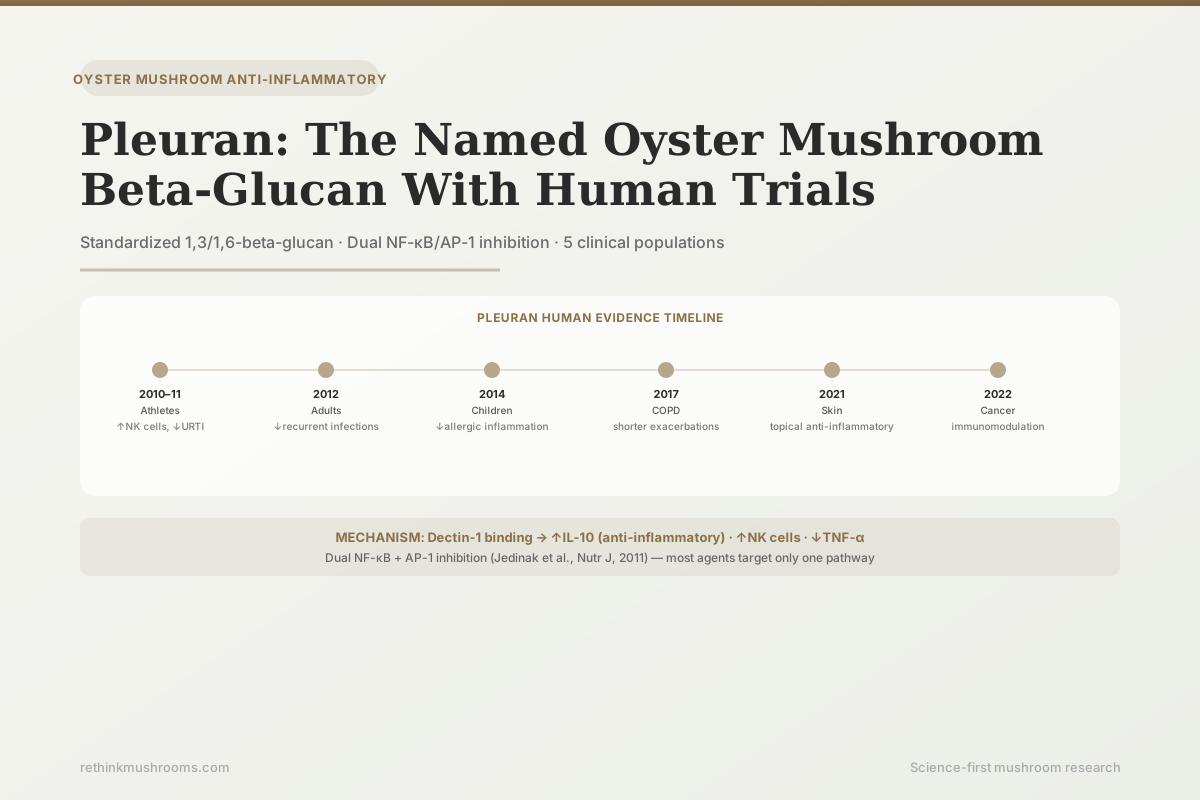
Pleuran has been studied in human trials spanning athletes, children with recurrent infections, children with allergies, COPD patients, and breast cancer patients, each with documented immune and cytokine modulation effects.
Multiple RCTs, 2010–2022
Standardized compound
Pleuran is a named 1,3/1,6-beta-glucan from P. ostreatus, not generic mushroom extract; it has a defined structure and its own clinical evidence base
Dual-pathway inhibitor
Oyster mushroom inhibits both NF-κB AND AP-1 transcription factors; most anti-inflammatory agents target only one (Jedinak et al., 2011)
IL-10 increased
Pleuran shifts cytokine balance toward IL-10 (the anti-inflammatory regulator) while reducing TNF-α in pro-inflammatory immune states
Multiple RCTs, 2010–2022
 View as image ↗
Most articles about oyster mushrooms and inflammation refer to beta-glucan as the active compound and leave it there. Pleuran is different. It is a specific, named, standardized beta-glucan compound extracted from Pleurotus ostreatus, the common oyster mushroom, with its own body of human clinical trials across multiple diseases and populations. Understanding Pleuran as a distinct compound rather than generic "mushroom beta-glucan" is the key to interpreting the clinical evidence correctly.
This article covers what Pleuran is, how it modulates cytokines, and what the human evidence shows across athletes, children, COPD patients, cancer patients, and skin inflammation applications. For the broader picture of oyster mushroom anti-inflammatory mechanisms including NF-κB inhibition and adhesion molecule suppression, see Oyster Mushroom and Inflammation: Anti-Inflammatory Mechanisms. For the complete oyster mushroom research guide, see our pillar article on oyster mushrooms.
Key Takeaways
- Pleuran is a standardized insoluble 1,3/1,6-beta-glucan from Pleurotus ostreatus with a defined molecular structure and its own clinical trial evidence base, distinct from generic beta-glucan supplements
- Pleuran binds the Dectin-1 receptor on macrophages, triggering an intracellular signaling cascade that increases IL-10 (an anti-inflammatory balancing protein), activates NK cells, and reduces TNF-α production in pro-inflammatory states
- Two human RCTs in athletes (Bergendiová et al., Eur J Nutr, 2010 and 2011) established Pleuran's immunomodulatory effects, including increased NK cell activity and reduced upper respiratory infection incidence
- Subsequent RCTs extended the evidence to children with recurrent respiratory infections (Mitera et al., 2012) and children with allergic inflammation (Jesenak et al., 2014), showing effects on both Th1 and Th2 immune arms
- Observational human data shows Pleuran shortened COPD exacerbation duration (Minov et al., 2017), and a clinical study documented immune modulation in breast cancer patients (Spacek et al., 2022)
- The Jedinak 2011 mechanistic study established that oyster mushroom inhibits both NF-κB AND AP-1 transcription factors simultaneously, a dual-pathway inhibition that distinguishes it from most single-target anti-inflammatory agents
What Pleuran Is and Why the Named Compound Distinction Matters
Most mushroom health discussions treat "beta-glucan" as a single entity. It is not. Beta-glucan is a category of polysaccharides that varies by source species, molecular weight, degree of branching, solubility, and three-dimensional structure. Different beta-glucans activate different receptors, produce different immune responses, and have different clinical evidence.
Pleuran is a specific preparation: an insoluble 1,3/1,6-linked beta-D-glucan extracted from the fruiting bodies of Pleurotus ostreatus. It has a defined molecular structure, a consistent extraction protocol, and clinical studies using standardized doses of the named compound. This is the same type of distinction as "lentinan" from shiitake (another named, standardized mushroom polysaccharide), where the compound designation carries specific structural and clinical meaning beyond just "mushroom beta-glucan."
Pleuran's insolubility is a structural property that matters for how it interacts with the immune system. Insoluble beta-glucans are recognized differently from soluble ones at the gut-immune interface. They interact with gut-associated lymphoid tissue, are taken up by intestinal immune cells, and trigger immune responses via a different physical mechanism than soluble fibers that dissolve and form gels. Both have immune effects, but through different pathways.
Bergendiová and colleagues published the foundation study establishing Pleuran as a defined human immunomodulatory intervention in the European Journal of Nutrition in 2010.[1] This study characterized the dose and safety profile that the subsequent clinical trials built on. Pleuran is commercially available as a supplement ingredient under that trade name, manufactured by BioAktiv SK in Slovakia, and has been used as the test article in the clinical studies described below.
How Pleuran Modulates Cytokines: The Dectin-1 Pathway
Pleuran's cytokine effects begin at a surface receptor called Dectin-1. Dectin-1 is a pattern recognition receptor on macrophages, dendritic cells, and other immune cells that functions as a shape-specific lock for beta-1,3-glucan molecules. When Pleuran binds Dectin-1, it fires an intracellular signal chain (through Syk kinase and CARD9) that activates NF-κB (the master inflammation-switching protein) and simultaneously drives the production of specific cytokines.
The cytokine profile that Pleuran drives is specifically immunomodulatory rather than simply pro-inflammatory or anti-inflammatory. It increases IL-10, an anti-inflammatory regulatory protein that acts as a brake on excessive immune responses. It increases IL-12 and stimulates NK cell (natural killer cell) activity, which enhances immune surveillance. And it can suppress TNF-α (the primary inflammatory alarm signal) in states of existing excess inflammation.
The mechanistic study by Jedinak and colleagues published in Nutrition Journal in 2011 identified a particularly important property of oyster mushroom's anti-inflammatory activity: it inhibits two inflammation-activating proteins simultaneously.[3] NF-κB is the master switch for inflammation genes. AP-1 is a second transcription factor that controls a parallel set of inflammatory genes related to cell stress, immune activation, and cytokine production. Most anti-inflammatory drugs or compounds target one of these pathways. Oyster mushroom extract blocked both NF-κB and AP-1 activation, reducing TNF-α, IL-1β, IL-6, and nitric oxide production across both pathways.
This dual-pathway inhibition matters mechanistically: inflammation driven through the AP-1 pathway (which occurs in conditions like colitis, skin inflammation, and certain infections) would not be addressed by an NF-κB-only inhibitor. Oyster mushroom's broader pathway coverage may explain why Pleuran shows effects across conditions that involve different inflammatory mechanisms.
The result in terms of cytokine balance: Pleuran increases IL-10 (the regulatory anti-inflammatory signal), reduces excess TNF-α, IL-1β, and IL-6 production in inflamed states, and activates NK cells and macrophages toward a more effective but better-regulated immune response.
The Athlete Studies: Where the Human Evidence Base Began
The first systematic human evidence for Pleuran came from studies in athletes, where the combination of high physical stress, frequent respiratory infections, and well-defined immune parameters made for a measurable test population.
Bergendiová and colleagues published a second study in the European Journal of Nutrition in 2011, testing Pleuran supplementation in athletes over a training season.[2] Compared to placebo, the Pleuran-supplemented athletes showed significantly reduced incidence of upper respiratory tract infections, along with increased circulating NK cell counts. This established two human-level effects: a practical clinical outcome (fewer infections) and a mechanistic immune marker (higher NK cells) supporting the cytokine modulation hypothesis.
Athletes experience post-exercise immune suppression, a well-documented transient depression of immune function following intense training. The NK cell and infection reduction findings suggest Pleuran blunts this suppressive effect by maintaining the IL-12/NK cell activation side of the immune balance even under physical stress.
Children, COPD, and the Breadth of Human Evidence
The athlete studies established Pleuran's immunomodulatory effects in stressed healthy adults. Subsequent research extended the evidence to populations with different types of immune dysregulation.
Mitera and colleagues published a human RCT in 2012 showing that Pleuran supplementation significantly reduced the frequency of recurrent respiratory tract infections in human subjects.[4] This is a common pediatric condition where the immune system is not effectively clearing recurrent bacterial and viral challenges. The Pleuran effect here is on the Th1 side of immunity, the arm that coordinates responses against infectious pathogens.
In 2014, Jesenak and colleagues extended the evidence to allergic inflammation in children, showing that Pleuran reduced allergic symptoms in children with recurrent respiratory infections who also had allergic sensitization.[5] Allergic inflammation is driven by a different immune arm, Th2, which produces IgE antibodies and drives the symptoms of allergic rhinitis, asthma, and eczema. The fact that Pleuran showed effects on Th2-mediated allergic inflammation as well as Th1-mediated infectious response is significant: it suggests Pleuran modulates cytokine balance more broadly rather than simply shifting toward one immune arm.
This is consistent with IL-10's role. IL-10 acts as a regulatory brake on both Th1 and Th2 excessive responses, preventing either over-stimulation or over-suppression. A compound that raises IL-10 would theoretically moderate both types of immune dysregulation.
Moving to chronic inflammatory disease, Minov and colleagues published a 2017 observational study in 32 COPD patients supplemented with Pleuran.[6] COPD (chronic obstructive pulmonary disease) is characterized by persistent airway inflammation, with repeated exacerbations that cause significant morbidity. The Pleuran group had shorter exacerbation duration compared to controls (6.7 days versus 7.4 days). This is an observational study and cannot establish causation, but the finding in a difficult chronic inflammatory condition is consistent with Pleuran's immunomodulatory profile and supports extension of the evidence beyond healthy populations.
Spacek and colleagues' 2022 clinical study in breast cancer patients receiving treatment found that Pleuran from Pleurotus ostreatus beta-glucan modulated immune parameters in this population.[7] Cancer and cancer treatment create severe immune dysregulation; the Pleuran evidence in this context suggests the immunomodulatory effects are present even in heavily compromised immune systems.
The topical extension of Pleuran research was published by Schiano and colleagues in 2021, testing Pleuran applied to skin in a human study.[8] The result was improved skin parameters with soothing and anti-inflammatory effects at the local tissue level. This adds a fifth application domain: not just systemic immune modulation after oral consumption, but direct local anti-inflammatory activity when applied topically, relevant to eczema and atopic dermatitis.
Where Pleuran Fits Within the Broader Beta-Glucan Clinical Evidence
Dalmas and colleagues published a systematic review in 2021 examining the full body of RCT evidence for fungal beta-glucans across all health applications.[9] Pleuran from Pleurotus ostreatus features as one of the better-characterized beta-glucan compounds in the clinical literature, with multiple independent RCTs across different conditions providing a consistent signal.
The overall picture from the systematic review context: fungal beta-glucans including Pleuran have demonstrated consistent effects on immune modulation and some inflammatory markers in human trials. The evidence quality ranges from high (well-designed RCTs) to low (small observational studies), and more large-scale trials are needed. But the direction is consistent and the mechanistic basis is established.
What distinguishes Pleuran from most mushroom supplement discussions is the combination of: a named and standardized compound, multiple independent research groups testing it, human trial evidence across diverse clinical populations, and a mechanistic explanation (dual NF-κB/AP-1 inhibition plus Dectin-1-mediated cytokine modulation) that coheres with the clinical findings.
For the chronic inflammatory conditions covered by this evidence base, see Oyster Mushroom for Chronic Inflammatory Conditions. For the joint inflammation preclinical evidence for oyster mushroom, see Oyster Mushroom and Joint Inflammation: Preclinical Evidence and Oyster Mushroom Arthritis Research. For how mushroom beta-glucans reduce gut inflammation, see Mushroom Beta-Glucans and Gut Inflammation. For the antioxidant activity that is upstream of the anti-inflammatory cascade, see Oyster Mushroom and Antioxidants.
The Bottom Line
Pleuran is a standardized 1,3/1,6-beta-glucan from Pleurotus ostreatus with a defined clinical evidence base across athletes, children with recurrent infections and allergies, COPD patients, breast cancer patients, and skin inflammation applications. Its cytokine effects work through Dectin-1 receptor activation, increasing IL-10 and NK cell activity while reducing TNF-α in pro-inflammatory states. The mechanistic study by Jedinak 2011 established dual NF-κB and AP-1 inhibition as a distinguishing property. The evidence quality ranges from strong RCTs in athletes and children to observational data in COPD; no large-scale trials exist in autoimmune disease specifically.
Frequently Asked Questions
Sources & References
- 1. Source details for this reference are not yet available.
- 2. Source details for this reference are not yet available.
- 3. Source details for this reference are not yet available.
- 4. Source details for this reference are not yet available.
- 5. Source details for this reference are not yet available.
- 6RTHM-00897·Minov, Jordan et al. (2017). “Effects of Pleuran (Β-Glucan from Pleurotus Ostreatus) Supplementation on Incidence and Duration of COPD Exacerbations..” Open access Macedonian journal of medical sciences.Study breakdown →PubMed →↩
- 7RTHM-01617·Spacek, Jan et al. (2022). “Immunomodulation with β-glucan from Pleurotus ostreatus in patients with endocrine-dependent breast cancer..” Immunotherapy.Study breakdown →PubMed →↩
- 8. Source details for this reference are not yet available.
- 9. Source details for this reference are not yet available.