Oyster Mushroom & Inflammation
21 days
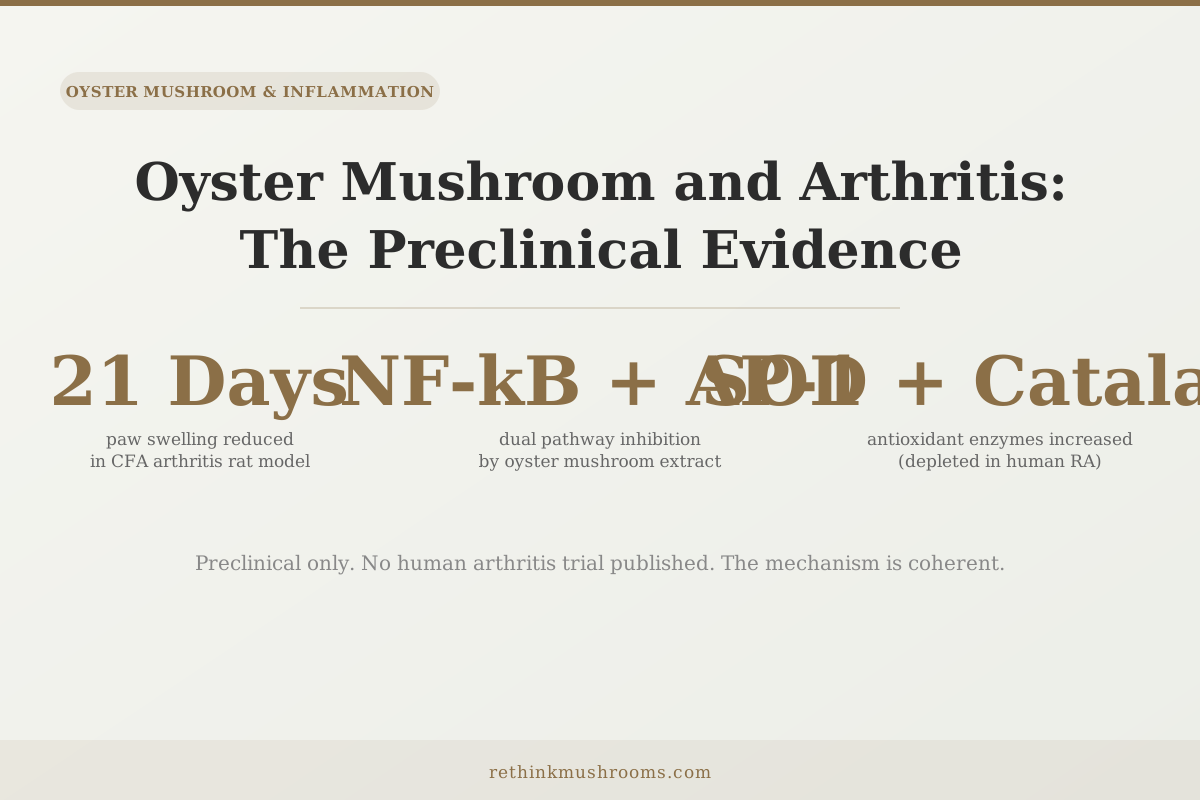
In rats with CFA-induced arthritis, a standard rheumatoid arthritis model, Pleurotus ostreatus extract significantly reduced paw swelling and joint diameter over 21 days, alongside increases in antioxidant enzymes depleted in human RA.
Mathew et al., International Journal of Medicinal Mushrooms, 2019
Dual Pathway
NF-kB + AP-1 both inhibited: oyster mushroom blocks two inflammation switches
5 Species
anti-inflammatory potency compared across the Pleurotus genus (Sarangi 2022)
No Human RCT
arthritis-specific trial in humans has not been published
Mathew et al., International Journal of Medicinal Mushrooms, 2019
 View as image ↗
Oyster mushroom (Pleurotus ostreatus) has been evaluated in a standard rat model of rheumatoid arthritis, and the results are specific enough to be worth examining in detail. The primary study tested whole mushroom extract against CFA-induced arthritis in rats over three weeks, measuring paw swelling, joint dimensions, antioxidant enzyme activity, and proteinase levels. It is the most direct preclinical evidence currently available for oyster mushroom arthritis research.
There is no published human randomized controlled trial testing oyster mushroom in arthritis patients. This article covers the preclinical case for why that trial might be worth running, what the current animal and cell evidence shows, and what the honest limitations are.
For an overview of oyster mushroom research more broadly, what is oyster mushroom covers the full species profile. This article focuses on the arthritis-specific evidence.
Key Takeaways
- Pleurotus ostreatus extract significantly reduced paw volume, joint diameter, and inflammatory markers in rats with CFA-induced arthritis over 21 days, with X-ray confirmation of reduced joint swelling (Mathew 2019)
- The same study found increased superoxide dismutase (SOD) and catalase activity in treated animals; both enzymes are specifically depleted in human rheumatoid arthritis, making this finding clinically meaningful
- Oyster mushroom inhibits two separate inflammation transcription factors, NF-kB and AP-1, simultaneously; most anti-inflammatory drugs target only one pathway (Jedinak 2011)
- A 2022 comparison of five Pleurotus species found species-specific differences in NF-kB inhibition potency, with P. ostreatus among the most active (Sarangi 2022)
- P. eryngii (king oyster) beta-glucan showed distinct immunomodulatory properties from P. ostreatus beta-glucan, suggesting the specific species matters for expected effects (Chan 2017)
- No human clinical trial has tested oyster mushroom specifically in arthritis or joint inflammation patients; the evidence base is preclinical
What the CFA Arthritis Model Is and Why Researchers Use It
The Complete Freund's Adjuvant (CFA) model is the most widely used preclinical model for rheumatoid arthritis research. Before examining what oyster mushroom did in this model, it helps to understand what the model actually measures, because this is what allows you to interpret the results.
CFA is a mixture of killed mycobacteria and mineral oil. When injected into a joint or foot pad, it triggers a systemic immune reaction and a persistent inflammatory response in the joint tissue. Over the following weeks, the injected animals develop symptoms that closely resemble human RA: swelling, joint damage, cartilage erosion, elevated inflammatory markers, and reduced mobility.
This model has been used for decades to test NSAIDs, corticosteroids, and biological disease-modifying drugs before they enter human trials. The same methods used to evaluate ibuprofen, methotrexate, and anti-TNF biologics in early development were applied to the oyster mushroom extract study. This doesn't mean the outcomes will translate to humans. Animal models fail to predict human outcomes more often than they succeed. But it does mean the preclinical evidence is gathered using validated methodology.
The specific outcomes measured in the Mathew 2019 study are worth understanding individually, because each maps to a real feature of human RA.
What the Oyster Mushroom Arthritis Study Found
Mathew and colleagues published their evaluation of Pleurotus ostreatus extract in CFA-induced arthritis in the International Journal of Medicinal Mushrooms in 2019.[1] Rats were given whole mushroom extract orally alongside induction of CFA arthritis, and measured across multiple endpoints over 21 days.
Paw volume and joint diameter. The arthritis-treated rats given oyster mushroom extract showed significantly lower paw swelling compared to the untreated arthritis group. Joint diameter was also significantly reduced. X-ray imaging confirmed the structural finding: joint swelling was visibly reduced in the extract-treated animals. In human RA, joint swelling is both the most visible symptom and a direct measure of synovial inflammation.
Gripping activity. The treated animals showed improved grip activity compared to arthritic controls. Grip strength is used as a functional endpoint in arthritis research because it reflects the practical consequence of joint inflammation on mobility and pain-driven behavior. In humans, grip strength is a standard clinical measure of RA disease activity.
Antioxidant enzymes: SOD and catalase. This finding is often missed in secondary coverage of mushroom research, but it is mechanistically important. Superoxide dismutase (SOD) and catalase are the body's two primary antioxidant enzymes. Both are specifically and measurably depleted in human rheumatoid arthritis joints. Oxidative stress in RA synovial tissue is not incidental to the disease; it drives cartilage damage and synovial inflammation by activating NF-kB, the master inflammatory transcription factor.
The oyster mushroom extract significantly increased SOD and catalase activity in the arthritic rats.[1] This finding connects two separate research streams: the antioxidant properties of oyster mushroom, which have been studied independently, and the arthritis research. The antioxidant effect provides a mechanistic explanation for why anti-inflammatory effects appear: oyster mushroom appears to interrupt the oxidative stress that activates NF-kB, reducing inflammation upstream of the cytokine cascade.
Proteinase activity. The study also measured proteinase (protease) activity, which was reduced in treated animals. In human RA, matrix metalloproteinases and other proteases are the direct agents of cartilage destruction: they digest the collagen matrix of joint cartilage. Reducing proteinase activity in an arthritis model is a clinically meaningful finding because it speaks to cartilage preservation, not just symptom reduction. For readers interested in the antioxidant research stream that connects to this finding, oyster mushroom antioxidant research covers that evidence base.
The Two Inflammation Pathways Oyster Mushroom Blocks
The mechanistic depth of the oyster mushroom arthritis evidence comes from a 2011 study by Jedinak and colleagues, published in the journal Nutrition Journal, which specifically investigated how oyster mushroom extract suppresses inflammation at the molecular level.[2]
Most anti-inflammatory drugs work by targeting a single pathway. Ibuprofen and other NSAIDs block COX enzymes. Corticosteroids broadly suppress immune signaling. Biological anti-TNF drugs (like etanercept and adalimumab) specifically neutralize one cytokine.
Oyster mushroom extract inhibited two separate transcription factors: NF-kB and AP-1. Both are master regulators of inflammatory gene expression. NF-kB is often called "the master inflammation switch" because when it activates, it turns on the genes for TNF-α, IL-1β, IL-6, and nitric oxide production. AP-1 is a separate transcription factor that also drives inflammatory gene expression, particularly the matrix metalloproteinases that destroy cartilage.
When Jedinak's team measured the downstream effects, they found that inhibiting both transcription factors reduced production of TNF-α, IL-1β, IL-6, and nitric oxide simultaneously. All four are central drivers of RA synovial inflammation. TNF-α and IL-1β are specifically targeted by expensive biological drugs in human RA treatment.
The dual inhibition distinguishes oyster mushroom from single-pathway anti-inflammatory agents. Whether this advantage translates to human joint tissue, where the inflammatory milieu is far more complex than cell culture, is not yet tested. The mechanism is documented; the clinical translation is not.
This pathway evidence connects directly to the Mathew arthritis study: the antioxidant enzyme increase (SOD, catalase) reduces oxidative stress, which in turn reduces NF-kB activation, which reduces cytokine production, which reduces joint inflammation. These aren't isolated observations; they form a coherent mechanistic chain. For more on the broader inflammation mechanisms of oyster mushroom, the article on oyster mushroom anti-inflammatory mechanisms covers this in full.
Does the Species Matter? Differences Within the Oyster Mushroom Genus
"Oyster mushroom" is not a single entity. The Pleurotus genus includes dozens of species, and the research spans several of them. Understanding which species was studied, and whether species differences are biologically significant, is important for interpreting the evidence.
Sarangi and colleagues published a 2022 comparison of five Pleurotus species in the journal Antioxidants, measuring anti-inflammatory and antioxidant potency across P. ostreatus, P. eryngii, P. djamor, P. citrinopileatus, and P. pulmonarius.[3] The study found species-specific differences in both antioxidant capacity and cytokine suppression, with P. ostreatus showing strong NF-kB inhibition across multiple assays. This is the first systematic within-genus comparison for anti-inflammatory potency, and it establishes that choosing which oyster mushroom species matters for anti-inflammatory applications.
The king oyster mushroom (P. eryngii) is separately studied for its beta-glucan profile. Chan and colleagues' 2017 study specifically isolated the extracellular beta-glucan from P. eryngii and found it showed distinct immunomodulatory properties compared to the well-characterized P. ostreatus beta-glucan known as Pleuran.[4] The P. eryngii beta-glucan activated macrophages and NK cells through partially different signaling pathways than Pleuran, suggesting that different oyster mushroom species may be preferable for different applications.
The practical implication for the arthritis research: the primary CFA arthritis study used P. ostreatus (the standard oyster mushroom), and the mechanistic inhibition data for NF-kB and AP-1 is also from P. ostreatus. This is the species with the most arthritis-relevant preclinical evidence. Products using P. eryngii (king oyster), while well-studied for other properties, have different beta-glucan profiles and have not been specifically evaluated in arthritis models.
For those interested in how oyster mushroom consumption connects to cardiovascular inflammation through similar adhesion molecule pathways, the article on oyster mushrooms and heart health covers that research separately.
The Evidence Ceiling and What a Human Trial Would Need to Show
The preclinical case for oyster mushroom in arthritis is coherent and specific. Paw swelling reduced in a validated arthritis model. Antioxidant enzymes depleted in human RA increased. Proteases that destroy cartilage decreased. The molecular mechanism explains these findings through dual NF-kB and AP-1 inhibition that targets the same cytokines (TNF-α, IL-1β) that expensive biological drugs address.
That is a strong preclinical profile. And it is still preclinical.
Animal models of RA fail to predict human clinical outcomes in the majority of cases. Hundreds of compounds have shown benefit in the CFA model that did not replicate in human trials. The reasons are structural: rat joints, rat immune systems, and rat inflammatory responses differ from human ones in ways that matter. The oral bioavailability of oyster mushroom compounds, specifically whether the active anti-inflammatory constituents actually reach the joint in meaningful concentrations after digestion, has not been tested in humans for this specific application.
A credible path from the current evidence to a human Phase I or II trial for oyster mushroom in arthritis would require: dose-finding studies to establish effective plasma concentrations, safety data in a relevant human population (mushroom food use provides background safety data), and a pilot trial measuring RA biomarkers (CRP, ESR, DAS28 score, or synovial histology) in patients with early-stage RA alongside standard treatment. None of these have been published.
For readers interested in where Pleuran's human immunomodulatory evidence currently stands across other inflammatory conditions, the article on Pleuran and inflammatory cytokine modulation covers the clinical research in athletes, children, and COPD patients. The article on oyster mushroom for chronic inflammatory conditions maps the full landscape of human evidence. For a broader look at the oyster mushroom joint inflammation evidence base including non-arthritis joint conditions, the companion article on oyster mushroom and joint inflammation covers systemic joint and inflammatory evidence beyond the RA-specific animal model data.
The absence of human clinical trial data is not evidence that the approach won't work; it is simply the current state of the research. The preclinical profile described here, including multi-pathway mechanism, specific endpoints in a validated model, and antioxidant findings that map to known RA deficits, is the kind of evidence base from which human trials are typically designed. Whether that step happens for oyster mushroom and arthritis is a question of research funding and priority, not of whether the underlying biology is interesting. It is.
The Bottom Line
Oyster mushroom (Pleurotus ostreatus) extract reduced paw swelling, joint diameter, and inflammatory markers in a CFA-induced rat arthritis model over 21 days, alongside increases in antioxidant enzymes (SOD, catalase) that are specifically depleted in human RA. The dual inhibition of NF-kB and AP-1 provides a mechanistic explanation linking the antioxidant findings to the joint inflammation outcomes. No human clinical trial in arthritis patients has been published. The preclinical evidence is specific and mechanistically coherent; clinical translation remains untested.
Frequently Asked Questions
Sources & References
- 1. Source details for this reference are not yet available.
- 2. Source details for this reference are not yet available.
- 3. Source details for this reference are not yet available.
- 4. Source details for this reference are not yet available.