Oyster Mushroom Research
3 rodent studies
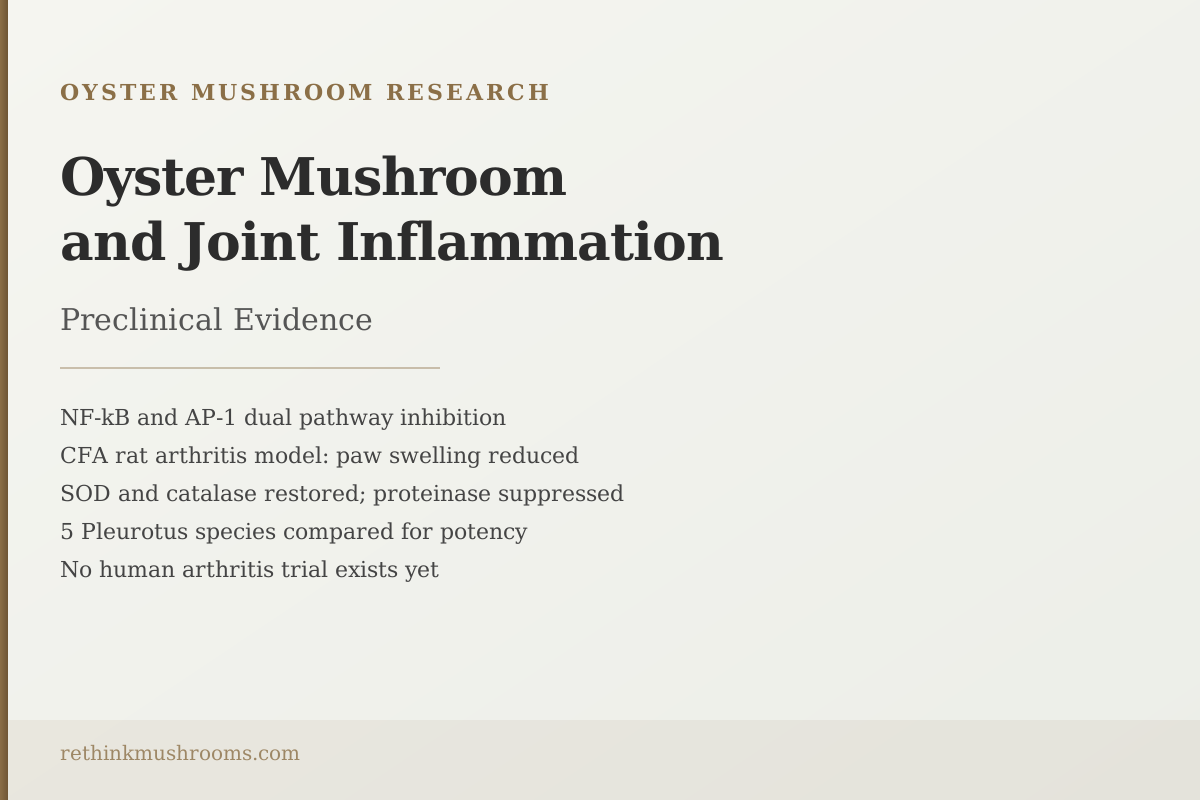
Three published animal studies have tested Pleurotus ostreatus in an induced-arthritis model — one using a whole-mushroom extract, two using the isolated beta-glucan. All three reported reduced paw swelling. None of them involved a human being.
Chourasia et al. 2019; Rovenský et al. 2011; Bauerová et al. 2009
Dual pathway
oyster mushroom extract inhibited DNA-binding of both NF-κB and AP-1 in macrophages, and suppressed TNF-α and IL-6 in mice given it orally
+ methotrexate
oyster mushroom beta-glucan potentiated methotrexate in arthritic rats, producing a larger reduction in paw swelling than the drug alone
No human trial
oyster mushroom has never been tested in a human arthritis clinical trial; all joint-specific evidence is rodent or cell-culture work
Chourasia et al. 2019; Rovenský et al. 2011; Bauerová et al. 2009
 View as image ↗
Most writing about oyster mushroom joint inflammation repeats the same line: there is one animal study, and no human data. Half of that is right. The human half is right — nobody has run an arthritis trial in people. The animal half is not. Three published rodent studies have tested Pleurotus ostreatus in an induced-arthritis model, and the two that get missed are arguably the more interesting ones, because they tested the isolated beta-glucan rather than the mushroom, and one of them tested it against and alongside methotrexate.
That gap in the record exists for a mundane reason. The beta-glucan from oyster mushroom is sold under its own names — Pleuran, Imunoglukán — so studies about it do not surface when you search for the mushroom. The result is a literature that looks thinner than it is, and a set of findings that look simpler than they are.
This article covers what those three studies actually measured, what the supporting mechanistic work does and does not show, and where the evidence stops. Where the commonly repeated version of a finding is wrong, it says so.
For a broader overview of oyster mushroom's documented properties, see what is oyster mushroom: the world's second most popular mushroom.
Key Takeaways
- Three published rodent studies have tested oyster mushroom in an induced-arthritis model, not one: a whole-extract study (Chourasia 2019) and two studies of the isolated beta-(1,3/1,6)-D-glucan (Rovenský 2011; Bauerová 2009)
- In CFA-induced arthritis in rats, hydroethanolic P. ostreatus cv. Florida extract at 200 and 400 mg/kg orally significantly reduced paw volume and joint diameter and raised SOD and catalase activity over 21 days; the extract's anti-proteinase effect was measured in vitro, not in joint tissue
- Oyster mushroom beta-glucan reduced hind paw swelling and arthritic score on its own, and when combined with methotrexate it markedly potentiated the drug — a larger reduction than methotrexate alone. That is an interaction finding as much as a benefit finding
- Oyster mushroom extract inhibited the DNA-binding activity of both NF-κB and AP-1 in macrophages while suppressing TNF-α, IL-6 and IL-12p40; oral dosing also suppressed TNF-α and IL-6 in mice, so this is not purely cell-culture work
- The widely repeated claim that oyster mushroom "inhibits ICAM-1 and VCAM-1" overstates its source. In that study white button mushroom consistently reduced the adhesion molecules; oyster mushroom modulated them selectively. What every species did do was reduce monocyte binding
- No human clinical trial has tested oyster mushroom, in any preparation, in arthritis or any other joint condition
Why Joint Inflammation Works the Way It Does
Chronic joint inflammation, whether from rheumatoid arthritis or another inflammatory joint condition, runs through several overlapping mechanisms. Two transcription factors act as master switches: NF-κB (nuclear factor kappa-light-chain-enhancer of activated B cells) and AP-1 (activator protein 1). When these are activated in synovial tissue — the membrane lining the joint — they switch on production of TNF-α, IL-1β, IL-6 and nitric oxide, the mediators that drive synovial inflammation and joint destruction.
A second mechanism is proteinase activity. Proteinases, including the matrix metalloproteinases, break down the extracellular matrix that cartilage is built from. Their overproduction in inflamed joints contributes to the progressive cartilage loss seen in late-stage rheumatoid arthritis and in osteoarthritis.
A third is oxidative stress. Free radicals generated by activated immune cells in the joint both damage tissue directly and further activate NF-κB, creating a self-reinforcing loop. Antioxidant enzymes such as superoxide dismutase (SOD) and catalase normally contain that loop.
These three mechanisms are worth holding in mind, because they are precisely the endpoints the rodent studies measured.
What the Three Rodent Studies Actually Tested
The Complete Freund's Adjuvant (CFA) model and the closely related adjuvant arthritis model are the standard preclinical approaches for rheumatoid arthritis. Injecting adjuvant into rats produces sustained immune activation and synovial inflammation that reproduces several of RA's features: joint swelling, immune infiltration, systemic inflammatory markers and weight loss. The same models are used to evaluate NSAIDs and DMARDs before human trials.
Evidence Ledger
Three Rodent Joint-Inflammation Studies, Not One
Oyster mushroom joint content routinely describes a single animal study. Three exist — and they tested two different things. One used a whole-mushroom extract; two used the isolated β-glucan, which is sold under its own product names and so gets missed by anyone searching on the mushroom rather than the compound.
Parameter
Chourasia 2019 [1]
Rovenský 2011 [2]
Bauerová 2009 [3]
What was given
Hydroethanolic extract, whole mushroom
β-(1,3/1,6)-D-glucan, isolated
β-(1,3/1,6)-D-glucan (Imunoglukan)
Source
P. ostreatus cv. Florida
P. ostreatus
P. ostreatus
Model
Complete Freund’s Adjuvant arthritis, rats
Adjuvant arthritis, rats
Adjuvant arthritis, Lewis rats
Dose and route
200 and 400 mg/kg, oral
1 mg/kg every second day
2 mg/kg daily, oral
Duration
21 days
28 days
28 days
Active comparator
Piroxicam 4 mg/kg i.p.
Methotrexate 1 mg/kg/week (and combination)
Glucomannan 15 mg/kg (separate arm)
Reported outcomes
- Paw volume ↓ (p < 0.001)
- Joint diameter ↓ (p < 0.001)
- SOD and catalase ↑ (p < 0.001)
- X-ray joint swelling ↓; grip activity ↑
- Proteinase activity ↓ — in vitro arm only
- Hind paw swelling ↓ (glucan alone)
- Arthritic score ↓ (glucan alone)
- Combination potentiated MTX on both
- Serum albumin decline blocked (MTX arms)
- Hind paw volume ↓
- GGT activity ↓ in hind paw joint homogenate
- TBARS ↓, total antioxidant status ↑
- IL-1α, IL-4, TNF-α, MCP-1 modulated
Why this matters: three independent rodent studies reporting reduced paw swelling is a stronger and more interesting starting point than one — but it is also a narrower one than it first looks. Two of the three tested the isolated β-glucan rather than the mushroom, all three used adjuvant-induced arthritis in rats, and none of them establishes a dose, a preparation, or an outcome in a human being. Nothing here is medical advice.
Sources: Chourasia 2019 [1]; Rovenský 2011 [2]; Bauerová 2009 [3]. Values as reported in the published abstracts.
The most recent is also the most conventional. In 2019, Chourasia and colleagues published a CFA arthritis study in the International Journal of Medicinal Mushrooms.[1] Rats with CFA-induced arthritis received hydroethanolic extract of Pleurotus ostreatus cv. Florida orally at 200 and 400 mg/kg over 21 days, with piroxicam at 4 mg/kg intraperitoneally as an active comparator.
The study had two arms, and the distinction matters. In vitro, the extract produced a significant decrease (p < 0.001) in proteinase activity and significant membrane stabilisation across antiproteinase, albumin denaturation and heat-induced haemolysis assays. In vivo, extract-treated rats showed significant decreases (p < 0.001) in paw volume and joint diameter over 21 days. X-ray examination showed reduced joint swelling, histopathology showed a significant decrease in joint space, and grip activity improved as a functional measure. SOD and catalase activities rose significantly — the antioxidant arm of the result, and the reason the authors described the extract as demonstrating potent antioxidant activity rather than only anti-inflammatory activity.
So the anti-proteinase finding, which is the one most directly relevant to cartilage protection, is a test-tube result rather than a measurement in the animals' joints. It is a reason to look further, not evidence that the extract preserved cartilage in a living rat.
Chourasia, Tiwari, Ganeshpurkar, Jaiswal, Shrivastava, Dubey (2019) · International Journal of Medicinal Mushrooms
- Population
- Rats with Complete Freund's Adjuvant-induced arthritis
- Intervention
- Hydroethanolic extract of P. ostreatus cv. Florida, 200 and 400 mg/kg orally, 21 days
- Comparator
- Piroxicam 4 mg/kg intraperitoneally
- Finding
- In vivo: significant (p < 0.001) reductions in paw volume and joint diameter, significant increases in superoxide dismutase and catalase, reduced joint swelling on X-ray, and improved grip activity versus arthritic controls. In vitro: significant (p < 0.001) reduction in proteinase activity and membrane stabilisation.
positive A clean, multi-endpoint animal result with an active drug comparator. It is still rats, still 21 days, the anti-proteinase result is in vitro rather than in joint tissue, and the doses used have no established human equivalent.
Chourasia et al., International Journal of Medicinal Mushrooms, 2019
The two older studies tested something different: not the mushroom, but the beta-(1,3/1,6)-D-glucan isolated from it — the compound marketed as Pleuran and, in the Slovak research where much of this work originates, as Imunoglukán.
In 2009, Bauerová and colleagues gave that glucan orally at 2 mg/kg daily to Lewis rats with adjuvant arthritis induced by Mycobacterium butyricum.[3] Hind paw volume fell. So did plasma thiobarbituric acid-reacting substances, a marker of lipid peroxidation, while total antioxidant status rose. Most relevant to joints specifically, gamma-glutamyl transferase activity fell in hind paw joint homogenate — an actual measurement in joint tissue rather than a systemic proxy. Plasma IL-1α, IL-4, TNF-α and MCP-1 were all modulated in the treated animals.
The Methotrexate Result
The 2011 study by Rovenský and colleagues, published in Rheumatology International, is the one that deserves the most attention and gets the least.[2] It was not designed to ask whether oyster mushroom glucan works. It was designed to ask whether the glucan changes what methotrexate does — methotrexate being the first-line disease-modifying drug for rheumatoid arthritis in actual clinical practice.
Rats with adjuvant arthritis received methotrexate at 1 mg/kg per week, beta-glucan from P. ostreatus at 1 mg/kg every second day, or both, for 28 days. The glucan on its own significantly decreased hind paw swelling and arthritic score. Methotrexate on its own significantly inhibited markers of inflammation and arthritis. The combination produced a more significant reduction in both swelling and arthritic score than methotrexate alone — the authors described the glucan as markedly potentiating the drug's effects, and concluded that it increased the treatment efficacy of methotrexate.
Combination Finding
The Study That Tested Oyster Glucan Alongside a Real Arthritis Drug
Rovenský 2011 ran four arms in adjuvant-arthritic rats over 28 days. The interesting result is not that the β-glucan worked alone — it is that adding it to methotrexate, the first-line drug for rheumatoid arthritis, produced a larger reduction than methotrexate by itself.
Bar lengths encode the ordering the authors reported, not measured values — the published abstract gives direction and statistical significance for each arm but does not publish numeric effect sizes.
Arthritic control
Reference state. Serum albumin significantly lower than in healthy controls.
β-glucan-PO alone
Significantly decreased hind paw swelling and arthritic score on its own.
Methotrexate alone
Low-dose MTX significantly inhibited markers of both inflammation and arthritis.
MTX + β-glucan-PO
Glucan “markedly potentiated” MTX — a more significant reduction in swelling and arthritic score than MTX alone.
Read this carefully: a compound that measurably changes what methotrexate does in an animal is not thereby a safe thing to add to methotrexate in a person. Potentiation and interaction are the same observation described with two different levels of enthusiasm. This was rats, prophylactic dosing, 28 days, and no human co-administration study has been done. Anyone taking a DMARD should treat this as a reason to ask their rheumatologist before adding a β-glucan supplement, not as a reason to add one. Nothing here is medical advice.
Source: Rovenský et al., Rheumatology International, 2011 [2].
The Dual Pathway Mechanism
The mechanistic basis for all of this comes from a 2011 study by Jedinak and colleagues in Nutrition Journal, which found that oyster mushroom concentrate suppresses inflammation through simultaneous inhibition of NF-κB and AP-1.[4]
In RAW264.7 murine macrophages, oyster mushroom concentrate at 0–100 μg/ml suppressed LPS-induced secretion of TNF-α, IL-6 and IL-12p40, and reduced prostaglandin E2 and nitric oxide production by downregulating COX-2 and iNOS. Gel-shift analysis showed it inhibited the LPS-dependent DNA-binding activity of both AP-1 and NF-κB. In concanavalin A-stimulated mouse splenocytes it also inhibited proliferation and the secretion of interferon-γ, IL-2 and IL-6.
It is worth being precise about one detail that secondary summaries routinely get wrong: this study is not purely in vitro. Oral administration of the concentrate markedly suppressed TNF-α and IL-6 in mice challenged with LPS. That in vivo oral arm is what makes the mechanism relevant to something a person might swallow, rather than a phenomenon confined to cells in a dish.
Two pathways matter more than one because most anti-inflammatory agents work primarily through NF-κB, and AP-1 regulates many of the same pro-inflammatory genes through a separate route. Both are active in the inflamed synovium in rheumatoid arthritis. That said, the cytokines Jedinak measured were TNF-α, IL-6 and IL-12p40 — not IL-1β, which is often attributed to this study and was not among its endpoints.
For the full mechanism breakdown across multiple pathways, see oyster mushroom and inflammation: anti-inflammatory mechanisms.
Species Comparison: Which Pleurotus, and For What
In 2022, Stastny and colleagues published a comparison of five Pleurotus species in Antioxidants, focusing deliberately on the lesser-known members of the genus alongside the familiar one.[5] The result was a split rather than a ranking.
The 80% methanol extract of P. ostreatus Florida — the same cultivar used in the arthritis study — was the most active in the NF-κB inhibition assay and had the highest beta-glucan content at 43.3% by dry weight. But P. flabellatus was the most active radical scavenger with the highest ORAC value and the highest content of ergosterol, ergothioneine and mannitol, and it was a chloroform extract of P. flabellatus, not P. ostreatus, that showed significant anti-inflammatory COX-2 activity. The authors singled out P. flabellatus as the species most worth further investigation.
The practical implication is narrower than "oyster mushroom is anti-inflammatory." Within a single genus, the species that best inhibits NF-κB is not the species with the strongest antioxidant profile or the COX-2 activity. "Oyster mushroom" as a supplement category is not chemically uniform, and the extraction solvent changes which activity you capture.
Adhesion Molecules: A Claim Worth Correcting
Martin published a 2010 study in Nutrition Journal testing whether common and specialty mushrooms affect adhesion molecule expression in a pro-inflammatory environment.[6] Human aortic endothelial cells were treated with DMSO extracts of whole dehydrated mushrooms at 0.1 mg/mL, then stimulated with IL-1β at 5 ng/mL for six hours. ICAM-1, VCAM-1 and E-selectin-1 were assayed by ELISA, and binding of dye-loaded U937 human monocytes was measured.
ICAM-1 and VCAM-1 are the proteins that let circulating monocytes attach to blood vessel walls and enter tissue, and VCAM-1 overexpression in synovial vessels does facilitate the immune infiltration that sustains joint inflammation in RA. So the claim that oyster mushroom suppresses them is an attractive one. It is also stronger than the study supports.
Attribution check
Does oyster mushroom shut down ICAM-1 and VCAM-1?
The claim
“Oyster mushroom extract significantly inhibits the adhesion molecules ICAM-1 and VCAM-1 on blood vessel walls.”
Secondary summaries of Martin's 2010 mushroom panel, which collapse results from five mushroom varieties tested side by side into one headline and attach it to whichever species the article happens to be about.
What research shows
OverstatedWhite button mushroom was the extract that consistently reduced VCAM-1, ICAM-1 and E-selectin-1 (p < 0.05). Oyster mushroom sat in the group the author described as modulating adhesion molecule expression 'singly, collectively, or combinatorially' — selective, not uniform.
The finding that did hold for every species tested, oyster mushroom included, is arguably more functionally meaningful: all of them significantly reduced monocyte binding to the endothelium, which is the downstream event adhesion molecules exist to enable. This is cell-culture work in aortic cells, designed around cardiovascular disease, not joints.
Martin, Nutrition Journal, 2010
A related result comes from Lavi and colleagues in 2010, who gave glucans from Pleurotus pulmonarius — a relative of P. ostreatus — orally to mice with dextran sulfate sodium-induced colitis.[7] At the higher doses the glucan preparations blocked colon shortening, suppressed myeloperoxidase activity and improved macroscopic score; histological damage, tissue TNF-α protein and IL-1β expression fell across the dose range. Its relevance here is narrow but real: anti-inflammatory effects followed oral consumption of mushroom glucans, in a different tissue, in a different disease model. It is evidence that the route works, not evidence about joints.
For the connection between oyster mushroom antioxidant activity and its anti-inflammatory effects, see oyster mushroom and antioxidants: free radical scavenging research. For the adhesion molecule work in its intended cardiovascular context, see oyster mushrooms for heart health: cardiovascular research review.
Where the Evidence Stops
- Cell studiescompleted
Dual NF-κB and AP-1 DNA-binding inhibition with suppressed TNF-α, IL-6, IL-12p40, PGE2 and NO (Jedinak 2011). Adhesion molecule and monocyte binding panel (Martin 2010). Five-species extract comparison (Stastny 2022).
- Animal studiescurrent
Three induced-arthritis rodent studies: whole extract at 200–400 mg/kg over 21 days (Chourasia 2019); isolated beta-glucan alone and combined with methotrexate over 28 days (Rovenský 2011); oral Imunoglukán with joint-tissue GGT and plasma cytokine endpoints (Bauerová 2009). Oral glucans in DSS colitis (Lavi 2010).
- Small human trialsmissing
No trial of oyster mushroom or its beta-glucan has been run in people with arthritis or any joint condition, at any size.
- Large RCTsmissing
None.
- Meta-analysismissing
None. There is nothing human to pool.
The evidence sits firmly at the animal tier and has not moved off it. Three independent rodent studies is a more substantial base than the single-study version usually reported, and the methotrexate combination result gives the work a clinical shape. But the gap between that and the first human joint trial is total: no dose, no preparation, no safety data in inflammatory disease patients.
Chourasia 2019; Rovenský 2011; Bauerová 2009; Jedinak 2011; Martin 2010; Stastny 2022; Lavi 2010
Translation from animal models to human trials has a poor success rate in anti-inflammatory research generally, and particularly for compounds acting on pathways as central as NF-κB, where broad inhibition at the wrong dose produces immunosuppression rather than resolution.
Research gap
What would it take?
What would have to happen for oyster mushroom to become a credible option for joint inflammation?
Agreement on what is being tested
Two of the three animal studies used the isolated beta-glucan and one used a whole hydroethanolic extract. These are different interventions with different active fractions, and the field has not settled on which one a human trial would use.
Human pharmacokinetics into joint tissue
No data exists on whether any oyster mushroom compound reaches synovial tissue after oral dosing in humans, or at what concentration.
A defensible human dose
The rodent doses span 1 mg/kg of isolated glucan to 400 mg/kg of whole extract. No human equivalent dose has been established for either.
Safety data in inflammatory disease patients
Beta-glucans modulate immune signalling rather than simply suppressing it, which makes safety in autoimmune patients and those on immunosuppressants a question that must be answered before efficacy, not after.
A methotrexate co-administration study
The single most clinically-shaped animal finding — glucan potentiating methotrexate — is also the one that most needs a human interaction study before anyone acts on it.
A Phase 1/2 trial in any arthritis population
None registered or published.
Chourasia 2019; Rovenský 2011; Bauerová 2009
Practical context
ModerateAnimal evidence is not a treatment plan — and this one has a specific catch
Concern
The joint-specific evidence for oyster mushroom is entirely rodent and cell-culture. Treating culinary or supplemental oyster mushroom as a substitute for prescribed anti-inflammatory or disease-modifying therapy is not supported by anything described here. The methotrexate potentiation result adds a distinct concern: a compound that measurably amplifies a DMARD in animals is a compound that could alter its effect in a person, and no human interaction study has been done.
What the research says
Oyster mushrooms are a well-tolerated food and eating them is reasonable for ordinary dietary reasons. Anyone considering a concentrated beta-glucan supplement while managing a diagnosed joint condition should raise it with the clinician managing that condition first, particularly if they take methotrexate or another DMARD.
Particularly relevant for: People with rheumatoid arthritis or other autoimmune disease, anyone on immunosuppressants or methotrexate, and anyone with a known mushroom allergy warrant particular caution.
What to do
Treat this article as research education, not medical advice. Do not start, stop or change any prescribed medication on the basis of it.
Rovenský 2011; Bauerová 2009; Chourasia 2019
For the broader Pleuran evidence across human inflammatory conditions including respiratory infections, where the clinical evidence is genuinely more developed, see oyster mushroom for chronic inflammatory conditions. For how Pleuran modulates inflammatory cytokines specifically, see Pleuran and inflammatory cytokine modulation.
The Bottom Line
The preclinical case for oyster mushroom in joint inflammation rests on three rodent studies, not one. A hydroethanolic P. ostreatus cv. Florida extract at 200 and 400 mg/kg reduced paw volume and joint diameter while raising SOD and catalase over 21 days in CFA arthritis, with its anti-proteinase activity demonstrated in vitro rather than in joint tissue (Chourasia 2019). The isolated beta-(1,3/1,6)-D-glucan reduced hind paw swelling and arthritic score on its own, and markedly potentiated methotrexate when combined with it (Rovenský 2011). Oral Imunoglukán reduced hind paw volume and joint-tissue GGT activity while modulating plasma IL-1α, TNF-α and MCP-1 (Bauerová 2009). Supporting mechanism comes from dual NF-κB and AP-1 inhibition with an in vivo oral mouse arm (Jedinak 2011). The often-repeated claim that oyster mushroom suppresses ICAM-1 and VCAM-1 overstates its source, where white button mushroom carried that result. No human trial of oyster mushroom in arthritis or any joint condition has been published.
Frequently Asked Questions
Sources & References
- 1RTHM-01045·Chourasia, Ayushi et al. (2019). “Evaluation of Antiarthritic Effect of Culinary-Medicinal Oyster Mushroom Pleurotus ostreatus cv. Florida (Agaricomycetes) on Complete Freund's Adjuvant Induced Arthritis in Rats..” International journal of medicinal mushrooms.Study breakdown →PubMed →↩
- 2RTHM-02388·Rovenský, Jozef et al. (2011). “The effects of β-glucan isolated from Pleurotus ostreatus on methotrexate treatment in rats with adjuvant arthritis..” Rheumatology international.Study breakdown →PubMed →↩
- 3RTHM-02389·Bauerová, Katarína et al. (2009). “Study of new ways of supplementary and combinatory therapy of rheumatoid arthritis with immunomodulators. Glucomannan and Imunoglukán in adjuvant arthritis..” Toxicology and industrial health.Study breakdown →PubMed →↩
- 4RTHM-00219·Jedinak, Andrej et al. (2011). “Anti-inflammatory activity of edible oyster mushroom is mediated through the inhibition of NF-κB and AP-1 signaling..” Nutrition journal.Study breakdown →PubMed →↩
- 5RTHM-01618·Stastny, Jan et al. (2022). “Antioxidant and Anti-Inflammatory Activity of Five Medicinal Mushrooms of the Genus Pleurotus..” Antioxidants (Basel.Study breakdown →PubMed →↩
- 6RTHM-00354·Martin, Keith R (2010). “Both common and specialty mushrooms inhibit adhesion molecule expression and in vitro binding of monocytes to human aortic endothelial cells in a pro-inflammatory environment..” Nutrition journal.Study breakdown →PubMed →↩
- 7RTHM-00190·Lavi, Iris et al. (2010). “Orally administered glucans from the edible mushroom Pleurotus pulmonarius reduce acute inflammation in dextran sulfate sodium-induced experimental colitis..” The British journal of nutrition.Study breakdown →PubMed →↩