King Trumpet Mushroom
First Human RCT
Kleftaki 2022 was the first randomized controlled trial to use P. eryngii as food rather than extract, finding improvements in glucose, body weight, and inflammatory markers in 100 metabolically unhealthy adults.
Kleftaki et al., Antioxidants, 2022
Food-format trial
effects came from snacks, not extracts or concentrated supplements
Top ergothioneine source
Pleurotus species rank among the highest of all mushrooms (Kalaras 2017)
1-3% of diet
dose where P. eryngii reduced gut inflammation in mice (Hu 2019)
Kleftaki et al., Antioxidants, 2022
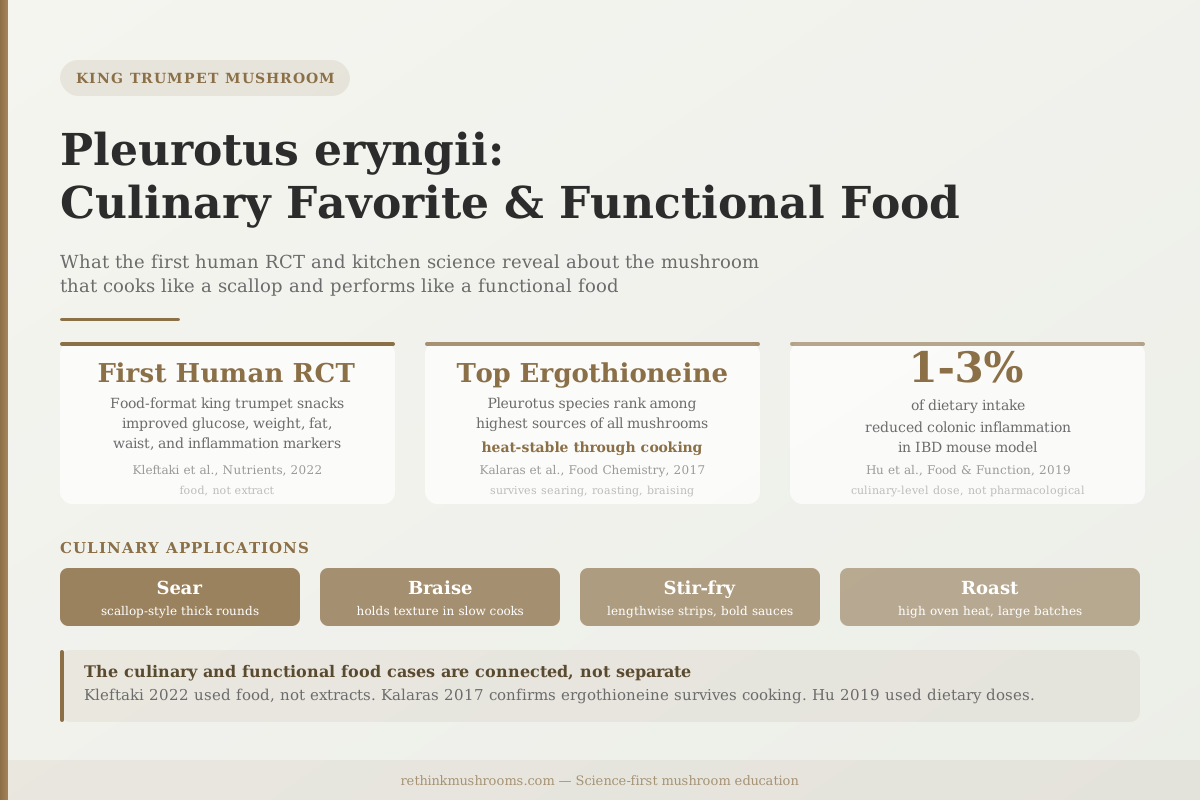 View as image ↗
If you only read one thing
King trumpet (Pleurotus eryngii) is the same mushroom whether you treat it as a scallop-like culinary ingredient or a functional food, and the science says those two roles converge. In 2022, the first human randomized controlled trial fed P. eryngii as a food snack — not an extract — to 100 metabolically unhealthy adults for three months and found improvements in blood glucose, body weight, body fat, waist circumference, and markers of inflammation and oxidative stress. Animal studies at ordinary dietary amounts point the same way on gut inflammation and obesity. And the mushroom's standout antioxidant, ergothioneine, survives cooking intact. The short version: you do not have to choose between eating it for flavor and eating it for the documented effects — searing it in a hot pan delivers both.
The thick, dense stem of a king trumpet mushroom (Pleurotus eryngii) holds up to high heat, absorbs fat-soluble flavor without falling apart, and produces a texture so similar to seared scallop that restaurant chefs routinely use it as a plant-based substitute. That is the culinary case for this species. The functional food case is newer and backed by an actual human trial.
In 2022, Kleftaki and colleagues published the first randomized controlled trial on P. eryngii conducted in humans, using food-format mushroom snacks as the intervention rather than an extract or supplement. The results included improvements in blood glucose, body weight, and inflammatory markers at ordinary eating amounts. What is king trumpet mushroom covers the species background. This article covers what happens when it meets both a hot pan and a controlled trial.
Key Takeaways
- Kleftaki 2022 was the first RCT on P. eryngii using food (not extract): participants who replaced regular snacks with king trumpet snacks showed improvements in blood glucose, body weight, body fat percentage, and waist circumference
- The Kleftaki trial was also the first human evidence that P. eryngii reduces markers of inflammation and oxidative stress
- Pleurotus species rank among the highest mushroom sources of ergothioneine (Kalaras et al., 2017), and ergothioneine has excellent thermal stability, so cooking does not substantially destroy it (Liu et al., 2020)
- Hu 2019 found P. eryngii at 1-3% of total dietary intake reduced colonic inflammation in an IBD mouse model, a dose that corresponds to regular culinary consumption
- Du 2024 found whole king oyster mushroom (not extract) inhibited obesity development and improved gut microbiota balance in high-fat diet mice
- The dense, umami-rich texture of the king trumpet stem comes from a high-chitin structure and lower water content than most cultivated mushrooms
Why King Trumpet Has Meaty Texture That Most Mushrooms Can't Match
Most cultivated mushrooms have thin caps that collapse quickly under heat. King trumpet is different because the edible focus is the thick stem, which has a densely packed internal structure and lower moisture content than oyster, shiitake, or button mushrooms.
The structural reason is chitin. Chitin is the tough carbohydrate polymer that forms the walls of fungal cells and the shells of crustaceans and insects. In most mushrooms, chitin is concentrated at the outer surfaces. In the stem of P. eryngii, the chitin matrix runs throughout the entire structure, which is why the flesh does not soften or collapse under high heat. It firms up instead.
The flavor is umami-rich because the flesh contains high concentrations of free glutamate. Glutamate is the same compound responsible for the deeply savory character of aged parmesan, soy sauce, and slow-cooked meat. P. eryngii has enough of it that the mushroom tastes satisfying with minimal seasoning.
The cap is edible and has a more delicate texture, but in both home and professional kitchens the stem is the main attraction.
What Asian Cuisine Has Always Known About King Trumpet
Pleurotus eryngii grows naturally in the dry steppes of Central Asia and the Mediterranean, fruiting on the roots of Eryngium plants in arid soils. Its dominant culinary profile today is Japanese and Korean.
In Japan, it is sold as "eringi" and most commonly appears as thick slices, seared in a very hot dry pan until golden and then finished with butter and soy sauce. The high heat amplifies both the browning and the glutamate-driven savory depth.
In Korea, it appears in stir-fries, hot pot broths, and as banchan (small side dishes), often in combination with sesame oil, gochujang paste, or doenjang (fermented soybean paste). Its structural firmness allows it to absorb aggressive flavors without losing texture, which makes it well-suited to bold preparations.
Chinese cuisine uses it in braises and soups where long cooking time would ruin most mushrooms. King trumpet holds its texture through extended heat, which is why it appears in hot pots and slow-braised dishes alongside proteins that require similar cooking times.
The English name "king oyster" reflects its family relationship to oyster mushrooms (Pleurotus ostreatus), though the two species taste and cook quite differently despite the shared genus.
How to Prepare King Trumpet: Techniques That Work (and Why)
The most distinctive preparation slices the stem horizontally into thick rounds, about two to three centimeters thick, which gives each piece the visual shape and approximate size of a sea scallop. Scoring the cut surface in a crosshatch pattern with a knife increases surface area, promotes even browning, and improves presentation.
For best results: place the scored rounds cut-side down in a very hot, dry pan. No oil is needed initially. The dense flesh does not stick the way lean proteins can, and oil added too early prevents the browning reaction from developing. Once the surface develops deep golden color, add butter or oil and let it foam. Turn and repeat on the other side.
This method produces a surface crust from the Maillard reaction (the browning that occurs when proteins and sugars in food are exposed to high heat) while the interior stays firm and slightly chewy.
For stir-fries, slice the stem lengthwise into thick strips. This orientation creates longer, more fibrous pieces that hold up in sauces and absorb liquid while maintaining structure. The cap cooks more quickly and can be added partway through.
Can you eat king oyster mushrooms raw? Technically yes, but the experience is poor. Raw P. eryngii is tough, the raw chitin structure is difficult to digest, and the flavor is bland to mildly bitter. Cooking transforms both texture and flavor in ways that make it essentially a different ingredient.
The First Human Trial on Pleurotus eryngii: What Kleftaki 2022 Found
Until 2022, the research on P. eryngii in humans was close to nonexistent. Animal models had produced promising results, but the step from animal data to human evidence had not been taken. Kleftaki and colleagues changed that with a three-month randomized controlled trial in 100 metabolically unhealthy adults, published in Antioxidants.[1]
The study design was notable for its real-world framing. One hundred metabolically unhealthy adults were randomized; both arms received standard nutritional counseling, and the intervention arm additionally ate a daily king trumpet mushroom snack (baked, then UV-B irradiated to raise its vitamin D2 content) for three months.[1] Rather than testing a concentrated extract at pharmacological doses, participants consumed the mushroom at food-format quantities. This is an unusually direct test of the functional food hypothesis: can eating this mushroom, in the way people actually eat mushrooms, produce measurable biological effects?
Kleftaki et al. (2022) · Antioxidants
- Population
- 100 metabolically unhealthy adults, randomized into two arms
- Intervention
- Daily baked, UV-B-irradiated P. eryngii mushroom snack plus standard nutritional counseling, for 3 months
- Comparator
- Standard nutritional counseling alone (no mushroom snack)
- Finding
- The mushroom group showed regulated glucose levels and reductions in body weight, body fat, and waist and hip circumference vs. control. LDL and SGOT fell within the intervention group, and IL-6 and oxidized-LDL (markers of inflammation and oxidative stress) decreased. Serum vitamin D2 rose significantly.
positive First human RCT on P. eryngii as food rather than extract. Single trial in a specific metabolically-unhealthy population; results need replication before generalizing to healthy eaters.
Kleftaki et al. (2022), Antioxidants, 11(11) — PMID 36358485
The results supported the hypothesis. Participants showed improvements in blood glucose regulation, body weight, body fat percentage, and waist circumference.[1] These were the primary metabolic outcomes.
The study also produced what it described as the first human evidence that P. eryngii affects inflammation and oxidative stress. Markers of both, including IL-6 and oxidized LDL, decreased in the mushroom snack group.[1] The anti-inflammatory finding is notable because inflammation markers are connected to a wide range of chronic conditions, and the evidence here came from a controlled trial at food-level consumption rather than from a cell experiment or animal model.
The mechanism behind the metabolic improvements likely involves the fiber and beta-glucan content of P. eryngii. Beta-glucans are complex carbohydrates (long chains of glucose units linked in a specific branching structure) that slow the absorption of glucose from a meal, blunting the blood sugar spike that follows eating. They also feed beneficial gut bacteria.
This does not mean everyone who eats king trumpet will see the same metabolic results. Kleftaki's trial was conducted in a specific population (metabolically unhealthy adults) under controlled dietary conditions. What it establishes is that the functional effects are real and occurred at food-level consumption.
The Ergothioneine Advantage: What Cooking Does and Does Not Destroy
A recurring question about functional mushrooms is whether cooking destroys the compounds that make them interesting. For many plant-based antioxidants, this is a genuine concern. For ergothioneine, the published evidence says it largely does not apply.
Kalaras and colleagues measured ergothioneine and glutathione concentrations across multiple mushroom species and found that Pleurotus species, including P. eryngii, rank among the highest ergothioneine sources of all commonly available mushrooms — and that both antioxidants are more concentrated in the cap than the stem.[3] A separate stability study by Liu and colleagues then asked the question that matters for cooks: does ergothioneine survive heat?
The finding: ergothioneine showed excellent thermal stability, holding up to heat as well as to light and to acidic or basic conditions.[5] (Liu's group did note one caveat — prolonged high-temperature heating of mushroom-extracted ergothioneine eventually reduced its concentration, so the durability is high but not unlimited.) Glutathione, the other major antioxidant present in high amounts in mushrooms, is less durable under heat and degrades more significantly through cooking.
This matters because ergothioneine is not just another antioxidant. It is the only antioxidant with a dedicated transporter in the human body. That transporter, called OCTN1 (encoded by the SLC22A4 gene), evolved specifically to absorb ergothioneine from food and has been preserved by natural selection across human evolution. The body treats this compound as important enough to build specialized machinery around it. For a deeper look at the transporter biology and what it implies, OCTN1 and what it reveals about ergothioneine covers the evidence in full.
The practical takeaway from these two studies combined: P. eryngii is among the richest dietary ergothioneine sources (Kalaras), and that ergothioneine tolerates ordinary cooking heat (Liu). So every culinary application of king trumpet, whether searing, roasting, or braising, delivers the ergothioneine content essentially intact. The functional benefit is preserved alongside the culinary experience.
Glutathione is different. Its partial degradation through cooking means raw or minimally heated preparations retain more of it, though mushrooms are not the primary dietary source of glutathione for most people in any case.
Whole Mushroom Research: What Du 2024 Found
Most functional mushroom research tests isolated extracts at doses far higher than food consumption would deliver. Du and colleagues took a different approach by feeding whole king oyster mushroom to mice on a high-fat diet to test whether the food itself, at dietary proportions, would produce anti-obesity effects.[2]
Food, Not Extract
Three Studies, One Direction — All Used the Whole Mushroom
Most functional-mushroom research tests concentrated extracts at pharmacological doses. The P. eryngii evidence is unusual: a human trial and two animal models all fed the food itself, at amounts a person could actually eat — and all converged on metabolic and gut benefit.
Kleftaki 2022[1]
Human RCTSubjects
100 metabolically unhealthy adults
Format
Whole mushroom snack (food)
Dose
Daily snack, 3 months
Finding
Lower glucose, body weight, body fat, waist circumference; reduced IL-6 and oxidized LDL
Du 2024[2]
Animal (mouse)Subjects
High-fat-diet mice
Format
Whole mushroom (food)
Dose
Dietary intake
Finding
Less obesity and fat gain, better glucose tolerance, improved gut microbiota, less fatty liver
Hu 2019[4]
Animal (mouse)Subjects
DSS-colitis mice
Format
Whole mushroom (food)
Dose
1–3% of diet
Finding
Reduced colonic inflammation, longer colons, lower cytokines, higher short-chain fatty acids
The human trial (Kleftaki) is the strongest single piece of evidence; the animal studies (Du, Hu) add consistency at dietary doses. None of it proves food-as-medicine on its own — a single human RCT still needs replication — but the alignment across methods is what makes the case worth taking seriously.
Source: Kleftaki 2022; Du 2024; Hu 2019 (see references)
The results showed that mice receiving whole king oyster mushroom alongside the high-fat diet developed less obesity than controls eating the same diet without mushroom. The mushroom-fed group showed less body weight gain and less fat accumulation over the study period, along with improved glucose tolerance and reduced severity of high-fat-diet-induced fatty liver.[2]
Du 2024 also measured gut microbiota composition, the community of microorganisms that live in the intestine and contribute to metabolic health. The mushroom-fed group showed shifts in microbial balance associated with improved metabolic outcomes — more beneficial bacteria such as Akkermansia, Lactobacillus and Bifidobacterium, and fewer of the strains associated with dysbiosis. The high fiber content of P. eryngii, including its beta-glucans and other complex polysaccharides, likely drove the prebiotic effect (a prebiotic feeds beneficial gut bacteria rather than being absorbed directly by the host).
The main limitation of Du 2024 is that it is an animal model. Results from high-fat diet mouse models do not automatically translate to human outcomes. The relevance here is that the study tested whole food rather than an extract, and the results pointed in the same direction as Kleftaki 2022 (metabolic improvement, gut benefit). Two independent lines of evidence from different methodological approaches supporting the same direction is a stronger position than either study alone.
Gut Health at Dietary Intake: Hu 2019's Culinary-Level Dose
Hu and colleagues designed their study around one specific question: does P. eryngii at a culinary consumption amount, rather than a pharmacological dose, reduce gut inflammation in a mouse model of inflammatory bowel disease?[4]
Inflammatory bowel disease (IBD) involves chronic, recurring inflammation in the colon. The mouse model they used produces this inflammation chemically (dextran sodium sulfate), triggering the same kind of immune response seen in human IBD. The question was whether dietary P. eryngii could blunt that response.
The mushroom was added to the diet at 1% and 3% of total food by weight. For a person eating 2,000 calories per day from mixed foods, this corresponds to roughly one to three medium-sized king trumpet mushrooms per day, a reasonable culinary amount rather than a therapeutic dose.[4]
At both the 1% and 3% levels, dietary P. eryngii reduced colonic inflammation: the mushroom-fed mice showed a lower disease index, longer colons (a marker of less inflammatory damage), and reduced pro-inflammatory cytokines in the colonic mucosa compared with controls. The study also reported a shift in gut microbiota toward a healthier profile and higher cecal short-chain fatty acids.[4]
The explicit framing around culinary-level doses is what makes Hu 2019 notable within the functional mushroom literature. Most animal studies in this field use doses that no person would consume through food. Hu 2019 asked a more honest version of the question.
The limitation remains: IBD in mice is not the same as IBD in humans, and no human trial has tested P. eryngii specifically for gut inflammation. What Hu 2019 adds is mechanistic plausibility for the gut-related effects seen in Du 2024 and metabolic context for the Kleftaki results.
Where King Trumpet Fits in the Functional Mushroom Landscape
The functional mushroom category is dominated by lion's mane research on cognitive outcomes, reishi research on immune modulation, and cordyceps research on exercise performance. King trumpet has a smaller accumulated research base but a distinct profile: the evidence clusters around metabolic health and gut outcomes, and the centerpiece study used food rather than supplements.
This positions P. eryngii differently from most functional mushrooms. The relevant question is not "how does this extract compare to a reishi extract" but rather "does eating this mushroom as food, as people have done in Japan and Korea for decades, produce measurable biological effects?" The Kleftaki trial says yes.
The ergothioneine data from Kalaras 2017 adds a layer that connects P. eryngii to a broader literature on longevity nutrients. Pleurotus species as a group are among the leading dietary sources of a compound the body evolved specialized transport machinery to absorb,[3] and that compound survives the cooking process intact.[5] This is an attribute that no extract-based approach can improve upon, because the functional benefit is already fully present in the cooked food.
The animal research from Du 2024 and Hu 2019 supports the same direction as the human trial data, rather than pointing in contradictory directions. For a look at how different mushroom species might work in combination, best mushroom combinations for immune support reviews the synergy research.
- Cell & Lab Studiescompleted
Antioxidant, anti-inflammatory and lipid-related activity characterized for P. eryngii polysaccharides, beta-glucans and ergothioneine across numerous in vitro studies.
- Animal Studiescompleted
Whole-mushroom feeding reduced DSS colitis at 1-3% of diet (Hu 2019) and attenuated high-fat-diet obesity while improving gut microbiota (Du 2024).
- Case Reportsmissing
- Human RCTcurrent
Kleftaki 2022: a single 3-month RCT (n=100) using a food-format mushroom snack found metabolic, anti-inflammatory and antioxidant improvements.
- Large Confirmatory Trialmissing
- Pooled Meta-Analysismissing
P. eryngii has crossed the threshold most functional mushrooms never reach: a controlled human trial using the food itself, not an extract. But that evidence rests on one trial in one population. The animal work is consistent and uses dietary-level doses, which strengthens plausibility. What is still missing is replication in larger and broader human populations before food-as-medicine claims can be made confidently.
Kleftaki et al. (2022); Du et al. (2024); Hu et al. (2019)
The Bottom Line
Pleurotus eryngii is one of the few culinary mushrooms tested in a randomized controlled trial using food rather than extract as the intervention. Kleftaki 2022 found real metabolic and anti-inflammatory effects at food-level consumption. The high ergothioneine content of Pleurotus species documented by Kalaras 2017 survives cooking, since ergothioneine is thermally stable (Liu 2020). Animal research from Du 2024 and Hu 2019 supports gut health and anti-obesity effects at dietary intake levels. The culinary and functional food evidence for king trumpet is not separate. It converges on the same conclusion.
Frequently Asked Questions
Sources & References
- 1RTHM-00771·Kleftaki, Stamatia-Angeliki et al. (2022). “A Randomized Controlled Trial on Pleurotus eryngii Mushrooms with Antioxidant Compounds and Vitamin D2 in Managing Metabolic Disorders..” Antioxidants (Basel.Study breakdown →PubMed →↩
- 2RTHM-00876·Du, Hengjun et al. (2024). “Dietary intake of whole king oyster mushroom (Pleurotus eryngii) attenuated obesity via ameliorating lipid metabolism and alleviating gut microbiota dysbiosis..” Food research international (Ottawa.Study breakdown →PubMed →↩
- 3RTHM-00476·Kalaras, Michael D et al. (2017). “Mushrooms: A rich source of the antioxidants ergothioneine and glutathione..” Food chemistry.Study breakdown →PubMed →↩
- 4RTHM-00560·Hu, Qiuhui et al. (2019). “Dietary Intake of Pleurotus eryngii Ameliorated Dextran-Sodium-Sulfate-Induced Colitis in Mice..” Molecular nutrition & food research.Study breakdown →PubMed →↩
- 5RTHM-00633·Liu, Xinqi et al. (2020). “A Study on the Antioxidant Properties and Stability of Ergothioneine from Culinary-Medicinal Mushrooms..” International journal of medicinal mushrooms.Study breakdown →PubMed →↩