Poria & Skin Health
1880 Yurong San formula
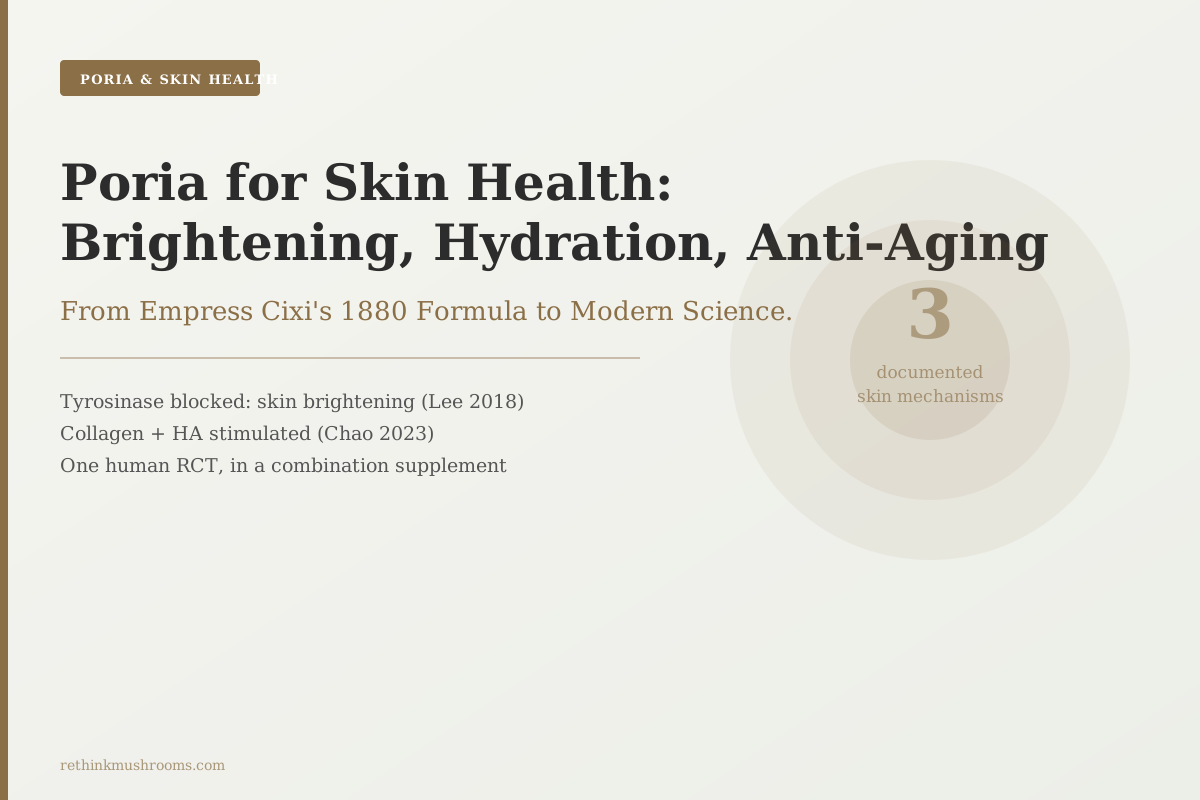
Empress Dowager Cixi's imperial physicians built a Poria cocos-containing skin formula 140 years before modern research mapped how the mushroom suppresses melanin and stimulates collagen.
Lei et al., J Ethnopharmacol, 2025
Tyrosinase ↓
Poria extract suppresses the melanin enzyme (Lee 2018)
Collagen + HA ↑
Lanostane triterpenoids in aging rats (Chao 2023)
1 human RCT
in a combination supplement only (Hao 2024)
Lei et al., J Ethnopharmacol, 2025
 View as image ↗
The Empress Dowager Cixi was 45 years old when her imperial physicians wrote up a face-care formula called Yurong San, in the sixth year of the Guangxu reign (1880). The formula contained Poria cocos along with several other plant ingredients, and palace records describe Cixi using it daily. Modern researchers cracking open Lei et al. (2025), a comprehensive review in the Journal of Ethnopharmacology, found the same Poria cocos working through three identifiable mechanisms: it suppresses the enzyme that makes pigment, it stimulates the cells that build collagen and hyaluronic acid, and its starch-like polysaccharides hold moisture against the skin.[5] This is what poria cocos skin health benefits look like in 2025 evidence: three different effects, each backed by a different study, all converging on the same outcome the imperial physicians were trying to produce in 1880. This article is part of the pillar guide to Poria (Wolfiporia extensa / Fu Ling).
The clearest piece of human evidence is Hao et al. (2024), a randomized double-blind placebo-controlled trial in Chinese women.[4] The Hao trial tested Poria cocos in combination with jujube and GABA against placebo for sleep and skin endpoints. It is the only completed human randomized controlled trial that measured Poria's skin effects with objective tools, and almost no consumer health site has reported on it. The rest of the evidence base is animal studies, dermal fibroblast experiments, and a 2,000-year traditional medicine record.
Key Takeaways
- Poria cocos skin health benefits operate through three distinct mechanisms: tyrosinase inhibition for brightening, lanostane triterpenoids for collagen and hyaluronic acid synthesis, and polysaccharides for moisture retention
- Lee and Cha (2018) showed Poria cocos extract reduced melanin synthesis in B16F10 cells by both blocking tyrosinase activity and lowering MITF expression, and a Poria-containing cream improved skin brightness in an in vivo skin test[1]
- Chao et al. (2023) found a Poria cocos lanostane triterpenoid extract enhanced type I collagen and increased hyaluronic acid in human dermal fibroblast cells, and reversed skin aging markers in D-galactose-induced aging rats[2]
- Fang et al. (2021) showed Poria cocos extract suppresses the metalloproteinase enzymes that break down collagen while activating the Nrf2 antioxidant pathway in human dermal fibroblasts[3]
- Hao et al. (2024) is the only completed human RCT measuring Poria's skin effects, and it tested Poria in combination with jujube and GABA, not as a single ingredient[4]
- Lei et al. (2025) and earlier comprehensive reviews now place Poria's skin applications in a 2,000-year traditional medicine record, with the most documented historical use being the Yurong San formula commissioned for Empress Cixi in 1880[5]
- All Poria-only skin evidence is preclinical (cells and animals); the single human RCT used a combination supplement, not Poria alone
The Hao 2024 RCT: The Only Human Trial That Has Tested Poria Cocos Skin Health Benefits
Most articles that recommend Poria for skin lean on traditional Chinese medicine claims and a handful of cell experiments. The actual human trial data is much thinner than the marketing makes it sound. As of 2025, the only completed human randomized controlled trial that measured Poria's skin effects with objective tools is Hao et al. (2024), published in Food Science & Nutrition.[4]
The Hao trial recruited Chinese women with poor sleep quality and self-reported skin problems. Participants were randomized to a combination supplement containing Poria cocos, Ziziphus spinose (Chinese jujube), and GABA, or to placebo, and were followed for both sleep parameters and skin parameters. The supplement group showed improvements in both sleep quality scores and skin health measurements compared with placebo.
Two things to take from this. First, the trial was a positive result on objective skin endpoints in human subjects, which is more than can be said for many botanicals with much louder marketing. Second, the trial used a combination, not Poria alone, which means it cannot tell you whether Poria, jujube, GABA, or some interaction between them produced the skin effect. The honest read is that Poria-containing supplements have one positive RCT for combined sleep and skin outcomes, and Poria-alone has zero completed human RCTs for skin.
What that means in practice: any consumer health site that tells you Poria is "clinically proven" to brighten skin or reduce wrinkles is overstating the evidence. The actual claim that holds up is that a Poria-containing combination supplement produced measurable skin improvements in one trial, and that the cell and animal evidence for individual Poria mechanisms is consistent enough to suggest Poria is contributing rather than just along for the ride.
Mechanism One: How Poria Cocos Skin Brightening Works at the Enzyme Level
The clearest single mechanism for Poria's skin effects is melanogenesis suppression. Melanogenesis is the process by which skin cells produce melanin, the pigment responsible for skin tone, sun tanning, and the dark spots that appear with age and sun exposure. The central enzyme in this process is tyrosinase, which converts the amino acid tyrosine into the precursors of melanin. Compounds that block tyrosinase reduce melanin production and lighten skin tone.
Lee and Cha (2018) is the foundational study for Poria's effect on this pathway.[1] They tested Poria cocos extract on B16F10 mouse melanoma cells, the standard cell line for studying pigment production. The extract reduced melanin synthesis and decreased tyrosinase activity at non-toxic concentrations. The mechanism was not just enzyme blocking. The Poria extract also lowered tyrosinase protein expression and reduced MITF, the master transcription factor that turns the tyrosinase gene on in the first place. So Poria works at two levels: it makes the cell produce less of the enzyme, and it slows down the enzyme that does get produced.
Lee and Cha then took it one step further. They formulated the Poria extract into a cream and tested it on actual skin in an in vivo experiment. Skin brightness, measured as the L value on the standard Lab* color scale used in dermatology, went up. This is the closest thing in the published literature to topical proof of concept: Poria-containing cream applied to skin produced a measurable lightening effect.
A Korean follow-up by Kang et al. (2019) extended the picture by testing Poria cocos mycelium fermented with freeze-dried plum.[7] The fermented preparation showed greater anti-melanogenic activity than either Poria or plum alone, suggesting that processing method changes potency. Fermentation appears to release or modify Poria compounds in a way that increases their bioavailability and tyrosinase-blocking effect.
The cluster article on Poria and melanogenesis covers the molecular detail of this pathway, and the tyrosinase inhibition and cosmetic science article compares Poria to commercial brightening agents like kojic acid, arbutin, and hydroquinone.
Mechanism Two: Lanostane Triterpenoids, Collagen, and the Anti-Aging Story
Skin aging is largely a story of collagen breakdown. Type I collagen makes up most of the structural protein in the dermis and gives young skin its firmness and resistance. As skin ages, two things happen at once: collagen synthesis slows down, and the metalloproteinase enzymes (MMPs) that break collagen down become more active. The visible result is the loss of firmness and the formation of fine lines.
Chao et al. (2023) tested whether Poria cocos lanostane triterpenoids could push back on this process.[2] Lanostane triterpenoids are the waxy, structurally complex compounds concentrated in Poria's outer rind, and the most studied member of this family is pachymic acid. The Chao team used a standardized lanostane triterpenoid extract called Lipucan and tested it in two systems: human dermal fibroblast cells (the cells that build collagen and hyaluronic acid in human skin), and aged rats induced with D-galactose to mimic accelerated skin aging.
In the fibroblast cells, the extract significantly increased type I collagen expression. It also increased hyaluronic acid (HA), the molecule that holds water in the dermis and gives skin its plumpness and bounce. In the aged rats, the extract reversed several markers of skin aging when applied at standard preclinical doses.
This is the first study to demonstrate that Poria triterpenoids stimulate the cells responsible for both collagen and hyaluronic acid production. It is also the mechanism that explains why Poria has a centuries-long reputation as a moisturizing and skin-restoring herb. The traditional Chinese medicine framing was correct in observation; the Chao 2023 data identified the molecular reason.
A complementary study from Fang et al. (2021) covered the destruction side of the equation.[3] The Fang team treated human dermal fibroblasts with Poria cocos extract and looked at what happened to MMP enzymes, TGF-β1 (the signaling molecule that tells fibroblasts to make more collagen), and the Nrf2 antioxidant pathway. Poria extract suppressed MMP activity, raised TGF-β1, and activated Nrf2. The Nrf2 pathway protects skin from oxidative damage caused by UV exposure and pollution, both of which accelerate aging. So Poria has a dual anti-aging action: it tells fibroblasts to make more collagen while also suppressing the enzymes that destroy it, and at the same time it props up the antioxidant defense that prevents the damage that triggers MMP activity in the first place.
Mechanism Three: Why Poria Polysaccharides Hold Moisture
The third mechanism is the one most consumers will recognize from skincare marketing: hydration. Poria cocos contains beta-glucan polysaccharides, including the structurally important pachymaran, which act as humectants. A humectant is a molecule that binds water and holds it against a surface. In skincare, humectants are the workhorses behind any product that promises moisture retention. Glycerin, hyaluronic acid, and beta-glucans all work this way.
The dual angle the Chao 2023 study makes interesting is that Poria does not just contain a humectant; it also stimulates the body to make more of its own humectant. Lanostane triterpenoids increased hyaluronic acid production in human dermal fibroblasts.[2] So a Poria preparation provides both an external humectant (the polysaccharides) and an internal stimulus to make more of the body's own humectant (the HA-promoting triterpenoids).
Nie et al. (2020) is the academic source that explicitly notes the cosmetics industry uses Poria polysaccharides for their moisturizing effect.[6] The same review notes the use of Poria triterpenes for skin lightening. So the two-mechanism positioning of Poria, polysaccharide-for-moisture and triterpenoid-for-brightening-and-anti-aging, is not a marketing construct. It is how the academic pharmacology community describes the mushroom.
For comparison context, our companion article on Poria polysaccharides and skin hydration goes deeper on how Poria's hydration mechanism differs from Tremella, the more famous moisture mushroom. The short version: Tremella primarily holds water against the skin (humectant only), while Poria does both. It holds water and tells the skin to make more of its own water-holding molecules.
Inside Yurong San: The 1880 Imperial Skincare Formula
The Empress Dowager Cixi was born in 1835 and reigned over China through the late Qing Dynasty. Court records, including the medical compilation "Cixi Guangxu's Selected Medical Prescriptions," document her concern with her skin in middle age: rough texture, yellowing tone, and dark spots that resisted the cosmetics available to her. In the sixth year of the Guangxu reign, which corresponds to 1880, her imperial physicians compiled a face powder called Yurong San (Jade Beauty Powder) drawn from an earlier Qing Dynasty formula known as the Eight White Powder. Poria cocos was one of the ingredients.
Cixi reportedly used the formula daily. The palace maid De Ling later wrote that the Empress's skin in old age remained smooth and bright, a description that sits in unusual contrast with the rough, discolored skin she was reportedly trying to correct in 1880. Whether or not the formula was responsible, it was used as if it worked, and it was passed down through the imperial physicians as a recipe worth preserving.
What modern science can say with reasonable confidence is what was likely happening at the molecular level. Yurong San did not contain isolated compounds. It contained whole Poria cocos, which means it contained both the lanostane triterpenoids that suppress tyrosinase (mechanism one) and the lanostane triterpenoids that stimulate collagen and hyaluronic acid (mechanism two), and the polysaccharides that hold moisture (mechanism three). All three of the mechanisms identified in 21st-century research are present in the source material the imperial physicians were using in 1880. They were running an empirical optimization process that selected for visible skin improvement, without molecular biology, and they landed on a botanical that turns out, on inspection, to have three relevant mechanisms running in parallel.
The cluster article on Fu Ling in Chinese cosmetic tradition and the Empress Cixi connection covers the full historical record, and the Poria in TCM 2,000 years article covers the broader Chinese medicine tradition Poria sits inside. For molecular-level depth on the same compounds, our pharmacology of Wolfiporia extensa covers how each compound class produces its effects.
Topical, Oral, or Both? What the Evidence Supports
The mechanism evidence above splits cleanly across the two delivery routes. The tyrosinase inhibition data (Lee and Cha 2018) included a topical cream test that showed brightness improvement on actual skin. The collagen and hyaluronic acid data (Chao 2023, Fang 2021) was generated in dermal fibroblast cells, which is the closest cell-level proxy for what would happen if Poria compounds reached the dermis. The hydration polysaccharide effect is intrinsically topical, since the humectant action depends on the polysaccharide sitting on the skin surface and binding water.
The one human RCT (Hao 2024) was an oral supplement, not a topical product, and it produced positive skin endpoints with combined oral Poria, jujube, and GABA. So the picture is mixed: topical evidence is mechanistic and includes one in vivo cream test; oral evidence is one combination RCT.
The honest takeaway is that both routes have plausible support, and a reader who wants to follow the existing evidence has two options. A topical Poria-containing skincare product targets the mechanisms most directly. An oral Poria supplement, especially in a Poria-jujube-GABA combination matching the Hao 2024 trial, has the strongest human signal but does not let you say the skin effect was Poria specifically. For broader context on whether topical mushroom products work in general, our companion article on mushroom skincare research reviews the evidence across multiple species. For comparison, our Tremella and chaga in skincare article covers the alternatives most commonly marketed alongside Poria.
The Honest Limit: One Combination Trial Is Not Three Mechanisms Confirmed
The full evidence base for Poria cocos skin health benefits as of 2025 looks like this: one human RCT in a combination supplement (Hao 2024); one cell-and-skin study showing tyrosinase inhibition with topical brightness (Lee and Cha 2018); one cell-and-rat study showing collagen and hyaluronic acid promotion with anti-aging effects (Chao 2023); one cell study showing collagen preservation and antioxidant support (Fang 2021); one Korean fermentation study showing enhanced anti-melanogenic activity (Kang 2019); and several comprehensive reviews documenting the cosmetic-relevant pharmacology (Lei 2025, Xiong 2025, Nie 2020, Wei 2022).
This is more evidence than most consumer botanicals carry, and it is consistent across studies in identifying three distinct mechanisms that all align with documented skin outcomes. It is also less evidence than most readers would assume from how confidently Poria is marketed. There is no Poria-alone human RCT for any skin endpoint. The single human trial that exists used a combination supplement and measured skin as a secondary outcome, not the primary endpoint. The cell and animal data is consistent and mechanistically detailed but cannot be directly translated to predict effect sizes in humans.
What the evidence does support: Poria cocos has three plausible, mechanistically distinct skin-relevant actions, all of which are documented in peer-reviewed research. It has one positive human signal in a combination context. And it has a 140-year track record in a documented Chinese imperial skincare formula that, on retrospective inspection, contained the active compounds modern researchers have now identified.
What the evidence does not yet support: clinical claims about specific outcomes (percentage reduction in wrinkles, specific lightening of hyperpigmentation, defined moisture retention numbers in human skin). Those would require Poria-only human RCTs that have not yet been completed.
The Bottom Line
Poria cocos has three documented skin mechanisms in 2025 evidence: tyrosinase inhibition for brightening (Lee and Cha 2018), lanostane triterpenoids that stimulate collagen and hyaluronic acid (Chao 2023, Fang 2021), and polysaccharides that hold moisture (Nie 2020). The single human RCT (Hao 2024) tested Poria in a combination supplement, not alone, and produced positive skin and sleep outcomes. The Empress Cixi formula Yurong San from 1880 contained Poria as one of its core ingredients, providing a 140-year empirical track record that aligns with the modern molecular evidence.
Frequently Asked Questions
Sources & References
- 1RTHM-00970·Lee, HyunKyung et al. (2018). “Poria cocos Wolf extracts represses pigmentation in vitro and in vivo..” Cellular and molecular biology (Noisy-le-Grand.Study breakdown →PubMed →↩
- 2RTHM-01668·Chao, Chien-Liang et al. (2023). “Poria cocos Lanostane Triterpenoids Extract Promotes Collagen and Hyaluronic Acid Production in D-Galactose-Induced Aging Rats..” Life (Basel.Study breakdown →PubMed →↩
- 3RTHM-01349·Fang, Chien-Liang et al. (2021). “Poria cocos (Fuling) targets TGFβ/Smad7 associated collagen accumulation and enhances Nrf2-antioxidant mechanism to exert anti-skin aging effects in human dermal fibroblasts..” Environmental toxicology.Study breakdown →PubMed →↩
- 4RTHM-01901·Hao, Yining et al. (2024). “Effects of a combination of Poria Cocos, Ziziphus spinose, and gamma-aminobutyric acid (GABA) on sleep quality and skin health: A randomized double-blind placebo-controlled clinical trial..” Food science & nutrition.Study breakdown →PubMed →↩
- 5RTHM-02126·Lei, Juanhong et al. (2025). “A multidimensional perspective on Poria cocos, an ancient fungal traditional Chinese medicine..” Journal of ethnopharmacology.Study breakdown →PubMed →↩
- 6RTHM-01268·Nie, Anzheng et al. (2020). “Phytochemistry and Pharmacological Activities of Wolfiporia cocos (F.A. Wolf) Ryvarden & Gilb..” Frontiers in pharmacology.Study breakdown →PubMed →↩
- 7RTHM-01070·Kang, Kyung-Yun et al. (2019). “Verification of the Functional Antioxidant Activity and Antimelanogenic Properties of Extracts of Poria cocos Mycelium Fermented with Freeze-Dried Plum Powder..” International journal of biomaterials.Study breakdown →PubMed →↩