Psilocybin for Cannabis Dependence
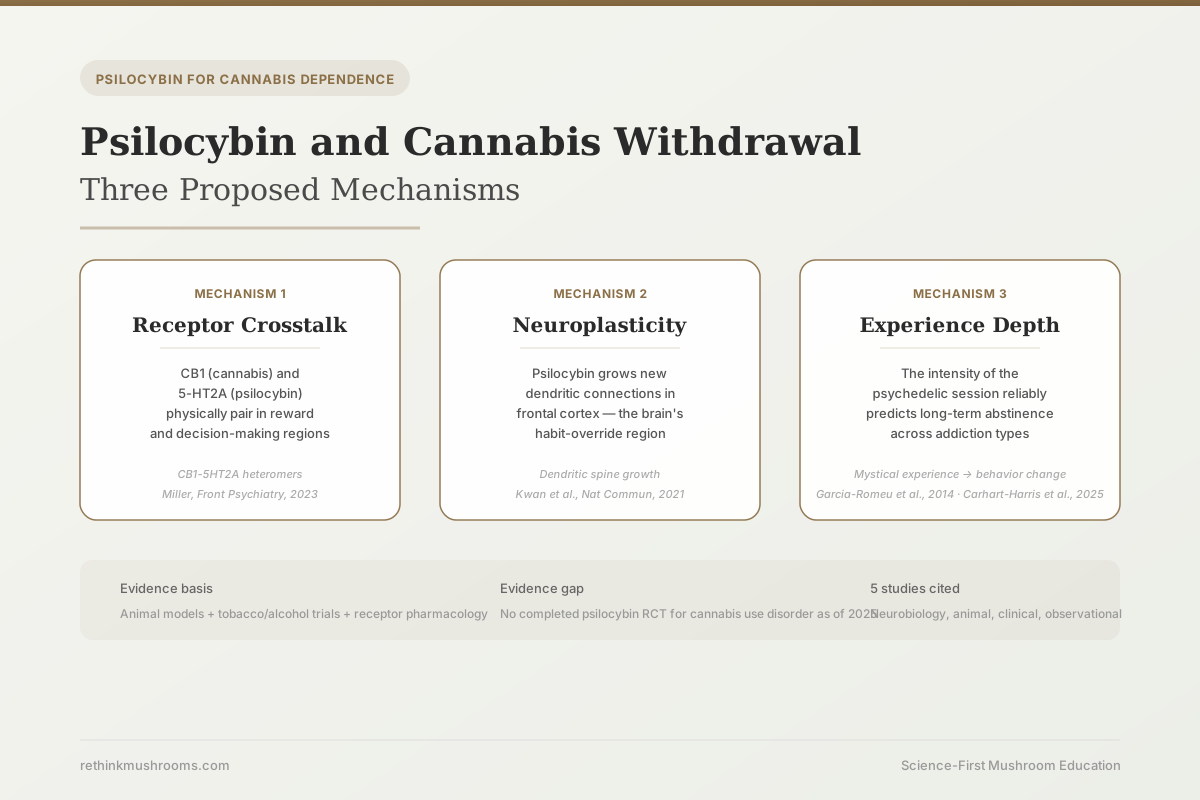
3 proposed pathways
Psilocybin may theoretically address cannabis withdrawal through overlapping receptor biology, habit-circuit neuroplasticity, and the therapeutic power of the psychedelic experience itself.
Urban MM, Front Neurosci, 2023
CB1 + 5-HT2A
receptors physically pair into heteromers in the same brain cells (Viñals et al., 2015)
Frontal cortex
rapid dendritic spine growth observed after psilocybin in animals (Shao et al., 2021)
Experience depth
predicts long-term abstinence in tobacco trials (Garcia-Romeu et al., 2014)
Urban MM, Front Neurosci, 2023
 View as image ↗
Cannabis and psilocybin work on completely different receptor systems: one activates CB1 receptors, the other activates 5-HT2A receptors. So when researchers argue that psilocybin might help people with cannabis withdrawal, they're not saying the two drugs cancel each other out. They're making a more interesting claim: that psilocybin-induced neuroplasticity, habit-circuit disruption, and a shared molecular interface between the two receptor systems could combine to interrupt the dependence cycle in ways that standard treatments don't.
Whether that theory holds up in clinical trials is a separate question. As of 2025, no completed randomized controlled trial has tested psilocybin specifically for cannabis use disorder. What exists is a body of mechanistic research, animal data, and extrapolated evidence from alcohol and tobacco addiction. A serious examination of psilocybin's broader track record in addiction treatment supports the theoretical rationale, even if direct cannabis evidence hasn't been generated yet.
This article examines the three biological pathways that form the scientific basis of the theory.
Key Takeaways
- Psilocybin's serotonin receptor (5-HT2A) and cannabis's receptor (CB1) are co-expressed in some of the same brain cells, where they physically link into paired structures called heteromers; activating or blocking one receptor changes how the other responds (Viñals et al., PLoS Biology, 2015). This molecular coupling is the most cannabis-specific part of the pharmacological argument
- Psilocybin triggers rapid, persistent growth of new dendritic spines in the frontal cortex (the brain's decision-making and impulse-control region), a structural neuroplasticity change observed in animals (Shao et al., Neuron, 2021)
- A 2023 neurobiology mini-review by Urban and colleagues (Frontiers in Neuroscience) synthesizes how psilocybin-induced neuroplasticity in prefrontal circuits may counteract the neural changes that sustain addiction, framing psychedelics as habit-circuit disruptors rather than chemical substitutes
- In tobacco-cessation work, the intensity of psilocybin-occasioned mystical experiences predicted long-term abstinence, establishing the psychedelic experience itself as a likely active ingredient (Garcia-Romeu et al., 2014)
- The same experience-driven pattern held in a different condition: in psilocybin for treatment-resistant depression, the quality of the acute experience predicted antidepressant outcomes (Roseman, Nutt & Carhart-Harris, 2018), reinforcing the experience-as-mechanism argument
- Naturalistic (non-clinical) survey data is cautionary: past psilocybin and LSD use was associated with higher, not lower, odds of substance use disorder, with only peyote/mescaline showing a protective link (Rabinowitz et al., 2022). The mechanistic case for psilocybin in cannabis dependence remains theoretical, not clinically validated
Cannabis Withdrawal Is a Habit Problem, Not Just a Chemistry Problem
The popular image of drug withdrawal focuses on physical symptoms: nausea, shaking, pain. Cannabis withdrawal is real (irritability, sleep disturbance, appetite loss) but relatively mild compared to opioid or alcohol withdrawal in physical terms. The harder problem is behavioral.
People with cannabis use disorder are not, for the most part, stuck because the physical symptoms are unbearable. They're stuck because the behavior is entrenched. Cannabis use becomes woven into routines, social contexts, emotional regulation strategies, and responses to boredom, stress, or anxiety. The challenge isn't surviving the first week without cannabis. The challenge is rebuilding a relationship with those triggers: learning different responses to stress, sleep difficulties, and social situations where use was automatic.
A 2023 neurobiology mini-review by Urban and colleagues, published in Frontiers in Neuroscience, frames this precisely.[2] Classical psychedelics like psilocybin are being investigated for substance use disorders not because they provide chemical substitution or block cravings directly, but because they appear to alter gene expression and neuroplasticity in prefrontal regions in ways that could counteract the rigid neural patterns that sustain compulsive use. The withdrawal symptom isn't the therapeutic target. The habituated brain is.
This distinction matters for understanding why the mechanistic case is more sophisticated than "use one drug to quit another." Psilocybin isn't proposed as a substitute for cannabis. It's proposed as a way to temporarily alter the neural architecture in which addictive behavior runs; alternative patterns can then take hold in that window.
The Receptor Pair Nobody Talks About: CB1 and 5-HT2A in the Same Cell
Cannabis works primarily through CB1 receptors, proteins on brain cells that the body's own endocannabinoid system also uses, and that THC binds to produce cannabis's characteristic effects. Psilocybin works through a completely different protein: the 5-HT2A serotonin receptor.
These are distinct systems, and that difference is real. But in certain brain regions, CB1 and 5-HT2A receptors are expressed in the same cells. And in those cells, they don't just coexist. They physically link into paired structures called heteromers, where activating one receptor influences how the other responds.
This coupling has been characterized directly in the laboratory. Viñals and colleagues showed in 2015 that CB1 and 5-HT2A receptors form functionally active heteromers in specific brain regions (in their work, circuits involved in memory), and that the coupling is real, not incidental: co-stimulating both receptors with agonists actually reduces downstream cell signaling, and blocking one receptor silences signaling through its partner, an effect called cross-antagonism.[3] When psilocybin activates 5-HT2A receptors in regions that also express CB1, then, it is not acting in pharmacological isolation from the cannabis system. It is acting on a receptor that is physically connected to the cannabis system at the molecular level.
To make the CB1-5HT2A heteromer concrete: imagine two door handles on the same door. Turning one handle slightly shifts the position of the other. Both handles still open the door on their own, but the mechanical coupling means you can't operate one without some influence on the other. The CB1-5HT2A pair works similarly: the receptors remain distinct, but their functional connection means signaling through the serotonin system partially modulates how the endocannabinoid system responds.
This molecular crosstalk is the most cannabis-specific part of the mechanistic argument, and it is almost entirely absent from consumer content on this topic. It is also where the reasoning turns genuinely speculative: the heteromer interaction is well documented in pharmacological literature, but its behavioral implications for cannabis dependence have not been directly tested in humans, and the receptors Viñals's team studied sat in memory-related circuits rather than the reward pathways most central to addiction. The inference that this coupling gives psilocybin specific relevance for cannabis is the article's own extrapolation, not an established clinical finding.
How Psilocybin Grows New Connections in the Brain's Willpower Region
The second mechanism operates at the cellular level in the prefrontal cortex, the brain region responsible for planning, impulse control, and override of automatic behavior. When this region is underactive or less well-connected, habits are harder to resist. When it's more plastic, more capable of forming new connections, new responses to old triggers become possible.
A 2021 study led by Shao in the laboratory of Alex Kwan, published in Neuron, examined how psilocybin affects frontal cortex structure.[1] Using live imaging in mice, the researchers found that a single dose of psilocybin drove rapid and persistent growth of dendritic spines (the branching connections through which neurons communicate) in the frontal cortex. The new spines appeared within a day and a meaningful fraction were still present a month later, alongside changes in the animals' behavior.
This is a structural neuroplasticity finding, and it is what makes psilocybin interesting for habit-driven disorders in theory: the frontal cortex of someone with an established cannabis habit has been shaped by that habit. Chronic cannabis use affects the density and function of connections in exactly this region, the place where "I shouldn't do this" gets generated and either wins or loses against "but I want to." Psilocybin-induced spine growth in this region represents a potential mechanism for loosening some of that entrenchment, so that new responses can be learned.
The important caveat: the Shao work was conducted in animal models. The translation to human cannabis use disorder is theoretical. The structural changes observed in rodent frontal cortex after psilocybin administration are promising, but "promising in mice" has a poor track record of reliably predicting human outcomes in psychiatry.
For a deeper look at how this neuroplasticity mechanism applies across addiction broadly, neuroplasticity and addiction: how psilocybin opens a window covers the evidence base in detail.
Why the Depth of the Psychedelic Experience Predicts Long-Term Abstinence
The third mechanism is the most philosophically interesting and, in some ways, the best empirically supported, even though it's the hardest to explain pharmacologically.
In addiction trials using psilocybin for tobacco and alcohol, the pharmacology alone doesn't predict outcomes. What predicts outcomes is the quality of the psychedelic experience the person has during the session.
Garcia-Romeu and colleagues published the foundational finding in 2014 in Current Drug Abuse Reviews, examining psilocybin-assisted treatment for tobacco addiction.[4] What predicted whether participants stayed abstinent at six months wasn't simply whether they took psilocybin. It was whether they had what the researchers scored as a mystical-type experience during the session: a sense of unity, feelings of deep meaning, noetic quality (the sense of having learned something profound). The more intense and complete the mystical experience, the more likely the person was to have stopped smoking.
This pattern is not unique to smoking. In a separate clinical trial (psilocybin for treatment-resistant depression), Roseman, Nutt, and Carhart-Harris found in 2018 that the quality of the acute psychedelic experience, specifically the "oceanic boundlessness" dimension that overlaps with mystical-type states, predicted antidepressant outcomes, whereas ordinary sensory-perceptual effects had negligible predictive value.[5] Two different conditions, the same signal: the depth of the experience, not the drug alone, tracks with who improves. That consistency is why many researchers treat the experience itself as an active ingredient of psilocybin therapy rather than an incidental side effect.
What might explain this? The working hypothesis is that a sufficiently intense psychedelic experience disrupts the self-narrative: the story a person has built about who they are, what they do, and why change is difficult or impossible. People with entrenched addictions often have identities organized partly around their substance use. A mystical experience, as described in the literature, can produce a rapid reordering of that self-model. What felt fixed and permanent suddenly doesn't. The behavior change comes not from a pharmacological effect on cravings but from a psychological shift in the person's relationship to their own habits.
For cannabis specifically, this mechanism is untested but theoretically applicable. Cannabis use disorder often involves a strong self-identity component: "I'm a daily smoker," "I use cannabis to manage stress," "quitting isn't really something people like me do." A psilocybin-occasioned experience that disrupts that self-narrative could theoretically catalyze the same kind of reorientation observed in tobacco and depression trials.
The mystical experience and addiction recovery: why it matters covers this mechanism in full, including how sessions are structured to maximize its therapeutic potential.
What Studies of Naturalistic Psychedelic Use Show
One way to test any mechanistic theory is to look at what happens when people combine or use these substances in real life, outside a clinical context.
A 2022 study by Rabinowitz and colleagues in Frontiers in Psychiatry used national survey data (the 2017 NSDUH, with more than 56,000 respondents) to test whether past naturalistic use of classic psychedelics was associated with lower rates of substance use disorder, after controlling for confounders.[6]
The results were mixed and, for psilocybin specifically, ran opposite to the simple therapeutic hypothesis. Past use of psilocybin and LSD was associated with higher odds of past-year substance dependence or abuse, not lower, and the association was stronger for more recent LSD use. Only peyote and mescaline use was associated with lower odds of substance use disorder. Classic psychedelic use overall was not associated with nicotine dependence. In other words, unstructured psychedelic use did not behave like a treatment, and for psilocybin the naturalistic signal pointed the wrong way.
The mechanistic theory isn't contradicted by this, because the theory is specifically about therapeutic psilocybin use. Therapeutic use involves careful preparation, guided sessions with trained facilitators, specific doses, and structured integration afterward. Recreational co-use involves none of that. Expecting therapeutic results from recreational use is like expecting the carefully-controlled effects of a dosed medication from randomly self-administering an unknown amount. The pharmacology overlaps; the context that determines outcomes doesn't.
Rabinowitz's observational data is useful context, not clinical evidence, and it is a useful corrective: it shows that the mechanistic promise of a therapeutic application does not automatically translate into benefit from unstructured self-experimentation, and may even track with worse outcomes.
For more on how the psilocybin-for-cannabis-dependence question sits within the broader research landscape, including what questions clinical trials would actually need to answer, that article covers the full evidence picture.
Why These Mechanisms Haven't Been Tested for Cannabis Specifically
A convincing mechanistic story doesn't automatically mean an intervention works clinically. The history of medicine is full of treatments that made sense pharmacologically but failed in human trials, or worked in ways that had nothing to do with the proposed mechanism.
For cannabis use disorder specifically, there are no completed psilocybin randomized controlled trials. The three mechanisms described here (CB1-5HT2A receptor crosstalk, frontal cortex neuroplasticity, and experience-driven narrative change) are each grounded in legitimate research, but none of that research was conducted in people trying to stop using cannabis with psilocybin assistance.
Urban and colleagues' 2023 review makes clear that the neurobiological case is strongest as a theoretical rationale for conducting trials, not as evidence that the treatment works.[2] The Shao 2021 spine-growth data is preclinical. The Garcia-Romeu and Roseman findings come from tobacco and depression populations, where the self-model disruption mechanism may or may not work the same way as it would for cannabis. And the CB1-5HT2A heteromer work, while directly relevant to the cannabis system, was characterized in receptor pharmacology and memory circuits, not in a treatment context.
This is also where the current state of psychedelic research for marijuana addiction matters; what would need to be true about the trial design, population, and dose to actually test whether these mechanisms translate into clinical benefit.
The honest summary: the mechanisms are plausible, the indirect evidence is real, and the absence of direct evidence reflects an absence of trials rather than a proven absence of effect. That's not the same as "we know it works." It's more like: "there's a coherent scientific reason to run the trials, and nobody has run them yet."
The Bottom Line
Three biological pathways form the scientific basis for why psilocybin might reduce cannabis withdrawal and dependence: a shared molecular interface between cannabis's CB1 receptors and psilocybin's 5-HT2A receptors (which form functionally coupled heteromers), psilocybin-induced frontal cortex neuroplasticity that could disrupt the habit circuits sustaining compulsive use, and the therapeutic effect of the psychedelic experience itself, whose intensity predicts long-term outcomes in tobacco and depression trials. All three mechanisms are grounded in published research. None has been directly tested in a clinical trial for cannabis use disorder, and naturalistic (non-clinical) psilocybin use has, if anything, tracked with worse substance-use outcomes, which underscores that the theoretical promise depends on a therapeutic context that hasn't yet been studied for cannabis.
Frequently Asked Questions
Sources & References
- 1RTHM-01434·Shao, Ling-Xiao et al. (2021). “Psilocybin induces rapid and persistent growth of dendritic spines in frontal cortex in vivo..” Neuron.Study breakdown →PubMed →↩
- 2RTHM-01811·Urban, Marvin M et al. (2023). “Mini-review: The neurobiology of treating substance use disorders with classical psychedelics..” Frontiers in neuroscience.Study breakdown →PubMed →↩
- 3RTHM-02273·Viñals, Xavier et al. (2015). “Cognitive Impairment Induced by Delta9-tetrahydrocannabinol Occurs through Heteromers between Cannabinoid CB1 and Serotonin 5-HT2A Receptors..” PLoS biology.Study breakdown →PubMed →↩
- 4RTHM-00321·Garcia-Romeu, Albert et al. (2014). “Psilocybin-occasioned mystical experiences in the treatment of tobacco addiction..” Current drug abuse reviews.Study breakdown →PubMed →↩
- 5RTHM-02274·Roseman, Leor et al. (2018). “Quality of Acute Psychedelic Experience Predicts Therapeutic Efficacy of Psilocybin for Treatment-Resistant Depression..” Frontiers in pharmacology.Study breakdown →PubMed →↩
- 6RTHM-00792·Rabinowitz, Jonina et al. (2022). “The association between naturalistic use of psychedelics and co-occurring substance use disorders..” Frontiers in psychiatry.Study breakdown →PubMed →↩