Psilocybin for Cannabis Dependence
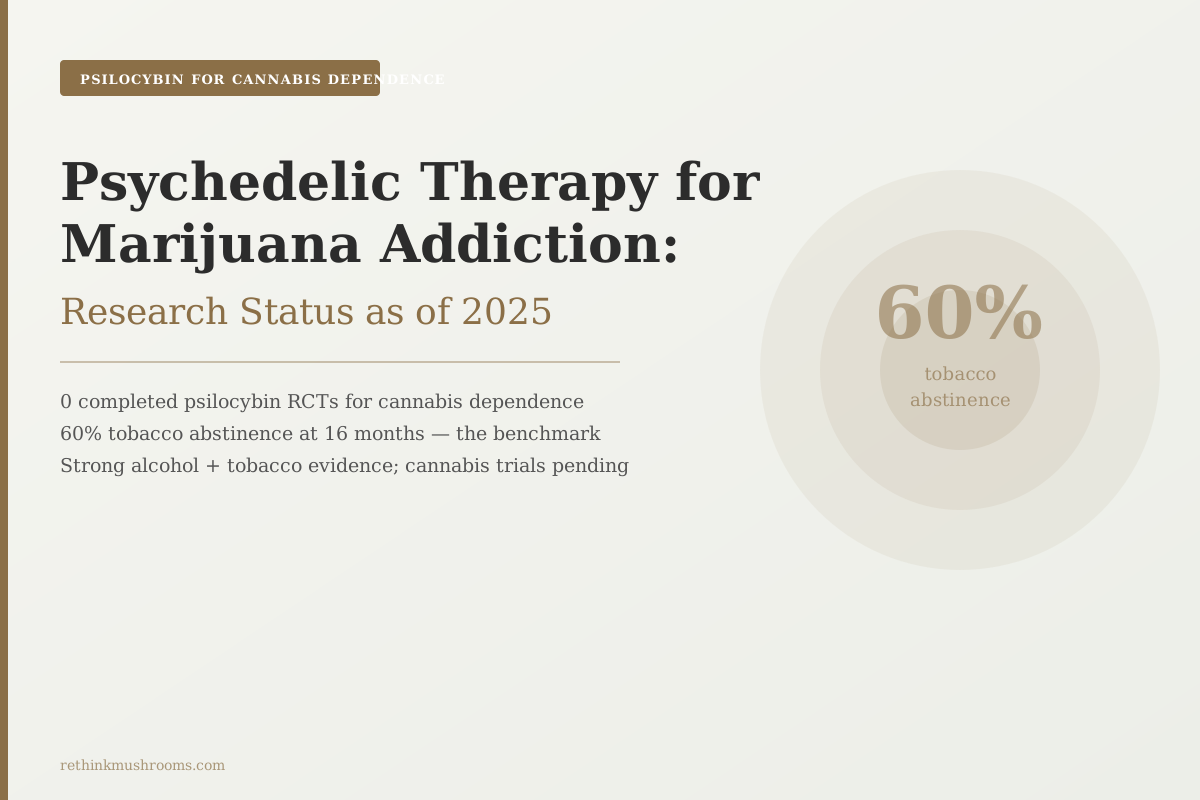
60% abstinence at 16 months
Johnson et al. (2016) found 60% of participants were still abstinent from tobacco 16 months after psilocybin-assisted therapy, the benchmark cannabis researchers are working toward.
Johnson et al., American Journal of Drug and Alcohol Abuse, 2016
0
completed psilocybin RCTs specifically for cannabis use disorder as of 2025
2023
year the only systematic review found no psilocybin CUD trial data (Phan et al.)
2025
most recent systematic review confirms: alcohol and tobacco data, no cannabis RCT
Johnson et al., American Journal of Drug and Alcohol Abuse, 2016
 View as image ↗
The most important thing to know about psychedelic therapy for marijuana addiction is what the research doesn't include: a completed randomized controlled trial testing psilocybin specifically for cannabis use disorder. As of 2025, that trial does not exist.
This matters because nearly every article on this topic extrapolates from alcohol and tobacco studies, or from mechanistic theory, without being clear that the direct cannabis-specific evidence gap is real and significant. A 2023 systematic review published in Frontiers in Psychiatry, the only systematic review to search specifically for psychedelics and cannabis use disorder, found ketamine data but no completed psilocybin trial for this population.[1]
That doesn't mean the research picture is empty. It means the evidence worth examining comes from two sources: what psilocybin has done in alcohol and tobacco addiction trials (strong), and why the mechanism might apply to cannabis (theoretically compelling). This article maps that territory honestly. For the broader question of how psilocybin produces addiction recovery across substances, see Psilocybin for Alcohol Addiction: The NYU Clinical Trial Results.
Key Takeaways
- No completed randomized controlled trial has tested psilocybin specifically for cannabis use disorder as of 2025 (Phan et al., Frontiers in Psychiatry, 2023)
- A 2025 systematic review of psilocybin for all substance use disorders confirmed strong effects in alcohol and tobacco but noted the absence of cannabis-specific trial data (Carhart-Harris et al., Drug and Alcohol Dependence, 2025)
- Psilocybin-assisted therapy produced 60% tobacco abstinence at 16-month follow-up in one long-term trial, the benchmark for what a cannabis trial could potentially show (Johnson et al., 2016)
- A 2015 proof-of-concept trial in alcohol dependence found significant reductions in heavy drinking days, establishing the clinical template for addiction treatment with psilocybin (Bogenschutz et al., 2015)
- Systematic reviews consistently confirm that extrapolating from alcohol/tobacco psilocybin data to cannabis use disorder is not supported without dedicated trials
- The theoretical case for why psilocybin could help with cannabis dependence rests on mechanisms: disruption of habit-loop neurocircuitry, serotonin-endocannabinoid system overlap, and the behavior-change effects of intense psilocybin sessions
The Honest Research Status as of 2025: No Cannabis-Specific Trial Completed
In 2023, researchers at the University of British Columbia published the only systematic review to date that looked specifically for evidence on psychedelics and cannabis use disorder. Their search, covering decades of the literature, found three topically relevant articles and noted that the only psychedelic with any CUD-specific trial data was ketamine, not psilocybin.[1] No completed psilocybin randomized controlled trial for cannabis use disorder existed.
That finding from Phan and colleagues hasn't changed. A 2025 systematic review of psilocybin across all substance use disorders, led by Robin Carhart-Harris and published in Drug and Alcohol Dependence, reached the same conclusion: strong evidence for alcohol and tobacco, no cannabis-specific RCT data.[3] The gap is confirmed by the most current and comprehensive evidence synthesis available.
Why does this matter? Because cannabis use disorder is genuinely common. About 9% of people who use cannabis develop dependence, a rate that rises to 17% among daily users. Cannabis is the most common illicit substance for which people seek addiction treatment in many countries. The absence of psilocybin trial data isn't because researchers think the question isn't worth asking; it's because the field has been working up from foundational proof-of-concept work in alcohol and tobacco, and cannabis is the next logical clinical target.
Clinical trials for psilocybin in cannabis use disorder are anticipated. But anticipated is not the same as completed. The research is not there yet.
What the Tobacco Evidence Shows, and Why It's the Benchmark
The most compelling single finding in the psychedelic addiction literature comes not from cannabis but from tobacco. In 2016, Johnson and colleagues published a long-term follow-up of a small psilocybin-assisted smoking cessation trial at Johns Hopkins. They found that 60% of participants were biologically verified as abstinent from tobacco at a 16-month follow-up, an extraordinary result in a condition where standard medications typically produce 30% or less abstinence at 12 months.[4]
The participants in that trial had failed to quit smoking multiple times before. They were not first-time quitters trying psilocybin as an initial approach. The protocol involved preparation sessions, one to three psilocybin sessions with a trained facilitator, and integration sessions afterward. Participants who had the most intense mystical experience during the psilocybin session showed the strongest long-term abstinence.
This is why the tobacco result matters for the cannabis question. Cannabis and tobacco are different substances with different pharmacology and different dependence mechanisms. But the pattern the tobacco trial established (that a single deeply meaningful psychedelic experience can disrupt an entrenched behavior pattern that other approaches couldn't budge) is the same pattern researchers are working to test in cannabis populations.
The tobacco result is the benchmark. If a dedicated psilocybin trial for cannabis dependence were run, the 60% tobacco abstinence rate at 16 months is the comparison point. For more on how the mystical experience specifically drives behavior change in addiction, see The Mystical Experience and Addiction Recovery: Why It Matters.
The Alcohol Proof-of-Concept That Built the Clinical Template
Before the tobacco long-term follow-up data came the first proof-of-concept trial in alcohol dependence. In 2015, Bogenschutz and colleagues at the University of New Mexico enrolled 10 participants with alcohol dependence, all of whom had been struggling with problem drinking for years. They received motivational enhancement sessions and one or two psilocybin sessions in a supervised clinical setting.[5]
The primary finding: percentage of heavy drinking days decreased significantly following psilocybin sessions, and this reduction was maintained at follow-up. The most meaningful predictor of alcohol reduction was, again, the intensity of the mystical or spiritually significant experience during the psilocybin session.
This proof-of-concept study was small and open-label. It didn't prove psilocybin works for alcohol dependence in the rigorous RCT sense. What it did was establish a replicable clinical approach, demonstrate that the protocol was feasible and acceptable to patients, and produce a signal strong enough to justify further investigation. Larger RCTs followed, confirming and extending the alcohol findings.
The clinical template this created (preparation, guided session, integration, meaningful experience as the active ingredient) is the same template that would be applied in a cannabis use disorder trial. The methodology exists. The addiction evidence base exists for other substances. The cannabis-specific trial is the missing piece.
What Systematic Reviews Say When They Take Stock
Two systematic reviews are most relevant to the current evidence picture.
Blei and colleagues published a 2023 systematic review of psilocybin specifically in addiction across all substances.[2] Their analysis found positive effects across the alcohol and tobacco literature, supporting the pattern established in individual trials, while confirming that no cannabis-specific trial data existed. The review categorizes the addiction evidence as promising but largely coming from early-phase trials with small samples.
The more recent and comprehensive synthesis is the 2025 systematic review by Carhart-Harris and colleagues in Drug and Alcohol Dependence.[3] This review covered efficacy and safety across all substance use disorders and reached the same directional conclusions: psilocybin shows consistent antidepressant and anti-addictive effects in well-designed trials for alcohol and tobacco, the safety profile from controlled settings is acceptable, and cannabis remains an untested population.
The consistent conclusion across both systematic reviews: the extrapolation from alcohol/tobacco evidence to cannabis is theoretically motivated but not empirically validated. Treating these as the same question is a scientific error that the field itself explicitly avoids.
The Evidence Gap Is Larger Than It Looks
Here is the logical step that most coverage skips: alcohol and cannabis are not pharmacologically similar substances.
Alcohol acts primarily on GABA receptors and produces physical dependence with serious withdrawal consequences. Cannabis acts primarily on CB1 cannabinoid receptors and produces a behavioral dependence pattern with milder withdrawal. The two addictions share some features (loss of control over use, continued use despite consequences, craving, withdrawal discomfort), but the underlying receptor pharmacology is different.
Psilocybin's anti-addictive effects in alcohol and tobacco are not primarily pharmacological in the sense of a drug opposing another drug at the same receptor. They are understood to operate through higher-order mechanisms: disruption of the default mode network (the self-referential brain circuit that maintains rigid behavioral patterns), promotion of neuroplasticity that makes new behaviors and perspectives more accessible, and the behavior-changing effects of intense, meaning-rich experiences.
These mechanisms are not specific to alcohol or tobacco. They could plausibly apply to cannabis dependence as well. But "plausibly applies" and "has been tested and found to work" are different statements. A 2017 review by De Vos and colleagues laid out the theoretical case for psilocybin across substance use disorders, including the mechanistic arguments for cannabis, but noted that evidence would require dedicated trials.[6] Eight years later, the conclusion is the same.
For the mechanistic picture of how psilocybin might specifically interact with cannabis dependence at the brain level, see Psilocybin and Cannabis Withdrawal: Potential Mechanisms. For what current evidence says about psilocybin's effects on craving across substance types, see Psilocybin and Craving Reduction: Mechanisms of Action.
What Would Have to Happen to Change This Picture
The research status will change when clinical trials run. The question for anyone following this field is not whether such trials will happen (and they almost certainly will), but when, and what they'll find.
A psilocybin trial for cannabis use disorder would require: a population of participants meeting diagnostic criteria for cannabis use disorder, a psilocybin-assisted protocol with preparation and integration support, randomized assignment to an active psilocybin dose vs. a control condition, and meaningful outcome measures (abstinence, reduction in use days, dependence symptoms).
None of that is technically difficult. The challenge is regulatory pathway, funding, and research priority. Cannabis use disorder has been a lower priority than alcohol, tobacco, and opioid use disorders in the addiction research hierarchy, because of both the lower mortality burden and the complicated legal status of the substance being treated.
The coming years will likely produce the first dedicated trials. When results are published, this summary will need updating. Until then, the research picture is what the systematic reviews say it is: no completed psilocybin RCT for cannabis use disorder, and no evidence base yet to confirm or deny what the tobacco and alcohol data suggests could be possible.
For the broader context of why psilocybin works across multiple addictions, see Psilocybin for Addiction: Why It Works Across Substances. For the question of whether psilocybin could specifically help with quitting cannabis, see Psilocybin for Cannabis Dependence: Can a Psychedelic Help Quit Weed?. For an exploration of why using a psychoactive to treat dependence on another psychoactive is a more nuanced question than it first appears, see The Paradox of Using One Psychoactive to Quit Another.
The Bottom Line
As of 2025, no randomized controlled trial has specifically tested psilocybin for cannabis use disorder. The only systematic review targeting this question (Phan et al., 2023) found no completed psilocybin CUD trial data, a conclusion confirmed by the 2025 Carhart-Harris systematic review. The addiction evidence base for psilocybin is strong in alcohol and tobacco, with the 60% long-term tobacco abstinence result (Johnson et al., 2016) representing the benchmark for what cannabis trials might show. The theoretical mechanisms support the possibility of cannabis application, but dedicated trials are needed before the evidence picture changes.
Frequently Asked Questions
Sources & References
- 1. Source details for this reference are not yet available.
- 2. Source details for this reference are not yet available.
- 3. Source details for this reference are not yet available.
- 4. Source details for this reference are not yet available.
- 5. Source details for this reference are not yet available.
- 6. Source details for this reference are not yet available.