Psilocybin & Addiction
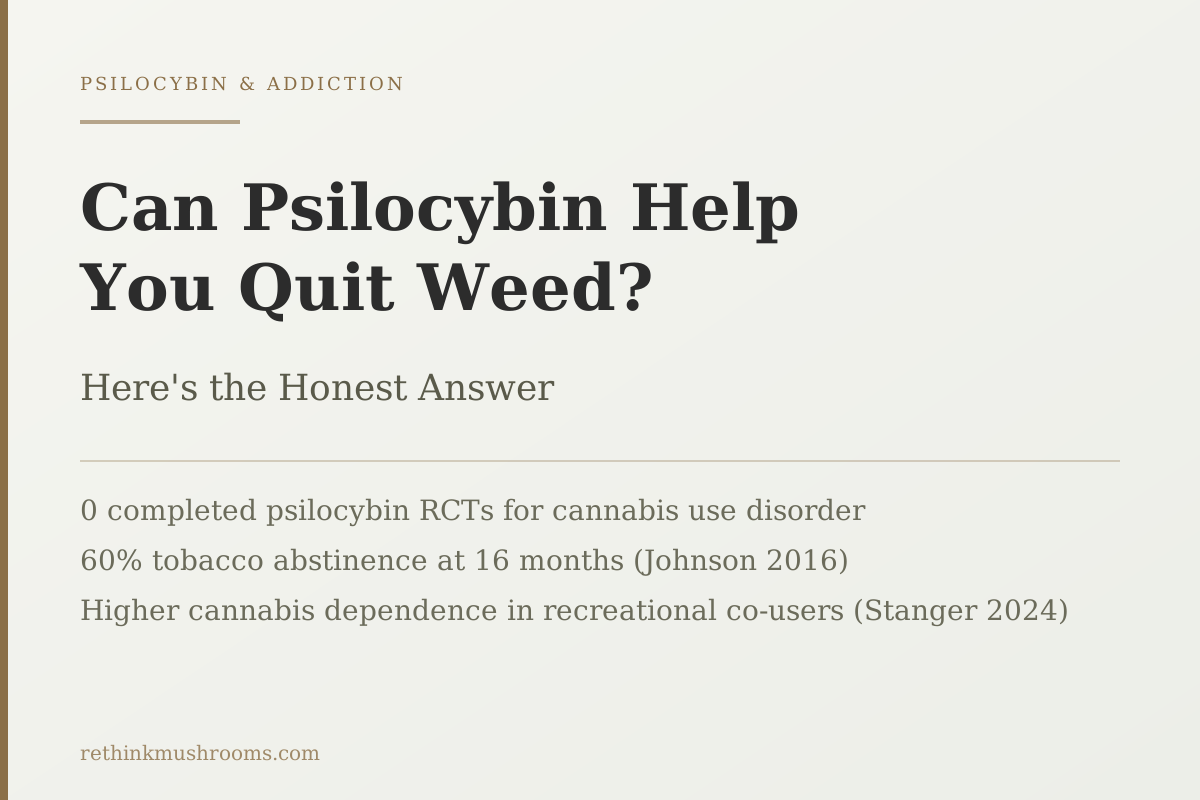
60% tobacco abstinence at 16 months
Johnson et al. (2017) found 60% of participants in a psilocybin-assisted tobacco cessation program were still abstinent at long-term (16-month or later) follow-up. No equivalent trial has been run for cannabis.
Johnson et al., Am J Drug Alcohol Abuse, 2017
0
completed psilocybin RCTs for cannabis use disorder as of 2025
Higher
cannabis dependence scores in recreational psilocybin co-users (Stanger 2024)
2025
year of the most recent comprehensive psilocybin-for-addiction systematic review
Johnson et al., Am J Drug Alcohol Abuse, 2017
 View as image ↗
If you've heard that psilocybin helps people quit smoking, there's a real study behind that. In a long-term follow-up published in 2017, Johnson and colleagues at Johns Hopkins found that 60% of the tobacco-dependent participants in their psilocybin-assisted therapy pilot were still abstinent at 16 months or later.[4] That number gets cited constantly in discussions about psilocybin and cannabis. The reasonable inference: if it works for cigarettes, why not weed?
The honest answer is that nobody has tested that inference yet. As of 2025, no completed clinical trial has examined psilocybin specifically for quitting cannabis. Extrapolating from tobacco and alcohol trials is not unreasonable. The mechanistic reasoning is real. But it is extrapolation, not evidence. This article explains what the research actually contains, what it still lacks, and one 2024 finding that should give anyone considering casual self-experimentation serious pause. For the broader context on psilocybin across addiction conditions, the guide to psilocybin for alcohol addiction covers the foundational clinical work.
Key Takeaways
- No completed clinical trial has specifically tested psilocybin for cannabis use disorder. Phan et al.'s 2023 systematic review in Frontiers in Psychiatry searched for this evidence and found none.[1]
- Johnson et al. (2017) reported 60% biologically verified tobacco abstinence at long-term (≥16-month) follow-up in the 15-participant psilocybin-assisted therapy pilot (67% at 12 months). This is the addiction benchmark; no cannabis equivalent data exists.[4]
- Stanger et al. (2024) found that regular cannabis users who had recently used psilocybin recreationally showed higher cannabis dependence scores than those who had not. The result went in the opposite direction from what most would expect.[2]
- Bogenschutz et al.'s 2015 proof-of-concept trial showed psilocybin reduced heavy drinking days in alcohol-dependent patients, establishing the treatment template that researchers hope to extend to cannabis.[5]
- Meshkat et al.'s 2025 systematic review of psilocybin for substance use disorders found the published evidence concentrated in alcohol and tobacco trials, catalogued 26 ongoing registered trials, and again found no completed cannabis-specific randomized trial.[3]
- CBT and contingency management are the current evidence-based first-line treatments for cannabis use disorder. Psilocybin-assisted therapy has not been validated for cannabis.
The Research Gap: One Systematic Review Found Zero Psilocybin Trials for Cannabis
In 2023, Phan and colleagues published what is still the only systematic review specifically designed to answer this question: what clinical trial evidence exists for treating cannabis use disorder with psychedelics?[1] They searched the literature for this specific combination. What they found: three topically relevant papers, and some limited evidence for ketamine. For psilocybin specifically, treating cannabis specifically: nothing. No completed randomized controlled trial existed.
That was 2023. In 2025, Meshkat and colleagues published a systematic review of psilocybin across substance use disorders, screening the published trials and cataloguing the ongoing pipeline.[3] The published evidence they found clustered in alcohol and tobacco use disorder, with a handful of studies in cocaine, opioid, and nicotine use; they also logged 26 clinical trials still in progress. Cannabis still had no completed dedicated trial.
This gap matters because it defines the limits of what anyone can honestly claim. Psilocybin researchers believe a cannabis use disorder trial will be run eventually. The research question is legitimate, and the pipeline of psychedelic clinical trials has expanded significantly. But the results aren't in. Anyone reading a consumer health article, a wellness site, or a psychedelic-advocacy blog that claims psilocybin is effective for cannabis dependence is reading extrapolation dressed as evidence.
There is a direct answer for the featured snippet crowd: no, there is no completed clinical trial testing psilocybin for quitting cannabis as of 2025. The evidence that does exist comes from alcohol and tobacco trials and from mechanistic theory. Both are real and worth taking seriously. Neither is the same as a positive cannabis-specific result.
The 60% Number: Why Researchers Keep Citing Tobacco Data
When psilocybin researchers discuss addiction, the tobacco number comes up constantly, and for good reason. Johnson and colleagues at Johns Hopkins ran a psilocybin smoking cessation program built around a 15-week treatment protocol.[4] Fifteen tobacco-dependent participants received preparation sessions, moderate-to-high-dose psilocybin sessions with trained guides, and integration therapy afterward. The long-term follow-up reported in 2017 found that at 16 months or later, 60% were still abstinent (67% at 12 months). For a condition where most interventions struggle to produce sustained quit rates above 30%, that result stood out.
The alcohol data is also substantive. Bogenschutz and colleagues ran a proof-of-concept trial using psilocybin in patients with alcohol use disorder.[5] Participants showed meaningful reductions in heavy drinking days following psilocybin sessions. This was a small early trial designed to test feasibility, not a large definitive study. But it established that the treatment template works: prepare the patient, conduct psilocybin sessions in a therapeutic context, support integration afterward. That structure could produce real behavior change in a dependence condition.
These two datasets are why researchers expect psilocybin to be relevant for cannabis. The mechanism that seems to drive results in tobacco and alcohol doesn't depend on those substances' pharmacology specifically. It depends on the person's psychology and the depth of the therapeutic experience. A participant in psilocybin therapy doesn't quit smoking because psilocybin chemically blocks nicotine cravings. They quit because the experience changes how they relate to the habit. Often this happens through what researchers describe as a psychologically meaningful or transformative session. In principle, that mechanism applies to cannabis too.
In principle. The trial hasn't been run. For a broader look at where psilocybin addiction research stands today, psychedelic therapy for marijuana addiction: research status covers the full landscape.
The Finding That Changes the Conversation: Recreational Co-Use Doesn't Help
Here is the result that almost no cannabis-and-psychedelic content mentions, even though it directly addresses the question most readers are asking. Stanger and colleagues, in a 2024 study published in Cannabis and Cannabinoid Research, examined regular cannabis users who had also recently used psilocybin, not in a therapeutic setting, but in the naturalistic way that people combine substances outside clinical contexts.[2]
The results went the wrong direction. Cannabis users who had recently used psilocybin showed higher cannabis dependence scores than those who hadn't used psilocybin. They also more strongly endorsed using cannabis out of boredom, because it was available, or simply for the enjoyment of it. Those motivational patterns are associated with heavier, less intentional use rather than with someone managing their consumption.
This doesn't mean psilocybin is useless for cannabis dependence. It means that recreational co-use and structured therapeutic use are not the same situation. Treating them as interchangeable is a real error.
Consider what the successful addiction trials actually involved. In Johnson's tobacco program, participants spent multiple sessions before the psilocybin day working with a therapist to clarify their intentions and prepare for the experience. The psilocybin session itself was conducted in a designed clinical environment with trained guides present. Afterward, participants worked through what they experienced in integration sessions over weeks. The 60% abstinence rate was the product of that entire system. It wasn't produced by someone occasionally taking psilocybin at a social gathering while they also used their substance of choice.
Stanger's finding describes what happens when people organically combine psilocybin and cannabis without that structure. That combination appears associated with worse cannabis outcomes, not better. The people in his study weren't in therapy. They were using two substances because they wanted to. The selection effects alone complicate the picture: people who recreationally combine multiple psychoactive substances may have systematically different relationships with drugs than those who don't.
This is the nuance that most content on this topic skips entirely. For a full treatment of the philosophical and pharmacological tension in using one psychoactive to address another, see the paradox of using one psychoactive to quit another.
What Actually Works for Cannabis Use Disorder Right Now
The evidence for treating cannabis use disorder doesn't require psilocybin speculation. Several validated approaches already exist, and they're worth knowing before any discussion of experimental options.
Cognitive behavioral therapy (CBT) is the most consistently studied intervention. CBT for cannabis use disorder works by addressing the thought patterns and behavioral sequences that sustain use: identifying triggers, building coping strategies, and disrupting the automatic chain from situation to craving to use. Multiple trials show meaningful reductions in use frequency and dependence severity. It doesn't work for everyone, and sustained abstinence rates vary, but the evidence base is real and replicated.
Contingency management pairs confirmed abstinence (verified via urine testing) with financial incentives. The effect sizes in cannabis use disorder rank among the strongest seen for any behavioral intervention in this population. It's been consistently validated across different settings and populations. It's also underused in practice because it requires ongoing resources to administer.
Brief motivational interventions, typically one or a small number of structured conversations with a trained counselor, show effects in users who are ambivalent about their use but haven't sought formal treatment. These are often delivered in primary care or college health settings.
None of these approaches involves psilocybin. They're the current standard of care because they've been tested in well-designed trials with cannabis-dependent populations. Psilocybin may one day have an evidence base here. The rationale for trying it in a clinical trial is sound. But anyone weighing options right now is looking at a very unequal evidence landscape: multiple validated treatments on one side, theoretical extrapolation on the other.
Why Researchers Believe Cannabis Trials Are Coming
The mechanistic case for testing psilocybin in cannabis use disorder is real, and it's somewhat more specific than the case for testing it in, say, cocaine addiction.
Cannabis and psilocybin both affect overlapping brain systems. Cannabis activates the endocannabinoid system, the brain's network of receptors involved in regulating mood, appetite, reward, and memory. Psilocybin activates the serotonin system. These two systems don't operate independently. The specific receptor types targeted by each substance (CB1 receptors for cannabis and 5-HT2A receptors for psilocybin) physically pair together on the same neurons in a molecular arrangement called a heteromeric receptor complex. When two receptor types share that physical pairing, activating one changes how the other responds.
This molecular crosstalk is the reason cannabis and psilocybin might interact in ways that cannabis and nicotine don't. Activating the 5-HT2A receptor (psilocybin's primary target) in a system already shaped by chronic CB1 activation (from regular cannabis use) could theoretically produce specific effects that extrapolation from tobacco or alcohol doesn't fully capture. This cross-system interaction is discussed in pharmacology research but is absent from almost all consumer content on this topic.
Beyond the receptor-level specifics, psilocybin triggers a period of enhanced neuroplasticity after administration. Neuroplasticity is the brain's capacity to form new connections and dismantle old ones. Compulsive cannabis use involves deeply ingrained behavioral patterns, and those patterns rest on well-reinforced neural pathways. When the brain is in a more plastic state, those pathways become easier to disrupt, especially when combined with psychotherapy that provides new frameworks for understanding one's relationship to the substance.
The intensity of the psilocybin experience itself also matters clinically. Research across multiple psilocybin trials has found that the depth of the experience during the session predicts outcomes afterward. A technically administered psychedelic experience that doesn't reach meaningful psychological intensity shows different results from one that does. This is one of several reasons why recreational co-use doesn't function like therapeutic administration. The clinical protocols are designed to maximize the depth and meaningfulness of the experience, not simply to introduce psilocybin into the system.
For the neurobiological mechanisms in detail, see psilocybin and cannabis withdrawal: potential mechanisms. For the broader question of why psilocybin affects addiction across different substances, psilocybin for addiction: why it works across substances covers the transdiagnostic theory.
The Bottom Line
As of 2025, no clinical trial has specifically tested psilocybin for cannabis use disorder. Strong results in alcohol and tobacco addiction trials, including 60% tobacco abstinence at 16 months, drive the research hypothesis, and the mechanistic case is specific enough to be worth clinical investigation. But a 2024 observational study found that recreational co-use of psilocybin and cannabis was associated with higher cannabis dependence scores, not lower. Structured therapeutic psilocybin and unstructured recreational co-use are fundamentally different situations. Validated treatments for cannabis use disorder already exist. Psilocybin-assisted therapy is a legitimate research direction that has not yet been tested in this population.
Frequently Asked Questions
Sources & References
- 1RTHM-01767·Phan, Angela N et al. (2023). “Systematic review and rationale of using psychedelics in the treatment of cannabis use disorder..” Frontiers in psychiatry.Study breakdown →PubMed →↩
- 2RTHM-02246·Stanger, Madeline K et al. (2026). “Comparing Cannabis Use Motivations and Dependence Across Regular Cannabis Users Who Have or Have Not Recently Used Psilocybin..” Cannabis and cannabinoid research.Study breakdown →PubMed →↩
- 3RTHM-02148·Meshkat, Shakila et al. (2025). “Efficacy and safety of psilocybin for the treatment of substance use disorders: A systematic review..” Neuroscience and biobehavioral reviews.Study breakdown →PubMed →↩
- 4RTHM-00475·Johnson, Matthew W et al. (2017). “Long-term follow-up of psilocybin-facilitated smoking cessation..” The American journal of drug and alcohol abuse.Study breakdown →PubMed →↩
- 5RTHM-00673·Bogenschutz, Michael P et al. (2015). “Psilocybin-assisted treatment for alcohol dependence: a proof-of-concept study..” Journal of psychopharmacology (Oxford.Study breakdown →PubMed →↩