Psilocybin for Cannabis Dependence
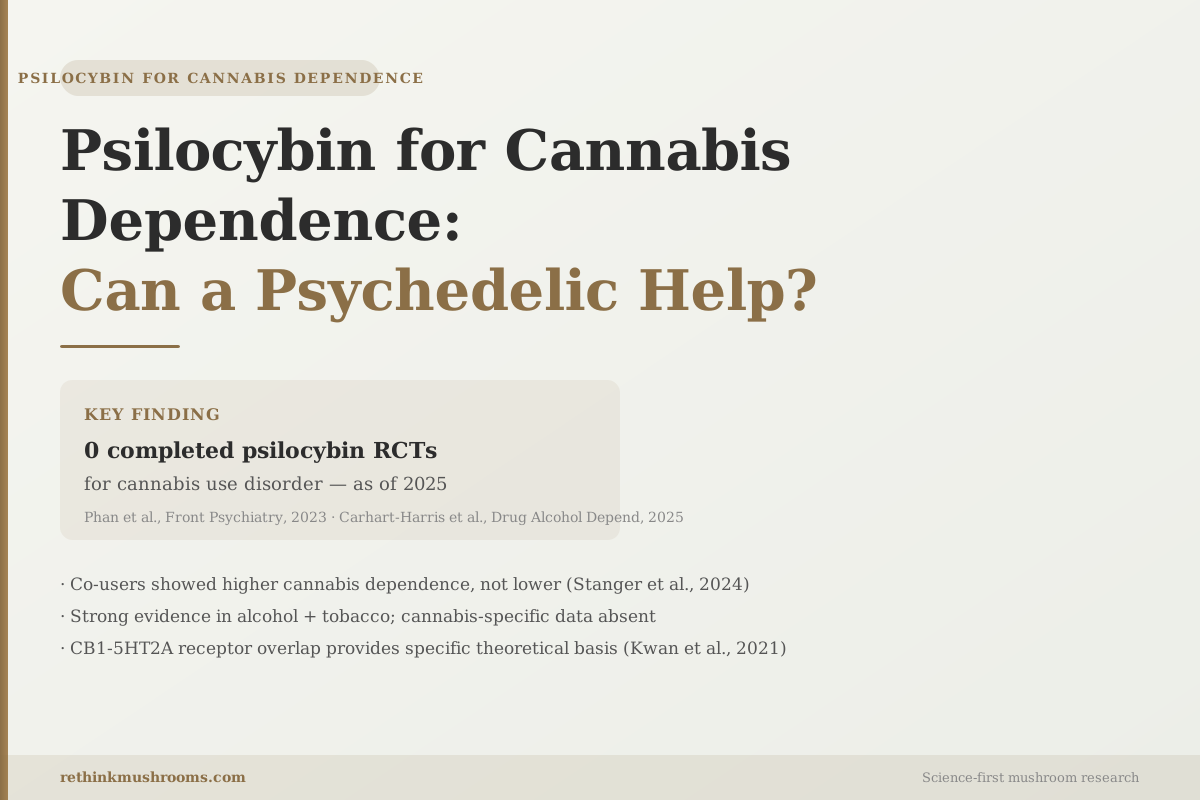
0 completed psilocybin RCTs for cannabis use disorder
Every systematic review to examine this question reaches the same conclusion: psilocybin has not been tested in a dedicated cannabis use disorder trial as of 2025.
Phan et al., Front Psychiatry, 2023; Carhart-Harris et al., Drug Alcohol Depend, 2025
Only systematic review specific to psychedelics + CUD
found no psilocybin trial data (Phan 2023)
Co-users showed higher cannabis dependence
not lower (Stanger et al., 2024)
Strong psilocybin evidence in alcohol and tobacco
but cannabis-specific trial evidence does not exist
Phan et al., Front Psychiatry, 2023; Carhart-Harris et al., Drug Alcohol Depend, 2025
 View as image ↗
The most honest answer to whether psilocybin can help with cannabis dependence is one that almost no health website will give you: the research has not tested it yet. Not specifically, not in a dedicated clinical trial, not in a population of cannabis users with a structured therapeutic goal. As of 2025, every systematic review of this question finds the same thing: there is no clinical trial evidence for psilocybin in cannabis use disorder specifically.[1][4]
That fact is the starting point for an honest examination of this topic. Psilocybin research for other addictions, like alcohol, has produced compelling results. The theoretical case for extending those results to cannabis is biologically grounded. And at least one real-world dataset provides a warning about what happens when people try to bridge that gap on their own, without therapeutic structure.
This article covers what the research shows, what it doesn't show, and why the distinction matters.
Key Takeaways
- No completed randomized controlled trial has specifically tested psilocybin for cannabis use disorder as of 2025, confirmed by two independent systematic reviews (Phan et al., 2023; Carhart-Harris et al., 2025)
- The only systematic review to search specifically for psychedelics and cannabis use disorder found ketamine trial data but no psilocybin trial evidence (Phan et al., 2023)
- People who recreationally combined psilocybin and cannabis showed higher cannabis dependence scores than non-psilocybin users, the opposite of the intuitive expectation (Stanger et al., 2024)
- Psilocybin-assisted therapy shows strong results for alcohol and tobacco addiction, but those results cannot simply be assumed to apply to cannabis
- At the molecular level, psilocybin targets a pathway biologically connected to the cannabis system: the CB1 and 5-HT2A receptors physically pair together in certain brain regions, providing a specific theoretical mechanism (Kwan et al., 2021)
- The difference between recreational co-use and structured psilocybin-assisted therapy is not a minor procedural detail; available data suggest they produce fundamentally different outcomes
The One Systematic Review That Searched This Question, and What It Found
In 2023, a research team set out to answer the precise question at the center of this article: what evidence exists for using psychedelics to treat cannabis use disorder?[1] The Phan et al. review searched the literature specifically for psychedelic treatments for cannabis use disorder. Not addiction in general, not psychedelics for other conditions, not cannabis for psychiatric conditions. Psychedelics, for cannabis use disorder, specifically.
After a systematic search, they identified three topically relevant papers. None reported a completed psilocybin randomized controlled trial for cannabis use disorder. The only psychedelic with any cannabis-specific clinical trial data was ketamine, a dissociative that works through a different receptor system than psilocybin entirely.
Why does this matter so much? Because most consumer content on this topic either ignores this review or misrepresents what it found. The standard approach is to cite psilocybin's results in alcohol and tobacco trials, describe the neurobiological mechanisms through which it might affect addiction, and leave readers with the impression that cannabis dependence is a near-solved problem. The Phan review makes explicit that it is not.
The review team did identify a theoretical rationale for studying psilocybin in cannabis use disorder; the mechanisms are plausible, and cannabis dependence is a genuine clinical problem affecting roughly 9% of regular users. But the review's primary contribution was confirming that the clinical experiment simply has not been run.
That gap remained unfilled through 2025. The systematic review by Carhart-Harris and colleagues published that year, the most comprehensive evidence synthesis across all psilocybin and substance use disorder research, reached the same conclusion: alcohol and tobacco have clinical trial data; cannabis does not.[4]
Psilocybin Has Strong Evidence for Other Addictions, but That Evidence Doesn't Automatically Transfer
The evidence for psilocybin in alcohol and tobacco addiction is genuinely strong. A 2023 systematic review of psilocybin across addiction contexts[3] found positive signals across multiple substance types. The 2025 Carhart-Harris review confirmed those findings for alcohol and tobacco use disorders while noting the cannabis-specific trial gap.[4] Long-term tobacco abstinence rates in some psilocybin trials exceeded those of most approved pharmacological approaches.
The extrapolation to cannabis is understandable. Substance use disorder, whether alcohol, tobacco, or cannabis, shares common features: compulsive use despite negative consequences, craving, habit formation, and the persistence of use even when the person wants to stop. The brain circuits that sustain all three overlap considerably. If psilocybin disrupts that cycle in one, the reasoning goes, it should disrupt it in another.
That reasoning has merit. It is also not sufficient as evidence.
Cannabis dependence has distinct biological features that separate it from both tobacco and alcohol. THC, the primary psychoactive compound in cannabis, binds to CB1 receptors in the endocannabinoid system. This receptor network is not the primary target of either alcohol or nicotine. Cannabis withdrawal, which involves irritability, sleep disruption, and appetite changes that motivate continued use, is driven by endocannabinoid system dysregulation. Psilocybin acts primarily through serotonin 2A receptors and does not directly bind CB1 receptors.
The mechanisms that make psilocybin effective for tobacco, including the disruption of nicotine-driven habit circuits and the role of psychedelic experiences in behavior change, do not map cleanly onto endocannabinoid withdrawal. This is not a reason to dismiss psilocybin as a potential cannabis treatment. It is a reason to want cannabis-specific data before drawing clinical conclusions.
The question of why psilocybin works across different addictions at all is covered in the article on psilocybin for addiction: why it works across substances.
The Stanger Finding: Recreational Co-Use Correlated With Higher Cannabis Dependence
The most important and least-cited data point in this area comes from a 2024 study by Stanger and colleagues.[2]
The researchers compared regular cannabis users who had recently used psilocybin with regular cannabis users who had not. The hypothesis was straightforward: if naturalistic co-use of psilocybin reduced cannabis dependence, the psilocybin-using group should show lower dependence scores.
The result went the other direction.
Cannabis users who had recently used psilocybin showed higher cannabis dependence scores than those who had not used psilocybin. They also more strongly endorsed enjoyment, boredom, and availability as motivations for their cannabis use. These motivation patterns are associated with more habituated, compulsive use, not with controlled or occasional use.
This is a correlational study. It cannot establish causal direction, and the causal question here is genuinely unclear. One possibility: psilocybin exposure somehow increased cannabis dependence. Another possibility: people with more entrenched cannabis dependence were more likely to seek out novel psychoactive experiences, including psilocybin, producing a correlation through selection rather than causation. The Stanger data does not resolve this.
What the Stanger finding does settle is the narrower question of whether recreational co-use of cannabis and psilocybin functions as a dependence reduction strategy. The answer, from the only study to look directly at naturalistic co-users, is that it does not. People combining psilocybin and cannabis in their daily lives showed more cannabis dependence, not less.
This finding matters because a significant fraction of people who read about psilocybin's potential for addiction treatment interpret it as a basis for incorporating psilocybin into their recreational cannabis use. The Stanger data suggests that approach does not replicate the effects seen in structured clinical settings.
For more on why using one psychoactive to quit another is more complicated than it sounds, the article on the paradox of using one psychoactive to quit another covers the pharmacological differences that make psilocybin-assisted therapy distinct from recreational co-use.
The Molecular Case: Why Cannabis and Psilocybin Share Biology That Other Addiction Pairs Don't
Despite the evidence gap, the theoretical case for psilocybin in cannabis dependence is stronger than it is for most substance pairings. The reason is molecular.
A 2021 study by Kwan and colleagues[5] found that psilocybin works through a mechanism that links serotonin 2A receptor activation to structural changes in dendritic spines in the frontal cortex. Dendritic spines are the fine projections on neurons that form connections between brain cells. This same mechanism underlies both the cognitive changes of a psychedelic experience and vulnerability to substance use disorders. Psilocybin, through this pathway, touches the cellular machinery that makes the brain more or less susceptible to compulsive substance use.
The specific connection to cannabis dependence involves a molecular feature called CB1-5HT2A receptor heteromers. In plain terms: CB1 receptors are the primary targets of THC in the brain. 5-HT2A receptors are the primary targets of psilocybin. In certain brain regions, these two receptor types physically pair together, forming a linked molecular complex. When CB1 and 5-HT2A receptors pair like this, activating one receptor influences how the other functions. This is the CB1-5HT2A heteromer.
This physical pairing matters because it means the endocannabinoid system and the serotonin system are not merely parallel pathways that happen to occupy the same brain regions. In some locations, they are physically coupled at the receptor level. Psilocybin, by activating 5-HT2A receptors, does not only affect serotonin signaling. It activates a coupled CB1-5HT2A complex, which gives it a route to influence cannabis-relevant brain circuits that pharmacological agents targeting other receptor systems would not have.
This is why the theoretical case for psilocybin in cannabis dependence is more specific than the general "disrupts habit loops" argument made for other addictions. The molecular overlap between psilocybin's pharmacological target and cannabis's pharmacological target is specific and biologically grounded. It is not just an analogy.
That said, molecular mechanisms do not guarantee clinical outcomes. Many compounds with plausible mechanisms produce disappointing trial results. What the Kwan finding establishes is that the rationale is not merely analogical. The clinical test still needs to happen.
The article on psilocybin and craving reduction: mechanisms of action covers how psilocybin affects the craving circuitry relevant to all substance use disorders, including the 5-HT2A pathway.
Two Naturalistic Datasets, One Consistent Result: Recreational Co-Use Does Not Reduce Cannabis Use
The Stanger 2024 finding is not the only observational data on naturalistic psilocybin use and cannabis consumption. A 2022 study by Pisano and colleagues[6] examined whether naturalistic psychedelic use was associated with reduced co-occurring substance use in a large online sample. For some substances, psychedelic use correlated with reduced concurrent use. For cannabis specifically, the direction of effect was inconsistent.
Taken together, Pisano 2022 and Stanger 2024 point in the same direction. In real-world settings, without therapeutic structure, psilocybin use does not reliably reduce cannabis consumption. Cannabis use either remains stable or correlates with higher dependence in uncontrolled settings.
This pattern is consistent with a principle that psilocybin researchers have emphasized for years: the pharmacological effects of psilocybin are not themselves the therapeutic intervention. The therapeutic intervention is psilocybin combined with deliberate preparation, a supportive guide, and structured integration of the experience afterward. Remove those elements and you have a different experiment, one that the addiction trials were not testing, and one that naturalistic data suggests does not replicate their results.
The distinction between what clinical trials tested (structured psilocybin-assisted therapy with a trained guide and an explicit therapeutic goal) and what most people would actually do if they decided to try psilocybin for cannabis (recreational co-use without therapeutic structure) is not a minor procedural difference. Based on available data, it appears to be the difference between an intervention that could theoretically help and one that does not.
For more on the current state of cannabis addiction research specifically, the article on psychedelic therapy for marijuana addiction: research status surveys the full landscape, including ongoing research directions.
The Evidence Inventory: What Exists and What Doesn't
As of 2025, the evidence picture for psilocybin and cannabis dependence looks like this:
What the research shows:
Psilocybin-assisted therapy has demonstrated efficacy for alcohol and tobacco addiction in multiple clinical trials. The 2025 Carhart-Harris systematic review, the most comprehensive evidence synthesis to date, confirmed these effects.[4] Separate systematic reviews of psilocybin in addiction find consistent positive signals for non-cannabis substances.[3] At the molecular level, psilocybin targets a mechanism that intersects with cannabis biology through shared receptor architecture.[5]
What the research does not show:
No completed randomized controlled trial has tested psilocybin-assisted therapy for cannabis use disorder. The systematic review designed to find such evidence found none.[1] Naturalistic co-use of psilocybin and cannabis does not appear to reduce cannabis dependence, and correlates with higher dependence in uncontrolled settings.[2]
This is the honest evidence map. The research gap is real. The theoretical rationale is real. The naturalistic warning is real. All three coexist.
For anyone approaching this topic from a clinical perspective, as researchers, practitioners, or people curious about their own circumstances, this is where the evidence stands as of 2025. A dedicated clinical trial would change it. None has been completed yet.
The article on psilocybin and cannabis withdrawal: potential mechanisms explores what a psilocybin therapeutic mechanism for cannabis dependence might look like if the clinical evidence eventually develops.
The Bottom Line
As of 2025, no completed randomized controlled trial has specifically tested psilocybin for cannabis use disorder, a gap confirmed by every systematic review to examine this question. Psilocybin shows efficacy for alcohol and tobacco addiction, and the molecular mechanisms provide a biologically specific theoretical case for cannabis via the CB1-5HT2A receptor connection. But the one real-world dataset examining naturalistic co-use of psilocybin and cannabis found higher dependence scores in co-users, not lower, pointing to a fundamental difference between recreational co-use and structured psilocybin-assisted therapy. The clinical trial that would answer whether psilocybin helps cannabis dependence has not been conducted.
Frequently Asked Questions
Sources & References
- 1. Source details for this reference are not yet available.
- 2. Source details for this reference are not yet available.
- 3. Source details for this reference are not yet available.
- 4. Source details for this reference are not yet available.
- 5. Source details for this reference are not yet available.
- 6. Source details for this reference are not yet available.