Psilocybin Therapy Costs
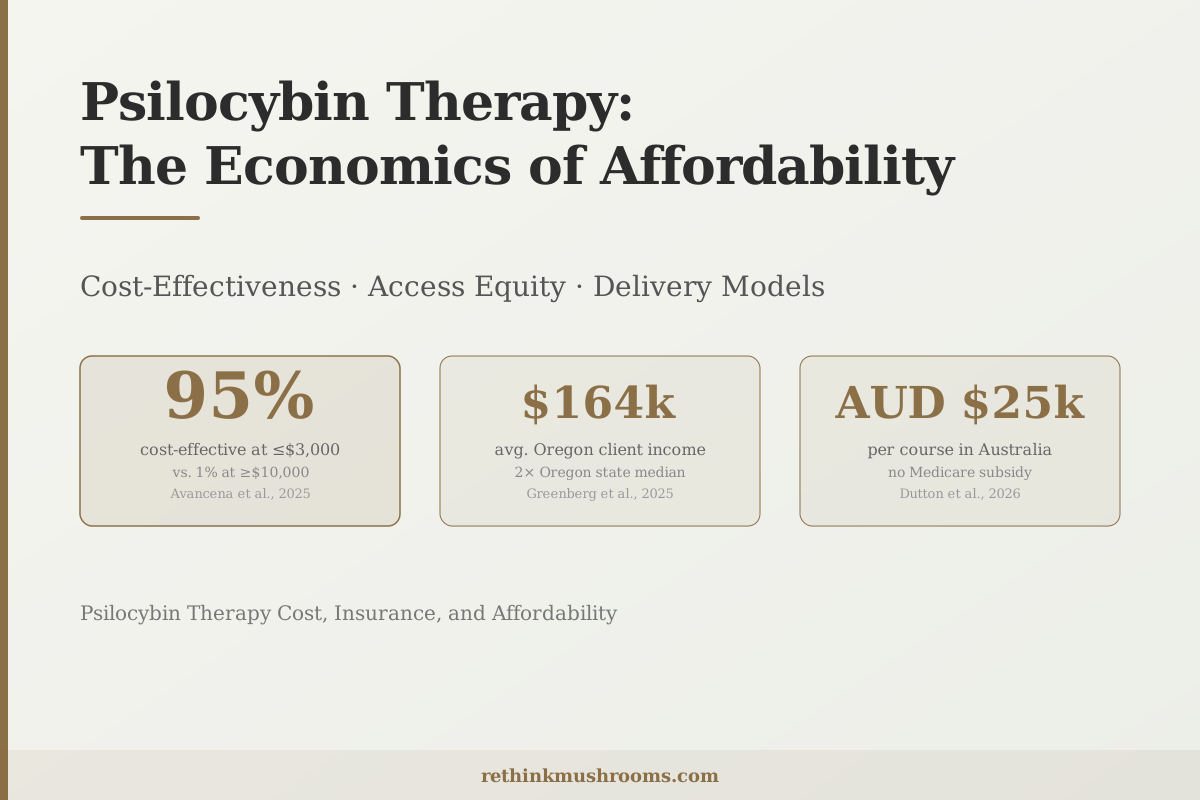
95% cost-effective probability at ≤$3,000
Avancena et al. (2025) found psilocybin-assisted therapy has a 95% probability of being cost-effective for treatment-resistant depression when the total course costs $3,000 or less. At $10,000 or more, that figure drops to 1%.
Avancena et al., Translational Psychiatry, 2025
AUD $25,000
per course in Australia's TGA-authorized program — not covered by Medicare Australia
$164k/yr
average annual income of Oregon psilocybin clients — double the state median
~$10
approximate drug cost per therapeutic psilocybin dose; the expensive part is therapist time
Avancena et al., Translational Psychiatry, 2025
 View as image ↗
A single therapeutic dose of psilocybin costs roughly $10 to produce. An Oregon psilocybin session runs $600 to $3,500. The gap between those two numbers is not markup — it is 15 to 20 hours of skilled human time: one to three preparation sessions, a six-to-eight-hour guided administration day, and one or two integration appointments. Psilocybin therapy is expensive because it is, structurally, intensive mental health care. The compound is the cheapest part.
That cost structure matters for understanding whether psilocybin therapy can ever be affordable, and what affordable would actually require. Two economic models published in 2023 and 2025 show that at the right price point, psilocybin-assisted therapy is not just affordable for patients but cost-saving for healthcare systems overall. The question is whether the current delivery model can reach that price point. This article covers the economics behind psilocybin therapy affordability, who has access right now, and what structural changes could shift the math. For the legal barriers preventing insurance coverage, see the cluster's coverage question article and the broader policy context at psilocybin's Schedule I status and history.
Key Takeaways
- Psilocybin therapy is expensive because of therapist time (15-20 hours per course), not the drug itself — the compound costs roughly $10 per therapeutic dose to produce
- Avancena et al. (2025) found PAT has a 95% probability of being cost-effective for treatment-resistant depression when total course cost is ≤$3,000; that probability falls to 1% at ≥$10,000[2]
- McCrone et al. (2023) showed psilocybin becomes cost-effective in the UK when therapist support costs are reduced by 50% — the economic argument for group session delivery models[1]
- Oregon clients average $164,000/yr in income — double the state median — and participants in clinical trials are 93% college-educated, showing the current access gap skews heavily toward high-income, highly educated populations[3]
- Australia authorized psilocybin therapy in 2023 but a full treatment course costs AUD $15,000–$25,000 with no Medicare subsidy — the world's most advanced national program remains inaccessible to most Australians[5]
- Access inequity is the most frequently cited ethical concern across the psilocybin literature — a 2025 systematic scoping review found cost and access equity to be the #1 recurring issue[4]
Why a $3,500 Psilocybin Session Contains Only About $10 Worth of Drug
To understand why psilocybin therapy costs what it does, it helps to separate what you're actually paying for.
The compound itself is not expensive. Psilocybin is relatively straightforward to synthesize, and naturally occurring psilocybin mushrooms are cheap to cultivate. A therapeutic dose — typically 25mg of pure psilocybin or the equivalent in mushroom preparation — costs roughly $10 to $20 in drug or material costs. This is not meaningfully different from generic antidepressants.
The expensive part is everything else. A standard psilocybin-assisted therapy course involves:
- Preparation sessions (1-3 sessions): The therapist or guide meets with the patient in advance to establish rapport, explain the process, address anxiety, and set intentions. These are hour-long clinical sessions.
- Administration session (1 session, 6-8 hours): A trained facilitator is present for the entire duration of the psychedelic experience. They do not perform standard talk therapy during this session — their role is to hold the space, respond to distress, and provide a stable supportive presence. But they cannot be elsewhere for eight hours.
- Integration sessions (1-2 sessions): Follow-up appointments to process the experience and translate insights into lasting behavioral change.
A course spanning three preparation sessions, one 8-hour session, and two integration sessions requires approximately 18 hours of skilled mental health professional time. In the US, a licensed therapist bills $150 to $300 per hour. Run the math and you get $2,700 to $5,400 in therapist time before facility costs, compliance requirements, or any overhead.
McCrone and colleagues (2023) modeled this precisely in the UK context. Their decision analytic economic model showed that psilocybin-assisted therapy becomes cost-effective for severe depression when two conditions are met simultaneously: the drug price is reduced to £400–£800 per person, and therapist support costs are reduced by 50%.[1] Neither condition alone is sufficient. Both must be met. This tells you that the drug price ceiling is not the primary economic problem — the delivery model is.
The Cost-Effectiveness Tipping Point: $3,000 or $10,000?
"Cost-effective" has a specific technical meaning in health economics: it compares the cost of a treatment to the health outcomes it produces (measured in quality-adjusted life years, or QALYs) against an accepted threshold for what societies are willing to pay per unit of health. In the US, that threshold is typically $100,000 to $150,000 per QALY.
Avancena and colleagues (2025) built the most detailed US-specific cost-effectiveness model for psilocybin-assisted therapy in treatment-resistant depression.[2] Their findings show a sharp price sensitivity curve:
- At ≤$3,000 total cost per course: 95% probability of being cost-effective at the $150,000/QALY threshold
- At ≈$5,000: still cost-effective vs. standard of care, with positive probability
- At ≥$10,000: only 1% probability of being cost-effective
The $10,000 threshold represents a hard wall. Above it, psilocybin therapy cannot compete economically with standard treatment options even for treatment-resistant cases. Below $3,000, it almost certainly can.
Avancena's extended model adds a further dimension. When the analysis accounts for the long-term costs of treatment-resistant depression that go unaddressed by standard care — repeated medication trials, hospitalization, lost productivity, ongoing therapy — psilocybin-assisted therapy at $5,000 per course saves approximately $7,000 per patient and gains 0.10 QALYs compared to the standard of care.[2] This reframes the economics: the question is not whether $5,000 is affordable for a single treatment. The question is whether $5,000 once is affordable compared to $50,000+ spread across years of failed antidepressants, inpatient care, and disability.
For the specific breakdown of what current sessions cost and what's included at each price point, see what patients pay out of pocket for psilocybin therapy.
Low-Cost Psilocybin Therapy Options That Exist Right Now
Full-price psilocybin therapy is out of reach for most people. But lower-cost access pathways do exist, primarily in the US states that have legalized the practice.
Oregon sliding-scale providers: Oregon's Measure 109 framework allows service centers to set their own pricing. Some providers have implemented sliding-scale fee structures for lower-income clients. At the low end, some Oregon centers have offered sessions below $1,000 for qualifying applicants — placing them in the cost-effective range identified by Avancena 2025.
Colorado healing centers: Colorado's Proposition 122 legalized psilocybin healing centers in 2023. Several early operators have committed to discounts for veterans and people enrolled in Medicaid. Greenberg and colleagues (2025) specifically cite Colorado's sliding-scale healing center model as one of three early implementations of equitable access infrastructure.[3]
The Sheri Eckert Foundation: A nonprofit grant program established to provide financial assistance for qualifying individuals pursuing psilocybin therapy. Greenberg 2025 identifies this as one of the existing pathways for people who cannot afford standard pricing.
Clinical trial participation: Multiple psilocybin trials in depression, PTSD, addiction, and other conditions offer free access to FDA-approved psilocybin in a supported clinical setting. Eligibility criteria are restrictive, but for those who qualify, trials provide a legitimate access pathway at no cost.
Group session models: Several providers are experimenting with 2-to-4 person group sessions with shared facilitator time. This is not standard in the literature — most published trials used one-on-one guidance — but it is being piloted as a cost-reduction mechanism.
For a fuller look at the Oregon and international access landscape, see Oregon psilocybin services: how the world's first legal program works and legal psilocybin access options available right now.
The Access Gap: Oregon's Average Client Earns $164,000 a Year
The people who currently access psilocybin therapy legally are not a representative sample of the people who need it.
Greenberg and colleagues (2025) analyzed the demographics of the Oregon psilocybin services program in its early period. The finding: the average Oregon client earns approximately $164,000 per year — more than double Oregon's state median household income.[3] Clients are disproportionately white, disproportionately over 40, and over-represented by people with college degrees. Clinical trial populations show similar skew: a 2021 Johns Hopkins depression trial found 93% of participants had a college degree.
This is not an accident of who wants psilocybin therapy. It is a consequence of who can afford it.
Caporuscio and colleagues (2025) conducted a systematic scoping review of ethical issues in psychedelic-assisted psychiatry.[4] Across the studies they analyzed, cost-linked access inequity emerged as the most frequently cited ethical concern — more common in the literature than consent issues, therapist boundary violations, or evidence quality gaps. The consensus framing: a treatment that has produced its most compelling results in depression, PTSD, and addiction is currently available almost exclusively to people who are already economically stable.
Greenberg 2025 argues this creates a compounding inequity problem. Mental health disorders occur at higher rates in lower-income populations, where they are also least treated. Psilocybin therapy, if it proves as effective as the trial evidence suggests, would be most needed by exactly the populations who are currently most excluded from it.
Australia's Warning: Clinical Regulation Doesn't Guarantee Affordability
Australia offers the clearest illustration of where the current global model leads.
In February 2023, the Therapeutic Goods Administration (TGA) authorized authorized psychiatrists in Australia to prescribe psilocybin for treatment-resistant depression and MDMA for PTSD. This made Australia the first country in the world to approve psychedelic compounds for clinical use at the national level.
Dutton and colleagues (2026) documented what happened next in clinical practice.[5] A full psilocybin treatment course in Australia now costs between AUD $15,000 and $25,000. Medicare Australia provides no subsidy. Patients must pay private psychiatrist rates for all preparation and integration sessions, plus unsubsidized drug costs and facility fees.
The result: the world's most advanced national psilocybin program is accessible almost exclusively to patients who can afford private psychiatry. Dutton et al. characterize the model as "over-medicalized" — the requirement that all treatment occur within a private psychiatric framework, rather than allowing trained non-physician facilitators, structurally locks in costs that most patients cannot meet.
The Australia example matters for the US debate. It shows that formal clinical authorization alone does not create affordable access. Without public funding, a sliding-scale mandate, or an alternative delivery model, authorization creates a legal pathway that remains practically unusable for most of the population.
What Could Actually Lower the Price
The $3,000 cost-effectiveness threshold from Avancena 2025 is not unreachable. Several structural levers could get there.
Group session delivery: If two or three patients share a supervised session with one facilitator, the therapist-hours-per-patient ratio drops sharply. One 8-hour session serves three patients instead of one, cutting the largest cost component by 60-70%. McCrone 2023 shows that halving therapist support costs is the single most powerful lever for cost-effectiveness. Group models are the most direct path to that reduction.[1]
Trained non-physician facilitators: The Australia model requires psychiatrists to oversee treatment. Oregon and Colorado allow licensed facilitators who are not physicians. Non-physician facilitators can be trained to a high standard at lower labor cost. Greenberg 2025 proposes community health worker integration — training community health workers to provide supportive presence during sessions, with professional oversight, to further reduce per-session cost.[3]
Insurance coverage: For treatment-resistant depression patients who have already failed multiple antidepressant trials, insurance companies have a financial incentive to cover psilocybin therapy. Avancena 2025's long-term model shows PAT saves $7,000 per patient over standard care when downstream cost avoidance is included. This is the economic case that insurers would need to see before covering the treatment. Insurance coverage would shift psilocybin from an out-of-pocket expense to a copay — the most transformative affordability change possible, but dependent on FDA approval. The full pipeline from approval to coverage is covered in Medicare, Medicaid, and psychedelic therapy: future scenarios and insurance coverage for psilocybin therapy: cost, coding, and outlook.
Public funding for pilot programs: Colorado and Oregon could mandate that a portion of licensing fees from commercial centers fund subsidized access programs. This would not require federal action or insurance coverage — it is within the authority of state regulatory frameworks.
None of these levers individually reduces cost enough. The most likely path to broadly affordable psilocybin therapy runs through several of them in parallel: group delivery models, non-physician facilitation, and ultimately insurance coverage triggered by FDA approval.
The Bottom Line
Psilocybin therapy's high cost is driven by the human infrastructure of safe delivery — therapist preparation, guided sessions, and integration — not by the compound itself. Economic modeling shows a clear threshold: at $3,000 or less per course, PAT is highly cost-effective for treatment-resistant depression; above $10,000, it is not. Current access skews heavily toward high-income populations in every jurisdiction where legal therapy exists, including Australia's nationally authorized framework. Structural cost reductions through group delivery models, trained non-physician facilitators, and eventual insurance coverage offer the most viable paths toward broader affordability.
Frequently Asked Questions
Sources & References
- 1. Source details for this reference are not yet available.
- 2. Source details for this reference are not yet available.
- 3. Source details for this reference are not yet available.
- 4. Source details for this reference are not yet available.
- 5. Source details for this reference are not yet available.