Psilocybin Therapy Cost, Insurance, and Affordability
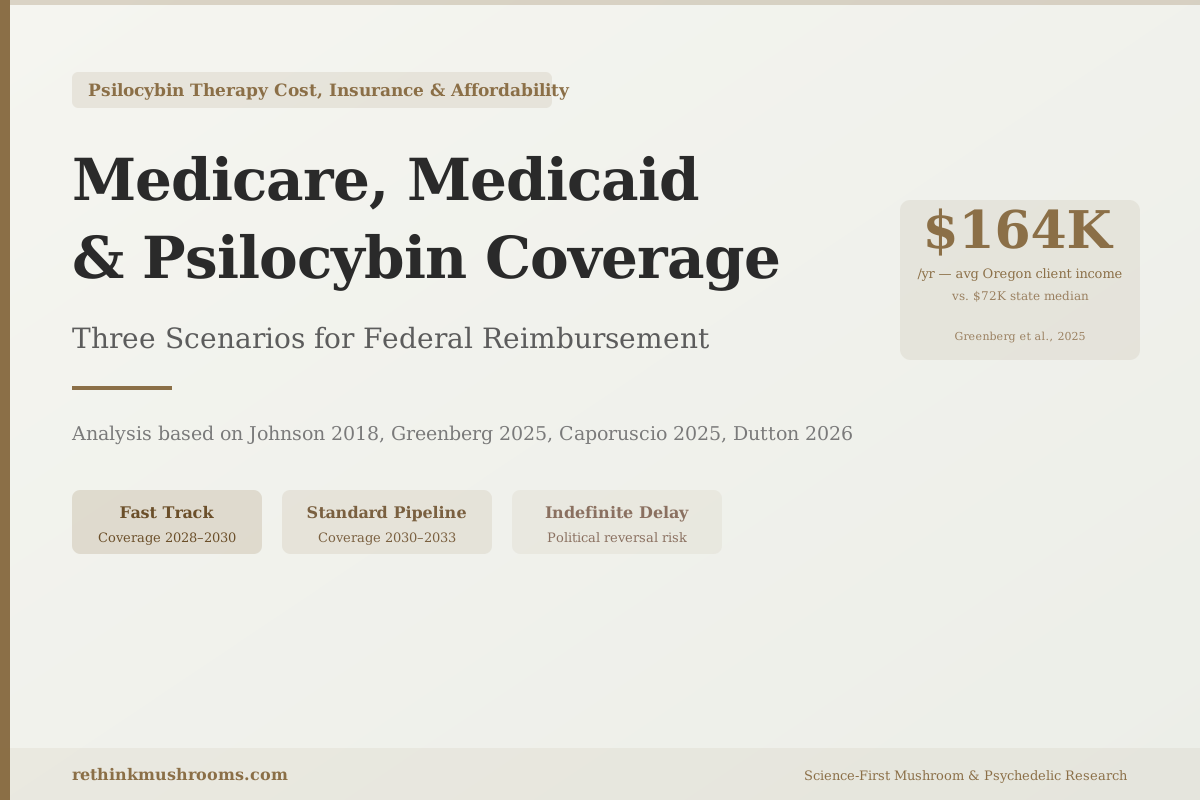
$164K/yr
The average annual income of Oregon psilocybin clients, more than double the state median, revealing who can afford therapy when Medicare and Medicaid coverage don't exist.
Greenberg et al., 2025
0
federal programs covering psilocybin therapy in 2026
3
sequential steps before federal coverage is possible
2029–30
earliest realistic Medicare coverage window
Greenberg et al., 2025
 View as image ↗
The average Oregon psilocybin client earns $164,000 a year, more than double the state median.[2] That number is not a coincidence. It is what psilocybin therapy costs when no insurance covers it, Medicare cannot pay for it, and Medicaid cannot touch it. The people who can afford it show up. Everyone else does not.
Medicare and Medicaid cover nearly 150 million Americans combined, including many of the people most likely to carry treatment-resistant depression, the condition where psilocybin's evidence base is strongest. As of 2026, neither program can pay for psilocybin therapy. Not because the evidence is insufficient. Because federal law classifies psilocybin as a Schedule I controlled substance, making it legally impossible to prescribe, bill, or reimburse under any federal health program.
This article is part of the broader coverage on psilocybin's Schedule I legal history and its consequences. Here, the focus is on what Medicare and Medicaid coverage would actually require, what the realistic timelines look like, and the three scenarios that could play out over the next five to seven years.
Key Takeaways
- Medicare and Medicaid cannot cover psilocybin therapy in 2026; Schedule I federal classification makes reimbursement legally impossible, regardless of clinical evidence
- Three sequential steps are required for federal coverage: FDA approval of a psilocybin product, DEA rescheduling out of Schedule I, and a CMS National Coverage Determination
- The AMA released CPT codes 0820T, 0821T, and 0822T for psilocybin sessions in June 2023, but Category III status means they track utilization data only, not reimbursement
- A Center for Medicare and Medicaid Innovation demonstration project could create a Medicaid access pathway years before the full NCD process completes
- Australia authorized psilocybin medically in 2023 but kept it outside public insurance; the result was AUD $15,000–$25,000 per course, accessible only to high-income patients despite being the world's most advanced national framework[4]
- Greenberg et al. (2025) identified insurance coverage as the single highest-leverage policy change for psilocybin access equity; the population currently excluded from access overlaps almost entirely with Medicaid enrollees and lower-income Medicare beneficiaries[2]
The Legal Barrier: Why Schedule I Blocks Any Federal Payment
The core issue is not political will or evidence quality. It is a legal chain with no gaps in it.
Psilocybin is Schedule I under the Controlled Substances Act. By definition, Schedule I means: high abuse potential, no accepted medical use, no safe conditions for use under medical supervision. Johnson et al. (2018) conducted a formal 8-factor analysis of psilocybin against all eight CSA criteria and concluded that psilocybin does not meet any of them. The evidence argues Schedule I classification is scientifically unjustified.[1] The law does not automatically update to match the evidence. It requires a formal rescheduling process, a Congressional act, or an FDA approval that triggers a mandatory DEA review.
The practical consequence for Medicare and Medicaid: a healthcare provider cannot legally prescribe a Schedule I substance. Medicare and Medicaid reimburse only for services built around legal prescriptions. No legal prescription means no reimbursement, regardless of the trial evidence, regardless of what billing codes exist.
The AMA released three CPT codes for psilocybin therapy in June 2023: code 0820T covers the first 60 minutes of in-person session monitoring, 0821T covers each additional 30 minutes, and 0822T covers monitoring by a second provider present during the session. These codes looked like infrastructure for coverage. In practice, they are Category III codes. Category III means the codes exist to track utilization data for future research purposes. Category III codes are not reimbursable by Medicare, Medicaid, or commercial insurance. A code becomes reimbursable only after promotion to Category I, which requires both sufficient clinical evidence and a substance that providers can legally prescribe.
The CPT codes are billing infrastructure waiting for the law to change. They are not a coverage pathway in themselves.
There is a partial exception worth noting. Preparation and integration sessions, the psychotherapy appointments that happen before and after a psilocybin session, can be billed to insurance under standard mental health CPT codes today. For patients with active mental health coverage, those components may be partially reimbursable even now. The psilocybin session itself is not. The billing mechanics and what can be covered under current rules are explored in the companion article on CPT codes and coverage outlook.
The Three-Step Pipeline: What Must Happen Before Federal Coverage Is Possible
Federal coverage for psilocybin follows a sequential pipeline. Each step must complete before the next becomes possible.
Step 1: FDA approves a specific psilocybin product
FDA approval would be for a specific drug formulation, from a specific manufacturer, for a specific indication. The most likely first indication is treatment-resistant depression. Approval removes the "no accepted medical use" criterion from psilocybin's Schedule I classification and triggers a mandatory DEA rescheduling review. Compass Pathways and researchers affiliated with MAPS have the most advanced clinical programs in this pipeline. Current projections for an FDA decision range from 2026 to 2028, depending on trial results and regulatory timelines.
Step 2: DEA rescheduling
FDA approval of a psilocybin product triggers a mandatory DEA review of the drug's Schedule I classification. The DEA can propose rescheduling to Schedule II, III, or lower, or it can decline to reschedule. An FDA-approved drug that remains Schedule I would represent a significant legal contradiction, making rescheduling of an FDA-approved psilocybin formulation highly probable. The rescheduling process typically takes 12 to 24 months after FDA action.
Step 3: CMS National Coverage Determination
After a drug is rescheduled and carries FDA approval, the Centers for Medicare and Medicaid Services can conduct a National Coverage Determination, a formal evidence review to decide whether Medicare will cover a treatment for a specific patient population. The NCD process typically takes 6 to 18 months. Private insurers generally follow CMS coverage decisions when setting their own policies.
Working through these three steps, the conservative best-case timeline runs as follows: FDA approval in 2027, DEA rescheduling in 2028, NCD complete in 2029 to 2030. The standard pipeline scenario puts full coverage at 2030 to 2033.
The CMMI Shortcut: How Medicaid Could Move Faster Than Medicare
The standard NCD pipeline is the most widely discussed federal coverage route. A less-discussed one exists through the Center for Medicare and Medicaid Innovation.
CMMI was created to test new payment models that could improve care quality or reduce costs. It can run demonstration projects that provide coverage for treatments not yet covered under standard Medicare or Medicaid rules, as long as the demonstration tests a defined payment or delivery model. A CMMI demonstration is not full coverage; it reaches only the states and providers enrolled in the pilot. But it could create Medicaid access years before a standard NCD completes.
Greenberg et al. (2025) proposed insurance coverage contingent on FDA approval as one of three equity pathways for psilocybin access, alongside sliding-scale community centers and community health worker integration.[2] A CMMI pilot could test multiple delivery models simultaneously, pairing payment coverage with community health worker support, and generate the data needed to justify a faster NCD after the pilot concludes.
The prerequisite for a CMMI demonstration is still DEA rescheduling. CMMI cannot authorize coverage for a Schedule I substance. But after rescheduling, CMMI can move on a coverage decision considerably faster than the standard NCD timeline. A CMMI pilot launched in 2028 could be operational by 2029, reaching Medicaid beneficiaries in pilot states well before a full NCD would complete.
Whether CMMI would prioritize a psilocybin demonstration project depends on CMS leadership priorities and the clinical data available at the time. The April 2026 executive order directing $50 million toward psychedelic research and FDA fast-track review creates the political conditions for CMMI engagement. A CMMI decision would remain a separate and independent administrative action.
What Changed in 2026: The Executive Order and the Congressional Pipeline
The federal policy landscape shifted in April 2026. An executive order directed $50 million in federal funding toward psychedelic-assisted therapy research and instructed the FDA to pursue accelerated review of psilocybin applications. This was a significant escalation from prior federal involvement, which had been largely confined to NIDA research grants and VA mental health research programs.
Congressional legislation has been developing in parallel. Bills under the Breakthrough Therapies framework would create formal legislative pathways for FDA review of psychedelic-assisted therapies, and some versions address DEA scheduling constraints directly. If passed, this legislation could compress the FDA timeline and potentially accelerate or partially bypass the standard DEA rescheduling process.
None of this creates current Medicare or Medicaid coverage. But it meaningfully shortens the distance between today and the conditions required for the fast-track scenario.
Johnson et al. (2018) documented the formal legal argument that Schedule I is scientifically unjustified for psilocybin, and argued that rescheduling requires either DEA action following FDA approval or a direct Congressional act.[1] The April 2026 executive order and Congressional bills are pushing toward both mechanisms simultaneously.
For a full picture of where the FDA approval process stands, see psilocybin's path to FDA approval. For background on the Schedule I classification and why it exists despite the clinical evidence, see why psilocybin is federally illegal.
Australia's Warning: Medical Authorization Without Public Funding Still Fails
Australia provides the clearest real-world preview of what US psilocybin coverage would look like if legal authorization arrives without public insurance.
In 2023, Australia's Therapeutic Goods Administration authorized psychiatrists to prescribe psilocybin for treatment-resistant depression. Australia became the first country globally to authorize psilocybin as a legitimate medical treatment. The world's most advanced national psilocybin framework was live.
Dutton et al. (2026) assessed the real-world outcome: a full treatment course in Australia costs AUD $15,000 to $25,000. Australia's Medicare does not cover psilocybin therapy. Patients pay private psychiatrist rates for multiple preparation appointments, private rates for the monitored administration session, and unsubsidized drug costs. The researchers described the resulting system as "over-medicalized" and concluded it effectively restricts access to high-income patients, despite being the most advanced national therapeutic psilocybin program in existence.[4]
The pattern the Australian data documents is a direct preview of what the US would produce at scale under the same conditions. Legal authorization without public funding creates a treatment that functions as a high-end private service. Who can currently access psilocybin legally and at what cost follows the same pattern in existing US state-level programs.
The Australian case also challenges a common assumption: that medical authorization in a national healthcare system automatically improves access. Australia has a national public healthcare system. It authorized psilocybin medically. And its most advanced national program still fails the equity test because medical authorization and payment coverage are separate decisions. The FDA approval step is necessary. It is not sufficient.
Why Medicaid Coverage Would Matter More Than Medicare
Both Medicare and Medicaid are discussed together in the federal coverage debate. Their equity implications are different.
Medicare primarily serves Americans 65 and older, along with some people with disabilities. It covers a broad cross-section of the older population, including many middle-income retirees. Medicaid covers people with low incomes, including working-age adults, parents, and people with disabilities who are often the most likely candidates for psilocybin therapy for treatment-resistant depression.
Caporuscio et al. (2025) conducted a systematic scoping review of ethical issues in psychedelic-assisted treatment and found that access inequity linked to cost was the most frequently cited concern across the included literature, appearing more often than concerns about informed consent, therapeutic boundary risks, or evidence quality gaps.[3]
The income data from Greenberg et al. (2025) quantifies who the current system excludes: the average Oregon client earns $164,000 per year, double the state median, and the client base is disproportionately white, college-educated, and over 40.[2] The demographic least present in Oregon's client base, including lower-income adults, people of color, and those without college degrees, maps closely onto the Medicaid-enrolled population. These are people who have often spent years cycling through failed medication trials for treatment-resistant depression, who carry the highest financial exposure to years of ongoing treatment costs, and who would benefit most from a treatment with durable effects on the first course.
Greenberg's roadmap identified insurance coverage contingent on FDA approval as the highest-leverage single policy change for reversing this pattern.[2] Medicaid coverage specifically would reach the population most systematically excluded from the current access model.
Medicaid coverage is also administratively more complex than Medicare. Medicaid is jointly federal-state funded and operated, meaning national coverage policy requires state-level implementation. Some states would move faster than others. The full insurance coverage landscape and what private insurers would do is explored in the companion article on the broader coverage question. The economics of why psilocybin therapy is expensive and what could lower costs provides the context for why Medicaid coverage would change the access math at the population level.
Three Scenarios: Fast Track, Standard Pipeline, and Indefinite Delay
Scenario A: Fast Track. Federal Coverage Pilot by 2028–2030
In this scenario, the FDA approves a psilocybin product for treatment-resistant depression in 2026 or 2027, accelerated by the April 2026 executive order and FDA fast-track designation. DEA rescheduling proceeds in 12 to 18 months, completing in late 2027 or early 2028. CMS launches a CMMI demonstration project immediately after rescheduling, covering psilocybin therapy for treatment-resistant depression in a set of pilot states by 2028 or 2029. A full NCD follows the pilot data, completing by 2030.
What must go right: FDA approval on the earlier end of the projected window, DEA cooperation rather than resistance, CMS leadership choosing to prioritize a CMMI psilocybin demonstration, and political continuity through at least two more years of federal support. The current executive order and FDA directive create conditions for this scenario. It is the optimistic scenario, not the most probable one.
Scenario B: Standard Pipeline. Full Coverage by 2030–2033
In this scenario, FDA approval arrives in 2027 to 2028. The DEA rescheduling process runs its standard 18 to 24 months after FDA action. CMS conducts a standard NCD review, completing 9 to 18 months after rescheduling. Private insurers follow CMS coverage at their own pace over the following one to two years.
This is the baseline scenario, assuming current federal momentum holds and the FDA and DEA processes proceed without significant political interference. No CMMI shortcut is pursued. Coverage, when it arrives, is durable and comprehensive. A cohort of patients with treatment-resistant depression cycles through the intervening years without access.
Scenario C: Indefinite Delay. Political Reversal
In this scenario, political reversal undoes the April 2026 federal momentum. The DEA resists rescheduling even after FDA approval. Congressional legislation fails to advance. CMS deprioritizes psychedelic coverage under a future administration. The CMMI pathway is never pursued.
This is not a hypothetical extreme. The DEA spent years declining to reschedule cannabis despite sustained federal court pressure. Federal health agencies operate within political environments that shift across administrations. The April 2026 executive order can be rescinded. Congressional bills can fail to advance. The indefinite-delay scenario does not require active hostility to psilocybin therapy; it requires only that the political window closes before the administrative pipeline finishes.
The Bottom Line
Medicare and Medicaid cannot cover psilocybin therapy in 2026 because Schedule I classification makes it legally unprescribable under any federal healthcare program, regardless of the clinical evidence. The fastest realistic pathway to federal coverage requires FDA approval of a psilocybin product, DEA rescheduling, and a CMS coverage determination, a process that could complete as early as 2029 to 2030 under optimistic conditions or extend past 2033 under a standard timeline. Australia's experience shows what results from medical authorization without public insurance: costs of AUD $15,000 to $25,000 per course, access restricted to high-income patients, and a system that medical status alone cannot fix.
Frequently Asked Questions
Sources & References
- 1. Source details for this reference are not yet available.
- 2. Source details for this reference are not yet available.
- 3. Source details for this reference are not yet available.
- 4. Source details for this reference are not yet available.