Turkey Tail (Trametes versicolor)
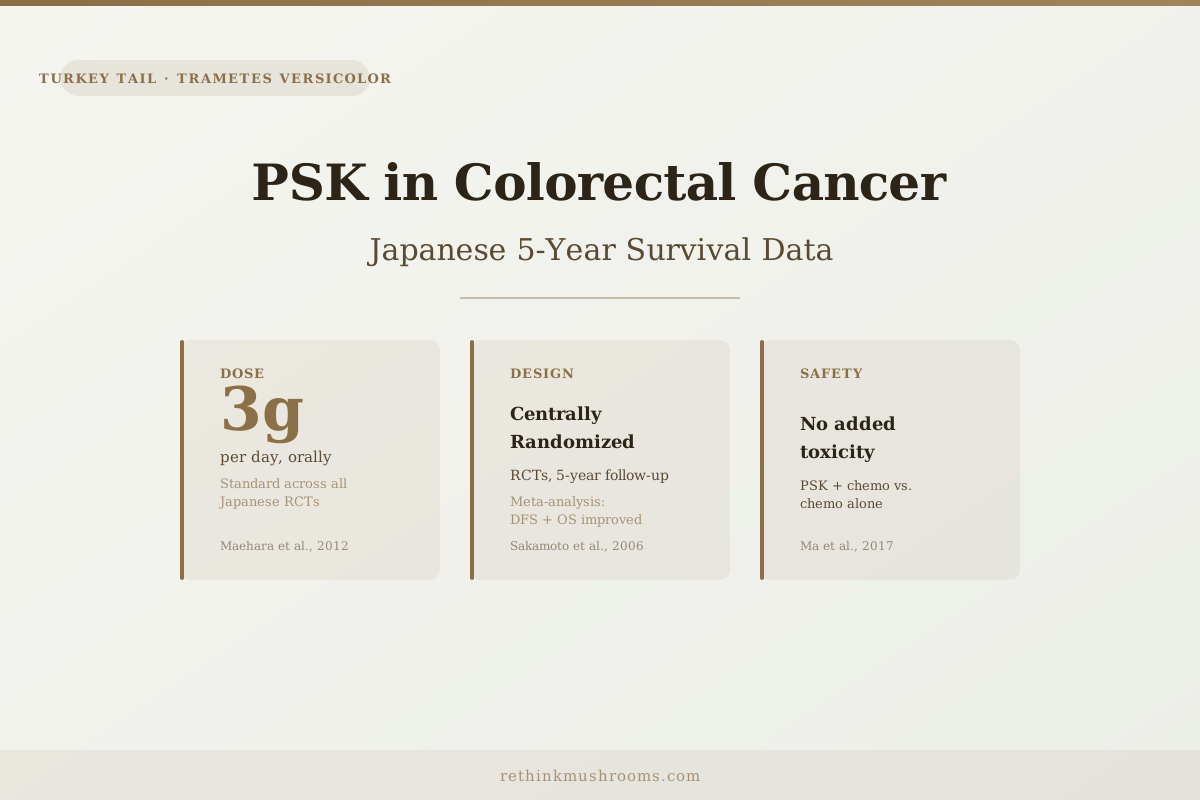
3g/day PSK
The standard dose across all Japanese centrally randomized trials of PSK in colorectal cancer; it is a pharmaceutical-grade protein-bound polysaccharide associated with significant improvements in both disease-free and overall survival after curative surgery.
Maehara et al., Surgery Today, 2012
Centrally randomized
trial design, stronger than standard randomization, prevents site-level selection bias
DFS + OS
both 5-year survival endpoints improved in the Sakamoto 2006 meta-analysis
Strongest evidence
Turkey Tail ranked #1 among medicinal mushrooms for cancer in Dan et al., 2023 scoping review
Maehara et al., Surgery Today, 2012
 View as image ↗
PSK has more controlled clinical trial data for colorectal cancer than any other medicinal mushroom. That claim comes not from a supplement company but from a 2023 independent scoping review published in Cureus, which concluded that Turkey Tail (Trametes versicolor) carries the strongest clinical evidence among medicinal mushrooms studied for colorectal, gastric, and breast cancer.[5]
That evidence rests on a specific research program: Japan's three-decade development of PSK (polysaccharide-K) as an adjuvant cancer treatment following surgery. The trials were not small or poorly controlled. They were centrally randomized controlled trials tracked over five years, later pooled into meta-analyses that remain the most rigorous data available for any medicinal mushroom in a cancer setting. This article examines what those trials found, how they were designed, who they studied, and what the findings cannot tell us.
For a broader introduction to what Turkey Tail and PSK are, see Turkey Tail mushroom: a science-based introduction. For the regulatory context (PSK is an approved prescription drug in Japan, not a supplement), see PSK (Krestin): Japan's approved mushroom cancer drug.
Key Takeaways
- The Sakamoto 2006 meta-analysis of centrally randomized Japanese RCTs found that PSK added to standard chemotherapy significantly improved both disease-free survival and overall survival in patients after curative colorectal cancer surgery[1]
- A 2017 network meta-analysis (Ma et al.) independently confirmed improved 5-year overall survival and disease-free survival, and specifically found that PSK combination therapy did not increase adverse events compared to chemotherapy alone[2]
- All Japanese PSK colorectal cancer trials used 3g/day of pharmaceutical-grade PSK orally, concurrent with post-surgery chemotherapy then as maintenance[3]
- The clinical data covers stage II and III colorectal cancer after curative resection only; PSK has not been tested in centrally randomized RCTs for metastatic disease[3]
- "Centrally randomized" means patient allocation was managed at a central facility, preventing selection bias at study sites; this methodological standard separates Japanese PSK trials from most supplement research
- Dan et al. (2023) identified Turkey Tail as the medicinal mushroom with the strongest clinical evidence base for gastric, breast, and colorectal cancer[5]
What the Sakamoto 2006 Meta-Analysis Found
The most important document in the PSK colorectal cancer literature is not a single trial. It is a meta-analysis.
Sakamoto and colleagues published their 2006 analysis of centrally randomized controlled clinical trials of PSK adjuvant immunochemotherapy in curatively resected colorectal cancer, pooling data from multiple Japanese RCTs conducted across the 1980s and 1990s.[1]
The trial design: patients whose colorectal tumors had been surgically removed received standard chemotherapy either alone or with PSK added. The primary endpoints were disease-free survival (DFS) and overall survival (OS), both measured at five years. DFS means no detectable recurrence at five years. OS means the patient is alive at five years.
The finding: PSK adjuvant immunochemotherapy significantly improved both disease-free survival and overall survival compared to chemotherapy alone.
Both endpoints moved in the same direction. That is not guaranteed in cancer trials. Sometimes a treatment reduces recurrence without extending life (because second-line treatments can rescue some relapsed patients), or extends life without reducing recurrence rates. PSK improved both, which is the outcome oncologists care about most in the adjuvant setting.
The Sakamoto analysis is the definitive colorectal cancer meta-analysis for PSK. The specific hazard ratios are in the original publication. The direction of effect is unambiguous. For a broader review of the full clinical trial evidence including individual study data, see Turkey Tail and colorectal cancer: PSK clinical trial results.
Why "Centrally Randomized" Is a Higher Evidence Standard
Most supplement research is criticized for weak methodology: small samples, short follow-up, open-label protocols, and simple randomization that can be manipulated. Japanese PSK trials operate at a different methodological level. The distinction centers on how patients were assigned to treatment groups.
In a simple randomized trial, researchers at each participating site assign patients to groups using a local list or envelope system. This creates a subtle but real opportunity for selection bias. A researcher who suspects a patient will respond poorly may, consciously or not, allocate that patient to the control group. Over many sites and hundreds of patients, these micro-biases accumulate.
Central randomization removes this entirely. All allocation requests are submitted to a central processing facility, which assigns patients by predetermined algorithm and returns assignments to each site. No site researcher sees the algorithm or influences the result. Neither the patient nor the site investigator knows in advance which group will receive PSK.
The Sakamoto 2006 analysis specifically analyzed centrally randomized trials, excluding lower-quality studies from the pool. This methodological filter is why the conclusions carry weight that a broader pooling of all PSK research would not. A meta-analysis of centrally randomized RCTs with five-year follow-up is not typical supplement evidence. It is pharmaceutical-grade clinical evidence.
The 2017 Network Meta-Analysis: Confirmation and Safety Data
A decade after Sakamoto, Ma and colleagues published an updated analysis: a systematic review and network meta-analysis of PSK for gastrointestinal cancer, comparing PSK across multiple treatment arms and chemotherapy backbones.[2]
A network meta-analysis compares treatments across multiple study arms simultaneously, including comparisons between combinations that were never directly tested against each other. This provides more granular evidence about which treatment combinations perform best relative to each other, not just relative to a single control.
The findings replicated the Sakamoto direction: PSK significantly improved 5-year overall survival and disease-free survival. But the Ma 2017 analysis added something the older meta-analyses did not examine carefully: safety.
The question matters because adding any agent to an already-intensive post-surgery chemotherapy regimen carries a legitimate concern about cumulative toxicity. Patients recovering from colorectal cancer surgery face a physically demanding treatment period. If PSK added to that burden (increasing nausea, immune suppression, or organ stress), the survival benefit would have to be weighed against quality-of-life costs.
Ma 2017 found no evidence of added toxicity. PSK combination therapy did not increase adverse events compared to chemotherapy alone. The survival benefit came without a detectable safety cost in this analysis.
Who the Trials Studied: The Adjuvant Context
Every data point cited above comes from a specific clinical population: patients with stage II or stage III colorectal cancer who underwent curative resection.[3]
Stage II colorectal cancer means the tumor penetrated deeply through the colon wall but did not spread to nearby lymph nodes. Stage III means lymph nodes were involved, but distant organs were not. Curative resection means the surgeon removed the tumor with clear margins; no visible cancer remained after surgery.
The adjuvant setting is the clinical context for every PSK trial. "Adjuvant" means treatment given after the primary treatment (surgery) to reduce the risk of recurrence. Patients in adjuvant PSK trials were, by conventional post-surgical assessment, cancer-free. The clinical problem they faced was invisible: microscopic residual cancer cells that survived surgery, circulate in the bloodstream or lodge in lymph nodes, and can seed new tumors months or years later.
PSK was tested specifically as a tool to address that post-surgical residual risk by activating immune surveillance. The question was not "can PSK treat visible tumors?" but "can PSK help prevent recurrence after the tumor is already removed?"
For a deeper explanation of the post-surgery recurrence prevention rationale, see PSK and post-surgery cancer recurrence prevention.
This adjuvant framing is the most important limitation in the PSK literature: the data does not extend to metastatic colorectal cancer, where the tumor has spread to distant organs and curative resection was not possible. There are no centrally randomized RCTs of PSK for metastatic disease. The survival data is specific to the post-curative-resection window.
The Dosing Protocol from Japanese Trials
Japanese PSK trials used a standardized dosing protocol across the study program.[3]
The standard dose was 3 grams per day, administered orally as a powdered extract in divided doses. Treatment was started concurrent with post-surgery chemotherapy and continued as maintenance after chemotherapy completion. Follow-up for survival endpoints was five years, with assessments at defined clinical intervals.
This standardization matters for interpreting the evidence. The fact that multiple trials across different sites and years used the same 3g/day dose allows meaningful comparison across studies. The Sakamoto meta-analysis pooled data from trials using this protocol, which is why its findings are interpretable as a consistent evidence base.
PSK is not interchangeable with commercial Turkey Tail mushroom supplements. It is a pharmaceutical-grade preparation of protein-bound polysaccharide manufactured by Kureha Corporation in Japan under the brand name Krestin, dispensed as a prescription medication. Clinical-grade manufacturing controls extract concentration, polysaccharide purity, protein-binding properties, and batch-to-batch consistency.
Commercial Turkey Tail supplements vary substantially in extract method, mushroom part used (mycelium vs. fruiting body), extraction solvent, and final PSK content. Whether commercial supplements deliver biologically equivalent PSK at the concentrations tested in trials is not validated by comparative pharmacokinetic data. The dosing protocol from Japanese trials applies to pharmaceutical-grade Krestin, not to supplement-market products.
How PSK Activates the Immune Response: The TLR2 Mechanism
The five-year survival data answers what PSK does. The immunological research answers how.
PSK is a TLR2 (Toll-Like Receptor 2) agonist. TLR2 is a pattern recognition receptor on the surface of immune cells, part of the innate immune system that originally evolved to detect bacterial cell wall components. When PSK binds TLR2, it triggers an activation cascade in the immune cells that carry that receptor.[3]
The cells activated through this pathway include:
CD8 T cells. These are cytotoxic T lymphocytes that recognize and kill cells displaying abnormal surface markers. Cancer cells can express abnormal protein fragments (neoantigens) derived from their mutations. CD8 T cells, when activated, scan for cells displaying these markers and destroy them.
Natural killer (NK) cells. NK cells do not require a learned antigen match. They target cells with reduced or absent MHC class I expression, a characteristic that many cancer cells develop to evade CD8 T cell surveillance. NK cells activate and kill these cells without needing prior sensitization.
TLR2 activation by PSK stimulates both populations simultaneously, enhancing both the specific and non-specific arms of the anti-tumor immune response. Fisher and Yang's foundational review documented this dual NK cell and T cell activation as a core mechanism, alongside direct antiproliferative effects on cancer cell lines and anti-metastatic activity in preclinical models.[4]
The clinical relevance in the post-surgery adjuvant setting: microscopic residual cancer cells are the target. PSK's TLR2-mediated immune activation creates heightened immune surveillance at the biological moment when microscopic residual disease is most vulnerable, before it has established vascular supply and grown beyond immune clearance capacity. For a dedicated explanation of this immune mechanism and its clinical implications, see how Turkey Tail enhances the immune system's anti-cancer response.
Forty Years of Japanese Research: The Historical Record
Japan's PSK research program is unusual in the history of natural compound pharmacology. Kureha Corporation began developing PSK from Trametes versicolor in the 1970s, identifying the protein-bound polysaccharide fraction as the biologically active component. By the 1980s, Krestin had received approval from Japan's Ministry of Health as a prescription adjuvant cancer treatment. By the late 1980s, it had become the world's best-selling cancer biologic by annual sales, not through aggressive marketing but because clinical outcomes in a country with high gastric and colorectal cancer incidence were generating prescriptions.
Fisher and Yang's 2002 review synthesized over 20 years of this research program.[4] Their conclusions: PSK produces anti-cancer effects through multiple distinct mechanisms: NK cell activation, T cell stimulation, direct antiproliferative activity in cancer cell line studies, and anti-metastatic properties in preclinical models. PSK was the most-prescribed cancer biologic in Japan at the time of writing, with a safety record accumulated over decades of post-approval use.
The 2023 Dan et al. scoping review brought the assessment to the current literature.[5] Across gastric, breast, and colorectal cancer, Turkey Tail (PSK) was identified as the medicinal mushroom with the strongest clinical evidence base. The high-quality Japanese RCTs were named as the backbone of that evidence. This conclusion from an independent 2023 review, not a PSK manufacturer, represents the current state of the evidence.
For a broader synthesis of this research history, see Turkey Tail and cancer: 40 years of research reviewed.
What the Data Does Not Cover
The Japanese PSK trial program is the strongest body of evidence for any medicinal mushroom in cancer treatment. It is also bounded by its design in ways that matter for anyone trying to interpret what the findings mean.
Western populations and modern chemotherapy regimens. The trials were conducted in Japan using chemotherapy protocols standard in Japan during the 1980s and 1990s. Current Western first-line regimens for stage III colorectal cancer (FOLFOX, CAPOX, often with bevacizumab) differ substantially from the mitomycin-C and tegafur-based regimens used in the original trials. Whether PSK interacts with contemporary chemotherapy in the same way is not established by the trial data.
Metastatic disease. Every trial studied adjuvant use after curative resection. Metastatic colorectal cancer, where the tumor has spread to liver, lungs, or other distant organs and curative surgery was not performed, is a biologically different clinical problem. There are no centrally randomized RCTs of PSK for metastatic disease. The five-year survival data applies specifically to the adjuvant post-surgery context.
Supplement equivalence. The 3g/day dose used in trials was pharmaceutical-grade Krestin. Commercial Turkey Tail supplements are not validated to deliver equivalent PSK concentrations, extract purity, or bioavailability. The evidence for Krestin does not transfer to over-the-counter products without pharmacokinetic bridging data that does not currently exist.
Staging beyond II-III. The trials specifically enrolled stage II and III patients. Stage I (early-stage, superficial) patients were not included because their recurrence risk is low enough that adjuvant chemotherapy is not standard of care. Stage IV (metastatic) patients were not included because curative resection was not the surgical goal. The PSK data sits in a specific stage range and should not be interpreted outside it.
For the parallel gastric cancer evidence (Japan's PSK research extended to stomach cancer with comparable rigor), see Turkey Tail for gastric cancer: the Japanese research legacy. For the broader long-term outcome data across the colorectal cancer literature, see Turkey Tail and colon cancer survival: long-term outcome data.
The Bottom Line
The Japanese PSK trial program produced the strongest clinical evidence available for any medicinal mushroom in cancer treatment. The Sakamoto 2006 meta-analysis of centrally randomized RCTs found significant improvements in both disease-free and overall survival at five years in stage II-III colorectal cancer patients after curative surgery. The Ma 2017 network meta-analysis confirmed the effect and found no added toxicity. The standard protocol was 3g/day of pharmaceutical-grade PSK (Krestin), a prescription medication in Japan. This evidence is specific to the adjuvant post-surgery context, does not extend to metastatic disease, and is not directly transferable to commercial Turkey Tail supplements.
Frequently Asked Questions
Sources & References
- 1RTHM-00200·Sakamoto, Junichi et al. (2006). “Efficacy of adjuvant immunochemotherapy with polysaccharide K for patients with curatively resected colorectal cancer: a meta-analysis of centrally randomized controlled clinical trials..” Cancer immunology.Study breakdown →PubMed →↩
- 2RTHM-00895·Ma, Yan et al. (2017). “Can polysaccharide K improve therapeutic efficacy and safety in gastrointestinal cancer? a systematic review and network meta-analysis..” Oncotarget.Study breakdown →PubMed →↩
- 3RTHM-00475·Maehara, Yoshihiko et al. (2012). “Biological mechanism and clinical effect of protein-bound polysaccharide K (KRESTIN(®)): review of development and future perspectives..” Surgery today.Study breakdown →PubMed →↩
- 4RTHM-00089·Fisher, Monte et al. (2002). “Anticancer effects and mechanisms of polysaccharide-K (PSK): implications of cancer immunotherapy..” Anticancer research.Study breakdown →PubMed →↩
- 5RTHM-01682·Dan, Amit et al. (2023). “Therapeutic Effects of Medicinal Mushrooms on Gastric, Breast, and Colorectal Cancer: A Scoping Review..” Cureus.Study breakdown →PubMed →↩