Psilocybin & Anxiety
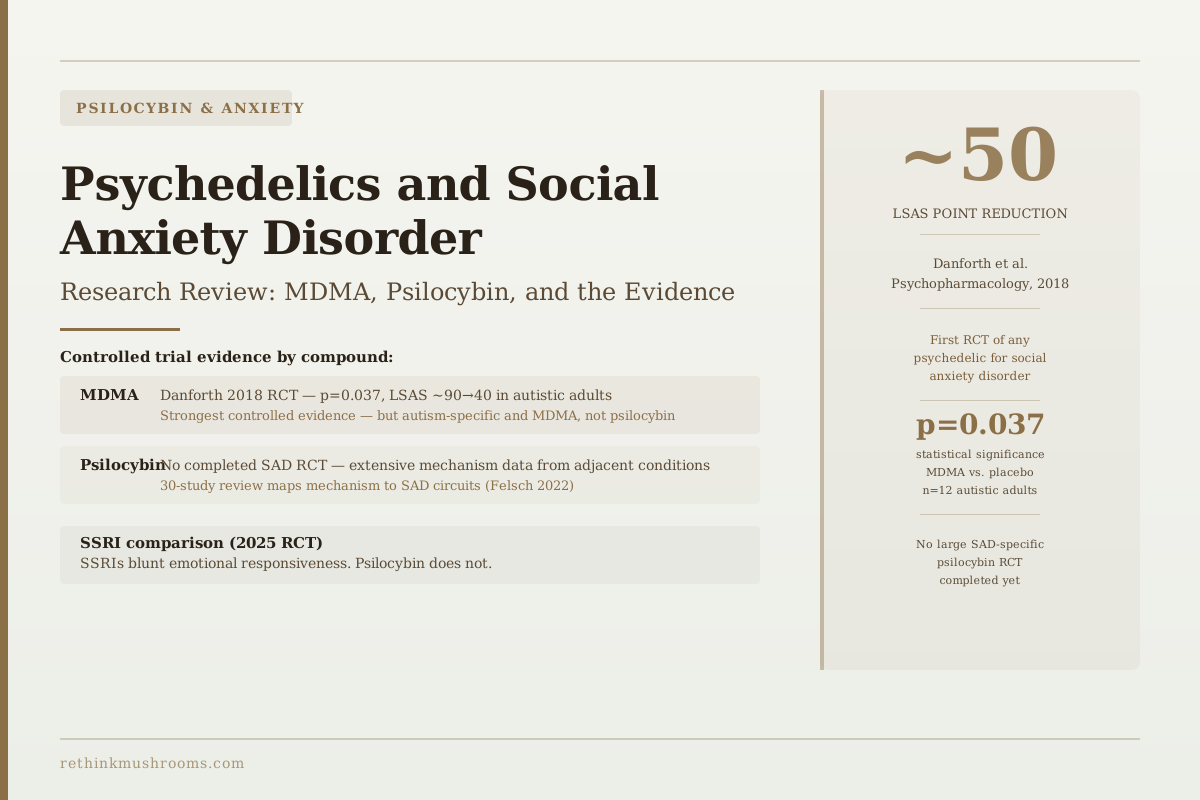
~50 point LSAS reduction
In the only controlled trial of any psychedelic for social anxiety disorder, MDMA reduced social anxiety scores by approximately 50 points on the Liebowitz Social Anxiety Scale in autistic adults — the most treatment-resistant population for this condition.
Danforth et al., Psychopharmacology, 2018
p = 0.037
Danforth 2018: MDMA vs. placebo for autism social anxiety — statistically significant reduction
30 studies
Felsch 2022 review identified the SAD-specific neural circuits psilocybin targets
Emotions preserved
Carhart-Harris 2025: psilocybin does not blunt emotional brain responses, unlike SSRIs
Danforth et al., Psychopharmacology, 2018
 View as image ↗
Social anxiety disorder affects roughly 12% of people at some point in their lives. Standard treatments — SSRIs and CBT — work for many, but a substantial portion of patients either don't respond adequately or stop treatment because of side effects. SSRIs in particular carry the concern of emotional blunting: reducing anxiety by reducing emotional reactivity broadly, which creates its own problems for people whose goal is richer social connection.
Research into psychedelics for social anxiety disorder research has accelerated substantially since 2018. The evidence base comes from multiple compounds — MDMA, psilocybin, and to a lesser extent LSD — working through overlapping but distinct mechanisms, and from patient populations that range from autistic adults with severe social anxiety to people with treatment-resistant depression. No single large trial has been completed specifically in social anxiety disorder patients, but the accumulated mechanism and pilot data make a coherent scientific case.
For the psilocybin-specific mechanism picture in social anxiety, Psilocybin and Social Anxiety: What the Research Shows covers that in depth. This article takes the broader view: which psychedelics are being studied, what the data shows across compounds, and how they compare to each other and to current standard treatments.
Key Takeaways
- The only controlled trial of any psychedelic for social anxiety disorder used MDMA (not psilocybin): 12 autistic adults with severe social anxiety showed a significant reduction in Liebowitz Social Anxiety Scale scores vs. placebo (p=0.037), from approximately 90 to approximately 40 (Danforth et al., Psychopharmacology, 2018).
- Autism involves measurable differences in 5-HT2A receptor density and serotonin transporter expression, making the serotonin system — psilocybin's primary target — specifically relevant to autism-associated social anxiety (Markopoulos et al., Frontiers in Pharmacology, 2021).
- A 2022 systematic review of 30 studies identified the three brain circuits social anxiety hijacks and showed how psilocybin combined with mindfulness targets each one mechanistically (Felsch & Kuypers, Neuroscience & Biobehavioral Reviews, 2022).
- Psilocybin combined with mindfulness training produced lasting reductions in self-referential processing versus mindfulness alone, directly addressing the overactive inner critic that drives social anxiety (Smigielski et al., NeuroImage, 2019).
- Psilocybin improved recognition of positive and neutral emotional facial expressions, with the brain change correlating with amygdala responses — suggesting improved social emotion processing rather than suppression (Carhart-Harris et al., Psychopharmacology, 2018).
- A 2025 RCT found escitalopram (SSRI) reduced emotional brain responses while psilocybin did not, a distinction highly relevant to social anxiety treatment where emotional numbing is a common reason for SSRI discontinuation (Carhart-Harris et al., 2025).
Why Standard Treatments Leave a Gap in Social Anxiety
Social anxiety is characterized by a specific and persistent bias: the brain treats social evaluation as threat. This automatic, pre-conscious process is the root of the disorder. A person with social anxiety doesn't simply feel nervous — their threat-detection system is misfiring, flagging social stimuli as dangerous before conscious reasoning can engage.
SSRIs dampen this threat response somewhat, but do so broadly. Serotonin is involved in nearly every aspect of emotional processing, so raising its availability throughout the brain reduces anxiety alongside positive emotional intensity, social warmth, and empathy. Many patients on SSRIs describe feeling less afraid but also less present — which is exactly the quality social connection requires. For social anxiety specifically, where the goal is to feel genuinely at ease with other people, this trade-off is more problematic than in other anxiety presentations.
CBT is effective for many patients but requires consistent practice and significant time investment. It also works cognitively — restructuring conscious thoughts about social situations — but cannot directly alter the automatic threat-detection process that fires before cognition engages.
The gap psychedelics are proposed to fill is a more targeted reset of the brain circuits that generate the automatic threat response, without the broad emotional suppression that makes SSRIs difficult for some patients. The evidence for whether they achieve this is what follows.
MDMA for Autism Social Anxiety: The Strongest Controlled Data
The most rigorous controlled evidence for a psychedelic reducing social anxiety comes from a study by Danforth and colleagues published in Psychopharmacology in 2018. Twelve autistic adults with severe social anxiety — Liebowitz Social Anxiety Scale scores of approximately 90, which is in the severe range — were randomly assigned to receive MDMA or placebo across two 8-hour assisted therapy sessions. [1]
The MDMA group showed a significant reduction in social anxiety compared to placebo (p=0.037). LSAS scores dropped from approximately 90 to approximately 40 in the MDMA group, compared to approximately 60 in the placebo group. The study enrolled 12 participants, making it a small pilot RCT. But it is the first randomized, double-blind, placebo-controlled trial of any psychedelic for any presentation of social anxiety disorder — and it was conducted in the most treatment-resistant population: autistic adults, for whom social anxiety is particularly severe and particularly resistant to conventional interventions.
Important to note: MDMA and psilocybin are different compounds with different mechanisms. MDMA works primarily by triggering the release of serotonin, dopamine, and norepinephrine from nerve terminals simultaneously, and by activating oxytocin release — producing acute feelings of trust and social openness. It is a serotonin releaser, not a receptor agonist. Psilocybin is a 5-HT2A receptor agonist — it activates serotonin receptors rather than flooding the synapse with serotonin.
Markopoulos and colleagues published a 2021 systematic review establishing the biological rationale for why serotonergic psychedelics broadly are relevant to autism social anxiety: autism involves measurable differences in 5-HT2A receptor density and serotonin transporter expression. These are the specific molecular targets for both MDMA and psilocybin. The serotonin system functions differently in autistic brains, and compounds that interact with it do so in a population where that interaction may have outsized relevance for social behavior. [2]
For the full MAPS-sponsored MDMA research context and how it relates to psilocybin, Psilocybin and Social Anxiety in Autism: The MAPS-Sponsored Research explains the important distinctions between what MAPS studied and what psilocybin researchers are now investigating.
Psilocybin: The Mechanistic Case for Social Anxiety
No controlled trial of psilocybin in social anxiety disorder patients has been completed. What exists is a substantial body of mechanism data from adjacent populations and conditions, and one systematic review that directly maps psilocybin's mechanism to SAD's specific neural pathology.
Felsch and Kuypers published that review in 2022, synthesizing 30 studies to identify the three brain circuits that social anxiety hijacks and how psilocybin with mindfulness addresses each one. [3] The three circuits are the salience network (which in social anxiety automatically flags social stimuli as threatening), the self-referential cortical regions (which sustain the anxious inner monologue), and the frontoparietal control system (which is underactive in SAD, weakening the brain's ability to override threat-biased attention). Psilocybin's acute network disruption specifically targets each of these: it quiets the default mode network that houses the self-referential chatter, reduces salience network overactivity, and the post-acute mindfulness reintegration period restores appropriate frontoparietal control.
Smigielski and colleagues provided direct experimental evidence for the self-referential component in a 2019 RCT. Participants receiving psilocybin before mindfulness practice showed lasting reductions in self-referential processing and lasting changes in default mode network connectivity compared to mindfulness alone. [4] The self-referential processing reduction persisted — it was not simply an acute effect of the drug.
Mertens and colleagues added the amygdala evidence in 2020: psilocybin treatment reduced amygdala reactivity to threatening stimuli and increased connectivity between the prefrontal cortex and the amygdala in people with treatment-resistant depression. [5] The amygdala threat-vigilance circuit is the same circuit that fires automatically in social anxiety — detecting social threat before conscious awareness can engage. Increased prefrontal control over the amygdala is the neurological substrate of being able to override that automatic threat response.
Psilocybin vs. MDMA: Different Mechanisms, Overlapping Potential
Framing psilocybin and MDMA as competitors for social anxiety treatment misses the mechanistic picture. They work differently and may be appropriate for different patient profiles.
MDMA's mechanism centers on acute serotonin and dopamine release, plus oxytocin activation. It produces profound feelings of social trust and emotional openness that persist for the session duration and can carry over into behavioral changes. For autism social anxiety, this acute social safety feeling may be particularly valuable — autistic adults often describe chronic hypervigilance in social situations that makes social interaction exhausting rather than rewarding. MDMA temporarily removes that hypervigilance.
Psilocybin's mechanism centers on 5-HT2A receptor activation, which produces a more perceptual and self-referential experience: the dissolution of the rigid self-narrative, acute ego softening, and the temporary disruption of the default mode network's self-critical chatter. For social anxiety that is primarily driven by the cognitive-emotional loop of anticipated judgment and self-evaluation, psilocybin's DMN disruption may address the root more directly.
Carhart-Harris and colleagues found in 2018 that psilocybin treatment improved the recognition of positive and neutral emotional facial expressions in people with treatment-resistant depression. [6] One of the characteristic features of social anxiety is misreading neutral faces as disapproving. Improved recognition of neutral and positive expressions — combined with reduced amygdala threat reactivity — is the perceptual shift that would reduce the automatic threat-bias. For the full picture of how psilocybin changes the sense of connection to others, Psilocybin and Social Connection: How It Changes Interpersonal Perception covers the empathy and prosocial evidence.
For the 5-HT2A receptor mechanism specifically and how serotonin receptor agonism interacts with anxiety circuits, psilocybin and 5-HT2A: the OCD serotonin connection covers the receptor pharmacology relevant to obsessive-anxious presentations.
The SSRI Distinction That Matters Most for Social Anxiety
A 2025 randomized controlled trial by Carhart-Harris and colleagues directly compared psilocybin and escitalopram (a standard SSRI) using brain imaging to measure emotional responsiveness. The SSRI reduced brain responses to emotional stimuli — consistent with the longstanding clinical observation of SSRI-induced emotional blunting. Psilocybin produced equivalent or superior antidepressant outcomes without reducing emotional brain responsiveness. [7]
For social anxiety, this is not a minor side-effect distinction. Social connection is inherently emotionally reciprocal. Being emotionally present, responsive, and empathic is what makes social interaction rewarding, not just tolerable. A treatment that reduces social fear by reducing emotional reactivity broadly produces an outcome where the person is less afraid but also less engaged — which can feel like trading one form of social disconnection for another.
Psilocybin's preserved emotional responsiveness, if it holds in social anxiety disorder patients specifically, would represent a qualitatively different treatment outcome: reduced fear, maintained warmth, improved social engagement. That hypothesis needs to be tested in SAD patients directly. The existing data from depression patients supports the mechanistic possibility.
The Honest Research Gap
No large, adequately powered, placebo-controlled clinical trial has been completed for any psychedelic in diagnosed social anxiety disorder patients as a primary population.
The Danforth 2018 MDMA trial enrolled 12 autistic adults — a small pilot in a specific subpopulation. Psilocybin has no completed SAD-specific controlled trial. LSD has even less controlled evidence for social anxiety. The mechanism data for psilocybin comes from depression trials and healthy volunteers. The Felsch 2022 systematic review proposes the mechanistic case; it does not provide clinical trial evidence.
For the strongest existing psilocybin anxiety evidence from controlled trials, the psilocybin end-of-life anxiety NYU and Hopkins trials represent the most rigorous anxiety evidence to date — and even those trials were in cancer patients with existential anxiety, not social anxiety disorder.
For autism-specific social anxiety research with psilocybin, including the PSILAUT mechanistic study at King's College London, Psilocybin and Autism-Related Social Anxiety: Emerging Research covers the emerging data in that population.
The Bottom Line
The strongest controlled evidence for any psychedelic in social anxiety disorder is the Danforth 2018 MDMA pilot RCT in 12 autistic adults (p=0.037, LSAS ~90→40). Psilocybin has no completed SAD-specific trial, but mechanism data from adjacent populations is substantial: the Felsch 2022 review maps psilocybin's mechanism to SAD's three dysregulated brain circuits; Smigielski 2019 shows lasting self-referential processing reductions; Mertens 2020 shows amygdala threat-reactivity reduction; Carhart-Harris 2025 shows psilocybin preserves emotional responsiveness where SSRIs reduce it. MDMA and psilocybin target social anxiety through different pharmacological routes. Both lack the large SAD-specific controlled trials needed to establish clinical efficacy. The mechanistic case is strong; the clinical evidence is ahead of it.
Frequently Asked Questions
Sources & References
- 1RTHM-00952·Danforth, Alicia L et al. (2018). “Reduction in social anxiety after MDMA-assisted psychotherapy with autistic adults: a randomized, double-blind, placebo-controlled pilot study..” Psychopharmacology.Study breakdown →PubMed →↩
- 2RTHM-01401·Markopoulos, Athanasios et al. (2021). “Evaluating the Potential Use of Serotonergic Psychedelics in Autism Spectrum Disorder..” Frontiers in pharmacology.Study breakdown →PubMed →↩
- 3RTHM-01513·Felsch, Corinna L et al. (2022). “Don't be afraid, try to meditate- potential effects on neural activity and connectivity of psilocybin-assisted mindfulness-based intervention for social anxiety disorder: A systematic review..” Neuroscience and biobehavioral reviews.Study breakdown →PubMed →↩
- 4. Source details for this reference are not yet available.
- 5RTHM-01252·Mertens, Lea J et al. (2020). “Therapeutic mechanisms of psilocybin: Changes in amygdala and prefrontal functional connectivity during emotional processing after psilocybin for treatment-resistant depression..” Journal of psychopharmacology (Oxford.Study breakdown →PubMed →↩
- 6. Source details for this reference are not yet available.
- 7. Source details for this reference are not yet available.