Psilocybin & Anxiety
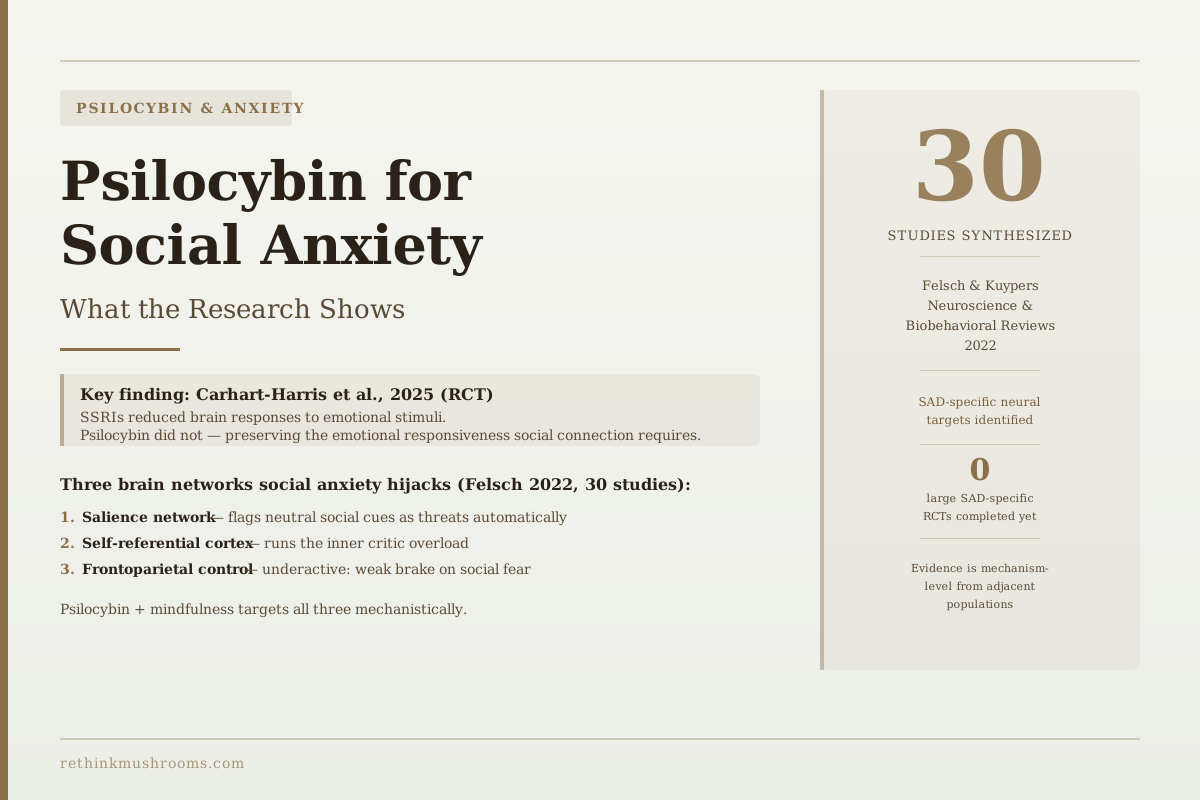
30 studies synthesized
A 2022 systematic review identified the specific brain circuits that social anxiety hijacks — the salience network, self-referential cortex, and frontoparietal control regions — and showed how psilocybin with mindfulness targets each one.
Felsch & Kuypers, Neuroscience & Biobehavioral Reviews, 2022
SSRIs: blunted
Carhart-Harris 2025 RCT: SSRIs reduce emotional brain responses; psilocybin does not
Amygdala-calmed
Mertens 2020: psilocybin reduces threat reactivity and increases prefrontal control over the amygdala
Self-reference quieted
Smigielski 2019 RCT: psilocybin + mindfulness reduces overactive self-referential processing vs. mindfulness alone
Felsch & Kuypers, Neuroscience & Biobehavioral Reviews, 2022
 View as image ↗
One of the most common concerns people raise about standard anxiety medications is emotional blunting — the feeling that SSRIs quiet anxiety by quieting everything. For some people, this trade-off is acceptable. For people with social anxiety, where the goal is to feel more comfortable in social settings and form real connections, feeling emotionally numbed is often worse than the original problem.
A 2025 randomized controlled trial directly tested whether this concern applies to psilocybin. Carhart-Harris and colleagues compared brain responses to emotional stimuli in patients receiving escitalopram (an SSRI) versus psilocybin. Escitalopram reduced emotional brain responsiveness. Psilocybin did not. The two treatments had similar antidepressant efficacy but opposite effects on emotional processing.
That finding sits at the center of a growing body of research into psilocybin for social anxiety. The research is not yet large or specific enough to definitively answer whether psilocybin treats social anxiety disorder as a clinical condition. But it does reveal a set of converging mechanisms — specific to social anxiety's neuroscience — that make psilocybin a scientifically coherent candidate. Psilocybin may reduce social anxiety by temporarily disrupting the default mode network (the self-referential brain circuit that drives social fear), allowing it to reset during therapy. Unlike SSRIs, psilocybin does not reduce emotional responsiveness. No large trial has tested it specifically for social anxiety disorder yet.
For the broader clinical evidence that psilocybin reliably reduces anxiety, including the strongest controlled trials to date, the psilocybin for cancer patients existential anxiety overview covers that evidence base. This article covers what the mechanism research suggests for social anxiety specifically.
Key Takeaways
- A 2022 systematic review of 30 studies identified the specific brain circuits that social anxiety hijacks and showed how psilocybin with mindfulness intervention targets each circuit mechanistically (Felsch & Kuypers, Neuroscience & Biobehavioral Reviews, 2022).
- A 2025 RCT found escitalopram (SSRI) reduced brain responses to emotional stimuli while psilocybin did not, revealing a key mechanistic difference in how the two treatments interact with emotional processing (Carhart-Harris et al., 2025).
- Psilocybin combined with mindfulness training produced lasting reductions in self-referential processing and altered default mode network connectivity compared to mindfulness alone — the brain change most directly relevant to social anxiety (Smigielski et al., NeuroImage, 2019).
- Psilocybin reduced amygdala reactivity to threatening stimuli and increased prefrontal control over the amygdala in people with treatment-resistant depression — providing neuroimaging evidence for how psilocybin quiets the threat-vigilance circuit (Mertens et al., 2020).
- Psilocybin improved recognition of positive and neutral emotional facial expressions, with changes correlating with amygdala responses — evidence that the drug enhances social emotional processing rather than suppressing it (Carhart-Harris et al., Psychopharmacology, 2018).
- A 2024 review proposed that psilocybin's lasting antidepressant effects may operate through a prosocial feedback loop: increased empathy → better relationship quality → sustained wellbeing (Bhatt et al., npj Mental Health Research, 2024).
What Makes Social Anxiety Different From General Anxiety
Social anxiety disorder is not simply shyness, nor is it a milder form of general anxiety. It has a specific neurological signature. The disorder centers on a particular failure mode in the brain: attention is pathologically biased toward social threat — perceived judgment, negative evaluation, social rejection — and this bias is largely automatic, operating below conscious control.
This makes it resistant to purely cognitive approaches. Standard cognitive behavioral therapy (CBT) can help people restructure their thinking about social situations. But if the brain's threat-detection system is automatically flagging neutral social stimuli as dangerous before conscious reasoning can engage, the cognitive correction always arrives too late.
Standard antidepressants (SSRIs) reduce the anxiety by broadly dampening emotional reactivity. They work for many people, but the emotional dampening that reduces social fear also reduces the warmth, empathy, and emotional presence that social connection depends on. For people with social anxiety, this creates a frustrating paradox: the medicine that reduces the fear also reduces the very emotional qualities that make social interaction rewarding.
Psilocybin's mechanism appears different. Rather than dampening emotional reactivity globally, the available evidence suggests it specifically resets the brain's default relationship to self-referential threat.
The Three Brain Networks Social Anxiety Hijacks, and How Psilocybin Targets Them
Felsch and Kuypers published a systematic review in 2022 in Neuroscience & Biobehavioral Reviews that identified the specific neural circuits underlying social anxiety disorder and mapped how psilocybin with mindfulness intervention addresses each one. [1]
The review drew from 30 studies and identified three overlapping circuit problems in SAD.
The first is the salience network, the brain system that decides which sensory inputs deserve attention. In social anxiety disorder, this network is dysregulated: it flags social stimuli (other people's faces, social judgments, the possibility of embarrassment) as high-priority threats even when no real threat is present. Attention is pulled toward these stimuli automatically, amplifying the experience of social fear.
The second circuit is the set of cortical-midline structures, the brain's self-referential processing regions, which generate and maintain the internal narrative about how one is being perceived. In social anxiety, these regions are overactive: the inner monologue about social performance runs continuously, draining cognitive resources and sustaining anxiety between actual social exposures.
The third is the frontoparietal control network, the prefrontal and parietal regions that govern executive control over attention. In social anxiety disorder, this network shows reduced activity. The executive brake on threat-biased attention is weak, allowing the salience network to drive behavior.
Psilocybin acutely disrupts the coordination between these networks — temporarily dissolving the rigid pattern of threat-biased attention — and the reintegration that follows during mindfulness practice appears to allow these networks to settle into a less maladaptive relationship. According to Felsch's analysis, the combination of psilocybin and mindfulness is mechanistically superior to either alone because psilocybin provides the acute network disruption and mindfulness provides the structured reintegration context.
For readers interested in how psilocybin's disruption of these self-referential circuits also explains its effects in OCD, psilocybin for OCD: breaking the loop covers the overlapping circuitry.
The SSRI Comparison: Psilocybin Preserves Emotional Responses Where SSRIs Don't
The 2025 Carhart-Harris study in a direct head-to-head comparison between psilocybin and escitalopram is one of the most clinically meaningful data points in this area. [2]
The study was designed primarily for depression, not social anxiety. But the emotional processing finding has direct implications for how these two treatments would differ in social anxiety contexts.
Escitalopram reduced brain responsiveness to emotional stimuli. This is consistent with the longstanding clinical observation of SSRI-induced emotional blunting: patients on SSRIs frequently report feeling less emotionally reactive, including less reactive to positive social experiences. The emotional flatness can reduce anxiety, but it also reduces the emotional reward of social connection.
Psilocybin produced the same or better antidepressant outcomes without reducing emotional responsiveness to stimuli. The brain's emotional circuitry remained intact.
For social anxiety specifically, this distinction matters considerably. A treatment that reduces social fear by making emotional experience less vivid overall may reduce anxiety while also reducing the emotional payoff of successful social interaction. A treatment that reduces the threat-bias specifically, without dampening the reward signal of positive social experience, would theoretically produce a more complete recovery.
The Carhart-Harris 2025 finding does not prove that psilocybin works this way in social anxiety disorder patients. But it establishes that the emotional blunting concern — one of the most common reasons people with social anxiety discontinue SSRIs — does not appear to apply to psilocybin at the level of brain responsiveness.
Social Anxiety Is an Overactive Inner Critic. Psilocybin May Quiet It.
The self-referential narrative that drives social anxiety lives in the default mode network, a set of brain regions that are most active when the mind is not focused on external tasks. In social anxiety disorder, this network runs a near-continuous assessment of social performance, replaying past social failures and anticipating future ones.
Smigielski and colleagues published a 2019 RCT in NeuroImage that tested whether psilocybin combined with mindfulness training produced measurable changes in this self-referential system. [3]
Participants who received psilocybin before mindfulness practice showed lasting reductions in self-referential processing and measurable changes in default mode network connectivity compared to participants who received mindfulness training alone. The key word is lasting: the changes in self-referential processing persisted after the acute psilocybin effect ended, suggesting that the disruption of the DMN created a window during which mindfulness practice produced a more durable change than it could achieve without the psilocybin priming.
This is the mechanism most directly relevant to social anxiety. The overactive inner critic — the constant internal commentary on how one is being perceived — is the experiential core of social anxiety. Psilocybin's disruption of the DMN, combined with the structured psychological context of mindfulness, appears to reduce this system's automatic dominance over attention.
For the full social connection angle — how psilocybin changes not just self-referential processing but the felt sense of connection to others — Psilocybin and Social Connection: How It Changes Interpersonal Perception covers the empathy and prosocial evidence.
After Psilocybin, Threatening Faces Don't Look as Threatening
Mertens and colleagues published a 2020 neuroimaging study measuring what happens to the amygdala after psilocybin treatment. The amygdala is the brain's threat-detection center, and in social anxiety disorder it is chronically overactive, flagging neutral or ambiguous facial expressions as threatening. [4]
After psilocybin treatment, Mertens found reduced amygdala reactivity to threatening stimuli alongside increased connectivity between the prefrontal cortex and the amygdala. The prefrontal cortex is the brain region that can override amygdala-driven fear responses. Increased connectivity between the two regions means the prefrontal cortex has more influence over the amygdala's threat signals — a direct neurological mechanism for reduced social fear.
Carhart-Harris and colleagues reported in a separate 2018 study that psilocybin treatment improved recognition of emotional facial expressions, particularly positive and neutral expressions, with changes correlating with amygdala responses. [5] In social anxiety disorder, one of the characteristic biases is misreading neutral expressions as threatening. Improved recognition of positive and neutral expressions is the perceptual correction that would reduce this bias.
Both studies were conducted in patients with treatment-resistant depression, not social anxiety disorder specifically. But the amygdala threat-vigilance circuit is the same circuit that is overactive in social anxiety. The neuroimaging evidence for how psilocybin changes this circuit is mechanistically applicable, while acknowledging that the patient populations differ.
Better Social Connection May Be Why the Effect Lasts
A 2024 systematic review by Bhatt and colleagues in npj Mental Health Research proposed a specific mechanism for why psilocybin's antidepressant and anxiolytic effects persist long after the drug clears the body. [6]
The proposed mechanism is a prosocial positive feedback loop. Psilocybin acutely increases empathy — the felt sense of sharing others' experiences. Increased empathy improves the quality of social interactions. Better social interactions reduce anxiety and depression. Sustained reduction in anxiety and depression maintains the improved empathy and social engagement. The loop sustains itself.
For social anxiety specifically, this mechanism has a particular relevance. Social anxiety involves social avoidance, which reduces the quality and frequency of social interactions, which in turn increases loneliness and depression, which reinforces the anxiety. This is also a self-sustaining loop — in the opposite direction. Psilocybin's acute effect on empathy and emotional openness may interrupt this negative cycle and allow a positive one to begin.
The Bhatt review did not test this hypothesis in clinical trials — it proposed it based on the available mechanism evidence. Whether psilocybin treatment actually produces the sustained social improvement that would maintain the loop is a question for controlled trials to answer.
For the specific evidence on how psilocybin changes empathy in a clinical population, microdosing psilocybin for anxiety covers the lower-dose approach for readers interested in options that don't involve full psychedelic experiences.
The Honest Limit: No Trial Has Tested Psilocybin Specifically for Social Anxiety Disorder
The evidence reviewed in this article is compelling as a mechanistic case. It is not clinical evidence that psilocybin works for social anxiety disorder as a diagnosed condition.
The Felsch 2022 review analyzed studies primarily from anxiety disorders broadly, depression, and mindfulness research — not from social anxiety disorder trials specifically. The Smigielski 2019 RCT enrolled healthy meditation practitioners, not SAD patients. The Mertens 2020 and Carhart-Harris 2018 studies enrolled patients with treatment-resistant depression. The Carhart-Harris 2025 comparison enrolled depression patients. None of the studies in this article's evidence base were conducted specifically in people diagnosed with social anxiety disorder.
The honest state of the field: psilocybin has mechanistic properties that appear specifically relevant to social anxiety's neuroscience, and controlled trials have shown it reduces anxiety in adjacent populations. No large, adequately powered, placebo-controlled trial has tested psilocybin in social anxiety disorder patients. That trial does not yet exist.
This is not a reason to dismiss the evidence. The mechanistic convergence is real, and the effects in adjacent conditions are replicated. It is a reason to read the literature carefully and resist the framing that psilocybin has been proven to treat social anxiety disorder.
For the full evidence review across multiple psychedelics and anxiety disorder subtypes, including where MDMA fits in the picture, Psychedelics and Social Anxiety Disorder: Research Review covers the complete literature. For readers specifically interested in how this research relates to autism-associated social anxiety, Psilocybin and Autism-Related Social Anxiety: Emerging Research covers that distinct population.
The Bottom Line
Psilocybin has not been tested in a large clinical trial specifically for social anxiety disorder. What exists is a mechanistically coherent body of evidence: psilocybin disrupts the three brain networks that social anxiety hijacks (salience network, self-referential cortex, frontoparietal control), reduces amygdala threat reactivity, improves emotional face recognition, and preserves emotional responsiveness where SSRIs reduce it. Combined with mindfulness practice, it produces lasting reductions in self-referential processing that persist after the drug clears. The distinction from SSRIs on emotional blunting is particularly relevant for social anxiety, where emotional presence is both the deficit and the treatment goal. The evidence to date is mechanism-level and from adjacent populations; social-anxiety-specific controlled trials are the missing piece.
Frequently Asked Questions
Sources & References
- 1RTHM-01513·Felsch, Corinna L et al. (2022). “Don't be afraid, try to meditate- potential effects on neural activity and connectivity of psilocybin-assisted mindfulness-based intervention for social anxiety disorder: A systematic review..” Neuroscience and biobehavioral reviews.Study breakdown →PubMed →↩
- 2. Source details for this reference are not yet available.
- 3. Source details for this reference are not yet available.
- 4RTHM-01252·Mertens, Lea J et al. (2020). “Therapeutic mechanisms of psilocybin: Changes in amygdala and prefrontal functional connectivity during emotional processing after psilocybin for treatment-resistant depression..” Journal of psychopharmacology (Oxford.Study breakdown →PubMed →↩
- 5. Source details for this reference are not yet available.
- 6RTHM-01859·Bhatt, Kush V et al. (2024). “The effect of psilocybin on empathy and prosocial behavior: a proposed mechanism for enduring antidepressant effects..” Npj mental health research.Study breakdown →PubMed →↩