Psilocybin, Social Anxiety & Autism
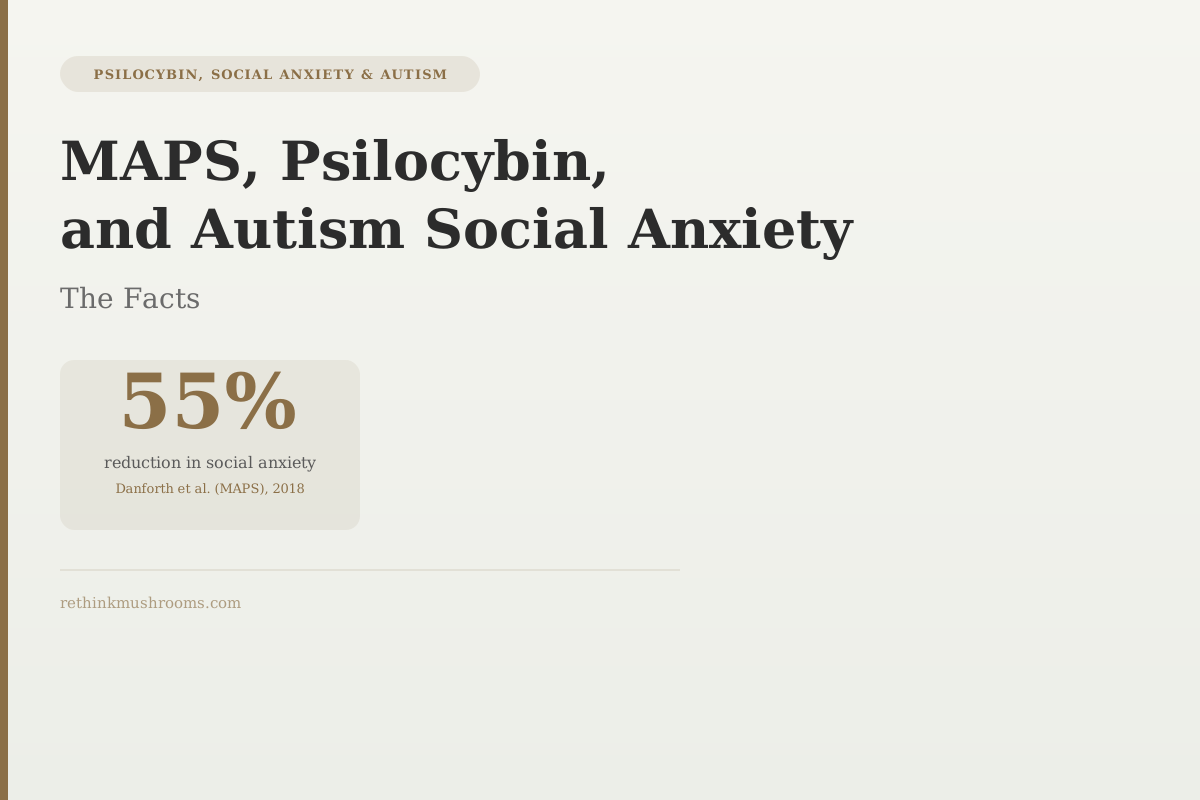
55% reduction in social anxiety scores
In the landmark Danforth 2018 trial, social anxiety scores in autistic adults dropped from ~90 (severe) to ~40 (mild) after MDMA-assisted therapy. MAPS sponsored that trial — but the compound was MDMA, not psilocybin. This article explains the distinction.
Danforth et al. (MAPS-sponsored), Psychopharmacology, 2018
12
autistic adults with severe social anxiety in the MAPS-sponsored trial
p=0.037
statistical significance of MDMA vs placebo
233
autistic adults reporting psychedelic use effects in a 2025 survey
Danforth et al. (MAPS-sponsored), Psychopharmacology, 2018
 View as image ↗
When people search for "MAPS psilocybin autism," they are often looking for the same study: a landmark trial of psychedelic-assisted therapy that showed dramatic reductions in social anxiety in autistic adults. The study exists, and the results were remarkable. But there is a crucial fact buried in the search results that most sites leave out: the compound in that trial was MDMA, not psilocybin. MAPS — the Multidisciplinary Association for Psychedelic Studies — sponsored it in 2018, and it remains the strongest controlled evidence for any psychedelic reducing social anxiety in autism.
Understanding what that study actually found, how MDMA and psilocybin differ mechanistically, and what the emerging psilocybin-specific research shows for ASD social anxiety is the purpose of this article. The distinction matters: autistic brains interact with serotonergic compounds differently than neurotypical brains, and the compound matters as much as the condition.
For the broader context of how psilocybin affects anxiety-related conditions, see psilocybin research in cancer patients with existential anxiety.
Key Takeaways
- MAPS sponsored the 2018 Danforth trial for autism social anxiety — but the compound was MDMA, not psilocybin; confusing the two is the most common error in coverage of this topic
- Danforth et al. (2018) found MDMA therapy significantly reduced social anxiety in 12 autistic adults (p=0.037), with scores dropping from a mean of ~90 (severe) to ~40 (mild) on a standard anxiety scale
- Psilocybin is a distinct compound from MDMA: it works primarily by activating a specific serotonin receptor (5-HT2A), while MDMA works by flooding the brain with serotonin and releasing the social bonding hormone oxytocin
- Autism involves measurable differences in the 5-HT2A receptor system that psilocybin targets directly, providing a biological rationale for studying psilocybin in ASD
- A 2025 scoping review found 4 published studies of psilocybin in ASD with descriptive therapeutic signals for social difficulties and fear at low doses — but the evidence base is still nascent
- A survey of 233 autistic adults who used psychedelics reported improvements in anxiety and social engagement, but a significant minority had challenging experiences — suggesting autistic brains may respond unpredictably
The MAPS Trial That Changed the Conversation — and What It Actually Used
Before the 2018 trial, there was a 2016 review paper by Amy Lyle Danforth and colleagues that laid out the scientific rationale for using MDMA to treat social anxiety in autistic adults.[2] The argument was specific and mechanistically grounded: social anxiety in autism is not identical to social anxiety disorder in the general population. Autistic adults with social anxiety often have heightened threat-sensitivity, reduced ability to read social cues in high-stress contexts, and a persistent experience of social interactions as unpredictable and potentially hostile. Standard anxiolytics address the anxiety but not the underlying social processing deficit.
MDMA, Danforth argued, had a pharmacological profile that might address both simultaneously. MDMA works by flooding brain synapses with serotonin and dopamine, while also triggering the release of oxytocin, which is the social bonding hormone. This combination, in neurotypical people, produces feelings of emotional openness, reduced social fear, and increased trust. The threat-detection center of the brain, the amygdala, shows reduced reactivity during MDMA effects. For autistic adults whose social anxiety is driven partly by an overactive threat-detection response to social situations, MDMA's profile was theoretically relevant.
The 2018 trial tested this hypothesis directly.[1] Twelve autistic adults with severe social anxiety enrolled in a randomized, double-blind, placebo-controlled study. Participants received either MDMA (75-125mg) or placebo in two 8-hour supervised therapy sessions. Social anxiety severity was measured before and after treatment on the Liebowitz Social Anxiety Scale (LSAS), a standard clinical instrument where a score of 60 or above indicates severe social anxiety.
The MDMA group entered with a mean LSAS score of approximately 90. After treatment, their scores dropped to approximately 40. The placebo group dropped from approximately 90 to approximately 60. The difference was statistically significant at p=0.037. In a 12-person trial, p=0.037 is a meaningful signal.
This is the study that launched a thousand search queries about "MAPS autism psilocybin." But the compound was MDMA. MAPS has since pursued MDMA-assisted therapy for PTSD (which completed Phase 3 trials), not psilocybin for autism. Those are separate research tracks.
Why Psilocybin Is Still Relevant — and Different
MDMA and psilocybin are both classified as psychedelics and both involve the serotonin system. But their mechanisms are distinct enough that the Danforth 2018 results cannot simply be transferred to psilocybin.
MDMA works primarily by reversing the serotonin transporter, which is the protein that normally recycles serotonin back into the cell after it has crossed a synapse. By blocking this recycling, MDMA causes a massive release of serotonin into synapses. It also triggers oxytocin release, which is why MDMA produces its characteristic feelings of social warmth and connection.
Psilocybin works differently. After ingestion, it is converted to psilocin, which activates a specific serotonin receptor called 5-HT2A. Rather than flooding synapses with serotonin, psilocybin acts on a specific receptor site and produces its effects by altering how certain brain networks communicate. The 5-HT2A receptor is particularly dense in the prefrontal cortex, the brain's decision-making region, and the activation of these receptors is what produces psilocybin's distinctive effects on perception, self-referential processing, and neural network integration.
The connection to autism is direct and specific. A 2021 systematic review of serotonergic psychedelics in autism found that ASD involves measurable differences in 5-HT2A receptor density, serotonin transporter expression, and serotonin-mediated social behavior circuits.[3] Psilocybin's primary mechanism — 5-HT2A agonism — directly targets a system known to function differently in autistic brains. This is not a coincidence; it is the biological rationale for studying psilocybin in ASD specifically.
This also means that psilocybin may not produce the same profile of effects in autistic brains as it does in neurotypical ones. If 5-HT2A receptors function differently in ASD, a drug that acts primarily through those receptors may produce meaningfully different responses. This is both a potential opportunity and an important caution.
For a deeper account of how psilocybin and social anxiety interact in non-autistic populations, see Psilocybin and Social Anxiety: Can It Help?. For the broader question of how psilocybin reduces anxiety across conditions, see Psilocybin and End-of-Life Anxiety: The NYU and Johns Hopkins Landmark Trials.
The Psilocybin-Specific ASD Research: What Exists Now
The PSILAUT study (Whelan et al., BMC Psychiatry, 2024; PMID 38658877) represents the first systematic investigation of whether psilocybin's 5-HT2A targets function differently in autistic versus neurotypical brains. The study enrolled 39 autistic and 30 non-autistic adults who received low doses of psilocybin (2mg and 5mg) as a pharmacological probe rather than a therapeutic dose. The study was designed not to treat autism but to test a hypothesis: that the same dose of psilocybin activates the 5-HT2A system differently depending on whether the brain is autistic or neurotypical. Results from PSILAUT are expected to inform whether psilocybin therapeutic trials in ASD should use different dosing protocols than those developed in neurotypical populations.
A 2025 scoping review of psilocybin in ASD (Moreno-Chaparro et al.) searched the literature through June 2024 and identified four published studies with clinical observations in autistic populations.[4] The indications addressed included cognitive rigidity, heightened fear responses, social difficulties, and the inability to generate mental imagery. Across these cases, descriptive therapeutic signals appeared at low doses, without toxic effects. The review concluded that the evidence base is nascent but the biological rationale is strong, and that formal clinical trials are warranted.
A 2025 ACS Pharmacology and Translational Science perspective covering psilocybin, LSD, and MDMA for prosocial behavior in ASD found that psilocybin's 5-HT2A agonism may reduce social fear and increase social reward through pathways distinct from MDMA's oxytocin-mediated effects.[5] The paper proposed that both compounds may be relevant to the two core social behavior deficits in autism: reduced motivation to engage socially, and elevated anxiety in social contexts.
The Stroud 2025 Survey: 233 Autistic Adults Who Used Psychedelics
The largest available dataset on how autistic people experience psychedelics comes not from a clinical trial but from an online survey.[6]
Stroud and colleagues (2025) surveyed 233 autistic adults who had used classical psychedelics, primarily LSD or psilocybin, and asked them to report perceived changes in mental health and social engagement. The majority reported improvements: reduced anxiety, reduced depression, and specifically improved social engagement and reduced social difficulties. These are self-reported outcomes from an uncontrolled observational survey, and should be interpreted accordingly.
What makes the survey clinically meaningful, despite its limitations, is the finding about negative experiences. A significant minority of participants reported challenging, distressing, or overwhelming experiences. This is a higher rate of challenging experiences than is typically seen in neurotypical populations given similar doses in clinical settings. The researchers interpreted this as evidence that autistic brains may respond differently and less predictably to psychedelics than neurotypical brains.
This unpredictability matters enormously for trial design. Psilocybin trials in neurotypical populations have developed screening protocols, preparation sessions, and session support structures that help participants navigate difficult experiences. Those protocols were developed based on neurotypical response patterns. If autistic participants are more likely to have challenging experiences at standard doses, the protocols need to be adapted. PSILAUT's mechanistic work — figuring out how 5-HT2A responds in autistic brains — is a prerequisite for designing those adapted protocols safely.
For a comprehensive look at how psilocybin affects social perception and empathy in non-autistic populations, see Psilocybin and Social Connection: How It Changes Interpersonal Perception.
Where the Research Stands: MAPS, Psilocybin, and What Comes Next
The clearest way to describe the current landscape:
MAPS pursued MDMA-assisted therapy for autism social anxiety through the Danforth 2018 pilot. That work has not advanced to Phase 2/3 trials specifically for autism. MAPS' organizational focus shifted to PTSD, where MDMA-assisted therapy progressed through Phase 3 trials before regulatory complications arose in 2024. Autism is not currently on MAPS' published clinical development pipeline.
Psilocybin for autism is being explored by different research groups, at an earlier stage. The PSILAUT study at King's College London is conducting the mechanistic groundwork. Research teams in Toronto are exploring psilocybin for autism-related conditions. The 2025 scoping review and survey data suggest enough of a signal to warrant formal clinical trials, but those trials are not yet underway at Phase 2 scale.
The honest summary is: the most rigorous psychedelic data for autism social anxiety is MDMA-based (Danforth 2018). The most biologically compelling rationale for why psilocybin might help is in the 5-HT2A differences documented in ASD research (Markopoulos 2021). The bridge between those two bodies of evidence — clinical trials of psilocybin specifically for autism social anxiety — has not yet been built.
For the broader question of what psychedelic treatments are under investigation for social anxiety disorder beyond autism, see Psychedelics and Social Anxiety Disorder: Research Review. For readers curious about lower-risk options while clinical research matures, see Microdosing Psilocybin for Anxiety: What We Know.
The Bottom Line
The landmark MAPS-sponsored study for autism social anxiety used MDMA, not psilocybin. The 2018 Danforth trial found MDMA significantly reduced social anxiety in autistic adults (p=0.037). Psilocybin is a distinct compound being explored in autism for different reasons: autism involves measurable differences in the 5-HT2A receptor system that psilocybin targets. The emerging psilocybin-specific ASD data — a scoping review, a 233-person survey, and the PSILAUT mechanistic study — suggests the rationale is strong but the clinical evidence is still at the earliest stage.
Frequently Asked Questions
Sources & References
- 1RTHM-00952·Danforth, Alicia L et al. (2018). “Reduction in social anxiety after MDMA-assisted psychotherapy with autistic adults: a randomized, double-blind, placebo-controlled pilot study..” Psychopharmacology.Study breakdown →PubMed →↩
- 2RTHM-00777·Danforth, Alicia L et al. (2016). “MDMA-assisted therapy: A new treatment model for social anxiety in autistic adults..” Progress in neuro-psychopharmacology & biological psychiatry.Study breakdown →PubMed →↩
- 3RTHM-01401·Markopoulos, Athanasios et al. (2021). “Evaluating the Potential Use of Serotonergic Psychedelics in Autism Spectrum Disorder..” Frontiers in pharmacology.Study breakdown →PubMed →↩
- 4RTHM-02154·Moreno-Chaparro, Jaime et al. (2025). “Psilocybin Use in the Autism Spectrum Disorder: A Scoping Review..” Clinical neuropharmacology.Study breakdown →PubMed →↩
- 5RTHM-02207·Wang, Xue et al. (2025). “Psychedelics and Pro-Social Behaviors: A Perspective on Autism Spectrum Disorders..” ACS pharmacology & translational science.Study breakdown →PubMed →↩
- 6RTHM-02187·Stroud, Jack et al. (2025). “Perceived changes in mental health and social engagement attributed to a single psychedelic experience in autistic adults: results from an online survey..” Psychopharmacology.Study breakdown →PubMed →↩