Mushroom Safety & Contamination
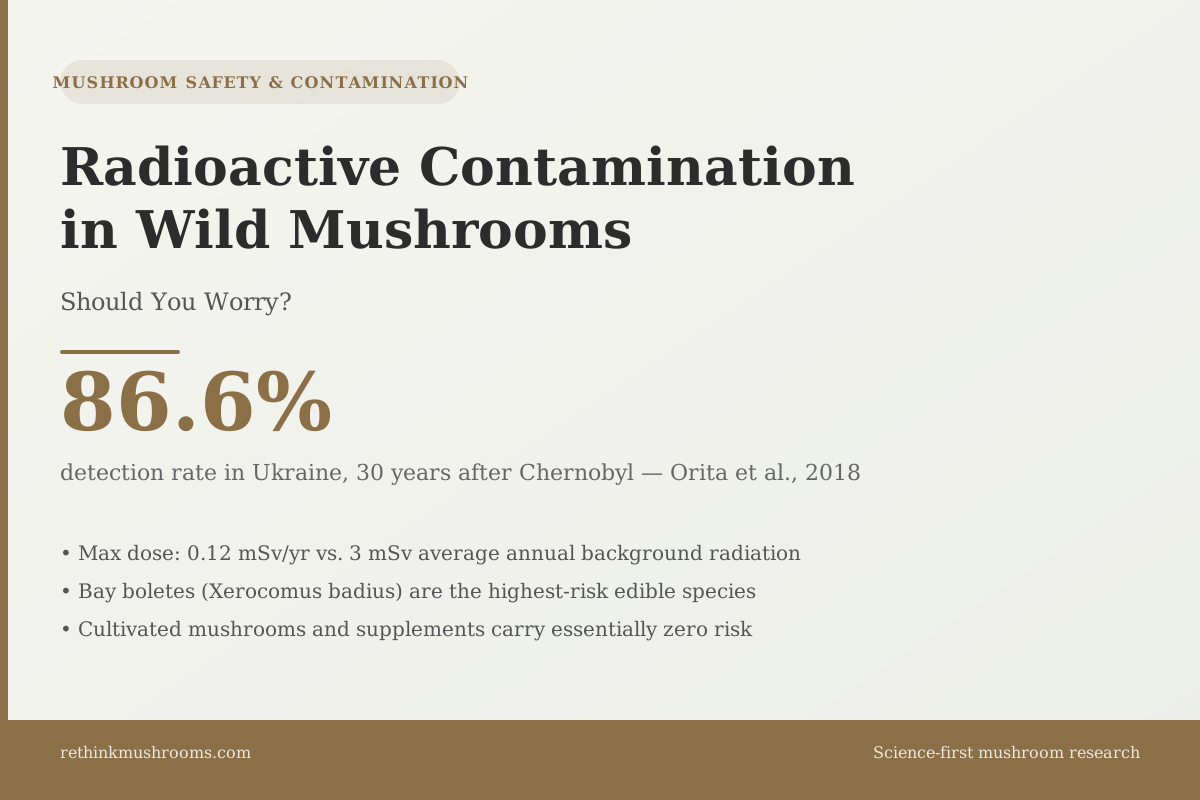
86.6% detection rate
Cs-137 from Chernobyl was found in 86.6% of wild Ukrainian mushroom samples collected 30 years after the accident, with estimated annual doses at typical consumption ranging from 0.001 to 0.12 mSv.
Orita et al., Chemosphere, 2018
0.12 mSv/yr
maximum estimated annual dose at 5 kg/year wild mushroom consumption
600 Bq/kg
EU regulatory limit for Cs-137 in food for the general population
30-yr half-life
for Cs-137, explaining why contamination persists four decades later
Orita et al., Chemosphere, 2018
 View as image ↗
Wild mushrooms in parts of Europe are radioactive. Not metaphorically, not historically. Measurably, right now, forty years after the Chernobyl accident released cesium-137 (a radioactive element with a 30-year half-life) across the continent. Researchers in Ukraine measured radioactive contamination in 86.6% of wild mushroom samples collected 30 years after the accident, and elevated levels persist in parts of Germany, Poland, and Austria today.
That's the "yes" answer. But "should you worry?" requires actual numbers, and the numbers are more nuanced than the headlines suggest. The dose from eating wild mushrooms with radioactive contamination turns out to be small, smaller in many cases than a dental X-ray. Whether that small dose warrants concern depends on how often you forage, which species you eat, and where.
This article covers radioactive contamination in wild mushrooms specifically, using data from two peer-reviewed studies that measured contamination levels and calculated actual radiation doses. Supplement users and people buying cultivated mushrooms can largely set this topic aside. It's a concern for regular wild-mushroom foragers, and even for them, the risk is species- and geography-dependent in ways the data can clarify. For a broader picture of mushroom contamination and supplement quality, the mushroom supplement buyer's guide covers the full quality picture.
Key Takeaways
- Cs-137 from Chernobyl remains detectable in wild mushrooms across Europe, with Orita and colleagues finding it in 86.6% of 127 wild Ukrainian samples 30 years after the accident[1]
- The estimated annual radiation dose from eating 5 kg of wild mushrooms per year ranges from 0.001 to 0.12 mSv, compared to the average annual background radiation dose of about 3 mSv from natural sources[1]
- Radioactivity varies dramatically by species: Xerocomus badius (bay bolete) and Paxillus involutus consistently show the highest Cs-137 levels; other species from the same forest can show levels 10-100x lower[1][2]
- Within a single forest, contamination varies dramatically across short distances; Ernst and colleagues found hotspots meters apart from clean areas, driven by soil type rather than blanket regional fallout[2]
- The EU regulatory limit for Cs-137 in food is 600 Bq/kg; some wild species in contaminated areas exceed this, but routine market testing for radioactivity in wild mushrooms is not standard practice
- Cultivated mushrooms and supplements grown on controlled substrates carry essentially no radioactive contamination risk; this concern applies specifically to wild-foraged species from affected European regions
Radioactive Contamination in Wild Mushrooms: The Chernobyl Legacy
The 1986 Chernobyl nuclear accident released large quantities of cesium-137 into the atmosphere. Cesium-137 is a radioactive isotope (a form of the element cesium) that decays slowly over time, with a half-life of about 30 years. That 30-year half-life means roughly half of the Cs-137 released in 1986 was still present in 2016, and half of what remains will still be there in 2046.
When the radioactive fallout settled, it entered European soils in patterns determined by weather, topography, and distance from the accident site. Ukraine, Belarus, and parts of Russia received the heaviest deposits. But wind carried Cs-137 as far as Scandinavia, central Europe, and the UK.
Here's the biological problem: mushrooms don't passively sit on top of soil. They're connected to it through extensive underground fungal networks (mycelium) that actively exchange nutrients with soil particles. Cesium-137 behaves chemically similarly to potassium, an element that organisms actively absorb. When Cs-137 is present in soil, mushroom-forming fungi take it up along with normal nutrients and concentrate it in the fruiting body above ground.
This is why contamination is still measurable today and why mushrooms often carry more radioactivity than the soil around them.
Orita and colleagues collected 127 wild mushroom samples from Ukraine in 2018, 30 years after the accident. Cs-137 was detectable in 86.6% of samples.[1] This wasn't a trace detection from sensitive instruments; these were concentrations measurable with standard laboratory gamma spectroscopy. The contamination is real and ongoing.
What the Dose Numbers Actually Mean
Detecting radioactivity is not the same as establishing harm. The biological question is: how much radiation does eating contaminated mushrooms deliver to the body?
Radioactivity in food is measured in becquerels per kilogram (Bq/kg). One becquerel means one radioactive decay event per second per kilogram of material, essentially how "active" the radioactive decay is in a given weight of food. The EU has set 600 Bq/kg as the limit for Cs-137 in food for general consumption.
But Bq/kg measures the source, not what the body receives. The body's actual radiation exposure is measured in millisieverts (mSv). Think of Bq/kg as measuring how loud a speaker is, and mSv as measuring how much sound actually reaches your ear depending on distance and insulation.
Orita and colleagues calculated the committed effective dose (the actual radiation dose the body receives from eating contaminated mushrooms over time) based on their contamination measurements. They estimated annual doses ranging from 0.001 to 0.12 mSv for people consuming approximately 5 kilograms of wild mushrooms per year.[1]
To put those numbers in context:
- Average annual background radiation (from soil, cosmic rays, radon): approximately 3 mSv
- A single transatlantic flight: approximately 0.1 mSv
- A chest X-ray: approximately 0.1 mSv
- A dental X-ray: approximately 0.005 mSv
- Maximum mushroom dose at 5 kg/year consumption: 0.12 mSv
The maximum estimated dose from eating 5 kg of wild mushrooms per year (a substantial amount of foraging) is about 4% of annual background radiation, roughly similar to one transatlantic flight or a chest X-ray.
At the lower end of the range (0.001 mSv), the dose is essentially negligible. Even at the maximum, the dose is small relative to what the body receives from unavoidable natural sources every year.
This doesn't make the contamination meaningless. People who forage heavily, who frequently eat the highest-accumulating species, and who forage in the most contaminated areas will receive doses at the higher end of this range. And the EU's 600 Bq/kg limit exists because regulators determined that repeated exposure to food above that threshold (particularly in children and during pregnancy) warrants reduction. But the numbers don't support panic, and they help identify where the real concerns lie.
Which Wild Mushroom Species Accumulate the Most Radioactivity
Not all mushrooms are created equal when it comes to Cs-137 uptake. The variation between species from the same forest is dramatic.
Orita and colleagues identified the highest Cs-137 concentrations in Paxillus involutus (a poisonous bolete-like mushroom, not typically eaten but collected for research) and Xerocomus badius (bay bolete, widely eaten across Europe).[1]
Ernst and colleagues' 2022 study of a German recreational foraging area reached consistent conclusions: Xerocomus badius showed persistently high Cs-137 across multiple collection sites, while other species collected from the same locations showed substantially lower contamination.[2]
The reason for this species-level variation lies in biological differences in how different fungi interact with soil. Some species form more intimate connections with soil particles through specific mycorrhizal relationships. Others preferentially absorb certain ions. The result is that two mushrooms growing meters apart can have Cs-137 concentrations that differ by an order of magnitude.
For foragers, this is practical information. The bay bolete (Xerocomus badius) is one of the most widely foraged edible mushrooms in central Europe and one of the highest-risk species for Cs-137 accumulation. Regular bay bolete consumption in affected regions contributes disproportionately to radioactive dose relative to other species.
Species associated with lower accumulation in the literature include most common culinary species (chanterelles, trumpet chanterelles, and others farther from the high bioaccumulators), though comprehensive species-by-species data with consistent methodology across all commonly foraged species hasn't been published.
Geographic Variation: The Hotspot Problem
The Chernobyl fallout didn't deposit evenly, and Cs-137 doesn't stay where it lands. Over decades, it moves through soils differently depending on soil chemistry, and it accumulates differently in different ecosystems.
Ernst and colleagues documented something striking in their 2022 spatial analysis of a German foraging area: contamination varied substantially across distances of just a few meters.[2] Two mushrooms of the same species, collected a short walk apart in the same forest, could have Cs-137 concentrations differing severalfold.
The key driver of this micro-scale variation is soil type. Sandy, acidic soils retain Cs-137 in forms more biologically available to fungi. Alkaline, clay-rich soils bind Cs-137 more tightly in forms fungi can't easily absorb. This means a forest with patches of different soil types will have patches of different contamination risk within it, even though the original fallout deposition was relatively uniform.
This finding has two practical implications for foragers. First, knowing the general contamination level of a region is necessary but not sufficient; soil conditions within that region determine actual risk. Second, the absence of contamination in one collection spot doesn't guarantee safety of the next collection spot nearby.
Germany and Austria maintain national food monitoring programs that have tracked radioactivity in wild mushrooms since Chernobyl. Several European countries publish updated data on Cs-137 concentrations in commonly foraged species from different regions. These national monitoring databases are the most reliable resource for foragers in affected areas, more specific than generalizations based on distance from the Chernobyl site.
Cultivated Mushrooms and Supplements: A Different Risk Category
The radioactive contamination concern applies to wild-foraged mushrooms from European forests with Chernobyl fallout. It does not apply in any meaningful way to cultivated mushrooms or mushroom supplements.
Cultivated mushrooms (shiitake, oyster, lion's mane, reishi, maitake, and others) are grown on controlled substrates: wood chips, sawdust, straw, or logs. These substrates don't come from Chernobyl-affected forests, and the growing environments are controlled and enclosed. There is no mechanism for Cs-137 from 1986 nuclear fallout to enter a cultivated mushroom grown on pasteurized wood substrate in a controlled facility.
Mushroom supplements, which are overwhelmingly made from cultivated mushrooms, carry essentially zero radioactive contamination risk for the same reason. If you're buying lion's mane powder, reishi extract, or a chaga supplement, radioactivity is not a relevant safety concern.
The contamination concerns for supplements are different: heavy metals (driven by substrate quality and species bioaccumulation), pesticide residues, and label accuracy. The mushroom supplement quality crisis covers these issues in full. The third-party testing for mushroom supplements article covers what good testing verification looks like.
Practical Guidance for Wild Mushroom Foragers
The evidence supports a calibrated response: not blanket avoidance of European wild mushrooms, but informed species and location selection.
Species selection matters most. Xerocomus badius (bay bolete) and related high-accumulating bolete species from affected regions carry disproportionate Cs-137 risk. Eating these frequently and in large quantities in the most contaminated areas drives doses toward the higher end of Orita's 0.001-0.12 mSv range. Diversifying species selection and reducing frequency of the highest-accumulating species is the most effective single intervention.[1]
Soil type within a forest shapes local risk. Sandy, acidic soils retain Cs-137 in bioavailable form. Alkaline, clay-rich soils bind it more tightly. Ernst and colleagues' finding of hotspots within meters of clean areas suggests that local knowledge about soil composition adds real information beyond regional generalizations.[2]
National monitoring databases are the best resource. Germany's Federal Institute for Risk Assessment (BfR), Austria's BOKU, and equivalent agencies in affected countries publish ongoing Cs-137 monitoring data for commonly foraged species by region. These databases are more reliable than any general-purpose article, including this one.
The EU 600 Bq/kg limit is the regulatory threshold. Some bay boletes from affected regions have been documented above this threshold. Wild mushrooms sold at farmers' markets or by foragers are less likely to be tested than commercially packaged products. Foragers who frequently eat bay boletes in affected regions benefit from checking regional monitoring data rather than assuming commercial safety standards apply.
For foragers who are new to European forests and want a broader safety framework, mushroom foraging for beginners: safety first covers the full safety picture, including radioactivity in context with the other risks of wild foraging.
The Bottom Line
Cs-137 from Chernobyl persists in European wild mushrooms and is still measurable in the majority of samples 30-40 years after the accident, with bay boletes (Xerocomus badius) among the highest-accumulating edible species. The estimated annual dose from 5 kg/year wild mushroom consumption ranges from 0.001 to 0.12 mSv, a small fraction of annual background radiation, and the risk is highly species- and geography-dependent. Cultivated mushrooms and supplements grown on controlled substrates carry essentially no radioactive contamination risk from this source.
Frequently Asked Questions
Sources & References
- 1. Source details for this reference are not yet available.
- 2. Source details for this reference are not yet available.