Mushroom Supplement Quality
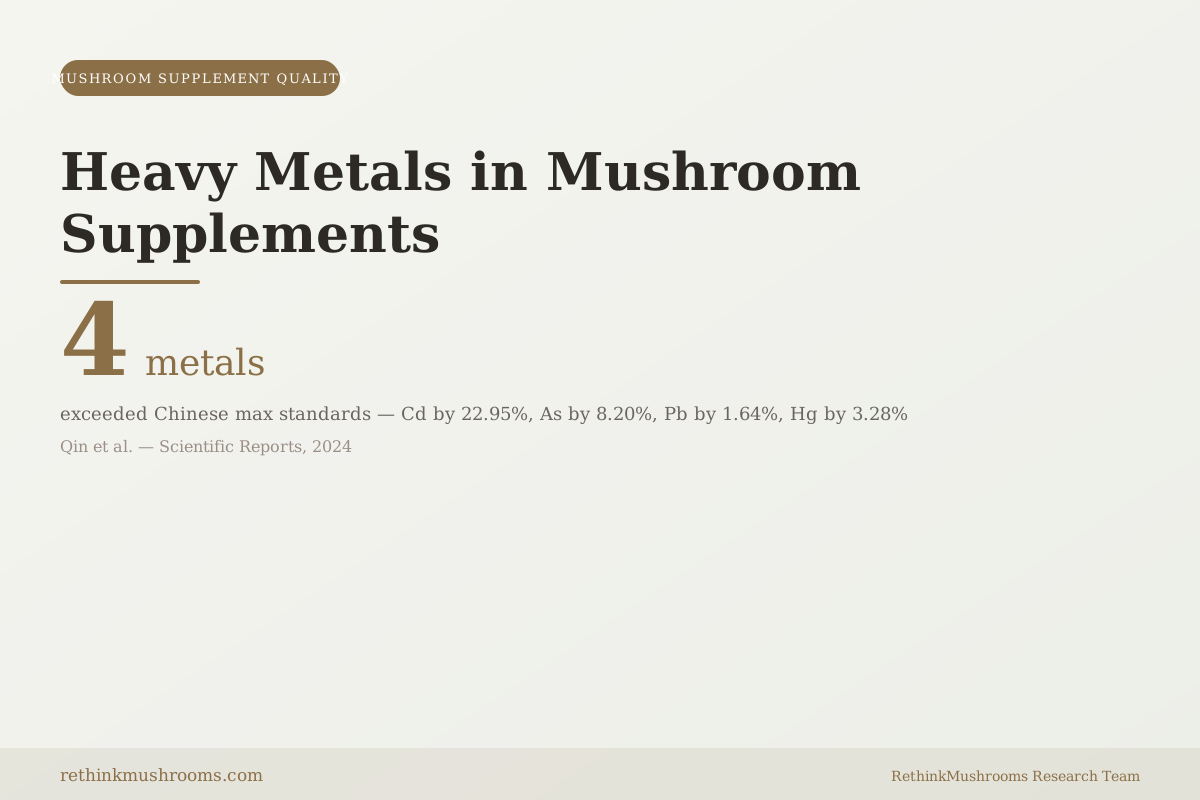
4 of 5 metals over limit
In a 2024 survey of edible mushrooms from mid-western China, cadmium, arsenic, lead and mercury concentrations all sat above the Chinese maximum standards — cadmium by 22.95%, arsenic by 8.20%, mercury by 3.28% and lead by 1.64%. Chromium was the only one of the five that stayed within the limit. A US survey of cultivated mushrooms found the opposite picture.
Qin et al., Scientific Reports, 2024
Arsenic
carried the highest modelled health risk in the Chinese survey (Hazard Index 14.02) even though cadmium was the more concentrated metal (Qin et al., 2024)
Substrate
reviewed as the route by which environmental metals reach the fruiting body, because cultivated mushrooms act as mycoremediators (Ab Rhaman et al., 2021)
Voluntary
heavy metal testing is not required before mushroom supplements reach US market shelves (You et al., 2024)
Qin et al., Scientific Reports, 2024
 View as image ↗
Mushroom supplements sold in the United States are not required to test for heavy metals before reaching shelves. That is the regulatory baseline. Under the Dietary Supplement Health and Education Act (DSHEA), manufacturers are responsible for product safety but do not need to submit to pre-market review or testing by the FDA. Heavy metal testing is voluntary.
A 2024 review of US immune-health botanical supplements, including functional mushrooms, documented the gap between what DSHEA requires on paper and what actually reaches consumers.[1] The distance between "required to be safe" and "demonstrated to be safe" is where product quality problems live.
What that gap contains is less obvious than it sounds. The contamination surveys that exist do not agree with each other, and the disagreement is not noise — it tracks where the mushrooms were grown. This article covers what those surveys actually measured, which metal carries the most risk (it is probably not the one you would guess), why substrate origin matters more than most labels reveal, and what to ask for when evaluating a product. For the broader quality picture, how to choose a mushroom supplement: the science-based buyer's guide covers the full landscape.
Key Takeaways
- Heavy metal testing is voluntary for US mushroom supplements. You et al. (2024, Crit Rev Food Sci Nutr) reviewed label compliance and ingredient verification across the US immune-health botanical market and described adulteration and inaccurate labelling as recurring problems, partly driven by pandemic-era supply chain pressure.
- Regional results diverge sharply. Qin et al. (2024, Scientific Reports) measured cadmium, arsenic, lead and mercury above Chinese maximum standards in mid-western Chinese mushrooms. Seyfferth et al. (2016, Environ Sci Technol) measured arsenic, lead and cadmium below 1 µg/g dry weight in every one of 40 cultivated samples from the two regions producing most US marketable mushrooms, and judged overall US dietary risk low.
- Cadmium is the most concentrated metal; arsenic carries the highest modelled risk. In Qin 2024 the Hazard Index ranked arsenic 14.02 above cadmium 7.21, with lead, chromium and mercury all below the threshold of concern. Liu et al. (2021, J Food Sci) independently reported the highest health risk index for arsenic across 610 samples from Jilin Province.
- Most sampled mushrooms were not polluted. In Liu 2021, single-factor pollution indices placed every species in the unpolluted range except Tricholoma matsutake and Pleurotus eryngii, with T. matsutake the only species exceeding the comprehensive index at 1.093.
- Substrate is the documented transfer route. Ab Rhaman et al. (2021, Journal of Fungi) reviewed how cultivated white-rot mushrooms grown on agricultural biomass act as mycoremediators, absorbing pollutants from the substrate into the fruiting body — which makes substrate provenance the variable a producer actually controls.
- Contamination is not the only failure mode. Risoli et al. (2023, Nutrients) genetically identified only 6 of 19 Italian mushroom supplements as matching their labelled species, and Windsor et al. (2025, Int J Mol Sci) separated authentic chaga from fermented-grain products by chemical fingerprint — meaning a clean metals report on the wrong species is still a failed product.
The Regulatory Baseline: Why Testing Is Voluntary
Pharmaceutical drugs must demonstrate safety and efficacy before reaching the market. Dietary supplements, including mushroom supplements, do not operate under that framework. DSHEA, the 1994 law governing US supplements, places responsibility for safety on the manufacturer but does not require pre-market testing, registration or FDA review.
You et al. (2024) reviewed the regulatory requirements and analytical approaches for verifying ingredient claims in US botanical products marketed for immune health, using elderberry, turmeric and functional mushrooms as their worked examples.[1] Their account is that top-selling botanical ingredients are subject to adulteration and inaccurate labelling through the intentional or unintentional addition of lower-grade ingredients, non-target plants and synthetic compounds — pressures they link in part to pandemic-era supply chain disruption. The regulatory authority to act exists, but it is largely reactive: it engages after a problem is identified rather than preventing it.
The practical consequence is that a mushroom supplement on a shelf may or may not have been tested for heavy metals before arriving there. The label is not required to disclose testing results, and a company can legally sell a product with no third-party contamination verification.
That is the baseline. The question is what the actual contamination picture looks like — and here the evidence is more interesting than a simple "supplements are contaminated" headline would suggest.
What the Surveys Found, and Why They Disagree
Two well-conducted surveys of edible mushrooms reached close to opposite conclusions. Both are credible. The difference between them is the single most useful thing in this literature.
Qin et al. (2024) · Scientific Reports
- Population
- 9 edible mushroom types from the mid-western region of China
- Intervention
- Measurement of arsenic, cadmium, chromium, mercury and lead by ICP-MS, with target hazard quotient and Hazard Index modelling for long-term consumption
- Finding
- Concentrations ranked Cd > As > Cr > Pb > Hg. Cadmium, arsenic, lead and mercury concentrations were 22.95%, 8.20%, 1.64% and 3.28% higher respectively than Chinese maximum standards; chromium did not exceed its limit. Hazard Index values ranked As 14.02 > Cd 7.21 > Hg 0.92 > Cr 0.68 > Pb 0.43, identifying arsenic and cadmium as the primary health risk sources. Dictyophora indusiata, Agaricus blazei and Morchella esculenta were named as the main risk contributors.
mixed A regional market survey, not a study of finished supplements. The exceedance percentages describe how far measured concentrations sat above a standard — they are not the share of samples that failed.
Qin et al., Scientific Reports, 2024
Seyfferth et al. (2016) · Environmental Science & Technology
- Population
- 40 samples across 12 types of raw cultivated mushrooms from 2 geographic locations producing the majority of marketable US mushrooms
- Intervention
- Total arsenic, lead and cadmium analysis, arsenic speciation and localisation in selected samples, plus substrate-to-fruit transfer assessment at one representative farm
- Finding
- Arsenic, lead and cadmium were all below 1 µg/g dry weight in every sample tested, and the authors assessed the overall risk of arsenic, cadmium and lead intake from US mushroom consumption as low. Between species, cremini carried significantly more total arsenic than shiitake, and cadmium was significantly higher in royal trumpet than in white button, cremini or portobello; lead did not differ between types.
positive Stated caveats matter: higher percentages of tolerable intake appear when risk is calculated per single serving, or when the substrate itself contains elevated metals.
Seyfferth et al., Environmental Science & Technology, 2016
Liu et al. (2021) sit between the two and add the largest sample base of the three.[3] They monitored lead, cadmium, mercury and arsenic across 610 edible mushroom samples, fresh and dried, collected from nine cities in Jilin Province, China. Cadmium and arsenic exceeded the applicable standards in some samples. But the summary judgement is more reassuring than that sentence alone implies: single-factor pollution indices placed all the sampled mushrooms in the unpolluted range except Tricholoma matsutake and Pleurotus eryngii, and on the comprehensive index only T. matsutake exceeded the threshold, at 1.093. The authors' own recommendation was narrow and specific — pay attention to arsenic contamination in those two species in that province.
That is a materially different claim from "Chinese mushrooms are contaminated." Liu 2021 also reported that bioconcentration depended on the mushroom species, the environment, and the physicochemical properties of each element, which is the mechanism behind the species-level pattern.
Same Question, Two Answers
Heavy Metals: How the Risk Changes With Where the Substrate Came From
Two surveys, two regions, two very different results. The variable that separates them is contamination of the growing substrate and surrounding environment, not the fact of eating mushrooms.
Cultivated, United States
40 samples · 12 mushroom types · 2 major growing regions
< 1 µg/g
dry weight for arsenic, lead and cadmium — in every sample tested.
Overall dietary risk assessed as low.
With two stated caveats: the percentage of tolerable intake rises when risk is calculated per single serving, and when the substrate itself contains elevated metals. Within the set, cremini carried more total arsenic than shiitake, and royal trumpet more cadmium than white button, cremini or portobello.
Seyfferth et al., 2016
Surveyed, Mid-Western China
9 edible mushrooms · ICP-MS · market survey
Measured concentration above the national maximum
Hazard Index — above 1.0 denotes concern
Qin et al., 2024
The connecting mechanism. A 2021 review notes that the white-rot fungi used in cultivation are grown on agricultural biomass and act as mycoremediators — they take pollutants up out of the substrate and into the fruiting body. That is a review-level description of the transfer pathway, not a measurement of any particular crop, and it is why substrate provenance is the lever a grower actually controls.
Sources: Seyfferth et al. (2016), Environmental Science & Technology; Qin et al. (2024), Scientific Reports; Ab Rhaman et al. (2021), Journal of Fungi (review). Exceedance percentages and Hazard Index values are as reported for that regional survey and do not transfer to other regions or supply chains.
Set side by side, these three surveys do not describe a single contamination level for mushrooms. They describe a distribution whose position depends on region, substrate and species. Without product-specific testing data, a given supplement cannot be located anywhere in that distribution — which is the actual argument for asking for a Certificate of Analysis, and a stronger argument than any single alarming number would be.
Cadmium Is the More Concentrated Metal. Arsenic Carries the Higher Modelled Risk.
This distinction gets lost constantly, including in supplement marketing, and both halves of it come from the same paper.
In Qin 2024, cadmium was the most concentrated metal measured and had the largest exceedance over its standard at 22.95%.[2] On concentration alone, cadmium is the headline. But concentration is not risk. When the same authors ran target hazard quotient modelling — which weights each metal by its toxicity and by realistic long-term intake — the ordering changed. Arsenic came out at a Hazard Index of 14.02 against cadmium's 7.21. Mercury (0.92), chromium (0.68) and lead (0.43) all landed below 1.0, the conventional threshold for concern.
Liu 2021 reached the same conclusion by a different route in a different province, reporting the highest health risk index for arsenic.[3] Two independent regional surveys, two different methods, same answer: arsenic is the metal doing most of the modelled damage, even where cadmium is the more abundant one.
One important qualification. Both surveys measured total arsenic. Inorganic arsenic is substantially more toxic than the organic arsenic species that also occur in food, and Seyfferth 2016 found that arsenic speciation and its distribution within the fruiting body differed between species — arsenic was spread throughout the fruiting body in cremini but concentrated in the hymenophore in shiitake.[4] A total-arsenic figure therefore overstates the toxicologically relevant dose to an unknown degree. That cuts toward reassurance, not alarm, but it also means arsenic numbers deserve more care than a single total reading provides.
Fact check
Is cadmium the metal to worry about most?
The claim
“Cadmium is the highest-risk heavy metal in mushrooms, so a product low in cadmium is the safe choice.”
Cadmium genuinely is the most concentrated metal in several mushroom surveys and produces the largest exceedance figures, which makes it the number that gets quoted.
What research shows
Partly TrueCadmium leads on concentration; arsenic leads on modelled health risk. Qin 2024 ranked Hazard Index values As 14.02 > Cd 7.21, with Hg, Cr and Pb all below the 1.0 threshold of concern, and Liu 2021 independently reported the highest health risk index for arsenic.
Both metals sat above the threshold in Qin 2024, so this is a question of ordering rather than of dismissing cadmium. And because both surveys measured total rather than inorganic arsenic, the true arsenic risk is likely somewhat lower than the raw Hazard Index suggests. A certificate showing only cadmium tells you least about the metal that ranked highest.
Qin et al., Scientific Reports, 2024; Liu et al., Journal of Food Science, 2021
How Growing Substrate Determines Metal Content
Ab Rhaman et al. (2021) reviewed the sources of agricultural biomass used to cultivate mushrooms and how environmental heavy metals accumulate and translocate into the fruiting body.[5] Mushrooms in the white-rot group are grown on sawdust, paddy and wheat straw, oil palm residues, corn cobs, sugarcane bagasse and comparable agricultural material. That biomass is sometimes polluted by heavy metals as a result of surrounding industrial and urban activity, and because mushrooms act as mycoremediators they absorb those pollutants from the substrate into their fruit bodies.
It is worth being precise about what kind of evidence this is: Ab Rhaman 2021 is a literature review describing a transfer pathway, not a measurement of any particular commercial crop. It establishes the mechanism and its plausibility, not the magnitude for any given product. Seyfferth 2016 supplies the direct measurement side, having assessed metal sources and substrate-to-fruit transfer at a representative farm.[4]
Substrate is also not the only variable. Liu 2021 attributed bioconcentration to species, environment and element chemistry together, and Seyfferth 2016 found significant differences between species grown under comparable US commercial conditions. The honest formulation is that substrate is the dominant controllable input, while species and growing environment modulate how much of what is available actually ends up in the fruiting body.
This is the quality variable most supplement labels do not disclose. "Organic" certification addresses pesticide inputs but does not guarantee low metal content if the organic substrate is itself metal-rich. "Grown in the USA" reduces some supply chain uncertainty without specifying substrate source. The question that determines contamination risk is narrower: what was this mushroom grown on, and has that substrate been tested?
For wild-harvested species such as chaga, the question takes a different form — which trees, what soil, and what is the industrial history of that land? That is why cultivated species on tested substrate are, as a category, a lower heavy metal risk than wild-harvested material for supplement use. For a broader look at how cultivation and processing decisions affect quality, the mushroom supplement quality crisis: why most products fail covers the systemic issues in detail.
The Other Failure Mode: Is It Even the Right Mushroom?
A clean heavy metal report on the wrong species is still a failed product, and the evidence for species substitution is considerably stronger than the evidence for widespread metal contamination in finished supplements.
Risoli et al. (2023) analysed mushroom-based dietary supplements sold as monotherapy on the Italian market and used DNA sequence matching against GenBank to check whether each product contained the species on its label.[6] Only 6 of 19 samples matched — four Lentinula edodes and two Ganoderma lucidum. Products labelled as G. lucidum returned sequences with 100% and 99% homology to G. resinaceum and G. sichuanense instead: closely related fungi, but not the species named on the package or the one the research literature is about. The authors also noted that large-scale medicinal mushroom cultivation happens mainly in China, where many production facilities lack internationally recognised good manufacturing practices, while many European sellers source from those manufacturers.
Risoli's team did additionally measure ergosterol, aflatoxins, heavy metals, nicotine and total glucan alongside the genetic work. No heavy metal exceedance is reported in their published summary, so this study is evidence about identity rather than about contamination — a distinction worth holding onto, because the Italian market study is often cited loosely as though it demonstrated both.
Windsor et al. (2025) attacked the same problem for a single species with a full analytical toolkit — HPTLC, LC-ELSD, LC-PDA/DAD, LC-QToF-MS, NMR, UV-Vis and iodine-starch assays.[7] They were able to distinguish wildcrafted chaga canker from North American chaga supplements built on mycelium fermented on grain. Authentic canker carried triterpenoids such as inotodiol and trametenolic acid plus phenolics like osmundacetone, and its melanin absorbance at 500 nm separated it from fermented grain products; iodine-starch assays and beta-glucan quantification confirmed a starch-rich composition in the fermented grain material and its absence in genuine canker.
Windsor 2025 is an authenticity and composition study rather than a contamination study — it did not report heavy metal measurements — but it earns its place here for a specific reason. It demonstrates that two products carrying the same species name can be chemically different materials. That is the same underlying lesson as the substrate story: the name on the label is not the specification. For the fruiting body versus mycelium question as a separate quality consideration, fruiting body vs. mycelium on grain: the consumer guide covers that evidence.
What to Look For: The Practical Decision Guide
The criteria that matter map onto what the research actually identifies as risk factors.
The four metals to check. Cadmium, lead, arsenic and mercury are the four with the most consistent documentation in the mushroom contamination literature. A Certificate of Analysis should show measured values for all four, not a blanket "tested and compliant."
Reference limits, and the unit trap. California Proposition 65 safe harbour levels are the most accessible published benchmark for US consumers. They are also routinely misread, because they are expressed per day while certificates report concentration.
Reading The Document
What to Check on a Heavy Metal Certificate of Analysis
Four metals, four reference points, and one unit conversion that most readings get wrong.
Prop 65 MADL — reproductive toxicity
The strictest of the commonly cited consumer benchmarks. A separate cancer figure (15 µg/day) is far looser; the 0.5 µg/day number is the one to hold a product to.
Prop 65 safe-harbour list — oral route
Use the oral figure. The 0.05 µg/day cadmium number that also appears on the Prop 65 list is for inhalation and has nothing to do with a capsule or powder.
Prop 65 safe-harbour list — inorganic arsenic, non-inhalation
The limit is for inorganic arsenic. CoAs usually report total arsenic, which also counts far less toxic organic forms — so a total-arsenic reading held to this limit is a conservative test, not a lenient one.
Listed for reproductive toxicity; oral figure not verified here
Require that the CoA reports a measured mercury value rather than "complies". We are not printing a threshold we could not confirm against a primary regulatory source.
The unit trap
The limits above are per day. Certificates of Analysis almost always report concentration — µg/g, or equivalently mg/kg or ppm. Those are not the same quantity, and comparing one against the other directly is the most common way a CoA gets misread. You need the serving size to convert:
Worked example: a CoA reporting 2 µg/g of lead in a product with a 1 g daily serving delivers 2 µg of lead per day — four times the 0.5 µg/day reference, even though 2 µg/g sounds small. Halve the serving and you halve the dose. This is ordinary unit arithmetic, not a research finding, but it is the step that decides whether a number on a CoA is reassuring or not.
Reference values: California Office of Environmental Health Hazard Assessment, Proposition 65 safe harbour levels (No Significant Risk Levels and Maximum Allowable Dose Levels). Proposition 65 figures are California warning thresholds, not federal supplement limits and not a medical safety line — they are used here because they are the most accessible published reference point a US consumer can check a product against.
Third-party testing verification. A CoA from an independent accredited laboratory is more informative than one from a company's own in-house testing. The test date and batch number should match the lot being sold. "Third-party tested" as a bare marketing phrase does not specify what was tested for, at what sensitivity, at what frequency, or from which batch.
Substrate disclosure. Companies that disclose the growing substrate, confirm it is tested for contamination, and can document supply chain provenance are operating above the norm. USDA Organic certification is some signal but does not specifically address heavy metal substrate testing.
Species verification. Given the Risoli 2023 identification results, a product that can evidence species identity — ideally by DNA or chemical fingerprint rather than assertion — is answering a question that a metals panel alone does not touch. For a practical guide to reading labels, what to look for on a mushroom supplement label covers the full framework.
Cultivated versus wild-harvested. For species where both exist, cultivated on tested substrate is the lower heavy metal risk category, because the substrate is a controlled and documentable input rather than an unknown site history.
Who should apply a wider margin
ModerateSome groups have less room between typical exposure and thresholds of concern
Concern
The Proposition 65 safe harbour figures for lead (0.5 µg/day) and cadmium (4.1 µg/day, oral) are both reproductive-toxicity thresholds, which is why they are stricter than the corresponding cancer figures. They are also daily-intake limits, so what matters is total dietary exposure rather than the supplement alone — a mushroom supplement adds to a baseline that already includes leafy vegetables, whole grains and shellfish.
What the research says
This is an argument for lot-specific documentation rather than for avoidance. A product with a current CoA showing measured values for all four metals, converted to a per-serving dose using the actual serving size, can be assessed directly instead of guessed at.
Particularly relevant for: People who are pregnant or trying to conceive, people with reduced kidney function, and anyone taking several botanical supplements daily whose exposures stack
What to do
Ask the manufacturer for a lot-matched Certificate of Analysis before starting a daily product, and convert concentration to per-day dose before comparing it against any published limit.
OEHHA Proposition 65 safe harbour levels; Qin et al., Scientific Reports, 2024
This article reports research findings and does not evaluate or recommend specific brands. It is general information about product quality, not medical advice. Anyone weighing a supplement against a diagnosed condition, a pregnancy, or existing medication should raise it with a clinician who knows their history.
Putting Risk in Context
The research documenting heavy metal contamination in mushrooms is real, and so is the research finding low risk. Qin 2024 measured four metals above Chinese standards in one region. Seyfferth 2016 measured all three of the metals it tested below 1 µg/g in every US cultivated sample and judged overall dietary risk low. Liu 2021 found most sampled species unpolluted with two specific exceptions. All three can be true at once because they sampled different places, different species and different supply chains.
Absolute dose also matters. Mushroom supplements are typically taken in small quantities — on the order of 500 mg to 2 g per day of dried mushroom equivalent — so even an elevated per-gram concentration translates into a modest daily metal dose relative to total dietary exposure. Cadmium in particular is present in staple foods including leafy vegetables, whole grains and shellfish, which is the context any supplement contribution sits inside.
So the question is not binary. It is: what is the measured contamination level in this specific product, what daily dose does that represent at the serving size on the label, and what does that add to everything else? Only product-specific testing data answers it. In the absence of that data, the evidence points toward cultivated species grown on tested substrate, with lot-specific third-party documentation and verified species identity, as the most defensible category.
What is missing
What it would take to answer 'is this product clean?' from published evidence alone
Could a consumer determine the heavy metal content of a specific mushroom supplement without a product-specific Certificate of Analysis?
Surveys of finished supplements rather than raw mushrooms
Qin 2024, Liu 2021 and Seyfferth 2016 all sampled edible or cultivated mushrooms. None analysed the finished capsules, powders and extracts consumers actually buy, where concentration steps could raise metal levels per gram.
Metals data linked to disclosed substrate
Seyfferth 2016 assessed substrate-to-fruit transfer at one representative farm, and Ab Rhaman 2021 reviewed the pathway. Neither connects substrate provenance to specific commercial products.
Brand- or lot-level published results
No study in this set reports results by brand or production lot, so no published source can rank commercial products.
Species identity verified alongside metals
Risoli 2023 verified species identity and measured metals in the same Italian sample set; that combination has not been repeated for the US market.
Routine mandatory pre-market testing
Under DSHEA no such requirement exists, which is why the data gap persists rather than closing over time (You 2024).
Qin et al. 2024; Liu et al. 2021; Seyfferth et al. 2016; Risoli et al. 2023; You et al. 2024
The Bottom Line
Heavy metal testing for US mushroom supplements is voluntary, and the contamination surveys that exist disagree in an informative way: Qin 2024 measured cadmium, arsenic, lead and mercury above Chinese maximum standards in one region, while Seyfferth 2016 measured arsenic, lead and cadmium below 1 µg/g in every cultivated US sample and judged dietary risk low. Liu 2021 found most sampled species unpolluted, with Tricholoma matsutake and Pleurotus eryngii the exceptions. Where risk was modelled, arsenic ranked above cadmium despite cadmium being the more concentrated metal. Substrate is the reviewed transfer route from environment to fruiting body, with species and growing environment modulating it, which makes substrate provenance and lot-specific third-party testing the meaningful quality signals. A separate and better-evidenced failure mode is identity: Risoli 2023 matched only 6 of 19 Italian supplements to their labelled species, and Windsor 2025 separated genuine chaga from fermented grain products by chemical fingerprint. The specific product, not the category, determines actual exposure.
Frequently Asked Questions
Sources & References
- 1RTHM-02031·You, Hong et al. (2024). “Label compliance for ingredient verification: regulations, approaches, and trends for testing botanical products marketed for "immune health" in the United States..” Critical reviews in food science and nutrition.Study breakdown →PubMed →↩
- 2RTHM-01969·Qin, Guofu et al. (2024). “Analysis of heavy metal characteristics and health risks of edible mushrooms in the mid-western region of China..” Scientific reports.Study breakdown →PubMed →↩
- 3RTHM-00705·Liu, Sijie et al. (2021). “Pollution level and risk assessment of lead, cadmium, mercury, and arsenic in edible mushrooms from Jilin Province, China..” Journal of food science.Study breakdown →PubMed →↩
- 4RTHM-00822·Seyfferth, Angelia L et al. (2016). “Arsenic, Lead, and Cadmium in U.S. Mushrooms and Substrate in Relation to Dietary Exposure..” Environmental science & technology.Study breakdown →PubMed →↩
- 5RTHM-00669·Ab Rhaman, Siti Maryam Salamah et al. (2021). “Mushroom Quality Related with Various Substrates' Bioaccumulation and Translocation of Heavy Metals..” Journal of fungi (Basel.Study breakdown →PubMed →↩
- 6RTHM-01778·Risoli, Samuele et al. (2023). “Mushroom-Based Supplements in Italy: Let's Open Pandora's Box..” Nutrients.Study breakdown →PubMed →↩
- 7RTHM-02209·Windsor, Coleton et al. (2025). “What This 2025 Chaga Supplement Authentication Study Actually Found.” International journal of molecular sciences.Study breakdown →PubMed →↩