Shiitake Safety
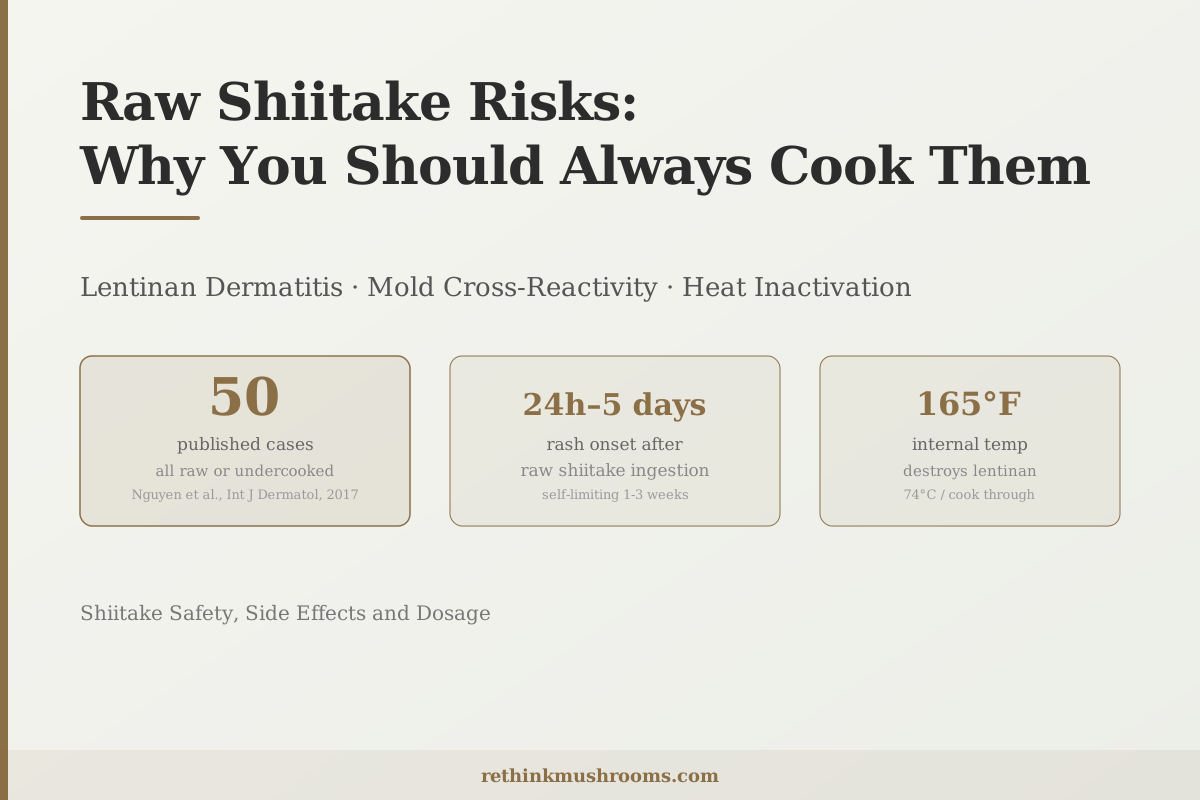
50 cases — all from raw or undercooked shiitake
Nguyen et al. (2017) reviewed all 50 published cases of shiitake dermatitis. Every case involved raw or undercooked consumption. No cases from fully cooked shiitake appear in the published literature.
Nguyen et al., International Journal of Dermatology, 2017
24h–5 days
time after eating raw shiitake when the lentinan rash typically first appears
Heat-sensitive
both lentinan (rash trigger) and the proteins causing mold cross-reactivity break down completely when cooked
1-3 weeks
self-limiting resolution time for shiitake dermatitis — no lasting effects documented
Nguyen et al., International Journal of Dermatology, 2017
 View as image ↗
Raw shiitake mushrooms contain two distinct compounds that can cause reactions in some people. One is lentinan — a heat-sensitive polysaccharide in shiitake cell walls that causes a distinctive skin rash when eaten raw or undercooked. The other is a set of heat-labile proteins that can trigger reactions in people already sensitive to airborne mold allergens. Both compounds break down when heated. Fully cooked shiitake is not associated with either reaction in the published literature.
The raw shiitake risks are therefore both real and entirely preventable. Nguyen and colleagues (2017) systematically reviewed every published case of shiitake-related dermatitis and found 50 cases in the literature — all from raw or undercooked mushrooms.[1] The rash is not an allergy in the traditional sense — no IgE antibodies are involved, no prior sensitization is required, and anyone can develop it from eating enough raw shiitake. It is a toxic reaction to an active compound that cooking destroys.
For a full overview of what shiitake mushroom is and why it's valued medicinally, see what is shiitake mushroom: the culinary mushroom with medicinal power.
Key Takeaways
- Raw or undercooked shiitake contains active lentinan, a heat-sensitive polysaccharide that triggers a toxic skin reaction (not an allergy) in susceptible people — all 50 documented cases in the literature were from raw or undercooked consumption[1]
- Shiitake dermatitis presents as a distinctive itchy rash with linear streaks (called a flagellate or whip-like pattern) on the trunk and limbs, appearing 24 hours to 5 days after eating
- Lentinan is heat-sensitive: fully cooking shiitake — reaching internal temperatures where the mushroom changes texture and moisture throughout — destroys it and prevents the reaction
- A second, separate risk exists for mold-sensitive individuals: raw shiitake contains heat-labile proteins that cross-react with mold allergens, causing mouth tingling, throat tightness, or hives; Gauld et al. (2024) confirmed this pattern in the most recent case report[3]
- The mold cross-reactivity risk is an IgE-mediated immune reaction (different mechanism from lentinan dermatitis); cooking denatures the responsible proteins, and most mold-allergic individuals tolerate fully cooked shiitake[2]
- The same lentinan that causes dermatitis when eaten raw is used as an injectable cancer adjuvant in Japan — context for understanding lentinan as a biologically active compound, not a toxin in the conventional sense
Can You Eat Raw Shiitake? The Direct Answer
Raw shiitake mushrooms carry two documented risks that do not affect cooked shiitake. For most people eating normal amounts of well-cooked shiitake, the risks are absent. For people eating raw or undercooked shiitake — as in sushi, barely-sautéed preparations, or shiitake-based raw dishes — both risks are present.
Risk 1 affects anyone who eats raw shiitake: lentinan in the raw mushroom can cause an itchy rash that appears on the trunk and limbs 24 hours to 5 days later. Fully cooking destroys lentinan.
Risk 2 affects people already sensitized to airborne mold allergens: raw shiitake contains proteins that cross-react with mold allergens. Eating raw shiitake can trigger oral tingling, hives, or in rare cases throat tightness. Cooking denatures these proteins; most mold-allergic individuals tolerate cooked shiitake.
Risk 1: The Lentinan Rash — and Why It Appears Days After Eating
Lentinan is a large polysaccharide (sugar chain molecule) found in shiitake cell walls. In its intact, unheated form, it activates immune cells — this is part of why shiitake is studied for immune support. That same immune activation, when triggered by large amounts of lentinan from raw mushrooms in the gut, can produce an inflammatory cascade in the skin.
The mechanism: lentinan stimulates monocytes and other immune cells to release inflammatory signaling molecules, including IL-1 and TNF-alpha. These molecules cause localized widening of blood vessels and, in the skin, small hemorrhages in the upper skin layers. The resulting rash follows lines of mechanical pressure — the areas where you've scratched, where clothing presses, where you've been touched. This creates the characteristic linear streaks that give the condition its name: flagellate dermatitis (from "flagellum," meaning whip).
Nguyen and colleagues (2017) analyzed all 50 published cases.[1] Key clinical findings from the systematic review:
- Onset: 24 hours to 5 days after eating; most cases appear within 48 hours
- Appearance: itchy linear red streaks and raised papules, predominantly on the trunk; may spread to limbs, neck, and face
- Progression: rash may intensify over 2-3 days before beginning to resolve
- Duration: self-limiting; resolves in 1-3 weeks with or without treatment
- Treatment: antihistamines reduce itching; topical corticosteroids speed resolution
- Diagnostic test: skin prick test is negative — this is NOT an IgE-mediated allergy
The "NOT an allergy" point matters clinically. Patients who develop shiitake dermatitis are sometimes tested for mushroom allergy and get negative results — because the test is looking for the wrong thing. Shiitake dermatitis is a toxic reaction to an active compound, not an immune sensitization. Anyone can develop it, regardless of allergy history, if they eat enough raw or undercooked shiitake.
For the detailed clinical explanation of shiitake dermatitis including photos and treatment protocols, see shiitake dermatitis: the flagellate rash side effect explained.
Why "Undercooked" Matters as Much as "Raw"
The 50 cases Nguyen reviewed included shiitake described as "lightly cooked," "briefly sautéed," "added at the last minute to stir-fry," and similar preparations. Not just raw mushrooms eaten directly.
Lentinan is destroyed by heat but requires adequate time and temperature to fully break down. A shiitake added to a hot pan for 30 seconds on each side may be browned on the outside and still intact in the center. The internal temperature matters, not just the surface appearance.
The practical threshold: cook shiitake until its texture changes throughout — the mushroom should be tender and slightly collapsed, not firm and squeaky. If using a food thermometer, the internal temperature should reach 165°F (74°C). This is standard poultry cooking guidance, applied to mushrooms. For safety purposes, cooking to this standard eliminates lentinan.
Risk 2: Mold Allergy and Cross-Reactive Raw Mushroom Proteins
The second risk is distinct in mechanism and affects a different population.
Dauby and colleagues (2002) published the foundational case describing how raw mushroom ingestion can cause an oral allergy syndrome — throat itching, mouth tingling, swelling — in a patient already sensitized to airborne mold allergens.[2] Allergy testing identified two heat-sensitive mushroom proteins — at 43 kD and 67 kD molecular weight — that cross-react with mold aeroallergens. The patient tolerated cooked mushrooms without reaction.
The mechanism: IgE antibodies produced in response to breathing mold (Alternaria, Cladosporium, or Aspergillus species, which are common environmental molds) can bind to structurally similar proteins in raw mushrooms. When those raw mushroom proteins enter the digestive system, the pre-formed IgE triggers a localized allergic reaction — oral tingling, throat itching, occasionally hives or respiratory symptoms.
Gauld and colleagues (2024) confirmed this pattern persists in the current patient population.[3] Their case involved a patient with known mold sensitization who developed throat itching and tightness after eating raw mushroom on pizza. Skin prick tests were positive to raw portobello and cremini mushrooms. The patient tolerated cooked mushrooms. The case illustrates both the persistence of this cross-reactivity pattern and its resolution with cooking.
This risk differs from lentinan dermatitis in important ways:
- It requires prior mold sensitization — not everyone is at risk
- It is an IgE-mediated immune reaction (the classic allergy mechanism)
- Symptoms appear quickly (minutes to an hour) rather than 24-48 hours later
- It can range from mild oral tingling to throat tightness
People with known mold allergy, respiratory reactions to mold exposure, or fungal-related asthma are the population most likely to experience this reaction with raw mushrooms. For more on the distinction between mushroom allergy and dermatitis, see shiitake allergy: symptoms and cross-reactivity.
How Fully Cooking Resolves Both Risks
The practical outcome of the research above is clear: both risks are eliminated by cooking, through different mechanisms.
Lentinan is a large polysaccharide whose biological activity depends on its three-dimensional folded structure. Heat disrupts that structure. When lentinan is heated to the temperatures reached in normal cooking (boiling, sautéing, roasting), the polysaccharide chain unfolds and its ability to activate immune cells is lost. This is why 50 published cases of shiitake dermatitis all involve raw or undercooked mushrooms: adequately cooked shiitake has no intact, biologically active lentinan remaining.
Cross-reactive proteins (the mold allergy risk) are heat-labile in a different way. These are proteins — molecules with complex folded shapes — whose IgE-binding sites depend on their three-dimensional structure. Heat denatures proteins: it unfolds them, destroying the specific shape that the IgE antibodies recognize. The same proteins that trigger oral tingling when raw become unrecognizable to the immune system when cooked. Dauby's original case (2002) and Gauld's 2024 replication both confirmed the patient tolerated cooked mushrooms.
The simplest practical summary: cook shiitake thoroughly, not lightly.
The Lentinan Paradox: A Therapeutic Compound That Requires Safe Handling
The compound at the center of shiitake dermatitis — lentinan — is also used as an injectable cancer treatment in Japan, where it has been approved as an adjuvant therapy for gastric and other cancers since 1977. This is not a contradiction. It reflects the difference in delivery method and dose.
When injected intravenously at controlled clinical doses, lentinan activates NK cells and T cells to enhance anti-tumor immunity — a therapeutic effect. The lentinan in raw mushrooms, arriving via the gut in uncontrolled amounts, triggers a different and excessive local immune response in the skin. The molecule is the same; the route, dose, and context are different.
Understanding lentinan's dual nature clarifies why the safety concern with raw shiitake is not about the mushroom being harmful in general. Cooked shiitake is extensively consumed globally, studied in clinical trials for immune support and cancer adjuvancy, and associated with numerous beneficial effects. The raw shiitake risk is specific to the raw state of one compound. For more on lentinan's medicinal applications, see lentinan: the shiitake compound approved for cancer treatment in Japan. For what research shows about the health benefits of regular cooked shiitake consumption, see eating shiitake daily boosts immunity: the landmark 2015 study.
For information on other safety considerations including drug interactions, see shiitake side effects and drug interactions.
The Bottom Line
Raw or undercooked shiitake carries two documented risks: lentinan-induced dermatitis (a toxic skin reaction affecting anyone) and cross-reactive protein reactions in mold-allergic individuals. Both are completely eliminated by adequate cooking. Nguyen et al.'s systematic review of 50 cases confirms no cases of lentinan dermatitis appear from fully cooked shiitake. The same lentinan that causes problems when consumed raw is used as an injectable cancer adjuvant in Japan — illustrating that the risk is specific to the raw preparation context, not the mushroom itself.
Frequently Asked Questions
Sources & References
- 1. Source details for this reference are not yet available.
- 2. Source details for this reference are not yet available.
- 3. Source details for this reference are not yet available.