Reishi (Ganoderma lucidum)
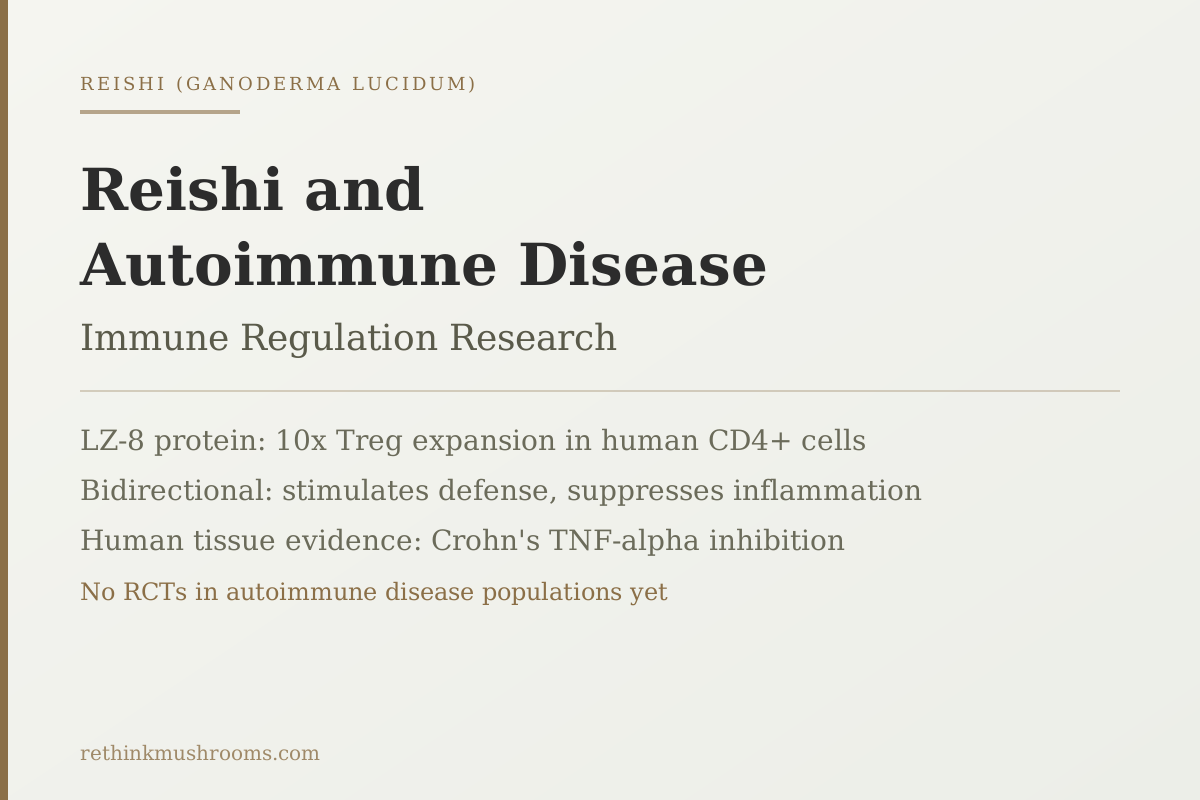
10x Treg expansion from LZ-8 protein in human cells
Hsu et al. (2013) found that reishi's LZ-8 protein induced a 4-fold expansion of regulatory T cells (Tregs) in mice and a 10-fold expansion in human primary CD4+ T cells. Tregs are the immune cells responsible for suppressing autoimmune inflammation.
Hsu et al., Evid-Based CAM, 2013
4-fold
murine Treg expansion from reishi LZ-8 protein (Hsu 2013)
Bidirectional
reishi regulates immune responses up or down depending on context
0 RCTs
completed in autoimmune disease populations specifically as of 2025
Hsu et al., Evid-Based CAM, 2013
 View as image ↗
The label "immune booster" creates a specific problem for people with autoimmune disease. Autoimmune conditions involve an immune system that is already overactive, attacking the body's own tissues. Adding an immune stimulant sounds like exactly the wrong direction. The question that follows naturally: is reishi actually an immune booster, and if so, should people with rheumatoid arthritis, Crohn's disease, or lupus avoid it?
The answer requires precision that the term "immune booster" doesn't provide. Reishi (Ganoderma lucidum) contains compounds that do different things to different parts of the immune system. One protein in reishi, LZ-8, expands regulatory T cells, the immune cells specifically responsible for suppressing overactive immune responses. A different fraction, the beta-glucans, activates NK cells and macrophages that defend against infection. These are opposite immune effects from a single mushroom. Understanding which part does what, and in which context, is what the research actually investigates. For broader context on reishi's mechanisms, see what is reishi mushroom: the science behind the mushroom of immortality.
Key Takeaways
- Reishi is a bidirectional immune regulator, not a unidirectional stimulant. Wang and Lin's 2019 comprehensive review documents how GL activates defensive immune cells while simultaneously suppressing inflammatory overactivation. The same mushroom does both depending on which immune context it encounters.[1]
- Hsu et al. (2013) found that reishi's LZ-8 protein expanded regulatory T cells (Tregs) 4-fold in mice and 10-fold in human primary CD4+ T cells via a CD45-dependent signaling pathway. Tregs are the immune cells that suppress autoimmune inflammation.[2]
- Liu et al. (2015) found that ganoderic acid C1 inhibited TNF-α and NF-κB activation in PBMC samples from Crohn's disease patients and in inflamed colonic mucosa. This is the most direct human tissue evidence for GL's anti-inflammatory action in an autoimmune condition.[3]
- Ratnaningtyas et al. (2024) demonstrated anti-arthritic, anti-inflammatory, and antioxidative effects of GL nanogel in a rheumatoid arthritis rat model.[5]
- The 2021 systematic review of RCTs (Vlassopoulou et al.) found GL beta-glucans consistently enhanced immune cell activity in healthy volunteers, but noted that evidence for therapeutic effects in specific disease states remains limited.[6]
- No completed randomized controlled trial has tested reishi specifically in an autoimmune disease population. The mechanistic and preclinical evidence provides biological plausibility, not clinical proof.
Immunostimulatory vs. Immunomodulatory: The Distinction That Changes Everything
| Feature | Immunostimulatory | Immunomodulatory |
|---|---|---|
| Direction of effect | One-way: increases immune activity | Bidirectional: normalizes immune activity |
| Effect on overactive immune response | Potentially harmful | Potentially beneficial |
| Effect on underactive immune response | Beneficial | Beneficial |
| Example for autoimmune context | Echinacea (increases innate immune activity) | Reishi LZ-8 protein (expands Tregs that suppress autoimmune inflammation) |
| Clinical relevance | Caution in autoimmune disease | Under investigation for autoimmune disease |
The distinction matters clinically because these two categories of immune effects have different implications for people whose immune systems are dysregulated.
An immunostimulant (something that simply increases immune activity) would plausibly worsen an autoimmune condition by adding more intensity to an already overactive immune attack. Echinacea, commonly cited in this context, primarily boosts innate immune activity, which is why some clinicians advise caution with it in autoimmune patients.
An immunomodulator works differently. Rather than simply increasing activity, it tends to normalize toward appropriate immune function. Wang and Lin's authoritative 2019 review, drawing on decades of GL research, documents this bidirectional property: GL activates macrophages, NK cells, and dendritic cells (beneficial when the immune system is underperforming against infection or cancer) while simultaneously activating pathways that suppress overactive inflammatory cascades (potentially beneficial when the immune system is attacking the wrong target).[1]
Guggenheim and colleagues' 2014 review in Integrative Medicine frames this directly: GL upregulates immune function in cancer contexts while suppressing inflammatory overactivation in allergy and inflammatory disease contexts.[4] The compound responds to immune context rather than uniformly amplifying everything.
The clinical translation of this bidirectionality remains uncertain. Preclinical properties don't automatically translate to human clinical outcomes. But the mechanism provides a biological rationale for why reishi's autoimmune effects deserve investigation rather than blanket dismissal.
The LZ-8 Protein: How Reishi Expands the Cells That Stop Autoimmune Attacks
Regulatory T cells, called Tregs (specifically FOXP3+ Tregs), are the immune system's primary mechanism for preventing autoimmune tissue damage. They identify and suppress other immune cells that have incorrectly targeted the body's own tissue. In many autoimmune conditions, including lupus, rheumatoid arthritis, and multiple sclerosis, Treg numbers or function are diminished. The brake on autoimmune activity is weakened.
Hsu and colleagues' 2013 study examined what reishi's LZ-8 protein does to Treg populations.[2] LZ-8 is a immunomodulatory protein specific to Ganoderma lucidum, structurally distinct from the beta-glucan fraction. In mice, LZ-8 stimulated a 4-fold expansion of FOXP3+ Treg cells. In human primary CD4+ T cells (cells drawn directly from human donors), the expansion was 10-fold. The mechanism operates via a CD45-dependent signaling pathway, with CD45 being a phosphatase that regulates T cell activation thresholds.
The significance for autoimmune disease: if LZ-8 can expand the Treg population, it could theoretically restore some of the Treg-mediated suppression that is diminished in autoimmune conditions. This is not a stimulatory effect but a specifically suppressive one, enhancing the immune system's own brake rather than pressing the accelerator.
Hsu's study also tested LZ-8 in a mouse model of acute intestinal inflammation, where LZ-8 reduced inflammatory activity consistent with the Treg expansion mechanism. This animal data provides a functional bridge from the cellular finding to an outcome relevant to inflammatory and autoimmune conditions.
For the broader pharmacological context on how GL's different compound classes interact with different immune cell types, see the pharmacology of Ganoderma lucidum: how reishi works.
The Closest Human Evidence: Crohn's Disease Tissue Data
Liu and colleagues (2015) tested whether ganoderic acid C1 (a triterpene from GL) could inhibit the inflammatory signaling in human tissue from Crohn's disease patients.[3] Crohn's disease involves chronic immune-mediated inflammation of the GI tract and shares pathological features with other autoimmune inflammatory conditions.
The study used peripheral blood mononuclear cells (PBMCs) drawn from Crohn's disease patients, as well as samples of inflamed colonic mucosa (actual inflamed gut tissue from Crohn's patients). Ganoderic acid C1 inhibited TNF-alpha production and NF-kB activation in both sample types.
TNF-alpha is one of the primary inflammatory cytokines elevated in Crohn's and other autoimmune inflammatory diseases. Anti-TNF biologics are among the most effective treatments for Crohn's, rheumatoid arthritis, and psoriasis. NF-kB is the transcription factor that drives production of multiple inflammatory mediators. Both are central targets in autoimmune disease treatment.
The Liu 2015 finding matters because it uses actual human patient-derived tissue rather than animal models or cell lines from healthy donors. The cells used were already in an inflamed, autoimmune-dysregulated state. That ganoderic acid C1 reduced TNF-alpha and NF-kB in that context is the kind of ex vivo evidence that bridges preclinical mechanism to human relevance. What it does not provide is clinical outcome data from patients taking reishi. The treatment occurred in a laboratory dish, not in a living person. Moving from ex vivo inhibition to in vivo clinical benefit requires a clinical trial that has not been conducted.
Rheumatoid Arthritis: Animal Model Evidence
Ratnaningtyas and colleagues (2024) investigated GL nanogel in a rat model of rheumatoid arthritis induced by complete Freund's adjuvant (CFA).[5] CFA injection produces joint inflammation that models key features of RA, including synovial inflammation and bone erosion.
The GL nanogel formulation demonstrated anti-arthritic effects (reduced joint swelling), anti-inflammatory effects (reduced inflammatory markers), and antioxidative effects (reduced oxidative stress markers) compared to controls. The nanogel delivery system is noteworthy: researchers are developing new GL formulations to improve bioavailability and targeting, addressing one of the practical challenges with oral whole-mushroom preparations.
This is 2024 animal data, not human clinical evidence. It establishes that GL can interfere with the inflammatory cascade in an RA-relevant model and that novel delivery approaches are being explored. Translating animal RA model results to human clinical benefit requires human trials that do not yet exist for GL specifically.
For lupus-specific evidence, including the Cai 2016 MRL/lpr lupus mouse data, see reishi and lupus: immune modulation research in autoimmune models.
What the Clinical Evidence Actually Shows
The clinical research on reishi's immune effects is real but limited to specific populations. Two high-quality studies provide the most direct clinical data.
Chen and colleagues published an 84-day randomized double-blind placebo-controlled trial in 2023 testing GL beta-glucan supplementation in healthy adult volunteers.[8] Participants taking GL beta-glucan showed significantly improved CD3+, CD4+, and CD8+ T lymphocyte counts, improved CD4/CD8 ratios, and increased NK cell counts and cytotoxicity compared to placebo by day 84. This is meaningful evidence that GL beta-glucan affects human immune parameters. The key limitation: these were healthy volunteers, not autoimmune patients. The effect of expanding NK cell activity in a healthy person is different from the same intervention in someone whose immune system is already attacking their joints or kidneys.
Vlassopoulou and colleagues' 2021 systematic review of randomized controlled trials reached a similar conclusion: GL beta-glucans consistently enhanced immune cell activity in healthy volunteers across multiple well-designed trials, but evidence for therapeutic effects in specific disease states remained limited.[6]
Pozzobon and colleagues' 2026 systematic review and meta-analysis of GL triterpenes' anti-inflammatory potential across preclinical models confirmed the mechanistic basis for the observed effects, providing the highest-level synthesis of the anti-inflammatory evidence to date.[9] Again, these are preclinical models.
Thuy and colleagues' 2023 systematic review of GL safety confirmed a generally favorable safety profile across studies, with the most common adverse events being digestive in nature and occurring at high doses.[7] A small number of case reports have documented more serious adverse events, including rare cases of liver injury and at least one case of apparent immune-mediated muscle injury, underscoring the importance of professional guidance for patients using GL alongside immunosuppressant medications.
The Evidence Gap and What It Means for Autoimmune Patients
There is a real mechanistic case for why reishi might benefit rather than harm autoimmune patients: the LZ-8 protein expands the specific immune cells that suppress autoimmune activity, the triterpene fraction inhibits inflammatory cytokines and NF-kB in human patient-derived tissue, and the compound appears to act as a bidirectional regulator rather than a simple stimulant.
There is also a genuine clinical evidence gap: no randomized trial has tested reishi in any autoimmune disease population. The human evidence is from healthy volunteers only. The disease-state evidence is from animal models and ex vivo tissue studies.
For autoimmune patients considering reishi: the mechanistic picture is nuanced and potentially favorable, but clinical proof in autoimmune populations does not yet exist. Patients on immunosuppressant medications face additional complexity because GL may interact with immunosuppressant activity in ways not captured by the existing data. For the compound-level context on which GL fractions are responsible for which immune effects, see reishi bioactive compounds: triterpenes, polysaccharides, and sterols.
Autoimmune & Immunosuppressant Use
ModerateReishi has a generally favorable safety profile, but autoimmune patients on immunosuppressants are a special case
Concern
Reishi's immune-active compounds could theoretically interact with immunosuppressant drugs used to control autoimmune disease, and no trial has tested reishi in this population. A small number of case reports document rare adverse events, including liver injury and at least one apparent immune-mediated muscle injury.
What the research says
Thuy et al. (2023) systematically reviewed Ganoderma lucidum safety and found a generally favorable profile, with the most common adverse events being digestive and occurring at high doses. That review characterizes typical use, not use alongside immunosuppressant regimens in autoimmune patients, for which no controlled safety data exist.
Particularly relevant for: People with rheumatoid arthritis, Crohn's disease, lupus, or MS, especially those taking immunosuppressant or biologic medications
What to do
Discuss reishi with the physician managing your autoimmune condition before starting it, particularly if you take immunosuppressant or anti-TNF medications. This article is educational and is not medical advice.
Thuy et al., Pharmacological Activities and Safety of Ganoderma lucidum Spores: A Systematic Review, 2023 (Reference 7)
The Bottom Line
Reishi acts as a bidirectional immune regulator rather than a simple immune stimulant. The LZ-8 protein fraction expands regulatory T cells that suppress autoimmune inflammation, while beta-glucans activate defensive NK cells and macrophages. Human tissue evidence from Crohn's disease shows GL triterpenes inhibit TNF-alpha and NF-kB in inflamed tissue. Animal models show effects in RA and lupus. The clinical evidence base, however, consists only of healthy volunteer trials. No randomized controlled trial has tested reishi specifically in an autoimmune disease population. The mechanism is plausible; clinical proof is pending.
Frequently Asked Questions
Sources & References
- 1RTHM-00594·Wang, Xin et al. (2019). “Immunomodulating Effect of Ganoderma (Lingzhi) and Possible Mechanism..” Advances in experimental medicine and biology.Study breakdown →PubMed →↩
- 2RTHM-00524·Hsu, Hsien-Yeh et al. (2013). “Reishi Protein LZ-8 Induces FOXP3(+) Treg Expansion via a CD45-Dependent Signaling Pathway and Alleviates Acute Intestinal Inflammation in Mice..” Evidence-based complementary and alternative medicine : eCAM.Study breakdown →PubMed →↩
- 3RTHM-00719·Liu, Changda et al. (2015). “Anti-inflammatory Effects of Ganoderma lucidum Triterpenoid in Human Crohn's Disease Associated with Downregulation of NF-κB Signaling..” Inflammatory bowel diseases.Study breakdown →PubMed →↩
- 4RTHM-00323·Guggenheim, Alena G et al. (2014). “Immune Modulation From Five Major Mushrooms: Application to Integrative Oncology..” Integrative medicine (Encinitas.Study breakdown →PubMed →↩
- 5RTHM-01974·Ratnaningtyas, Nuniek Ina et al. (2024). “Lingzhi or Reishi Medicinal Mushroom Ganoderma lucidum (Agaricomycetes) Nanogel in a Complete Freund's Adjuvant-Induced Rheumatoid Arthritis Rat Model: Anti-Arthritic, Anti-Inflammatory, and Antioxidative Activity..” International journal of medicinal mushrooms.Study breakdown →PubMed →↩
- 6RTHM-01451·Vlassopoulou, Marigoula et al. (2021). “Effects of fungal beta-glucans on health - a systematic review of randomized controlled trials..” Food & function.Study breakdown →PubMed →↩
- 7RTHM-01802·Thuy, Nguyen Huu Lac et al. (2023). “Pharmacological Activities and Safety of Ganoderma lucidum Spores: A Systematic Review..” Cureus.Study breakdown →PubMed →↩
- 8RTHM-01673·Chen, Shiu-Nan et al. (2023). “Evaluation of Immune Modulation by β-1,3; 1,6 D-Glucan Derived from Ganoderma lucidum in Healthy Adult Volunteers, A Randomized Controlled Trial..” Foods (Basel.Study breakdown →PubMed →↩
- 9RTHM-02241·Pozzobon, Rafaela Guedes et al. (2026). “Anti-Inflammatory Potential of Ganoderma lucidum Triterpenes: A Systematic Review and Meta-Analysis of Preclinical Evidence..” Pharmaceuticals (Basel.Study breakdown →PubMed →↩