Reishi (Ganoderma lucidum)
4x Treg expansion
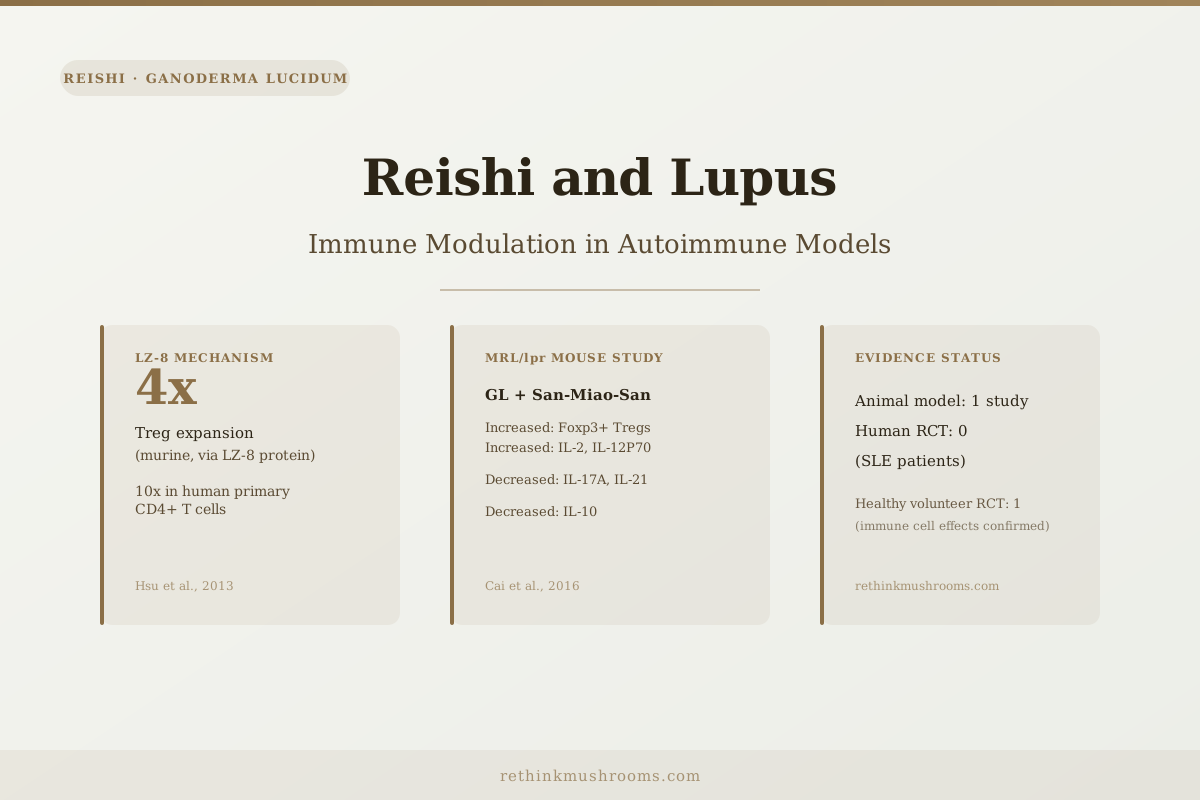
Hsu et al. (2013) found that reishi's LZ-8 protein stimulated a 4-fold expansion of regulatory T cells in mice and 10-fold in human primary CD4+ T cells; Tregs are the immune cells whose depletion drives autoimmune activity in lupus.
Hsu et al., Evidence-Based CAM, 2013
MRL/lpr mice
the only animal lupus model in which GL has been directly tested (Cai et al., 2016)
Foxp3+ Tregs
regulatory immune cells increased in lupus mice by GL + San-Miao-San treatment
0 human trials
no randomized controlled trials of reishi in SLE patients exist
Hsu et al., Evidence-Based CAM, 2013
 View as image ↗
No randomized controlled trial has tested reishi in lupus patients. That is the starting point, stated plainly, because the SERP for "reishi and lupus" is currently populated by content that either dismisses all evidence or overclaims benefit without noting that the human trial data does not exist. Both are a disservice.
The evidence that does exist is worth understanding. One study directly tested Ganoderma lucidum in a lupus animal model. One study documented the molecular mechanism by which reishi's LZ-8 protein expands the specific type of immune cells depleted in lupus. The broader immunomodulatory research helps explain why the mechanism is coherent for an autoimmune condition specifically. And the safety research is necessary context, because lupus patients are typically on immunosuppressive medications whose interaction with GL compounds has not been studied.
This is a cluster article in the Reishi allergy and immune series. For a broader discussion of reishi's role in autoimmune conditions, see reishi and autoimmune disease: immune regulation research. For the atopic dermatitis evidence, see reishi and atopic dermatitis: skin allergy evidence. The pillar introduction to reishi is at what is reishi mushroom.
Key Takeaways
- Cai et al. (2016) tested GL plus San-Miao-San in MRL/lpr lupus-prone mice; the treatment significantly increased Foxp3+ Treg cells and decreased IL-21, IL-10, and IL-17A while increasing IL-2 and IL-12P70; this is the only direct lupus model evidence for reishi[1]
- Hsu et al. (2013) found that reishi's LZ-8 protein stimulated a 4-fold expansion of Foxp3+ Treg cells in mice and 10-fold in human primary CD4+ T cells via a CD45-dependent signaling pathway; this is the mechanism most directly relevant to lupus, where Treg depletion allows autoreactive cells to operate unchecked[2]
- Wang and Lin (2019) described GL as a bidirectional immunomodulator: it activates defensive immunity when the immune system is underactive and suppresses inflammatory overactivation when it is excessive; this bidirectionality is why "immune booster" is the wrong framing for lupus patients[3]
- Thuy et al. (2023) systematic review found GL has a generally favorable safety profile; however, no studies have examined GL in combination with the immunosuppressive medications commonly used in SLE management[4]
- Chen et al. (2023) demonstrated significant enhancement of CD3+, CD4+, CD8+ T-lymphocytes and NK cell counts in a 84-day double-blind RCT in healthy volunteers; these are the highest-quality human immune data available for GL, but they were not collected in lupus patients[5]
- No human clinical trial of reishi specifically for lupus has been completed or registered; the evidence base is one animal study and mechanistic research only
What Lupus Is and Why the Immune Target Matters
Systemic lupus erythematosus (SLE) is an autoimmune condition where the immune system produces antibodies against the body's own tissues and DNA. These autoantibodies form immune complexes that deposit in organs including the kidneys, skin, joints, and blood vessels, triggering inflammation that causes the symptoms and organ damage characteristic of lupus.
At the cellular level, the core regulatory failure in lupus involves two cell types working in opposition:
Th17 cells are pro-inflammatory helper T cells that produce IL-17, a cytokine that promotes tissue inflammation. In lupus, Th17 activity is elevated; IL-17A is consistently higher in SLE patients than in healthy controls and correlates with disease activity.
Regulatory T cells (Tregs) are the immune system's braking mechanism. Foxp3+ Tregs suppress autoreactive lymphocytes that would otherwise attack the body's own tissues. In lupus, Treg numbers and function are reduced, allowing the Th17 and autoreactive B cell populations to operate without adequate suppression.
This is the immune landscape that makes reishi's LZ-8 protein mechanism particularly relevant: LZ-8 expands Foxp3+ Tregs. If the core regulatory defect in lupus is insufficient Treg activity, a compound that specifically expands Tregs is addressing the defect at its source. Whether it does so at achievable doses in human lupus patients is what the research hasn't yet determined.
The Only Direct Lupus Evidence: Cai 2016 in MRL/lpr Mice
Cai and colleagues (2016) published the only study that has directly tested GL in a lupus model.[1]
The animal model used was MRL/lpr mice. MRL/lpr is a well-established lupus-prone mouse strain that spontaneously develops autoimmune features resembling SLE: autoantibody production, immune complex kidney deposition (nephritis), lymphadenopathy, and elevated inflammatory cytokines. MRL/lpr mice are the standard preclinical model for testing lupus therapies because their disease features reliably reproduce key aspects of human SLE, including the Th17/Treg imbalance.
The treatment was GL combined with San-Miao-San, a traditional Chinese medicine formula. The study was not GL alone, which is the first interpretive limitation: any observed effects reflect the combination, and San-Miao-San has its own pharmacological activity.
The findings were directionally consistent with the proposed mechanism:
The treatment significantly increased Foxp3+ Treg cell numbers (the regulatory cells that are depleted in lupus).
The treatment significantly decreased IL-21 (a cytokine that promotes autoreactive B cell activity and is elevated in SLE), IL-10 (elevated in certain lupus phenotypes and associated with B cell hyperactivation), and IL-17A (the Th17 cytokine driving inflammatory tissue damage).
The treatment significantly increased IL-2 (a cytokine that supports Treg survival and proliferation) and IL-12P70 (a cytokine that promotes Th1 over Th17 differentiation).
This cytokine profile, if it translated to human lupus, would represent a meaningful shift in the disease's immune environment: fewer pro-inflammatory Th17 signals, more regulatory activity, less autoreactive B cell stimulation.
Two important caveats: First, the product tested was GL plus San-Miao-San, making it impossible to attribute the effect to GL alone. Second, MRL/lpr mice develop spontaneous lupus through a specific genetic mechanism (Fas gene deficiency), while human SLE is a heterogeneous disease with multiple genetic and environmental contributors. The mouse model is the best available preclinical tool for lupus research; it is not a reliable predictor of human treatment response.
The LZ-8 Mechanism: What Reishi's Protein Does to Regulatory T Cells
The molecular link between GL and Treg expansion comes from Hsu and colleagues' 2013 study of reishi's LZ-8 protein.[2]
LZ-8 is an immunomodulatory protein isolated from Ganoderma lucidum, distinct from the polysaccharide beta-glucans and triterpene ganoderic acids that are more commonly discussed. It is a fungal lectin (a protein that binds to specific carbohydrate structures on cell surfaces) and it acts through a CD45-dependent signaling pathway on T cells.
The findings: LZ-8 stimulated a 4-fold expansion of Foxp3+ Treg cells in mice. In human primary CD4+ T cells, the expansion was 10-fold. The study also demonstrated that this Treg expansion was sufficient to alleviate acute intestinal inflammation in mice, providing functional evidence that the expanded Tregs were suppressing inflammation effectively rather than simply increasing in number.
Why does a 10-fold expansion in human primary CD4+ T cells matter? Foxp3+ Tregs typically make up roughly 5-10% of circulating CD4+ T cells in healthy adults and are reduced in lupus patients. A compound that expands this population specifically addresses the regulatory deficit. The mechanism is not "immune stimulation" (which would be counterproductive in lupus) but "regulatory rebalancing": increasing the cells responsible for keeping autoreactive immunity in check.
This is the mechanism that most clearly explains why GL's immunomodulatory activity, properly understood, is not contraindicated for autoimmune conditions in the same way a general immune stimulant would be. LZ-8 doesn't boost overall immune activation; it specifically expands the regulatory population. For a fuller explanation of this bidirectionality, see how reishi modulates innate and adaptive immunity.
Why "Immune Booster" Is the Wrong Framing for Lupus
The most common error in consumer content about reishi and lupus is categorizing reishi as an "immune booster" and then drawing a straight line to danger for lupus patients. The reasoning goes: lupus is an overactive immune system, an immune booster would make it worse, therefore avoid reishi.
This framing is incomplete. Wang and Lin's comprehensive 2019 review of GL's immunomodulatory activity documents a more complex picture.[3] GL activates macrophages, NK cells, and T cells when the immune system is underactive (immunostimulatory effect). GL simultaneously suppresses overactive NF-κB signaling, reduces pro-inflammatory cytokine production, and expands Tregs when immune activation is excessive (immunosuppressive effect). These effects operate through different molecular targets and are context-dependent.
For lupus patients, the relevant components are the immunosuppressive ones: Treg expansion via LZ-8, NF-κB suppression via ganoderic acids, and reduction of Th17-associated cytokines. These are the mechanisms documented in the Cai 2016 lupus mouse study and the Hsu 2013 Treg expansion research.
The problem is not that reishi is categorically dangerous for lupus. The problem is that the evidence is insufficient to establish safety or efficacy in lupus patients, and that lupus patients take medications that could theoretically interact with GL's immunological effects.
The Human Immune Modulation Data (and Its Limits)
The highest-quality human evidence for GL's immune effects comes from Chen and colleagues' 2023 randomized controlled trial.[5] In this 84-day double-blind RCT, GL beta-glucan significantly enhanced CD3+, CD4+, and CD8+ T-lymphocytes, improved the CD4/CD8 ratio, and increased NK cell counts and cytotoxicity compared to placebo.
This is important context: the immune effects of GL in humans are documented at the cellular level in a controlled trial. The enhancement of these immune populations is real.
The limitation for lupus: this RCT enrolled healthy volunteers, not SLE patients. In healthy people, increasing T cell and NK cell activity is a benefit. In lupus patients, who already have dysregulated lymphocyte populations, the same intervention might behave differently, amplifying autoreactive populations alongside regulatory ones, or having unpredictable effects in the context of ongoing immunosuppressive treatment.
The Chen 2023 RCT establishes that GL affects human immune cell populations in a measurable way. It does not establish that those effects are safe or beneficial in lupus. That question requires a trial in lupus patients that has not been conducted.
Safety: What Is and Isn't Known
Thuy and colleagues' 2023 systematic review of GL spore pharmacological activity and safety found a generally favorable safety profile across the available research literature.[4] Adverse events in the literature are primarily gastrointestinal (nausea, diarrhea, dry mouth) and generally mild. Rare serious adverse events have been reported, including hepatotoxicity in some case reports.
The specific concern for lupus patients is interaction with their standard medications:
Hydroxychloroquine, mycophenolate mofetil, azathioprine, belimumab, and corticosteroids are commonly used in SLE management. All work by suppressing or modulating immune function. GL compounds also modulate immune function, through different molecular targets. Whether these effects are additive, synergistic, or antagonistic has not been studied. The combination safety question is genuinely unresolved.
A second concern specific to lupus: some case reports have associated GL supplementation with autoimmune necrotizing myopathy, a muscle-damaging autoimmune condition. The proposed mechanism involves GL's statin-like HMG-CoA reductase inhibitory activity, which can trigger HMGCR autoantibodies in susceptible individuals. This is a rare event, documented in case reports rather than controlled data, but it is a real concern for anyone with pre-existing autoimmune conditions.
The Pozzobon 2026 systematic review and meta-analysis, while focused on the anti-inflammatory potential of GL triterpenes rather than safety, provides the most current synthesis of preclinical evidence supporting the mechanistic basis for GL's effects.[6]
What the Evidence Cannot Tell Us
Four gaps define the boundaries of what the current research can answer:
No human lupus trial. Every finding cited above is from a mouse model or from healthy human volunteers. SLE is a heterogeneous human condition. Mouse lupus and human SLE share immunological features but do not share treatment responses reliably.
No GL-alone lupus data. The Cai 2016 study used GL plus San-Miao-San. Isolating GL's contribution to the observed effects would require a study with a GL-alone arm, which does not exist.
No drug interaction data. Patients with lupus typically take multiple immunosuppressive medications. The combination safety of GL with hydroxychloroquine, mycophenolate, azathioprine, or biologics has not been studied.
No dose or formulation standard. LZ-8 protein content varies across GL preparations. Whether commercially available reishi supplements deliver meaningful LZ-8 concentrations is not established.
For the parallel context of reishi in other autoimmune conditions, see reishi and autoimmune disease: immune regulation research. For the allergy and asthma research where the evidence is somewhat stronger, see reishi for allergies: antihistamine effects and research and Ganoderma lucidum and asthma: can reishi help?. For a cross-mushroom comparison in autoimmune regulation, see Poria and autoimmune regulation: balancing the immune response.
The Bottom Line
The reishi and lupus evidence base consists of one MRL/lpr mouse study showing GL increased Foxp3+ Tregs and reduced SLE-relevant cytokines, plus the LZ-8 Treg expansion mechanism that provides molecular coherence for the effect. No randomized controlled trial has tested reishi in SLE patients. The immunomodulatory framing is more accurate than "immune booster" for lupus: GL's Treg-expanding and NF-κB-suppressing effects are immunomodulatory in a direction that makes biological sense for autoimmune conditions. The interaction between GL compounds and the immunosuppressive medications commonly used in SLE management has not been studied, which is the unresolved safety question.
Frequently Asked Questions
Sources & References
- 1. Source details for this reference are not yet available.
- 2. Source details for this reference are not yet available.
- 3. Source details for this reference are not yet available.
- 4. Source details for this reference are not yet available.
- 5. Source details for this reference are not yet available.
- 6. Source details for this reference are not yet available.