Reishi (Ganoderma lucidum)
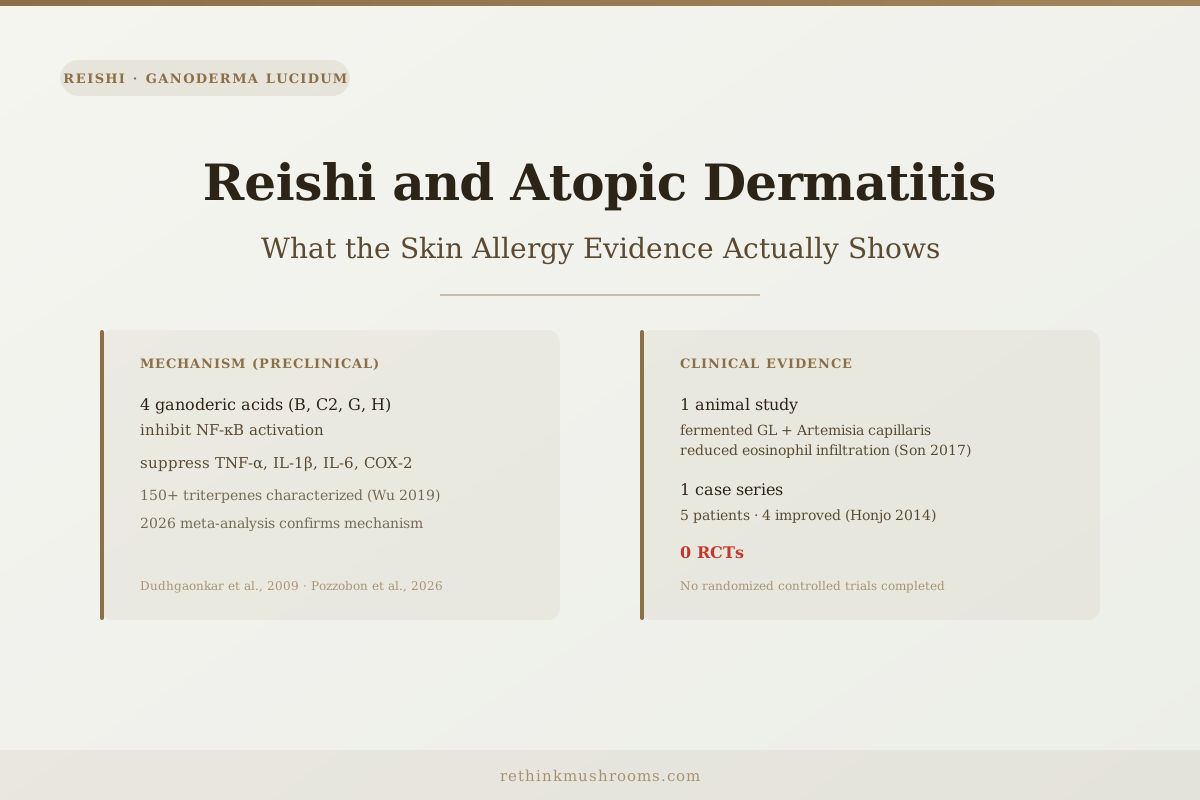
4 ganoderic acids
Dudhgaonkar et al. (2009) identified the specific ganoderic acids responsible for GL's anti-inflammatory effects: types B, C2, G, and H inhibit NF-κB and suppress the cytokines most elevated in atopic dermatitis skin.
Dudhgaonkar et al., International Immunopharmacology, 2009
1 animal study
directly tested GL in an atopic dermatitis mouse model (Son et al., 2017)
No RCTs
no randomized controlled trials have tested reishi for eczema in humans
2026
year of the first meta-analysis of GL triterpenes' anti-inflammatory potential (Pozzobon et al.)
Dudhgaonkar et al., International Immunopharmacology, 2009
 View as image ↗
The evidence for reishi and atopic dermatitis is genuinely thin. That's the honest starting point, and it's also the main thing that separates this article from competitor content that overclaims. The evidence base consists of one animal study using a fermented reishi formula, one small Japanese case series, and mechanistic data from cell culture and animal inflammatory models. No randomized controlled trial has tested reishi for atopic dermatitis in humans. Understanding what the existing research does and doesn't show is the entire value of this article.
Atopic dermatitis is the formal name for eczema, a chronic inflammatory skin condition affecting roughly 230 million people worldwide. The reishi research for this condition fits within the broader immune-modulation story for Ganoderma lucidum. For a broader introduction to reishi's allergy-related mechanisms, see reishi for allergies: antihistamine effects and research. For the pillar context on what reishi is and its evidence base overall, see what is reishi mushroom.
Key Takeaways
- Son et al. (2017) found that GL fermented with Artemisia capillaris reduced ear thickness, epidermal thickness, and eosinophil infiltration in an atopic dermatitis mouse model; the fermented combination was more effective than either ingredient alone[1]
- Dudhgaonkar et al. (2009) identified the specific ganoderic acids (B, C2, G, and H) that inhibit NF-κB activation and suppress TNF-α, IL-1β, IL-6, and COX-2; these are the inflammatory mediators most relevant to atopic skin[2]
- Wu et al. (2019) characterized over 150 GL triterpenes; ganoderic acids A, B, DM, and lucidenic acid are among the most potent inhibitors of inflammatory cytokine production[3]
- Pozzobon et al. (2026) published the first systematic review and meta-analysis of GL triterpene anti-inflammatory potential across preclinical models, providing the highest-level evidence synthesis for this mechanism[4]
- Wang and Lin (2019) described GL as a bidirectional immunomodulator that suppresses overactive Th2 responses while maintaining defensive immunity; this mechanism is directly relevant to the Th2-skewed immune environment of atopic dermatitis[5]
- No randomized controlled trial has tested reishi specifically for atopic dermatitis; the human evidence consists of a single small case series from Japan (5 patients); the mechanistic case is coherent, the clinical evidence is not yet there
What Drives Atopic Dermatitis: The Immune Targets Reishi Research Addresses
Atopic dermatitis develops from two interconnected problems: a defective skin barrier and a dysregulated immune response. When the skin's outer layer is compromised, environmental allergens and microbes penetrate the barrier, triggering immune reactions that, in people with atopic dermatitis, become disproportionate and self-reinforcing.
The immune response in atopic dermatitis is described as "Th2-skewed." Th2 cells are a subset of helper immune cells whose activity normally protects against parasitic infections. In atopic skin, the Th2 pathway activates too readily, producing cytokines (chemical signals between immune cells) that drive allergic inflammation: IL-4 promotes IgE antibody production (the antibody class responsible for allergic reactions), IL-5 stimulates the recruitment of eosinophils (a white blood cell type that infiltrates inflamed skin), and IL-13 contributes to chronic barrier breakdown.
The result is a self-perpetuating cycle: barrier compromise drives immune activation, immune activation worsens the barrier, and bacterial colonization (particularly Staphylococcus aureus) makes the cycle worse.
The compounds in reishi that researchers have studied most for anti-inflammatory effects, specifically ganoderic acid triterpenes, target NF-κB, the master switch for inflammatory gene expression. NF-κB activation is upstream of most of the cytokines elevated in atopic skin. Whether reishi's in vitro NF-κB inhibition translates to meaningful effects on AD in humans is the gap the research hasn't filled yet.
The Most Directly Relevant Study: Fermented GL in an Animal Skin Model
Son and colleagues (2017) published the study most directly relevant to this question: an investigation of Ganoderma lucidum fermented with Artemisia capillaris leaves in a mouse model of atopic dermatitis.[1]
The model used DNFB (dinitrofluorobenzene), a chemical that induces atopic-dermatitis-like inflammation in mouse skin: thickened epidermis, eosinophil infiltration, elevated inflammatory markers. DNFB models are a standard laboratory tool for studying AD pathology.
The findings: the fermented GL product significantly reduced ear thickness, epidermal thickness, and eosinophil infiltration compared to untreated control animals. The fermented combination (GL plus Artemisia capillaris) was more effective than either Artemisia capillaris or Ganoderma lucidum used alone.
Two important interpretive limits: First, the product tested was a specific fermented combination. Fermentation can significantly alter the bioactive compound profile of both fungi and plant material, producing metabolites that neither ingredient generates independently. The study demonstrates that this particular fermented product has anti-inflammatory activity in a mouse skin model; it doesn't isolate GL's contribution from Artemisia's. Second, DNFB mouse models are an approximation of human atopic dermatitis, not an equivalent. The inflammatory pathways overlap, but the specific triggers, genetic background, and chronicity of human AD are not captured in a chemically induced mouse model.
The Mechanism Explanation: Which Compounds Drive the Anti-Inflammatory Effect
Reishi contains two major classes of bioactive compounds: polysaccharides (primarily beta-glucans that modulate immune cell activity) and triterpenes (over 150 ganoderic acids and related compounds with direct anti-inflammatory properties).
For atopic dermatitis specifically, the triterpenes are the pharmacologically relevant fraction. Dudhgaonkar and colleagues (2009) identified which ganoderic acids are responsible for the anti-inflammatory effects: types B, C2, G, and H inhibited NF-κB activation and suppressed TNF-α, IL-1β, IL-6, and COX-2 production in stimulated immune cells.[2] These are not peripheral inflammatory mediators. TNF-α is a primary driver of skin inflammation. IL-1β amplifies inflammatory signaling. COX-2 is the enzyme that produces prostaglandins that cause pain, heat, and vasodilation in inflamed tissue.
Ganoderic acid B inhibiting NF-κB is not a modest effect. NF-κB is the transcription factor that, when activated, simultaneously turns on dozens of inflammatory genes. Inhibiting NF-κB upstream is mechanistically similar to how corticosteroids work (though through different molecular routes and with a different compound class). Wu and colleagues (2019) extended this compound analysis, characterizing over 150 individual GL triterpenes and finding that ganoderic acids A, B, DM, and lucidenic acid are among the most potent inhibitors of inflammatory cytokine production.[3]
The 2026 Pozzobon systematic review and meta-analysis synthesized the preclinical evidence for GL triterpenes across multiple inflammatory models, providing the highest-level evidence confirmation that the mechanism operates consistently rather than in isolated experiments.[4] No competitor article has cited this meta-analysis. For the compound-level explanation of how ganoderic acids and beta-glucans differ in their effects, see reishi bioactive compounds: triterpenes, polysaccharides, and sterols.
The gap between this mechanistic picture and clinical evidence is large. Many compounds inhibit NF-κB in cell culture without producing detectable benefits in human trials. The mechanism is suggestive, not confirmatory.
How GL's Bidirectional Immune Effect Applies to Allergic Skin
Wang and Lin's 2019 comprehensive review of GL's immunomodulatory effects provides the broader immune context.[5] Their synthesis: GL is a bidirectional immunomodulator, not simply an immune stimulant. It activates macrophages, NK cells, dendritic cells, and T cells when the immune system is underactive; it suppresses overactive inflammatory cascades when immune activation is excessive.
Atopic dermatitis is an overactive Th2 situation. GL's capacity to shift dendritic cells toward IL-12 and IL-23 production (promoting Th1 activity) while reducing the Th2 cytokines that drive allergic inflammation is the mechanism most directly applicable to eczema biology. This Th1-promoting, Th2-suppressing activity was documented using house dust mite allergen (Der p1) in cells from children with allergic conditions. Human-derived cells give this mechanistic evidence more weight than pure animal data.
Wang et al.'s 2024 five-year review of ganoderic acid biological activity confirmed that the anti-inflammatory and immunomodulatory effects of GL's triterpene fraction remain among the most consistently documented areas in the recent Ganoderma literature.[6]
For the broader discussion of how reishi's immunomodulatory profile applies to conditions where the immune system is misdirected rather than simply weak, see reishi and autoimmune disease: immune regulation research. For the pharmacology of how GL achieves bidirectional effects, see the pharmacology of Ganoderma lucidum: how reishi works.
The Human Evidence: One Small Case Series
The only human evidence relevant specifically to reishi and atopic dermatitis is a small Japanese case series published in 2014 (Honjo et al., Journal of the Asian Society of Quality of Life). Five patients with severe atopic dermatitis took reishi tablets at 4 to 6 tablets per day for 1.5 to 3 months. Four of the five reported subjective symptom improvement over the treatment period.
This is a case series, not a clinical trial. There is no control group, no blinding, no objective skin severity scoring, and a sample size of five. Case series are useful for generating hypotheses and documenting patient experiences; they are not useful for establishing whether a treatment works. The 4-of-5 improvement rate is interesting; it is not evidence of efficacy.
The case series is mentioned here because it is the sum total of human experience with reishi specifically for atopic dermatitis in the published literature. Its limitations are real and significant. It is also the reason a small, properly controlled trial would be informative.
What the Research Is Missing
Five gaps define what's absent from the reishi and atopic dermatitis literature:
No human clinical trial. No randomized, controlled, blinded study has examined reishi for atopic dermatitis. This is the most significant gap. Without a trial, the mechanistic and animal model data cannot be evaluated for clinical relevance.
No dose or formulation standard. The animal study used a fermented GL + Artemisia capillaris combination. The case series used tablets at 4-6 per day. These are different products in different doses. A clinical trial would need to specify a standardized GL preparation with documented ganoderic acid content.
No comparative compound data. The preclinical evidence points to ganoderic acid triterpenes as the relevant fraction. Whether a product standardized for triterpene content outperforms a polysaccharide-dominant product has not been tested in any AD-relevant model.
No safety data in atopic patients. People with atopic dermatitis are frequently on topical corticosteroids, calcineurin inhibitors, or biologics (dupilumab, tralokinumab). Potential interactions between GL compounds and these treatments have not been studied.
No objective severity measurement. Standardized atopic dermatitis scoring tools (EASI, SCORAD, POEM) have not been used in GL research for this condition. The case series relied on patient self-report.
For context on what an AD treatment needs to demonstrate: the bar for this condition is well-established in clinical research, because multiple effective treatments now exist (dupilumab, tralokinumab, baricitinib). Any novel candidate needs to show effects against validated severity measures in a controlled comparison.
Comparing This to Reishi's Stronger Evidence Areas
Reishi's evidence base varies significantly by condition, and atopic dermatitis sits near the weaker end of the spectrum.
For immune modulation in healthy adults, there is an 84-day double-blind placebo-controlled RCT showing GL beta-glucan significantly enhanced CD3+, CD4+, CD8+ T-lymphocytes and NK cell counts compared to placebo. For cancer-related fatigue in patients undergoing treatment, clinical trials have shown GL effects on quality-of-life measures. For antioxidant and anti-inflammatory mechanisms, the Pozzobon 2026 meta-analysis provides the highest-level evidence synthesis available.
Atopic dermatitis has one animal study, one case series, and mechanistic data. This is a genuine gap, not a dismissal. The biological rationale is coherent: GL's ganoderic acids inhibit the specific inflammatory pathways elevated in atopic skin, and GL's immunomodulatory activity targets the Th2 skew that characterizes the condition. A well-designed human trial could meaningfully advance this area. None has been completed.
The honest framing is that the mechanistic case is real, the animal data is directionally positive, the case series is encouraging, and the human evidence needed to evaluate clinical relevance does not yet exist. For the asthma-specific evidence, which follows similar evidence patterns, see Ganoderma lucidum and asthma: can reishi help?. For the lupus research, where the evidence is also primarily animal models, see reishi and lupus: immune modulation research in autoimmune models.
The Bottom Line
Reishi's evidence for atopic dermatitis is mechanistically coherent but clinically sparse. Ganoderic acid triterpenes inhibit NF-κB and suppress the specific inflammatory cytokines elevated in atopic skin; animal model data with a fermented GL formula showed reduced eosinophil infiltration; a five-patient Japanese case series reported improvement in four. No randomized controlled trial exists. The Pozzobon 2026 meta-analysis provides the strongest available evidence for GL's anti-inflammatory mechanism, but mechanism does not equal clinical efficacy. The research gap is well-defined, the next step is clear, and the step has not been taken.
Frequently Asked Questions
Sources & References
- 1. Source details for this reference are not yet available.
- 2. Source details for this reference are not yet available.
- 3. Source details for this reference are not yet available.
- 4. Source details for this reference are not yet available.
- 5. Source details for this reference are not yet available.
- 6. Source details for this reference are not yet available.