Reishi & Respiratory Health
9 asthma biomarkers reduced
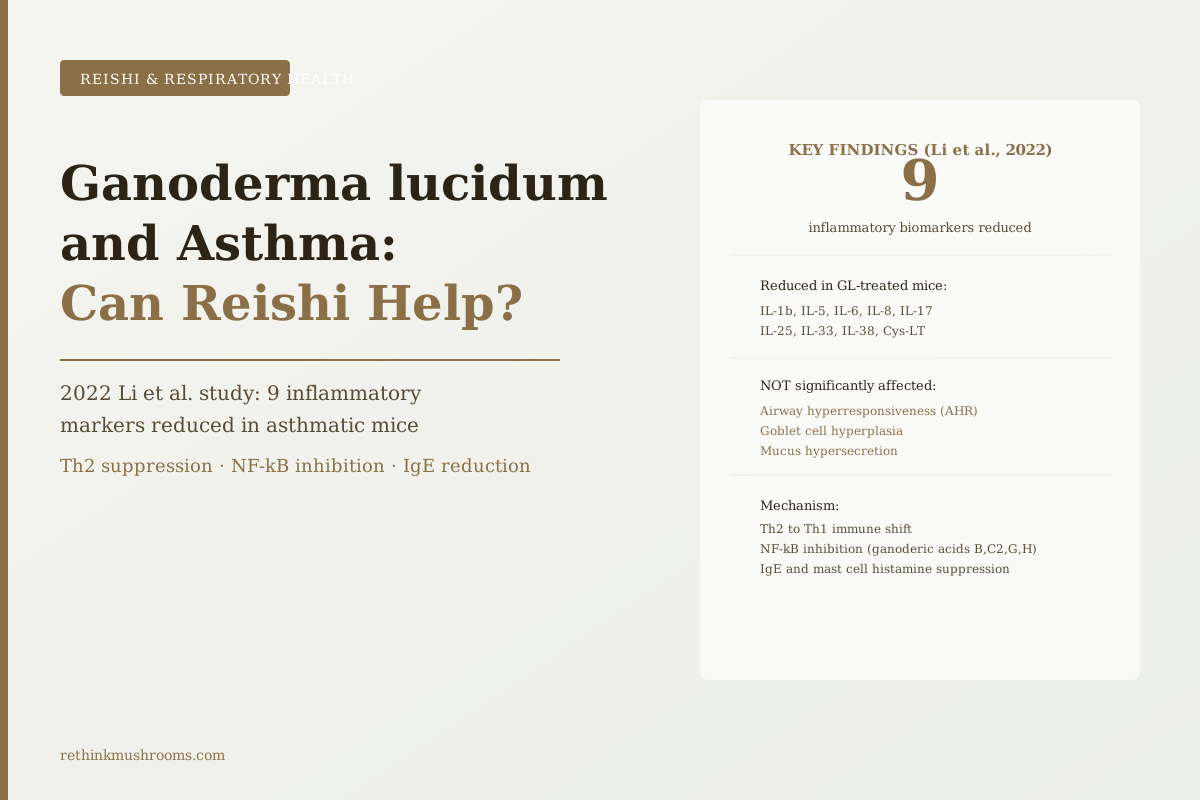
The 2022 Li et al. study in Journal of Ethnopharmacology found oral Ganoderma significantly reduced nine inflammatory mediators in allergic asthma, while leaving airway hyperresponsiveness and mucus secretion unchanged.
Li et al., Journal of Ethnopharmacology, 2022
Th2 to Th1 shift
in human dendritic cells from children with allergic asthma exposed to house dust mite allergen (Jan et al., BMC Immunology, 2011)
IgE + IL-4/5/13 reduced
in Ganoderma formosanum asthmatic mice, with airway hyperresponsiveness prevented (Pi et al., Phytomedicine, 2014)
2026 meta-analysis
confirmed significant anti-inflammatory potential of GL triterpenes across preclinical models (Pozzobon et al., Pharmaceuticals)
Li et al., Journal of Ethnopharmacology, 2022
 View as image ↗
Asthma is an immune overreaction. The airways become chronically inflamed because the immune system's Th2 arm is running hot: producing IgE antibodies, activating mast cells, releasing inflammatory molecules that constrict the bronchi and thicken the airway walls. Ganoderma lucidum (reishi mushroom) contains compounds that target this mechanism directly. Whether that translates from laboratory studies to human benefit is a different question, and the honest answer is that no clinical trial has yet tested reishi alone in human asthma patients. What the preclinical data on Ganoderma lucidum asthma research does show is worth examining carefully.
This article covers the mechanistic and animal-model evidence for reishi in asthma, including what a 2022 study found, what it didn't find, and why the ASHMI clinical trials you may have read about are not evidence for reishi alone. For the broader picture of reishi's biology, see what is reishi mushroom and what the science shows.
Key Takeaways
- A 2011 human cell study (Jan, BMC Immunology) found GL polysaccharide shifted immune balance from Th2 toward Th1 in dendritic cells from children with allergic asthma exposed to house dust mite allergen
- The 2022 Li et al. study (Journal of Ethnopharmacology) found oral Ganoderma reduced 9 inflammatory cytokines and leukotrienes in asthmatic mice, including IL-1β, IL-5, IL-6, IL-8, IL-17, IL-25, IL-33, IL-38, and cysteinyl leukotrienes
- Critically, Li et al. 2022 found NO effect on airway hyperresponsiveness (AHR), goblet cell hyperplasia, or mucus hypersecretion: three hallmarks of asthma severity that GL did not significantly affect
- Ganoderic acids B, C2, G, and H specifically inhibit NF-κB activation and suppress TNF-α, IL-1β, IL-6, and COX-2 (Dudhgaonkar et al., 2009), the precise compounds driving GL's anti-inflammatory effects
- ASHMI (Antiasthmatic Herbal Medicine Intervention) is a 3-herb TCM formula, not reishi alone; its clinical trial results cannot be attributed to Ganoderma
- No published RCT has tested reishi alone in human asthma patients; all current evidence is preclinical
How Asthma Creates the Immune Imbalance That Ganoderma Targets
Allergic asthma begins when the immune system responds to harmless substances (house dust mites, pollen, pet dander) as if they were dangerous. The T-helper 2 (Th2) immune pathway drives this response: Th2 cells produce cytokines including IL-4, IL-5, and IL-13, which tell B cells to produce IgE antibodies, activate eosinophils, and trigger mast cell degranulation. Mast cells release histamine and leukotrienes, which cause the airway constriction and inflammation that characterize an asthma episode.
The Th1 pathway, by contrast, drives cellular immunity against viruses and bacteria. A balanced Th1/Th2 immune response is protective. In allergic asthma, this balance is skewed heavily toward Th2.
Ganoderma lucidum polysaccharides appear to push this balance back toward Th1. Jan and colleagues demonstrated this in 2011 in a study that came unusually close to human asthma biology.[1]
Rather than working in mice, Jan et al. cultured dendritic cells from children with allergic asthma and exposed them to Der p 1, the primary house dust mite allergen responsible for most dust mite-triggered asthma. Dendritic cells are the immune system's field commanders: they take in an antigen, decide how to respond to it, and direct T cells accordingly.
When GL polysaccharide was added to these human dendritic cells, two things happened. IL-12 and IL-23 production increased. These are the cytokines that drive Th1 differentiation. At the same time, the Th2-promoting signaling decreased. In other words, the immune cells from asthmatic children responded to GL by moving toward a less allergic immune profile.
This is mechanistically important for two reasons. First, the cells came from children with allergic asthma, so the result tells us something about the disease, not just about cells from healthy donors. Second, the shift was driven by a specific Ganoderma fraction (polysaccharides), which distinguishes this from non-specific immune effects.
This cell study can't prove that reishi relieves asthma symptoms in people. It does explain why the hypothesis makes biological sense at the cellular level.
For a detailed look at how GL's individual compounds drive these immune effects, see reishi bioactive compounds: triterpenes, polysaccharides, and sterols.
The 2022 Landmark Study: What Ganoderma Reduced in Asthmatic Mice (and Three Things It Didn't)
The most comprehensive investigation of GL in asthma biology to date was published by Li and colleagues in the Journal of Ethnopharmacology in 2022.[2] It is the only study that systematically mapped which asthma features GL affects and which it leaves unchanged, and those distinctions matter more than most reporting acknowledges.
Li et al. induced allergic asthma in mice and treated them with oral Ganoderma. The study measured a broad panel of asthma-related mediators: cytokines, leukotrienes, and structural airway changes.
What GL significantly reduced:
| Inflammatory Mediator | Role in Asthma |
|---|---|
| IL-1β | Triggers mast cell activation and airway inflammation |
| IL-5 | Recruits and activates eosinophils |
| IL-6 | Drives systemic and local inflammation |
| IL-8 | Recruits neutrophils to the airway |
| IL-17 | Promotes neutrophilic airway inflammation |
| IL-25 | Triggers and amplifies Th2 responses |
| IL-33 | Activates mast cells and innate lymphoid cells |
| IL-38 | Modulates Th17/Th22 inflammatory signaling |
| Cysteinyl leukotrienes (Cys-LT) | The bronchoconstrictors targeted by standard leukotriene modifiers (montelukast) |
Reducing cysteinyl leukotrienes is particularly notable. This is the same target as montelukast (Singulair), a widely prescribed asthma controller medication. GL's ability to reduce Cys-LT in mice places it in mechanistic territory adjacent to established pharmaceutical approaches.
The study also measured peribronchial inflammation and perivascular inflammation, the tissue-level changes that surround the airways and blood vessels in asthmatic lungs. Both were significantly reduced by GL.
What GL did not significantly change:
These three findings are as important as the reductions above:
- Airway hyperresponsiveness (AHR): The heightened sensitivity of asthmatic airways to bronchoconstrictive triggers was not significantly affected. AHR is one of the defining clinical features of asthma and a primary measure of asthma control.
- Goblet cell hyperplasia: In asthma, mucus-producing goblet cells multiply in the airway lining. GL did not reduce this structural change.
- Mucus hypersecretion: Excessive mucus production, which clogs smaller airways, was not significantly reduced.
This pattern suggests GL's effects in asthma may be primarily anti-inflammatory rather than bronchoprotective or mucus-reducing. Reducing 9 pro-inflammatory mediators while leaving airway structure and responsiveness unchanged is a finding that requires honest interpretation: some asthma pathology was addressed, but not the full picture.
The Specific Ganoderic Acids Behind the Anti-Inflammatory Effect
The anti-inflammatory activity of Ganoderma in asthma and allergy comes primarily from its triterpene compounds, specifically the ganoderic acids. Dudhgaonkar and colleagues identified four of them in 2009 as the key active agents in GL's inflammatory suppression.[3]
Ganoderic acids B, C2, G, and H were found to inhibit NF-κB activation and suppress production of TNF-α, IL-1β, IL-6, and COX-2 in in vitro models. NF-κB is the transcription factor that coordinates the expression of most major pro-inflammatory cytokines, the signaling hub that turns on the inflammatory cascade. Blocking NF-κB at this level has downstream effects across the entire inflammatory pathway.
Bhardwaj and colleagues reviewed the anti-allergy mechanism specifically in 2014, synthesizing evidence that ganoderic acids suppress IgE production (the antibody central to allergic responses), inhibit histamine release from mast cells, and reduce the Th2 cytokines IL-4, IL-5, and IL-13 that drive allergic airway disease.[5]
A 2026 systematic review and meta-analysis by Pozzobon and colleagues in Pharmaceuticals provided the highest-level synthesis yet of GL triterpene anti-inflammatory evidence across preclinical models.[4] The meta-analysis confirmed significant anti-inflammatory potential across the pooled data, cementing the mechanistic foundation that the individual studies point toward. No competitor article on reishi and asthma has cited this 2026 analysis.
For a deeper look at how ganoderic acids specifically drive these effects, see ganoderic acids: the unique triterpenes in reishi. For the full pharmacological picture, see the pharmacology of Ganoderma lucidum: how reishi works.
Corroboration From a Related Species and a Novel Delivery Method
Two additional animal studies expand the preclinical evidence base for GL in asthma, though both carry important caveats about species specificity and formulation.
Ganoderma formosanum in asthmatic mice (Pi 2014): Pi and colleagues tested polysaccharides from Ganoderma formosanum, a species related to but distinct from Ganoderma lucidum, in a murine model of allergic asthma.[6] The polysaccharides prevented airway hyperresponsiveness and significantly reduced serum IgE along with the Th2 cytokines IL-4, IL-5, and IL-13.
This is worth noting because this study found an effect on airway hyperresponsiveness, the feature Li 2022 did not significantly affect in Ganoderma lucidum-treated mice. The difference may reflect species-specific activity, formulation differences (polysaccharide fraction vs. whole Ganoderma), dose, or the specific asthma model used. These studies are not directly comparable, and neither alone defines what reishi would do in a human asthma trial.
Selenium-enriched GL protein in asthmatic mice (Min-Chang 2014): A second 2014 study tested a selenium-enriched protein fraction from Ganoderma in ovalbumin-induced asthmatic mice.[7] This formulation significantly reduced IL-1β, TNF-α, oxidative stress markers, and NF-κB activation. The selenium enrichment angle is distinct from polysaccharide or triterpene preparations; this study explores a different fraction of reishi's bioactive profile.
Taken together, both 2014 studies corroborate the anti-inflammatory signal seen in Li 2022, while exploring different mechanistic pathways (Th2 cytokines via Pi 2014, oxidative stress and NF-κB via Min-Chang 2014). The convergence across different preparations and models strengthens the hypothesis without resolving the clinical question.
ASHMI Clinical Trials: What They Show and Why They Aren't Reishi Evidence
If you have researched reishi and asthma, you have probably encountered references to ASHMI clinical trials. ASHMI stands for Antiasthmatic Herbal Medicine Intervention, and it has been studied in several published clinical trials in asthma patients.
ASHMI is a three-herb TCM formula containing Ling Zhi (Ganoderma lucidum), Gan Cao (Chinese liquorice root), and Ku Shen (shrubby sophora root). Studies using ASHMI have produced meaningful asthma-related results in human participants.
The problem is attribution. When three biologically active herbs are combined and tested together, you cannot determine which herb produced which effect. Liquorice root (Glycyrrhiza) is a potent anti-inflammatory in its own right, with a well-established NF-κB inhibitory mechanism. Sophora flavescens has documented bronchodilatory and anti-inflammatory properties. Both herbs have independent evidence bases for respiratory effects.
Attributing ASHMI's clinical results to Ganoderma lucidum specifically is scientifically incorrect, and this is exactly what several competitor articles do. The clinically tested entity is the combination formula; reishi is one of three active ingredients.
This distinction matters if you are trying to understand what reishi alone does in asthma. The honest answer based on the current evidence base: we have strong preclinical mechanistic data and multiple animal studies pointing in a consistent direction, and no published human RCT testing reishi alone.
For how reishi fits into broader immune modulation across respiratory and allergic conditions, see reishi for allergies: antihistamine effects and research.
Where the Evidence Stands: Strong Mechanism, No Human Trial
The preclinical data for GL in asthma forms a coherent picture. The mechanism is clear: ganoderic acid and polysaccharide fractions suppress the Th2-dominant immune profile that drives allergic airway disease. Multiple animal models show reduced inflammatory cytokines. A human cell study shows that the Th1/Th2 shift happens in cells from actual asthma patients. A 2026 meta-analysis confirms the anti-inflammatory mechanism is robust across preclinical models.
The gap between this evidence and clinical application is the absence of a human clinical trial testing reishi alone in asthma patients. This is not a minor gap. Animal models of asthma frequently show promising results for compounds that subsequently fail to demonstrate clinical benefit in human trials, for reasons related to pharmacokinetics, dose translation, disease complexity, and endpoint selection.
What the evidence does not support is overclaiming. GL significantly reduced pro-inflammatory cytokines and cysteinyl leukotrienes in the best available preclinical study, while leaving airway hyperresponsiveness and mucus secretion unchanged. Both the positive findings and the null findings are informative.
What the evidence does support is the biological plausibility of a future human trial. The mechanism is specific, the target is relevant to asthma pathology, and the safety profile of GL preparations in humans is generally favorable across published studies. The research gap is clear; the question is whether someone will fund the trial to close it.
For broader context on reishi's immune regulatory properties in autoimmune and inflammatory conditions, see reishi and autoimmune disease: immune regulation research and reishi and atopic dermatitis: skin allergy evidence.
The Bottom Line
The preclinical case for Ganoderma lucidum in asthma rests on a convergent body of cell, animal, and mechanistic evidence: GL compounds suppress Th2 cytokines, inhibit NF-κB, reduce cysteinyl leukotrienes, and shift immune balance toward Th1 in human cells from asthmatic children. The 2022 Li et al. study is the most comprehensive assessment, showing reductions in nine inflammatory mediators alongside no significant effect on airway hyperresponsiveness or mucus secretion. ASHMI clinical trials, sometimes cited as reishi evidence, test a three-herb formula; the results cannot be attributed to Ganoderma alone. No published RCT has tested reishi alone in human asthma patients.
Frequently Asked Questions
Sources & References
- 1. Source details for this reference are not yet available.
- 2. Source details for this reference are not yet available.
- 3. Source details for this reference are not yet available.
- 4. Source details for this reference are not yet available.
- 5. Source details for this reference are not yet available.
- 6. Source details for this reference are not yet available.
- 7. Source details for this reference are not yet available.