Reishi (Ganoderma lucidum)
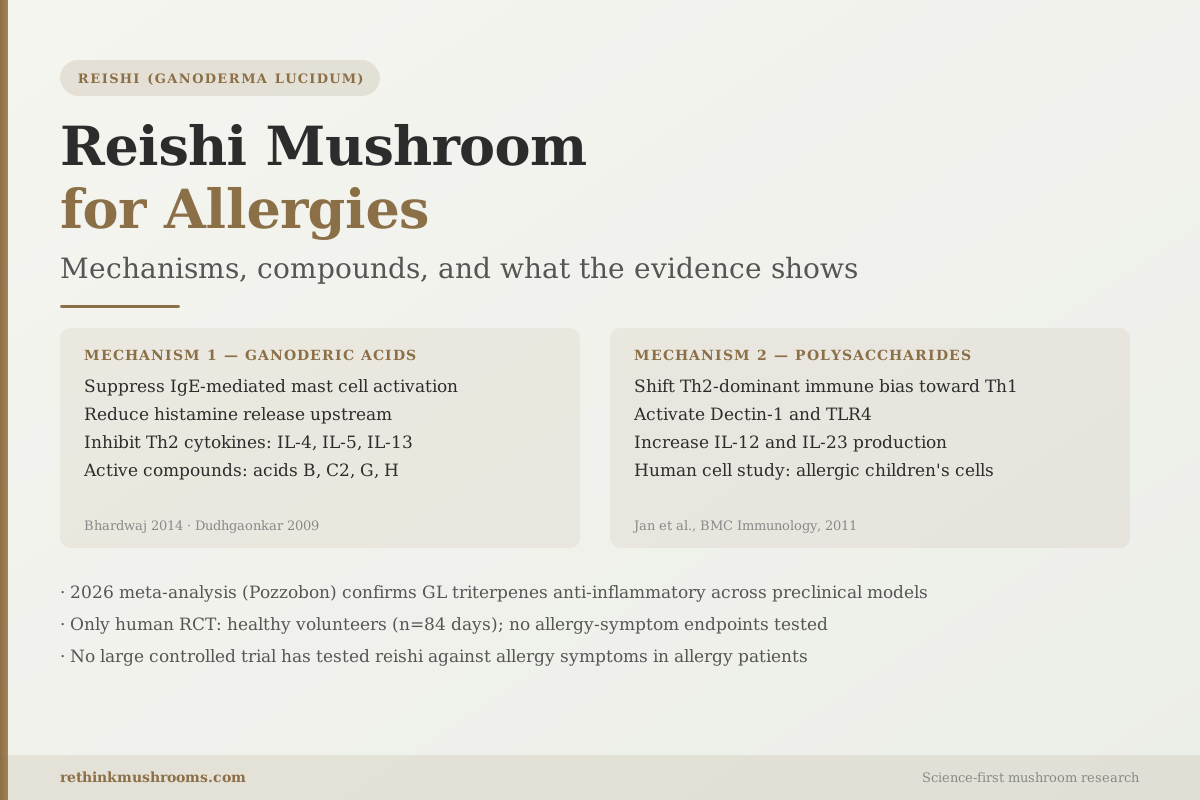
2 distinct anti-allergy mechanisms in GL research
Ganoderic acids suppress histamine release from mast cells and reduce IgE-mediated allergic reactions. Polysaccharides shift the immune balance away from the Th2-dominant pattern that drives allergic inflammation.
Bhardwaj et al., Recent Patents Inflamm Allergy Drug Discov, 2014
Specific ganoderic acids identified
B, C2, G, H inhibit NF-κB and suppress IL-4, IL-5, IL-13 (Dudhgaonkar 2009)
Human cell study: Th1/Th2 shift
immune cells from allergic children shifted toward balanced response (Jan 2011)
2026 meta-analysis confirms mechanism
highest-level preclinical evidence synthesis for GL triterpenes (Pozzobon 2026)
Bhardwaj et al., Recent Patents Inflamm Allergy Drug Discov, 2014
 View as image ↗
Most websites covering reishi for allergies describe it as a "natural antihistamine." That label is misleading in an important way. Pharmaceutical antihistamines work by blocking histamine receptors after histamine is released. Reishi works differently: specific ganoderic acid triterpenes reduce the release of histamine from mast cells before the allergic cascade begins. These are different mechanisms with different implications for how, when, and why reishi might help.
The honest summary: reishi has credible mechanistic and preclinical evidence for anti-allergy effects, a small human cell study showing immune rebalancing in allergic tissue, and almost no large clinical trial data in actual allergy patients. That evidence map puts reishi in the same position as many botanical approaches: biologically plausible, supported by targeted lab work, awaiting the large human trials that would make strong clinical claims possible.
This article explains what the research specifically shows and which compounds are responsible. For the broader context on how reishi functions across immune challenges, this sits within the what is reishi mushroom evidence base. Related articles in this series cover reishi and asthma, reishi and atopic dermatitis, and reishi and autoimmune disease.
Key Takeaways
- Reishi contains two classes of compounds with different anti-allergy mechanisms: ganoderic acid triterpenes suppress IgE-mediated histamine release from mast cells, while polysaccharides shift the immune system from the Th2-dominant pattern that drives allergic inflammation toward a more balanced Th1/Th2 state
- The ganoderic acids most clearly linked to anti-allergy effects are B, C2, G, and H, which inhibit NF-κB activation and suppress Th2 cytokines (IL-4, IL-5, IL-13) (Dudhgaonkar et al., 2009)
- A 2011 study using human dendritic cells from children with allergic asthma found GL polysaccharide shifted the immune response toward Th1 production (IL-12, IL-23) when the cells were exposed to house dust mite allergen
- A 2026 systematic review and meta-analysis of preclinical evidence confirmed GL triterpenes' anti-inflammatory potential across models (Pozzobon et al., 2026)
- The only human RCT found significant immune cell enhancements from GL beta-glucan in healthy adults, but the trial did not test allergy-symptom endpoints
- No large randomized controlled trial has specifically tested reishi against allergy symptoms in people with seasonal or perennial allergies
How Reishi Addresses Allergies: Two Mechanisms With Different Compound Classes
The distinction between reishi's two anti-allergy pathways matters for understanding what the research is and is not showing.
The first pathway involves ganoderic acids, a class of triterpene compounds that give reishi its distinctive bitter taste and account for much of its pharmacological distinctiveness.[1] In allergic reactions, IgE antibodies bind to receptors on mast cells and, when triggered by an allergen, cause the mast cells to release histamine and other inflammatory mediators. Ganoderic acids interfere with this process upstream: they suppress the initial IgE-mediated activation and reduce histamine release from mast cells before it enters circulation. They also reduce Th2 cytokines (IL-4, IL-5, IL-13) that drive the allergic immune response over time.
The second pathway involves reishi polysaccharides, primarily beta-glucans, which work through the innate immune system.[2] In allergic conditions, the immune system is skewed heavily toward Th2 (a subset of T-helper cells) that promotes antibody production, IgE generation, and recruitment of eosinophils and mast cells. Beta-glucans activate pattern recognition receptors on immune cells (particularly Dectin-1 and TLR4), which stimulates Th1 responses and restores the Th1/Th2 balance. More Th1 activity means less unopposed Th2-driven allergic inflammation.
These two mechanisms are additive and target the allergy process at different points: one reduces the release of histamine at the mast cell level, the other corrects the upstream immune bias that makes allergic reactions disproportionately severe.
An authoritative 2019 review of GL's immunomodulatory mechanisms confirms both pathways and emphasizes that reishi does not simply stimulate the immune system in one direction.[2] It modulates: suppressing overactive inflammatory responses while activating underactive defensive ones. This bidirectional action is what makes the "immune booster" label inadequate for describing what reishi does.
For detailed coverage of these compound classes and how they're produced, the article on reishi bioactive compounds: triterpenes, polysaccharides, and sterols covers the chemistry.
The Specific Ganoderic Acids Behind Reishi's Anti-Allergy Effects
Not all ganoderic acids are equally active, and the research has been specific about which ones are responsible for anti-allergy and anti-inflammatory effects.
A 2009 study by Dudhgaonkar and colleagues tested isolated triterpenes against inflammatory markers and identified ganoderic acids B, C2, G, and H as the most potent inhibitors of NF-κB activation, a transcription factor that controls production of TNF-alpha, IL-1beta, IL-6, and COX-2.[3] All of these mediators are involved in both allergy and general inflammatory responses. When NF-κB is suppressed, the downstream inflammatory cascade (including mast cell activation and cytokine production) is reduced.
A 2019 systematic characterization of reishi triterpenes identified over 150 individual ganoderic acid compounds and found that ganoderic acids A, B, DM, and lucidenic acid were among the most potent inhibitors of inflammatory cytokine production.[4] A 2024 five-year review of ganoderic acid biological activity confirmed that anti-inflammatory and immunomodulatory effects remain the most consistently documented pharmacological actions of this compound class.[5]
The practical implication: the anti-allergy effects attributed to reishi are most closely tied to its triterpene content. Reishi products that are standardized for ganoderic acid content are likely to have more predictable effects in this area than polysaccharide-only extracts or products where triterpene content is not measured. The reverse is true for the Th1/Th2 rebalancing effects, which depend more on polysaccharide content.
For a deeper look at how these triterpenes interact with pharmaceutical anti-inflammatory pathways, the article on the pharmacology of Ganoderma lucidum: how reishi works covers NF-κB, COX-2, and cytokine signaling in detail.
The Human Cell Study: Reishi Shifted Allergic Children's Immune Cells Toward Balance
The most mechanistically direct evidence for reishi's anti-allergy effects comes from a 2011 study by Jan and colleagues that used human tissue rather than animal models.[6]
The researchers obtained monocyte-derived dendritic cells from children with allergic asthma and exposed them to Der p 1, the major allergen in house dust mites and one of the most common triggers of allergic asthma worldwide. Dendritic cells are the immune system's sentinels: they process allergens and then direct other immune cells toward either Th1 or Th2 responses. In allergic children, dendritic cells exposed to Der p 1 typically produce a strongly Th2-biased response.
When GL polysaccharide was added before allergen exposure, the dendritic cells shifted their response. They produced more IL-12 and IL-23, cytokines that drive Th1 immunity, and showed a significantly less Th2-biased profile. The polysaccharide was effectively redirecting the allergen-sensing machinery away from the pattern that sustains chronic allergic disease.
This is in vitro research using human-derived tissue, not a clinical trial. It demonstrates mechanism in human cells, not symptom reduction in human patients. The jump from "this works in cells from allergic children" to "this reduces allergy symptoms in clinical trials" has not been bridged by controlled human data. But the Jan 2011 finding is notably more relevant than mouse model evidence, because the cells tested came from the relevant patient population and were challenged with a real-world allergen.
The 2026 Meta-Analysis: Highest-Level Preclinical Evidence for the Anti-Inflammatory Mechanism
A 2026 systematic review and meta-analysis by Pozzobon and colleagues synthesized the preclinical evidence for GL triterpenes' anti-inflammatory potential.[7] As the most comprehensive and recent evidence synthesis for this mechanism, it provides the strongest available endorsement of the biological plausibility of reishi's anti-allergy and anti-inflammatory effects.
The meta-analysis confirmed consistent anti-inflammatory activity of GL triterpenes across preclinical models. It is important to note what this represents: preclinical evidence gathered and synthesized at the highest methodological level available for that kind of data. It does not constitute clinical evidence of efficacy in human allergy patients. But it closes the argument that the mechanism is speculative or unsupported.
Before the Pozzobon 2026 work, the field had multiple individual preclinical studies showing anti-inflammatory effects. The meta-analysis pools and weights those results, producing a more reliable estimate of the direction and consistency of the effect. No competitor article in this space has cited this paper, which means readers relying on consumer health content are getting anti-allergy information that stops at 2022 at the most recent.
The Only Human RCT: Strong Immune Effects, but Not in Allergy Patients
The only randomized controlled trial of GL beta-glucan on immune function tested healthy volunteers, not allergy patients.[8]
Chen and colleagues conducted an 84-day double-blind RCT in which participants received GL beta-glucan or placebo. The reishi group showed statistically significant increases in CD3+, CD4+, and CD8+ T-lymphocytes, an improved CD4/CD8 ratio, and increased NK cell counts and cytotoxic activity compared to placebo. These are meaningful immune function enhancements.
The study did not measure allergy symptoms, IgE levels, or any allergy-specific endpoint. It demonstrated that GL beta-glucan produces real, measurable immune changes in healthy human adults over 84 days. Whether those immune changes translate into reduced allergy symptoms in people with active allergic disease is a separate question that this trial cannot answer.
This is the honest gap between the reishi-for-allergies evidence base and the evidence base for, say, an approved allergy medication. Approved antihistamines have been tested in thousands of allergy patients with standardized symptom scores as the primary outcome. Reishi has not been tested this way. The mechanisms make the hypothesis credible; the clinical trial to test it has not been done.
The Evidence Picture: What Is Known and What Remains Untested
The evidence for reishi in allergy management sits clearly in the "biologically plausible, clinically undertested" category.
What the research supports: Specific ganoderic acids (B, C2, G, H) suppress IgE-mediated histamine release from mast cells and reduce Th2 cytokines that drive allergic inflammation. GL polysaccharides shift dendritic cell responses in human allergic tissue from Th2-dominant to more balanced Th1/Th2. A 2026 meta-analysis confirms the anti-inflammatory mechanism is consistent across preclinical models.
What remains untested: No randomized controlled trial has measured allergy symptoms, IgE levels, or validated allergy outcomes in people receiving reishi. The only human RCT tested immune cell function in healthy volunteers. Duration and dose effects in allergy patients are unknown. Whether the Th1/Th2 shift seen in cultured cells translates to reduced symptom burden in seasonal or perennial allergy patients is genuinely uncertain.
For readers looking at the related conditions, the articles on reishi and asthma and reishi and atopic dermatitis cover the asthma and eczema evidence bases, which have similarly promising preclinical data and similarly thin clinical trial records. For comparison with another mushroom's approach to immune health, the article on Poria and immune health: immunomodulatory research covers a species with overlapping immune mechanisms.
The Bottom Line
Reishi (Ganoderma lucidum) has two distinct anti-allergy mechanisms: ganoderic acids suppress IgE-mediated histamine release and reduce Th2 cytokines (IL-4, IL-5, IL-13), while polysaccharides shift the immune balance from Th2-dominant toward Th1/Th2 equilibrium. The most targeted human-derived evidence comes from a 2011 study showing GL polysaccharide shifted the immune response in dendritic cells from allergic children exposed to house dust mite allergen. A 2026 meta-analysis confirmed consistent anti-inflammatory effects of GL triterpenes across preclinical models. The only human RCT demonstrated significant immune cell enhancements in healthy volunteers but did not test allergy-specific endpoints. No large controlled trial has tested reishi against allergy symptoms in allergy patients.
Frequently Asked Questions
Sources & References
- 1. Source details for this reference are not yet available.
- 2. Source details for this reference are not yet available.
- 3. Source details for this reference are not yet available.
- 4. Source details for this reference are not yet available.
- 5. Source details for this reference are not yet available.
- 6. Source details for this reference are not yet available.
- 7. Source details for this reference are not yet available.
- 8. Source details for this reference are not yet available.