Reishi (Ganoderma lucidum) and Fatigue
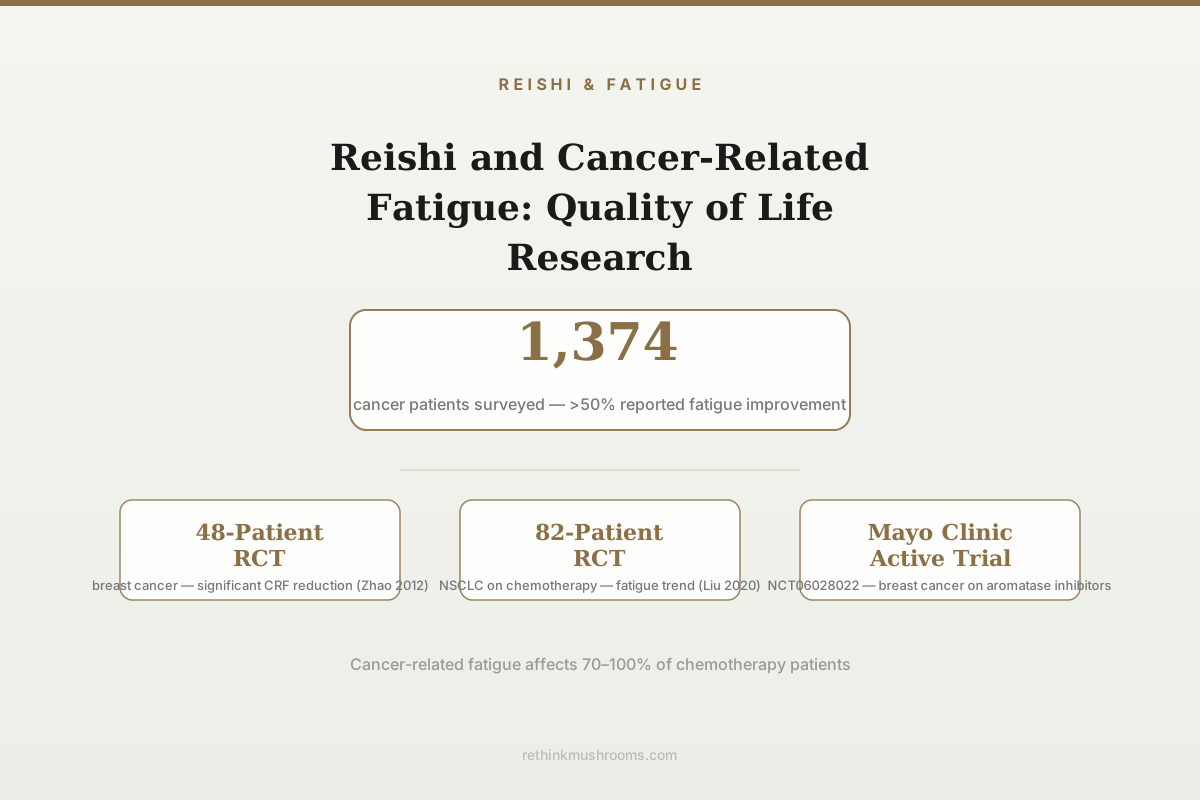
1,374 cancer patients
The largest real-world dataset on reishi in oncology: more than half of 1,374 cancer patients who had used reishi reported that fatigue improved quite a bit or very much.
Li et al., Integrative Medicine Research, 2024
48-patient RCT
breast cancer — significant CRF reduction at 4 weeks (Zhao 2012)
82-patient RCT
NSCLC on chemotherapy — fatigue stabilization trend (Liu 2020)
Active Mayo trial
NCT06028022 — breast cancer on aromatase inhibitors
Li et al., Integrative Medicine Research, 2024
 View as image ↗
Cancer-related fatigue is not the kind of tired that a good night's sleep fixes. Up to 100% of patients receiving chemotherapy experience it. Up to 30% of cancer survivors still report significant fatigue years after treatment ends. Unlike normal fatigue, it doesn't reliably respond to rest, and it can be severe enough to interfere with work, relationships, and daily function. Standard pharmaceutical options — stimulants like methylphenidate, corticosteroids — carry side effect profiles that many oncologists are reluctant to add to an already complex treatment regimen. Reishi mushroom (Ganoderma lucidum) has been studied in this context specifically, in cancer patients during and after treatment. This article is part of the broader guide to reishi mushroom and what the science shows.
Two clinical trials have tested reishi specifically in cancer populations, and a cross-sectional survey of 1,374 cancer patients adds a real-world scale to the clinical picture. The results are encouraging but not yet conclusive. A Mayo Clinic trial is currently enrolling patients to test reishi in breast cancer patients on aromatase inhibitors — an ongoing study that signals mainstream cancer research institutions now take this evidence seriously enough to fund formal investigation.
Key Takeaways
- Cancer-related fatigue (CRF) affects up to 100% of chemotherapy patients and can persist for years in survivors; standard treatments carry significant side effects, making well-tolerated alternatives a research priority
- Zhao et al. (2012) found GL spore powder significantly reduced CRF, anxiety, depression, and appetite loss vs placebo in 48 breast cancer patients on endocrine therapy over 4 weeks — the best-designed fatigue-specific clinical trial[1]
- Liu et al. (2020) found that more patients on reishi maintained or reduced fatigue during active chemotherapy (NSCLC, n=82) vs placebo, though the primary QoL endpoint was not statistically significant[2]
- A 2024 cross-sectional survey of 1,374 cancer patients who had used reishi found more than 50% reported fatigue improved quite a bit or very much — the largest observational dataset, with selection bias caveats[3]
- An active Mayo Clinic trial (NCT06028022) is testing reishi extract for fatigue and joint/muscle pain in breast cancer patients on aromatase inhibitors — a formal academic RCT that did not exist three years ago
- Reishi was well-tolerated in healthy subjects in a double-blind RCT, with no significant adverse events vs placebo — relevant context for cancer patients who are already managing complex medication regimens[5]
- Cell & Lab Studiescompleted
Ganoderma lucidum polysaccharides and spore compounds modulate inflammatory cytokines and immune signaling relevant to fatigue mechanisms
- Animal Studiescompleted
Anti-fatigue and immunomodulatory activity of GL preparations demonstrated in preclinical models
- Case Reports & Early Seriescompleted
Real-world survey of 1,374 cancer patients reporting symptom changes with reishi use (Li 2024)
- Small Human Trialscurrent
Two cancer-specific RCTs: Zhao 2012 (n=48 breast cancer, significant CRF reduction) and Liu 2020 (n=82 NSCLC, non-significant primary QoL endpoint with fatigue-stabilizing trend)
- Large Randomized Trialsmissing
None completed; an active Mayo Clinic RCT (NCT06028022) is enrolling breast cancer patients on aromatase inhibitors
- Meta-Analyses & Systematic Reviewsmissing
No dedicated meta-analysis of reishi for cancer-related fatigue endpoints
The evidence stops at two small cancer-specific trials — one positive (Zhao 2012), one with a non-significant primary endpoint (Liu 2020) — supported by a large but selection-biased survey. No large trial has finished. So reishi for cancer-related fatigue is a promising, actively-investigated signal, not an established treatment.
Zhao 2012, Liu 2020, Li 2024, plus the registered Mayo trial NCT06028022
Cancer-Related Fatigue: The Side Effect That Outlasts Treatment
Cancer-related fatigue (CRF) is one of the most common and least adequately treated symptoms in oncology. Surveys consistently show that 70-100% of patients receiving chemotherapy report significant fatigue, and that it is often the symptom patients consider most disruptive to their quality of life — ranking above nausea, pain, and other side effects that have more established pharmacological management.
What makes CRF different from ordinary tiredness is that it does not behave like a deficit of sleep or exertion. Resting doesn't resolve it. Sleeping more doesn't reliably help. The mechanisms behind CRF are not fully understood but likely involve inflammation driven by cytokines released during cancer treatment, disruption of the circadian rhythm, muscle wasting, anemia, and in some cases direct neurological effects of chemotherapy drugs on the central nervous system. It is physiologically distinct from the fatigue of ordinary exertion and responds to different interventions.
Standard pharmacological approaches carry significant tradeoffs. Methylphenidate (a stimulant medication used off-label for CRF) can improve alertness but produces insomnia, reduced appetite, and cardiovascular effects. Corticosteroids improve energy short-term but cannot be used chronically. Exercise is the intervention with the strongest evidence base, but many patients during active chemotherapy are too debilitated to maintain exercise programs. The gap between what patients need and what is available pharmacologically has driven interest in natural compounds with potential anti-fatigue activity and favorable safety profiles.
Reishi enters this conversation through its established immunomodulatory effects and a plausible mechanistic rationale: compounds in GL polysaccharides and spore powder reduce systemic inflammation, modulate the cytokine environment, and affect energy metabolism through mitochondrial pathways. The broader reishi fatigue mechanisms article covers how these pathways work specifically.
The Zhao 2012 Trial: Spore Powder in Breast Cancer Patients on Endocrine Therapy
The most directly relevant clinical study is a 4-week pilot RCT by Zhao and colleagues, published in Evidence-Based Complementary and Alternative Medicine in 2012.[1] Zhao enrolled 48 breast cancer patients who were receiving endocrine therapy — hormone-blocking treatments like tamoxifen or aromatase inhibitors that are used after primary chemotherapy and surgery for hormone-positive breast cancer. This population is particularly relevant: endocrine therapy is long-term (typically 5-10 years), and fatigue is one of the primary reasons patients discontinue it, with serious consequences for disease recurrence.
Participants were randomized to receive GL spore powder (a concentrated form of Ganoderma lucidum spores, standardized to polysaccharide content) or placebo for 4 weeks. The trial measured cancer-related fatigue using a validated instrument, as well as anxiety, depression, and appetite loss. By 4 weeks, the reishi group showed significantly greater reductions in all four symptom domains compared to placebo: fatigue, anxiety, depression, and appetite loss. The improvements were statistically significant rather than just numerically larger.
Several caveats apply. This was a pilot trial with 48 participants, designed to generate preliminary data to support a larger, more definitive study rather than to establish clinical proof on its own. Pilot trials are inherently underpowered to detect small effects reliably. The product used was GL spore powder, which is a specific preparation — results may not generalize to other reishi formats (extract, mycelium, whole mushroom powder). The 4-week duration doesn't address whether benefits persist or accumulate over the longer treatment courses that endocrine therapy requires.
Despite those limitations, Zhao 2012 is the most rigorous clinical trial specifically examining GL for cancer-related fatigue, and its findings across four symptom domains simultaneously is a more comprehensive signal than most CRF interventional studies produce.
Zhao et al. (2012) · Evidence-Based Complementary and Alternative Medicine
- Population
- 48 breast cancer patients receiving endocrine therapy (e.g. tamoxifen, aromatase inhibitors)
- Intervention
- Ganoderma lucidum spore powder, standardized to polysaccharide content, for 4 weeks
- Comparator
- Placebo
- Finding
- The reishi group showed significantly greater reductions in fatigue, anxiety, depression, and appetite loss versus placebo at 4 weeks — statistically significant across all four symptom domains.
positive The best-designed fatigue-specific reishi trial to date, but a small 4-week pilot: underpowered for small effects, uses one specific spore-powder preparation, and does not address whether benefits persist over the multi-year course of endocrine therapy.
Zhao et al., Evidence-Based Complementary and Alternative Medicine, 2012
The Liu 2020 NSCLC Trial: Reishi During Active Chemotherapy
Liu and colleagues published a larger trial in Integrative Cancer Therapies in 2020, enrolling 82 patients with non-small cell lung cancer (NSCLC) who were actively receiving chemotherapy.[2] This is a substantially different and more demanding clinical context than the Zhao trial: patients were in active chemotherapy rather than the maintenance phase of endocrine therapy, and lung cancer chemotherapy is typically more intensively toxic than endocrine therapy.
The intervention was a formula combining reishi with Privet (Ligustrum lucidum), a Chinese herbal botanical. This is both a strength and a limitation: multi-ingredient traditional formulas often have clinical effects that are difficult to attribute to individual components, but they also reflect how reishi is frequently used in Chinese clinical practice and may be more ecologically valid.
The primary finding was a trend rather than a significant result: the primary QoL endpoint did not reach statistical significance, meaning the study was not able to prove the formula improved overall quality of life beyond chance variation. Within that, a secondary observation is worth noting: more patients in the reishi group who were experiencing fatigue at baseline maintained their current fatigue level or showed reduction compared to placebo patients, suggesting the formula may help preserve functional status during chemotherapy even when it doesn't statistically improve overall QoL. The difference between "maintained or improved fatigue" and "significantly improved overall QoL" matters — a trial can show meaningful signals on individual symptom domains while failing to reach significance on a composite measure.
Liu 2020 is useful as supporting evidence for a potential anti-fatigue effect during active chemotherapy, but its non-significant primary endpoint is honest information. The study does not prove reishi improves QoL during NSCLC chemotherapy.
Liu et al. (2020) · Integrative Cancer Therapies
- Population
- 82 non-small cell lung cancer (NSCLC) patients receiving active chemotherapy
- Intervention
- A formula combining reishi with Privet (Ligustrum lucidum)
- Comparator
- Placebo
- Finding
- The primary quality-of-life endpoint did not reach statistical significance. As a secondary observation, more patients on the reishi formula maintained or reduced their fatigue during chemotherapy versus placebo.
mixed A multi-ingredient formula, so effects can't be attributed to reishi alone, and the primary endpoint was negative. The fatigue signal is hypothesis-generating, not proof that the formula improves overall QoL during NSCLC chemotherapy.
Liu et al., Integrative Cancer Therapies, 2020
What 1,374 Cancer Patients Who Used Reishi Reported
Li and colleagues published a cross-sectional survey in Integrative Medicine Research in 2024 that captures real-world data at a scale impossible to achieve in a clinical trial.[3] They surveyed 1,374 cancer patients who had used reishi, asking about their self-reported symptom changes across multiple domains.
For fatigue specifically, more than half of respondents reported that fatigue improved quite a bit or very much. Across other symptom domains, cancer patients in this survey also reported improvements in sleep, quality of life, nausea, and pain — suggesting reishi's effects in the real world extend across multiple cancer-treatment side effects.
The selection bias caveat is important. This was not a randomized trial. Patients who sought out and used reishi are not a random sample of all cancer patients — they are more likely to be motivated patients who actively pursued integrative medicine options, potentially more health-engaged, wealthier, and better-resourced than the average cancer patient. People who found reishi helpful are also more likely to respond to a survey about reishi. These biases inflate the reported benefit rate in ways that cannot be adjusted for entirely.
What the survey adds despite these limitations is scale. No other dataset captures this many cancer patients' reported experience with reishi. And the fact that improvements were reported across multiple symptom domains, not just fatigue, is consistent with reishi's known multi-pathway immunomodulatory effects rather than a nonspecific placebo response to a single reported symptom.
Population Data: The Shanghai Breast Cancer Survival Study
For broader population-level context, Bao and colleagues reported outcomes from the Shanghai Breast Cancer Survival Study — one of the largest breast cancer survivor cohorts ever assembled — in PLoS ONE in 2012.[4] Among survivors who used GL after diagnosis, overall quality of life scores were better than in non-users.
The confounding is substantial: many patients in this cohort used GL together with ginseng, and many other lifestyle and socioeconomic factors correlate with both supplement use and quality of life outcomes. The Shanghai study cannot establish that reishi caused better QoL outcomes. It can establish that reishi use is associated with better outcomes in this population, which is a softer but still meaningful observation when the sample size runs into the thousands.
The Shanghai data is most useful as population-level corroboration that reishi use in a cancer survivor population is associated with the kind of QoL benefits that the clinical trials attempt to demonstrate through controlled design. The broader research on reishi as a cancer adjunct covers additional outcome data from this population.
The Active Mayo Clinic Trial: When Mainstream Cancer Research Catches Up
The most newsworthy development in reishi and cancer fatigue research is not a completed study — it is an ongoing one.
NCT06028022 is a clinical trial registered with the US National Institutes of Health's ClinicalTrials.gov database: "Reishi Mushroom Extract for Fatigue and/or Arthralgias/Myalgias in Patients With Breast Cancer on Aromatase Inhibitors." It is being conducted through the Mayo Clinic and the Minnesota Community Clinical Trial Network (CCTN), which is a consortium of academic cancer centers.
The trial targets breast cancer patients experiencing fatigue and/or joint and muscle pain while on aromatase inhibitors — a specific, well-defined population that maps directly onto the Zhao 2012 pilot's patient group. Aromatase inhibitors (medications that block estrogen production after hormone-positive breast cancer) cause fatigue and musculoskeletal symptoms in a substantial proportion of patients, often severe enough to cause discontinuation. Discontinuation of aromatase inhibitors significantly increases recurrence risk, making symptom management a genuine oncological concern rather than a comfort issue.
That a Mayo Clinic consortium is now conducting a formal RCT on reishi for cancer fatigue represents a meaningful shift in the evidence landscape. Academic cancer centers do not typically fund trials on botanical interventions without a combination of preliminary clinical evidence, biological plausibility, and patient demand — all three of which now exist for reishi and CRF. The trial's results will provide substantially higher-quality evidence than anything currently available in this area.
Safety for Cancer Patients: What the Evidence Shows
Cancer patients are not healthy volunteers. Many are immunocompromised from treatment. Many are on complex medication regimens including chemotherapy agents, hormone therapies, targeted therapies, or anticoagulants. Any consideration of reishi in this population requires safety context that is distinct from what applies to healthy adults.
Wicks and colleagues conducted a double-blind randomized placebo-controlled safety trial in healthy subjects, published in the American Journal of Chinese Medicine in 2007.[5] GL was well-tolerated with no significant adverse events compared to placebo in that controlled setting. This is the foundational safety evidence, but it was conducted in healthy subjects rather than in patients with cancer or active disease.
The Zhao 2012 and Liu 2020 clinical trials in cancer patients reported no significant safety concerns specific to reishi. This is encouraging — cancer patients in active treatment are a much more medically complex population than healthy volunteers, and tolerability in both studies suggests GL is manageable even in that context.
Theoretical safety considerations for cancer patients include potential interactions with immunosuppressive medications used in some cancer contexts (GL is immunostimulatory, which could theoretically conflict with immune suppression) and the antiplatelet effects of some GL fractions, which might be relevant for patients on anticoagulants. No published clinical trial has reported these interactions as problematic, but the absence of documented problems in small trials is not the same as confirmed safety across all cancer patients and treatment regimens.
Drug interaction — active cancer treatment
ModerateTalk to your oncology team before adding reishi during cancer treatment
Concern
Reishi is immunostimulatory and some fractions have antiplatelet activity, which could theoretically conflict with immunosuppressive cancer regimens or add to bleeding risk in patients on anticoagulants. These interactions have not been formally studied in cancer patients.
What the research says
The two cancer-specific trials (Zhao 2012, Liu 2020) and a healthy-subject safety RCT (Wicks 2007) reported no significant adverse events, but small trials cannot rule out interactions across every treatment context.
Particularly relevant for: Cancer patients on chemotherapy, immunotherapy, or anticoagulants
What to do
Review any reishi use with your treating oncologist before starting, so it can be checked against your specific medications. This article is educational and not medical advice.
Zhao 2012, Liu 2020, Wicks 2007
The mushrooms for cancer-related fatigue evidence review positions reishi's evidence within the broader landscape of medicinal mushrooms studied for CRF, including comparisons with other options like cordyceps.
The Bottom Line
Reishi mushroom has two clinical trials specifically in cancer patients — Zhao et al. (2012) in 48 breast cancer patients showing significant reductions in fatigue, anxiety, depression, and appetite loss at 4 weeks, and Liu et al. (2020) in 82 NSCLC patients showing a fatigue-stabilizing trend during chemotherapy. A 1,374-patient cross-sectional survey (Li 2024) adds real-world scale but carries selection bias caveats. An active Mayo Clinic trial (NCT06028022) is testing reishi extract in breast cancer patients on aromatase inhibitors, representing the first major academic RCT in this space. The evidence is promising but not yet sufficient to establish reishi as a proven CRF treatment.
Frequently Asked Questions
Sources & References
- 1RTHM-00276·Zhao, Hong et al. (2012). “Spore Powder of Ganoderma lucidum Improves Cancer-Related Fatigue in Breast Cancer Patients Undergoing Endocrine Therapy: A Pilot Clinical Trial..” Evidence-based complementary and alternative medicine : eCAM.Study breakdown →PubMed →↩
- 2RTHM-01240·Liu, Jie et al. (2020). “Preliminary Efficacy and Safety of Reishi & Privet Formula on Quality of Life Among Non-Small Cell Lung Cancer Patients Undergoing Chemotherapy: A Randomized Placebo-Controlled Trial..” Integrative cancer therapies.Study breakdown →PubMed →↩
- 3RTHM-01931·Li, Xiaotong et al. (2024). “Symptom improvements and adverse effects with Reishi mushroom use: A Cross-Sectional survey of cancer patients..” Integrative medicine research.Study breakdown →PubMed →↩
- 4RTHM-00451·Bao, Ping-Ping et al. (2012). “Ginseng and Ganoderma lucidum use after breast cancer diagnosis and quality of life: a report from the Shanghai Breast Cancer Survival Study..” PloS one.Study breakdown →PubMed →↩
- 5RTHM-00123·Wicks, Sheila M et al. (2007). “Safety and tolerability of Ganoderma lucidum in healthy subjects: a double-blind randomized placebo-controlled trial..” The American journal of Chinese medicine.Study breakdown →PubMed →↩