Reishi and Fatigue
28.3%
Fatigue score reduction in an 8-week randomized trial in neurasthenia (132 enrolled, 123 assessable) vs. 20.1% in placebo. No cortisol spike. No crash. No dependency — and no measured proof of which mechanism produced it.
Tang et al. Journal of Medicinal Food. 2005
3
anti-fatigue pathways described for reishi — but they carry three different levels of proof
0
adenosine receptors blocked by reishi (vs. caffeine, which blocks them to force alertness)
2005
year of the anchor human fatigue trial — still the primary clinical evidence two decades later
Tang et al. Journal of Medicinal Food. 2005
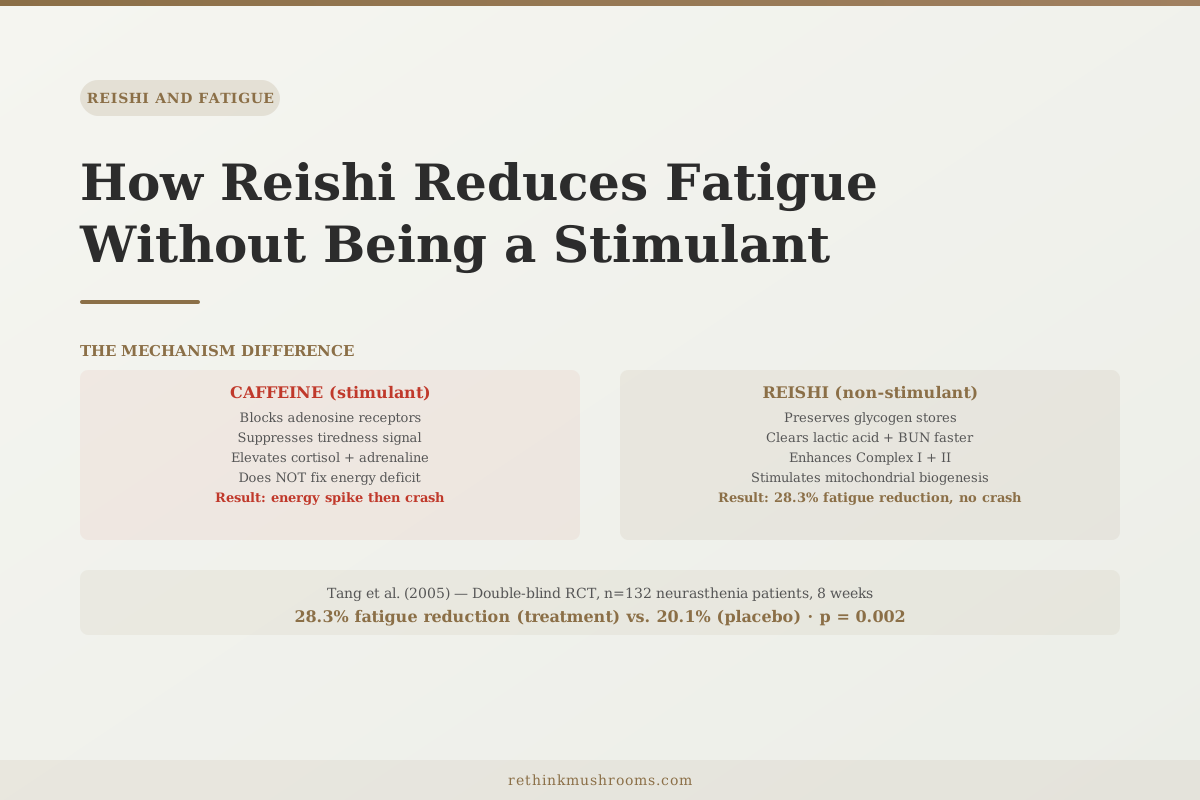 View as image ↗
Caffeine and reishi both reduce fatigue. That is where the similarity ends.
Caffeine works by blocking adenosine receptors. Adenosine is a chemical that accumulates in your brain while you are awake, progressively signaling tiredness. Caffeine physically occupies the receptor sites where adenosine would normally bind, preventing the tiredness signal from getting through. This is not a fix for tiredness. It is a suppression of the notification. When caffeine clears your system, all the adenosine that accumulated during its blockade floods the receptors simultaneously, producing the characteristic crash.
Reishi does not block adenosine receptors. It does not elevate cortisol or adrenaline. It does not force alertness. What the research documents instead is a different set of actions: improvements in the efficiency of cellular energy production, preservation of energy stores, reduced accumulation of metabolic waste that accompanies fatigue, and in animal models, enhancement of the mitochondrial machinery that generates energy in the first place.
The clinical outcome is documented once, well. Tang and colleagues showed in a 2005 double-blind RCT that patients with neurasthenia (a condition of persistent physical and mental exhaustion) taking a Ganoderma lucidum polysaccharide extract for 8 weeks reported a 28.3% reduction in fatigue scores, compared to 20.1% in the placebo group.[5]
This article explains the mechanisms proposed to sit behind that result — and, just as importantly, how far each one has actually been tested. For the broader clinical evidence on reishi and fatigue across different conditions, see Reishi for Fatigue: Research on Energy and Vitality. For the full reishi overview, see What Is Reishi Mushroom?.
Key Takeaways
- Caffeine suppresses the fatigue signal by blocking adenosine receptors; when it clears, the accumulated adenosine causes a crash. Reishi does not use this mechanism
- Reishi is described as working through three pathways — metabolic, mitochondrial, and neuroendocrine — but they are not equally supported, and the neuroendocrine one is the weakest by a wide margin
- Li et al. (2024) provides the primary metabolic data: in mice, a reishi-containing recipe raised liver and muscle glycogen and lowered blood lactate, serum urea nitrogen, and MDA, extending weight-bearing swim time from 10.1 to 15.2 minutes
- Ajith et al. (2009) found G. lucidum extract enhanced PDH, alpha-KGDH, SDH and Complex I and II in aged rat brain (p less than 0.01) — but 50 mg/kg and 250 mg/kg were not significantly different from each other
- Sudheesh et al. (2009) extended this to heart tissue, where the significant gains were in Krebs cycle dehydrogenases and Complex IV — not Complex I and II
- Yang et al. (2019) showed a GL proteoglycan stimulates mitochondrial biogenesis via the Sirt1/PGC-1-alpha pathway, though that study was about insulin resistance, not fatigue
- No study cited here measured cortisol or HPA-axis output in fatigued people taking reishi. The "normalizes cortisol" claim is an inference, not a finding
- Every mechanism above is rodent or cell work. The human evidence is essentially one 8-week trial
How Caffeine Creates Energy (and Why It Has to Crash)
Understanding what reishi does requires understanding what stimulants do, and why their approach is fundamentally different.
Fatigue, at the cellular level, has a chemical signature. Adenosine, a byproduct of cellular activity, accumulates in the brain over the course of a waking day. As adenosine builds up, it binds to adenosine receptors and progressively slows neural activity. This is the sleep drive, the body's signal that rest is needed. Caffeine has almost the same molecular shape as adenosine, which lets it occupy the same receptor sites and block adenosine from binding.
This is not energizing in any meaningful biological sense. Caffeine does not increase ATP (the cell's actual energy currency). It does not improve mitochondrial function. It does not reduce lactate or restore glycogen. It suppresses the tiredness notification while the underlying energy deficit continues accumulating. When caffeine's concentration in the bloodstream drops, the backed-up adenosine binds at once, producing the familiar crash.
Caffeine also elevates cortisol and adrenaline, which mobilize energy stores in a way that produces short-term alertness but contributes to the eventual decline as stress hormone levels fall. Regular high-dose use also leads to tolerance, as the body adjusts to chronic receptor blockade.
Reishi interacts with none of these mechanisms. No study has reported reishi binding adenosine receptors. Its fatigue-reducing effects are proposed to operate further upstream, in the systems that produce and manage cellular energy.
Mechanism Contrast
Signal vs. Substrate — Two Opposite Ways to Feel Less Tired
Caffeine intervenes on the message that says you are tired. Reishi intervenes on the machinery that made you tired. That difference explains the crash, the onset time, and why the two are not interchangeable — in either direction.
Dimension
Caffeine — stimulant
Reishi — non-stimulant
Where it acts
On the fatigue signal — occupies adenosine receptors in the brain
On the fatigue substrate — fuel stores, metabolic waste, mitochondrial enzymes
Effect on cellular energy (ATP)
None. Caffeine does not raise ATP, restore glycogen, or clear lactate
Raised ATP in rat muscle cells; enhanced mitochondrial enzymes in aged rat brain and heart
Stress hormones
Raises cortisol and adrenaline to mobilise stored energy
No cortisol spike reported in the cited human trial
What happens when it wears off
Accumulated adenosine binds at once — the crash. Tolerance builds with repeated use
No rebound mechanism described, because no receptor was blocked
Onset
Minutes
Weeks. Every cited protocol ran 14 days (mice) to 8 weeks (humans)
Strength of the human evidence
Extensively characterised in humans
One 8-week RCT in neurasthenia (123 assessable). Mechanisms are rodent and cell work
How to read it: the right-hand column is not the “better” column — it is the slower, less-proven one. Caffeine’s mechanism is certain and immediate; reishi’s is gentler in principle but rests mainly on rodent studies, with a single human fatigue trial behind it. The honest claim is that they do different things, not that one replaces the other.
Sources: Li 2024 [4] (mice, 14 days); Ajith 2009 [3] and Sudheesh 2009 [7] (aged rats); Tang 2005 [5] (human RCT). Caffeine pharmacology is established textbook mechanism. “No cortisol spike” reflects absence of reported effect, not a measured null result.
Pathway 1: Metabolic Efficiency
Geng and colleagues published a 2017 review in BioMed Research International examining the anti-fatigue functions of edible and medicinal mushrooms.[1] The review is useful for framing: it establishes the standard biomarker panel the field uses to measure fatigue in animals, and identifies polysaccharides, peptides, nucleosides, phenolic compounds and triterpenoids as the likely active constituents. It is a review, not primary data — and its own conclusion is a caution: most work has been done in animal models, and more human trials are needed.
The primary quantitative data for reishi specifically comes from Li and colleagues in 2024.[4] Mice were treated for 14 consecutive days, then run through a weight-bearing swimming test. Three of the four classic fatigue endpoints moved in the expected direction:
Glycogen preservation. Glycogen is the stored carbohydrate energy in muscle and liver tissue, and the primary fuel for sustained activity. Faster depletion is one mechanism of fatigue. Glycogen levels in both liver and muscle increased significantly. More fuel available means longer endurance before the reserve runs out.
Lower blood lactate. Lactate is produced when muscles work faster than the aerobic energy system can supply them. Its accumulation tracks with post-exertion fatigue. Serum lactic acid decreased significantly, suggesting either better aerobic capacity or faster clearance.
Lower serum urea nitrogen. Urea nitrogen rises when the body breaks down protein and amino acids during exertion, and elevated levels are a biomarker of fatigue-related tissue breakdown. Serum urea nitrogen decreased. Note the precise claim: the study measured a lower level, not a faster clearance rate — the two are related but not the same thing.
Lower MDA. Malondialdehyde is a marker of oxidative damage to fats. It fell in both liver and muscle, consistent with less oxidative stress during exertion.
The functional payoff was measurable: exhaustion time in the weight-bearing swim rose from 10.1 ± 0.5 minutes to 15.2 ± 1.3 minutes.
Li et al. (2024) · Heliyon
- Population
- Mice, 14 consecutive days of treatment
- Intervention
- PGB recipe — G. lucidum extract + broken G. lucidum spore powder + Paecilomyces hepiali mycelium
- Comparator
- Untreated controls; a second recipe (GBS) tested for sleep rather than fatigue
- Finding
- Weight-bearing swim exhaustion time rose from 10.1 ± 0.5 to 15.2 ± 1.3 minutes. Liver and muscle glycogen increased; serum lactic acid, serum urea nitrogen and MDA all decreased.
narrow-scope Mice, not people. The tested product was a multi-ingredient recipe, not reishi alone, so the effect cannot be cleanly attributed to G. lucidum. Two authors are affiliated with a commercial Ganoderma producer (Fujian Xianzhilou Biological Science and Technology Co. Ltd.), though the paper declares no competing interests.
Li K, et al. Heliyon. 2024;10(10):e30907. PMID 38770283.
Together these endpoints describe a fatigue physiology that is less burdened: more available fuel, less lactate, less protein breakdown, less oxidative damage. None of it involves blocking adenosine or spiking stress hormones. All of it happened in mice.
Pathway 2: Mitochondrial Enhancement
Mitochondria are the structures inside cells that convert fuel into ATP, the molecule that powers essentially every biological process. Reduced mitochondrial activity is one mechanism of chronic fatigue, particularly in aging tissue.
Ajith and colleagues published a 2009 study in Experimental Gerontology examining what an ethanol extract of Ganoderma lucidum does to mitochondria in the brains of aged rats.[3] Aged rats were used because mitochondrial enzyme activity naturally declines with age, creating a relevant model for age-related fatigue.
Rats received 50 or 250 mg/kg orally, once daily for 15 days. The extract significantly enhanced (p less than 0.01) the activities of pyruvate dehydrogenase, alpha-ketoglutarate dehydrogenase, succinate dehydrogenase, and Complex I and Complex II of the electron transport chain. Lipid peroxidation also fell significantly.
One detail the headline finding tends to lose: the researchers found no statistically significant difference between the 50 mg/kg and 250 mg/kg groups. A fivefold dose increase produced no additional benefit, which means the dose–response relationship is undefined. That matters for anyone trying to reason from rat doses toward a human serving size — the study does not license that arithmetic.
The brain findings were extended the same year by Sudheesh and colleagues, working with overlapping authorship, who tested a 70% ethanolic extract in the hearts of aged rats.[7] The significant improvements there were in the Krebs cycle dehydrogenases — isocitrate, alpha-ketoglutarate, succinate and malate dehydrogenase — and in Complex IV, the last station of the electron transport chain. Complexes I through IV were all measured; Complex IV was the one that reached significance (p less than 0.05).
This is worth stating precisely, because it is easy to blur: the heart study is not a replication of the brain study's Complex I and II result. It is a related finding in a different tissue, hitting a different point in the same chain. What the two together support is the broader claim that reishi improves mitochondrial energy handling in more than one organ of the aged rat — not that a single specific enzyme effect has been replicated.
Pathway 2b: Mitochondrial Biogenesis
The Ajith and Sudheesh studies document enhancement of existing mitochondria. Yang and colleagues added a different kind of finding in 2019.[2]
They characterized a proteoglycan from G. lucidum called FYGL (a compound that is part protein, part polysaccharide) and found it decreased reactive oxygen species and increased ATP content in rat skeletal muscle cells. In cells where PGC-1-alpha had been silenced, FYGL restored its expression and positively modulated the Sirt1/PGC-1-alpha pathway. Orally administered to obese (ob/ob) mice, it increased mitochondrial DNA copy number and the gene expression that controls mitochondrial biogenesis.
PGC-1-alpha is the master regulator of new mitochondria production; Sirt1 is the sensor that switches it on. When that pathway activates, the cell begins building new mitochondrial machinery rather than simply maintaining what it has.
The honest framing: this study was designed to explain how FYGL improves insulin resistance, not fatigue. Its energy-metabolism findings are real and relevant, but applying them to tiredness is an inference the paper itself does not make. No fatigue endpoint was measured.
For the detailed examination of reishi's mitochondrial research in chronic fatigue specifically, see Reishi and Mitochondrial Dysfunction in Chronic Fatigue: Mechanistic Research.
Pathway 3: The Neuroendocrine Angle — and Why It Is the Weak Link
Cortisol is the body's primary stress hormone. It mobilizes energy stores and produces alertness, which is why caffeine's cortisol-elevating effect creates a short-term boost. But cortisol elevation is biologically expensive: the decline after a spike is part of the crash, and chronically elevated cortisol affects sleep, immune function, and tissue repair.
Reishi is frequently described as normalizing the HPA axis — the hypothalamic-pituitary-adrenal system that regulates cortisol — rather than spiking it. This is the pathway most often invoked in marketing, and it is the one with the least support behind it.
Here is the actual evidence position: none of the studies cited in this article measured cortisol, ACTH, or HPA-axis output in fatigued people taking reishi. What can be said is narrower and negative — across the human trials available, reishi has not produced the stimulant-type effects (jitteriness, elevated heart rate, sleep disruption) that accompany cortisol and adrenaline elevation. Absence of a stimulant signature is a reasonable basis for saying reishi does not spike cortisol. It is not a basis for saying reishi corrects a dysregulated stress axis.
That distinction is the difference between an adaptogen in the pharmacological sense and an adaptogen in the marketing sense. The pharmacological claim — that reishi moves a dysregulated system toward normal — remains untested for fatigue in humans.
Evidence Reach
Three Pathways, Three Different Levels of Proof
“Three mechanisms” reads as three equally solid pillars. They are not. Two are measured in rodents, one is inferred from a study about something else, and one was never measured at all.
Pathway 1 — Metabolic efficiency
MeasuredGlycogen up, serum lactate down, serum urea nitrogen down, MDA down
Li 2024 is the primary quantitative source, but it tested a multi-ingredient recipe (reishi extract + spore powder + Paecilomyces hepiali), not reishi alone, and two authors work for a commercial Ganoderma producer.
Li 2024 [4] · framed by Geng 2017 review [1]
Mice · 14 days
Pathway 2 — Mitochondrial enzymes
MeasuredBrain: PDH, α-KGDH, SDH, complex I + II (p<0.01). Heart: Krebs dehydrogenases + complex IV (p<0.05)
Real and replicated across two tissues by overlapping author groups. But 50 mg/kg and 250 mg/kg produced no significant difference from each other, so the dose–response is undefined — and none of it was measured in people.
Ajith 2009 [3] · Sudheesh 2009 [7]
Aged rats · 15 days
Pathway 2b — Building new mitochondria
InferredSirt1/PGC-1α activation, mtDNA copy number up, ROS down, ATP up
Yang 2019 studied FYGL in the context of insulin resistance, not fatigue. Applying it to energy levels is a reasonable inference, not a tested outcome.
Yang 2019 [2]
Rat muscle cells + ob/ob mice
Pathway 3 — Neuroendocrine / HPA axis
Not measuredNothing, in any cited study
No study cited here measured cortisol, ACTH, or HPA-axis output in fatigued people taking reishi. The claim that reishi normalises rather than spikes cortisol is a plausible reading of the absence of stimulant-type side effects — not a finding.
No qualifying source
—
Outcome — Does fatigue actually drop in people?
MeasuredVAS fatigue −28.3% vs −20.1% placebo; 51.6% vs 24.6% rated more than minimally improved
Tang 2005 is the anchor: 132 enrolled, 123 assessable, neurasthenia (not healthy adults, not CFS). The placebo group improved 20.1% on its own — the reishi margin over placebo is roughly 8 points.
Tang 2005 [5]
Humans · 8 weeks
How to read it: the mechanism story and the outcome story are both real, but they are not yet joined. The rodent work shows reishi can change energy machinery; the human trial shows fatigue scores fell. No study has demonstrated that the first caused the second.
Sources: Geng 2017 [1]; Yang 2019 [2]; Ajith 2009 [3]; Li 2024 [4]; Tang 2005 [5]; Sudheesh 2009 [7]. Tiers reflect what each study measured and in what species, not quantitative effect sizes.
The Clinical Evidence: One Trial, Read Carefully
The Tang 2005 RCT is the clinical anchor for reishi and fatigue outside of cancer populations.[5]
132 patients with neurasthenia (ICD-10, characterized by persistent physical and mental exhaustion) were randomized to receive Ganopoly — a proprietary G. lucidum polysaccharide extract — at 1,800 mg three times daily (5,400 mg/day) or placebo, for 8 weeks in a double-blind design. 123 patients were assessable at study end.
On the Visual Analogue Scale for sense of fatigue, scores fell 28.3% from baseline in the treatment group versus 20.1% in placebo. Clinical Global Impression severity fell 15.5% versus 4.9%. Sense of well-being rose 38.7% versus 29.7%. And 51.6% (32 of 62) of the Ganopoly group were rated more than minimally improved, versus 24.6% (15 of 61) on placebo (P = .002).
Tang et al. (2005) · Journal of Medicinal Food
- Population
- 132 Chinese patients with neurasthenia (ICD-10); 123 assessable at 8 weeks
- Intervention
- Ganopoly (G. lucidum polysaccharide extract), 1,800 mg three times daily = 5,400 mg/day
- Comparator
- Matched placebo, double-blind, randomized parallel design
- Finding
- VAS fatigue fell 28.3% vs 20.1% placebo; well-being rose 38.7% vs 29.7%; 51.6% vs 24.6% rated more than minimally improved (P = .002).
positive Genuinely positive and well-designed — but note the placebo group improved 20.1% on its own, leaving a margin of roughly 8 percentage points. The population was neurasthenia patients, not healthy adults or CFS patients, and the product was one specific proprietary extract at a high dose.
Tang W, et al. J Med Food. 2005;8(1):53-8. PMID 15857210.
Two things are true at once here. The trial is real, randomized, placebo-controlled, and positive. And the effect over placebo is modest — a roughly 8-point margin on a subjective scale — in a specific diagnostic population, using one proprietary preparation at 5,400 mg/day. Reading it as proof that reishi reliably fixes everyday tiredness overstates it considerably.
- Cell studiescompleted
FYGL raised ATP and activated Sirt1/PGC-1-alpha in rat muscle cells (Yang 2019)
- Animal studiescompleted
Mitochondrial enzymes enhanced in aged rat brain and heart (Ajith 2009; Sudheesh 2009); endurance, glycogen, lactate and urea nitrogen improved in mice (Li 2024)
- Small human trialscurrent
One 8-week RCT in neurasthenia, 123 assessable, positive but modest over placebo (Tang 2005). Safety trial in 16 subjects over 10 days (Wicks 2007)
- Large RCTsmissing
No large trial has tested reishi for fatigue in general or healthy populations
- Meta-analysismissing
Too few human fatigue trials exist to pool
The preclinical layers are well populated and mechanistically coherent. The human layer is a single 8-week trial in one diagnostic population. Nothing has connected the rodent mechanisms to the human outcome.
Yang 2019 [2]; Ajith 2009 [3]; Sudheesh 2009 [7]; Li 2024 [4]; Tang 2005 [5]; Wicks 2007 [6].
Why Product Selection Matters
Li's 2024 study introduced a practical variable: not all reishi preparations are equivalent for anti-fatigue purposes.[4]
The researchers compared two recipes. PGB (reishi extract + spore powder + Paecilomyces hepiali mycelium) produced the anti-fatigue effect. GBS (reishi extract + spore powder + Ganoderma sinense) instead improved sleep — shortening sleep latency from 6.8 to 4.2 minutes and extending sleep duration from 88.3 to 152.5 minutes — without the same endurance benefit.
That is a genuinely useful result: two products both containing G. lucidum extract produced meaningfully different outcomes. Different extraction methods, polysaccharide and triterpene ratios, and companion ingredients produce different bioactive profiles.
It also carries an important limitation. Because both recipes were multi-ingredient, the study cannot tell you how much of either effect came from reishi itself versus its companion fungi. It demonstrates that formulation matters; it does not isolate reishi's contribution.
Verifiable beta-glucan content — tested by an enzymatic method rather than general polysaccharide colorimetry — remains the most actionable proxy for the polysaccharide fraction. For how that testing works, see How Beta-Glucan Testing Works: Megazyme and Other Methods.
For comparison with cordyceps, which targets overlapping but mechanistically distinct aspects of cellular energy metabolism, see Cordyceps for Energy: Fighting Fatigue Without Stimulants.
Safety and the Non-Stimulant Advantage
Wicks and colleagues published a 2007 double-blind, randomized, placebo-controlled safety trial of G. lucidum in healthy subjects.[6] Sixteen volunteers received 2 grams of extract or placebo twice daily for 10 consecutive days, with ECGs, blood counts, blood chemistry, urinalysis and immune markers monitored. No adverse effects were observed compared with placebo.
That is a reassuring result within its limits, and the limits are considerable — 16 people for 10 days. The authors' own conclusion was that a longer-term trial with a dose-escalating design is warranted.
Safety
LowReishi's safety record is clean but thin
Concern
The most-cited controlled safety trial enrolled 16 people for 10 days. That is far too small and too short to detect uncommon adverse effects, drug interactions, or anything arising from months of continuous use — which is how supplements are actually taken.
What the research says
No adverse effects versus placebo were observed in that trial, and the broader human trial record (including 8 weeks at 5,400 mg/day in the Tang study) has not surfaced a safety signal. The absence of a stimulant mechanism also removes the cardiovascular and dependency concerns that apply to caffeine at high doses.
Particularly relevant for: Not established for pregnancy, breastfeeding, or children. If you take anticoagulants, immunosuppressants, or are approaching surgery, talk to your physician before starting reishi.
What to do
Treat reishi's safety profile as 'no signal found in short trials' rather than 'proven safe long-term.' This article is educational and is not medical advice; fatigue that is persistent or worsening warrants a medical workup, not a supplement.
Wicks SM, et al. Am J Chin Med. 2007;35(3):407-14. PMID 17597499. Tang W, et al. J Med Food. 2005;8(1):53-8.
The non-stimulant mechanism does carry a real structural advantage. Stimulants bring cardiovascular effects at higher doses, dependency risk, tolerance, and sleep disruption. Reishi's documented effects on sleep run in the opposite direction — the Li 2024 GBS recipe shortened sleep latency and extended sleep duration in mice[4] — and better sleep is itself a fatigue-reduction mechanism, since disturbed sleep perpetuates chronic fatigue.
For the research specifically on reishi and sleep quality, see How Reishi Improves Sleep Quality Without Sedation.
The Bottom Line
Reishi reduces fatigue by a different route than stimulants: rather than blocking adenosine receptors to suppress the tiredness signal, it is proposed to act on the energy system itself. The metabolic evidence is strongest — in mice, a reishi recipe raised liver and muscle glycogen and lowered lactate, urea nitrogen and MDA while extending endurance (Li 2024). The mitochondrial evidence is real but rodent-only: enhanced dehydrogenases and Complex I and II in aged rat brain (Ajith 2009), Krebs cycle enzymes and Complex IV in heart (Sudheesh 2009), and Sirt1/PGC-1-alpha-driven mitochondrial biogenesis in cells and obese mice (Yang 2019). The neuroendocrine pathway is the weakest: no cited study measured cortisol in fatigued humans taking reishi, so "normalizes the HPA axis" is inference rather than finding. The human anchor is a single 8-week RCT in neurasthenia showing 28.3% fatigue reduction versus 20.1% on placebo (Tang 2005) — positive, but a modest margin in a specific population. Preparations differ meaningfully in effect (Li 2024), so product selection matters.
Frequently Asked Questions
Sources & References
- 1RTHM-00871·Geng, Ping et al. (2017). “Antifatigue Functions and Mechanisms of Edible and Medicinal Mushrooms..” BioMed research international.Study breakdown →PubMed →↩
- 2RTHM-01146·Yang, Zhou et al. (2019). “Modulation of energy metabolism and mitochondrial biogenesis by a novel proteoglycan from Ganoderma lucidum..” RSC advances.Study breakdown →PubMed →↩
- 3RTHM-00283·Ajith, T A et al. (2009). “Effect of Ganoderma lucidum on the activities of mitochondrial dehydrogenases and complex I and II of electron transport chain in the brain of aged rats..” Experimental gerontology.Study breakdown →PubMed →↩
- 4RTHM-01928·Li, Kexin et al. (2024). “The anti-fatigue and sleep-aiding effects vary significantly among different recipes containing Ganoderma lucidum extracts..” Heliyon.Study breakdown →PubMed →↩
- 5RTHM-00088·Tang, Wenbo et al. (2005). “A randomized, double-blind and placebo-controlled study of a Ganoderma lucidum polysaccharide extract in neurasthenia..” Journal of medicinal food.Study breakdown →PubMed →↩
- 6RTHM-00123·Wicks, Sheila M et al. (2007). “Safety and tolerability of Ganoderma lucidum in healthy subjects: a double-blind randomized placebo-controlled trial..” The American journal of Chinese medicine.Study breakdown →PubMed →↩
- 7RTHM-00317·Sudheesh, N P et al. (2009). “Ganoderma lucidum (Fr.) P. Karst enhances activities of heart mitochondrial enzymes and respiratory chain complexes in the aged rat..” Biogerontology.Study breakdown →PubMed →↩