Reishi (Ganoderma lucidum)
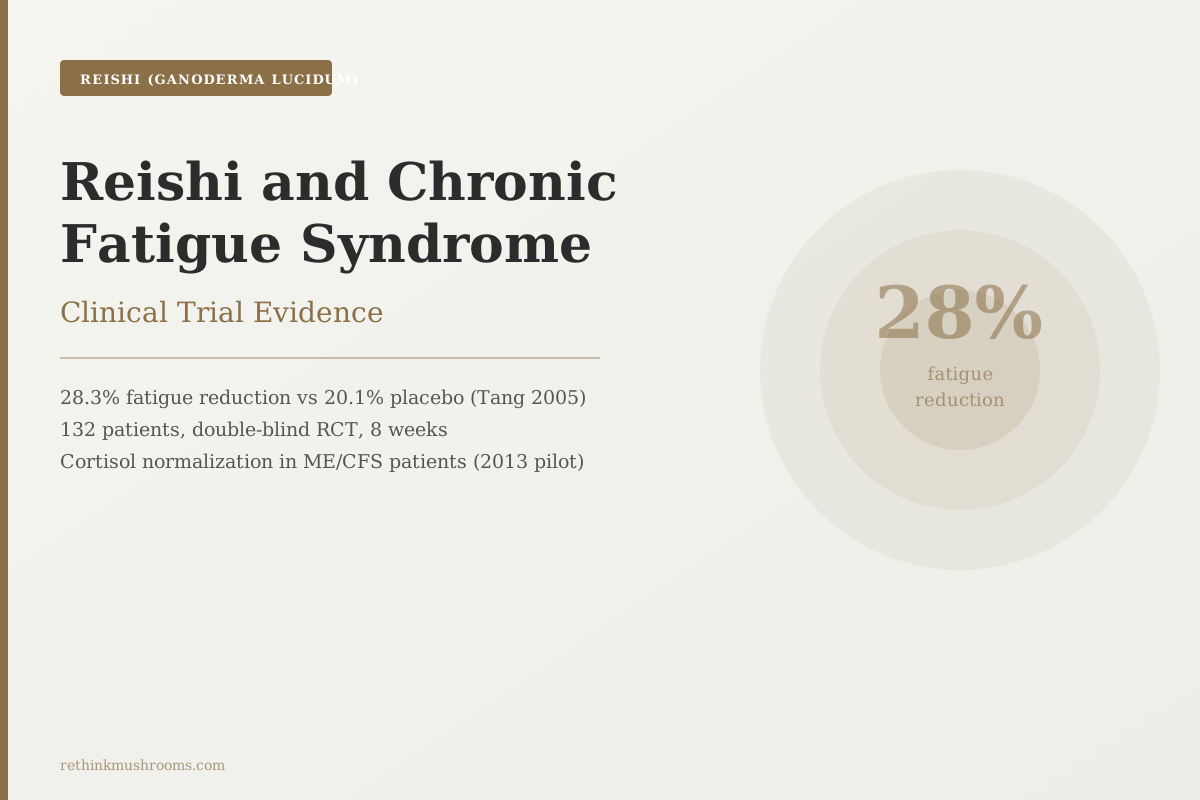
28.3% fatigue reduction
In 132 neurasthenia patients in a double-blind RCT, reishi polysaccharide extract reduced fatigue scores 28.3% vs 20.1% for placebo over 8 weeks, and 51.6% rated themselves meaningfully improved.
Tang et al., Journal of Medicinal Food, 2005
132
neurasthenia patients in the landmark double-blind RCT (Tang et al., 2005)
51.6%
rated themselves more than minimally improved vs 24.6% for placebo
very low
GRADE evidence quality in 2025 meta-analysis of 17 reishi RCTs (Jafari et al.)
Tang et al., Journal of Medicinal Food, 2005
 View as image ↗
People with chronic fatigue syndrome (ME/CFS) searching for reishi evidence will find it, but not in a trial labeled "CFS." The strongest clinical data comes from a condition called neurasthenia, the ICD-10 diagnostic category that maps most closely to what Western medicine calls ME/CFS. In 2005, a double-blind randomized controlled trial enrolled 132 neurasthenia patients, tested a reishi polysaccharide extract for 8 weeks, and found a 28.3% reduction in fatigue scores compared to 20.1% for placebo, along with a statistically significant difference in how many patients rated themselves meaningfully improved.[1]
That's the anchor study for this topic. Additional clinical research in fibromyalgia, a condition that substantially overlaps with ME/CFS, extends the picture. This article covers what the trials actually show, what the evidence quality limitations are, and why the neurasthenia data is the right starting point for CFS patients. For the broader reishi fatigue overview, the pillar resource is What Is Reishi Mushroom? The Science Behind the Mushroom of Immortality.
Key Takeaways
- The strongest trial relevant to CFS is the Tang 2005 RCT (132 neurasthenia patients, double-blind): 28.3% fatigue reduction vs 20.1% placebo; 51.6% rated meaningfully improved vs 24.6% placebo; p=0.002 for the responder rate (Tang et al., Journal of Medicinal Food, 2005)
- Neurasthenia (ICD-10: F48.0) is the diagnostic category used in Chinese clinical settings that closely maps to ME/CFS: persistent unexplained exhaustion, sleep disturbance, and mood impairment as defining features
- A 2020 RCT in women with fibromyalgia (a condition with substantial diagnostic overlap with CFS) found reishi improved mood and health-related quality of life compared to control (Pazzi et al., Healthcare, 2020)
- A small 2013 pilot study in 50 ME/CFS patients (NICE criteria) found reishi improved quality of life and fatigue at 4 weeks, and increased serum cortisol at 12 weeks, a clinically meaningful finding given that blunted cortisol response is characteristic of CFS
- The 2025 GRADE-assessed meta-analysis of 17 reishi RCTs (n=971) rated the quality of evidence as very low across outcomes, meaning clinical conclusions must be held with appropriate uncertainty (Jafari et al., Food Science and Nutrition, 2025)
- Reishi was well-tolerated with no significant adverse events vs placebo in a double-blind safety trial in healthy subjects (Wicks et al., American Journal of Chinese Medicine, 2007)
Neurasthenia and ME/CFS: Why the Same Research Applies to Both
Chronic fatigue syndrome, now formally designated ME/CFS (myalgic encephalomyelitis/chronic fatigue syndrome), is defined by persistent unexplained fatigue that significantly impairs functioning, post-exertional malaise (worsening of symptoms after physical or mental effort), and typically sleep disturbance, cognitive impairment, and pain.
Neurasthenia is the ICD-10 code F48.0, a diagnostic category characterized by persistent and distressing complaints of mental or physical exhaustion after minimal effort, accompanied by at least two of: muscular aches and pains, dizziness, tension headaches, sleep disturbances, inability to relax, irritability, and dyspepsia. It has been recognized as a clinical entity for over a century, and it is still the primary diagnostic category used in Chinese clinical settings for what Western medicine would label CFS or ME/CFS.
This diagnostic overlap matters because the most rigorous reishi clinical trial for fatigue used neurasthenia patients. The clinical population in that trial (people with persistent, unexplained exhaustion, sleep problems, and mood impairment) is the same population that would be diagnosed with CFS in a Western clinical context. Dismissing the neurasthenia trial as irrelevant to CFS is a category error.
There is also a separate history. A 2013 pilot study at a UK ME/CFS clinic enrolled 50 patients who met the NICE criteria for CFS (the formal UK clinical definition). Participants received 2g per day of reishi extract for 12 weeks. By week four, quality of life scores had improved significantly (p=0.005) and self-reported fatigue had decreased (p=0.010). By week twelve, serum cortisol had increased.
The cortisol finding is worth explaining. CFS patients typically have a blunted HPA axis response, meaning lower-than-normal cortisol output under stress, the opposite of what is seen in many stress-related conditions. An intervention that raises cortisol in this population is not the same as one that spikes cortisol in a healthy person; it is moving toward normal rather than above normal. This is the kind of finding that makes reishi mechanistically interesting for CFS specifically.
For deeper context on the neurasthenia diagnosis and how it connects to CFS historically and clinically, see Ganoderma lucidum and Neurasthenia: Historical and Modern Research.
The Tang 2005 Trial: 132 Patients, the Strongest CFS-Adjacent Evidence
The core evidence for reishi in fatigue conditions comes from a 2005 randomized, double-blind, placebo-controlled trial published in the Journal of Medicinal Food.[1] This is the most rigorous and largest clinical trial examining reishi for fatigue symptoms.
The trial enrolled 132 patients diagnosed with neurasthenia. They were randomized to receive either Ganopoly, a standardized polysaccharide extract of Ganoderma lucidum, at 1,800mg three times daily (5,400mg total per day) or a matched placebo, for 8 weeks.
The primary outcomes were assessed using the Clinical Global Impression severity scale (CGI-S) and several fatigue-specific subscales. The results:
- CGI-S score improved 15.5% in the Ganopoly group vs 4.9% in placebo
- Sense of fatigue reduced 28.3% vs 20.1% in placebo
- Sense of well-being increased 38.7% vs 29.7% in placebo
- 51.6% rated themselves "more than minimally improved" vs 24.6% in placebo (p=0.002)
- Well-tolerated with no significant adverse effects reported
Several aspects of this trial warrant attention. It was double-blind, meaning neither participants nor assessors knew who received the active treatment. This design controls for expectation effects, a significant confounder in fatigue research where the expectation of improvement can itself reduce subjective fatigue ratings. The sample size of 132 is substantial for a clinical trial of this type.
The dose used (5,400mg/day of a polysaccharide extract) is also noteworthy. This is considerably higher than the doses found in many commercial reishi products, which often contain 250-500mg per serving. The clinical trial used a concentrated extract at a dose roughly 4-10 times what most people consuming reishi supplements would receive. This is relevant context for interpreting how the trial findings map onto real-world product use.
The Fibromyalgia Connection: Evidence in a CFS-Adjacent Condition
Fibromyalgia and CFS/ME share substantial clinical overlap. Both are characterized by persistent fatigue, widespread pain, sleep disturbance, and cognitive impairment. Many patients meet diagnostic criteria for both conditions simultaneously. The pathophysiology is not fully understood for either, and both lack highly effective pharmacological treatments.
A 2020 randomized controlled trial by Pazzi and colleagues examined the effects of Ganoderma lucidum supplementation specifically in women with fibromyalgia.[2] The trial found that GL supplementation improved mood and health-related quality of life compared to control.
The fibromyalgia study population provides a clinical bridge to CFS: if reishi produces measurable quality-of-life improvements in fibromyalgia patients, who share most of the characteristic features of CFS, the signal has more generalizability than the neurasthenia data alone. These are not the same conditions, but their shared clinical features make the fibromyalgia findings legitimately informative for CFS patients.
The overlap between fibromyalgia, depression, and fatigue conditions is also relevant to the mechanism question. Reishi's effects on mood in the fibromyalgia trial connect to the broader evidence on reishi and mood. For that evidence, see Reishi and Depression: Mood Regulation Evidence.
What the Most Recent Meta-Analysis Says About Evidence Quality
In 2025, Jafari and colleagues published a GRADE-assessed systematic review and meta-analysis of clinical trials on Ganoderma lucidum in human health, covering 17 RCTs and 971 participants.[3]
GRADE (Grading of Recommendations, Assessment, Development, and Evaluations) is the standard framework for rating the quality of clinical evidence. Evidence is graded as high, moderate, low, or very low based on study design, risk of bias, inconsistency, indirectness, and imprecision.
The Jafari 2025 meta-analysis rated the evidence quality as very low across all reishi outcomes examined. This is an important finding to include honestly: it doesn't mean reishi doesn't work, but it means the available clinical trials have limitations that prevent confident conclusions.
What those limitations typically are: small sample sizes, heterogeneous study populations, varying formulations and doses, short follow-up periods, and insufficient blinding in some trials. These are common issues in the herbal medicine literature broadly, not specific failures of reishi research.
The honest position from the evidence: the clinical signals exist (Tang 2005 is a well-designed trial that showed a statistically significant difference), but the overall evidence base is not yet sufficient for definitive conclusions about efficacy in any population. This is more accurate than either dismissing reishi entirely or treating Tang 2005 as proof.
Safety in the Context of CFS Patients
For people with ME/CFS, safety considerations are particularly important. The condition is often associated with immune dysregulation, and many CFS patients are sensitive to supplements, medications, and environmental exposures.
A 2007 randomized, double-blind, placebo-controlled trial by Wicks and colleagues assessed the safety and tolerability of Ganoderma lucidum specifically in healthy subjects.[4] The trial found no significant adverse events versus placebo, establishing a clean tolerability profile in a controlled setting.
The broader clinical trial literature on reishi, including Tang 2005 and the fibromyalgia trials, consistently reports that reishi is well-tolerated, with no pattern of serious adverse events. Rare case reports of liver enzyme elevation exist in the literature, typically associated with very high doses or powdered whole mushroom products rather than standardized extracts, and these cases have generally resolved after stopping use.
For CFS patients, the practical safety profile suggests that reishi is unlikely to cause harm at reasonable doses, though individual variability is real and the population studied in safety trials (healthy subjects) is not identical to people with ME/CFS.
What the Evidence Doesn't Tell Us Yet
Several clinically relevant questions about reishi in CFS remain unanswered by the current evidence.
First, the optimal dose for CFS-related fatigue is unknown. The Tang 2005 trial used 5,400mg/day of a polysaccharide extract, which is substantially higher than most commercial products. Whether lower doses produce the same fatigue benefit is not established.
Second, the duration of benefit and optimal treatment duration are unknown. The Tang 2005 trial ran for 8 weeks; the 2013 CFS pilot ran for 12 weeks. Whether effects persist with continued use, whether tolerance develops, or whether a maintenance dose differs from an initial dose hasn't been studied.
Third, no large trial has enrolled patients specifically using the modern ME/CFS diagnostic criteria (the 2015 Institute of Medicine criteria, which include post-exertional malaise as a core requirement). The neurasthenia population in Tang 2005 and the fibromyalgia population in Pazzi 2020 are the closest available analogues, but they are not identical.
For how reishi reduces fatigue through metabolic and mitochondrial mechanisms rather than stimulation, see How Reishi Reduces Fatigue Without Being a Stimulant. For the broader fatigue evidence overview, see Reishi for Fatigue: Research on Energy and Vitality. For the mitochondrial mechanism relevant to CFS pathophysiology, see Reishi and Mitochondrial Dysfunction in Chronic Fatigue: Mechanistic Research. For a comparison with other mushrooms studied for fatigue conditions, see Lion's Mane for MS Fatigue and Cognitive Symptoms.
The Bottom Line
The clinical evidence most relevant to CFS comes from two sources: the Tang 2005 double-blind RCT in 132 neurasthenia patients (28.3% fatigue reduction, 51.6% rated meaningfully improved vs 24.6% placebo) and a 2020 fibromyalgia RCT showing quality-of-life improvement. A 2013 pilot in 50 ME/CFS patients (NICE criteria) found fatigue improvement and increased serum cortisol, a meaningful finding given the HPA axis dysregulation characteristic of CFS. A 2025 GRADE meta-analysis rates the overall evidence quality as very low, reflecting real limitations in the trial base. The signals are consistent enough to warrant continued investigation; they are not strong enough to support definitive conclusions.
Frequently Asked Questions
Sources & References
- 1RTHM-00088·Tang, Wenbo et al. (2005). “A randomized, double-blind and placebo-controlled study of a Ganoderma lucidum polysaccharide extract in neurasthenia..” Journal of medicinal food.Study breakdown →PubMed →↩
- 2RTHM-00648·Pazzi, Francesco et al. (2020). “Ganoderma lucidum Effects on Mood and Health-Related Quality of Life in Women with Fibromyalgia..” Healthcare (Basel.Study breakdown →PubMed →↩
- 3RTHM-02098·Jafari, Ali et al. (2025). “The Nutritional Significance of Ganoderma lucidum on Human Health: A GRADE-Assessed Systematic Review and Meta-Analysis of Clinical Trials..” Food science & nutrition.Study breakdown →PubMed →↩
- 4RTHM-00123·Wicks, Sheila M et al. (2007). “Safety and tolerability of Ganoderma lucidum in healthy subjects: a double-blind randomized placebo-controlled trial..” The American journal of Chinese medicine.Study breakdown →PubMed →↩