Reishi (Ganoderma lucidum)
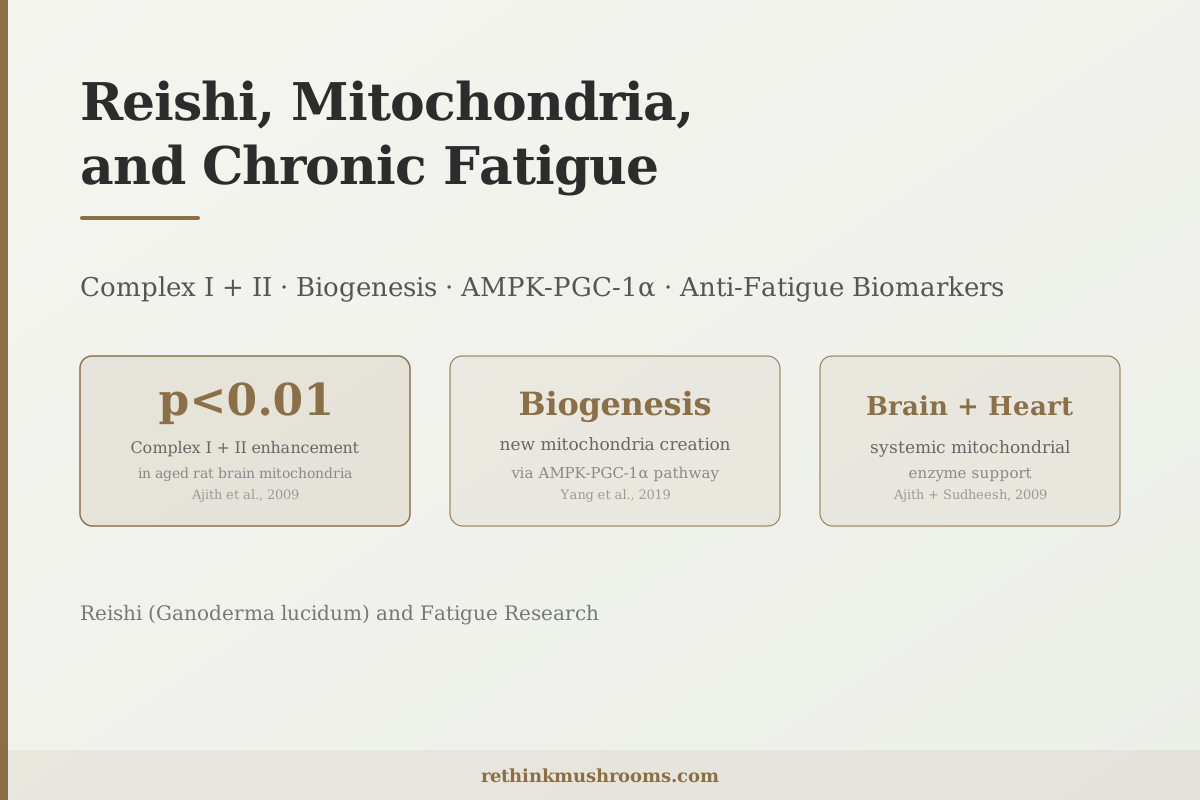
p<0.01 — Reishi's Complex I and II enhancement
Ajith et al. (2009) found Ganoderma lucidum significantly enhanced the activity of five mitochondrial enzymes in aged rat brains (p<0.01), including the electron transport chain's Complex I and Complex II — the primary machinery of cellular energy production.
Ajith et al., Phytotherapy Research, 2009
Biogenesis
Yang et al. (2019) showed Reishi stimulates creation of entirely new mitochondria — not just protection of existing ones
Brain + Heart
Reishi's mitochondrial enhancement confirmed in both brain (Ajith 2009) and cardiac tissue (Sudheesh 2009) — systemic, not organ-specific
No human RCTs
all mitochondrial evidence is preclinical; no human trial has measured mitochondrial function as a Reishi endpoint
Ajith et al., Phytotherapy Research, 2009
 View as image ↗
Chronic fatigue syndrome — more precisely called ME/CFS (myalgic encephalomyelitis/chronic fatigue syndrome) — is not tiredness that improves with rest. Research using specialized brain energy imaging shows that ME/CFS patients have measurably lower rates of ATP production in muscle tissue compared to healthy controls. ATP is the chemical form cells use to store and spend energy. When the machinery that makes ATP doesn't work efficiently, the result is the persistent, disproportionate exhaustion that defines ME/CFS — exhaustion that does not respond to sleep or caffeine because the problem is inside the cell, not in the signaling systems that feel alert or drowsy.
The relevant research question, then, is not whether reishi can make you feel more awake. It is whether reishi compounds can support the cellular machinery that produces energy in the first place. The preclinical evidence — from aged rat brain studies, cardiac tissue studies, and cell culture work — suggests that at least some components of Reishi do exactly that. This article examines what the research on reishi mitochondrial dysfunction and chronic fatigue actually shows, how the mechanism works, and where the evidence runs out. For a broader introduction to Reishi's properties and research, see the complete guide to Reishi mushroom.
Key Takeaways
- ME/CFS is associated with reduced mitochondrial ATP production — energy imaging studies show lower rates of cellular energy output in muscle tissue, explaining why fatigue in CFS doesn't resolve with rest
- Ajith et al. (2009) found Ganoderma lucidum significantly (p<0.01) enhanced the activity of five mitochondrial enzymes in aged rat brain, including Complex I and Complex II of the electron transport chain — the primary ATP-generating machinery[1]
- Sudheesh et al. (2009) extended this finding to cardiac tissue, showing Reishi's mitochondrial support is systemic rather than confined to the brain[2]
- Yang et al. (2019) showed a Reishi proteoglycan fraction stimulates mitochondrial biogenesis — the creation of new mitochondria — through the AMPK-PGC-1α signaling pathway[3]
- Geng et al. (2017) connected the mitochondrial mechanism to measurable anti-fatigue biomarkers: Reishi increases glycogen storage, accelerates clearance of blood waste products, reduces lactic acid accumulation, and improves lactate dehydrogenase activity[4]
- All mitochondrial evidence is preclinical — no human trial has measured mitochondrial function as a primary endpoint for Reishi; Jafari et al.'s 2025 meta-analysis of 17 Reishi RCTs noted very low GRADE evidence quality across all outcomes studied[5]
What Mitochondria Do and Why ME/CFS Patients May Have Fewer Working Ones
Every cell in the body contains mitochondria — small structures whose primary job is to convert food into ATP, the chemical currency cells use to power all their functions. A healthy cell may contain hundreds to thousands of mitochondria. Their efficiency directly determines how much energy the cell can produce.
The electron transport chain is the central machinery inside mitochondria. It is a sequence of protein complexes — numbered I through IV — that passes electrons down a biological relay race, releasing energy at each step and using it to build ATP. Complex I and Complex II are the first two stations in that chain, and their activity rate determines how fast ATP production can run.
In ME/CFS, several lines of evidence point toward impaired mitochondrial function. Studies using specialized MRI techniques that measure energy metabolites in tissue (phosphorus-31 MRS, or magnetic resonance spectroscopy) have found lower rates of ATP synthesis in the muscle tissue of ME/CFS patients during and after exertion. Some researchers have also documented reduced mitochondrial mass and impaired electron transport chain function in immune cells from ME/CFS patients. This is not proven as a universal mechanism — ME/CFS is heterogeneous and poorly understood — but the mitochondrial hypothesis has enough support that it has become one of the field's leading mechanistic frameworks.
The implication: for patients whose fatigue stems from mitochondrial inefficiency, interventions that support mitochondrial function could address the underlying energy deficit rather than simply masking fatigue signals.
How Reishi Enhances Mitochondrial Enzyme Activity
Ajith and colleagues (2009) tested Ganoderma lucidum extract in aged rats — using an aging model because mitochondrial function declines with age in a pattern that resembles, in some ways, the mitochondrial decline seen in chronic fatigue conditions.[1]
The researchers measured the activity of five mitochondrial enzymes in brain tissue:
- PDH (pyruvate dehydrogenase): converts glucose breakdown products into the form mitochondria need to start producing energy
- Alpha-KGDH (alpha-ketoglutarate dehydrogenase): operates in the citric acid cycle that feeds electrons into the transport chain
- SDH (succinate dehydrogenase, also called Complex II substrate): sits at the junction between the citric acid cycle and the electron transport chain
- Complex I (NADH dehydrogenase): the first and largest station in the electron transport chain
- Complex II: the second electron transport station, receiving electrons from SDH
GL extract at both 50mg/kg and 250mg/kg doses significantly enhanced the activity of all five enzymes compared to aged controls (p<0.01). The improvement was substantial enough to narrow the gap between aged and young rats on most enzyme measures.
The significance: these are not downstream fatigue signals or subjective tiredness ratings. These are direct measurements of the actual mechanical rate at which brain mitochondria produce energy. An aged mitochondrion that normally operates at reduced speed running faster after Reishi treatment is the cellular-level version of what anti-fatigue research is looking for.
Heart Tissue Confirms the Systemic Effect
Sudheesh and colleagues (2009) ran the same category of experiment in cardiac tissue rather than brain tissue.[2] Reishi enhanced the activities of heart mitochondrial enzymes and respiratory chain complexes in aged rats, replicating the brain findings in a different organ.
This matters for the chronic fatigue context because ME/CFS is a systemic condition. Brain-only effects might partially explain cognitive fatigue but would not account for the muscular and physical exhaustion that characterizes the condition. Cardiac and skeletal muscle mitochondria are where physical energy production primarily occurs. A compound that supports mitochondrial function in both brain and heart tissue suggests systemic rather than organ-specific activity.
The two 2009 studies together establish a consistent finding: Reishi restores declining mitochondrial enzyme activity in aged rat tissue across multiple organ types.
Mitochondrial Biogenesis: Creating New Energy Factories
The Ajith and Sudheesh studies showed Reishi restoring function in existing mitochondria. Yang and colleagues (2019) demonstrated something structurally different: Reishi may also stimulate the creation of entirely new mitochondria.[3]
Yang's study identified a novel proteoglycan fraction from Ganoderma lucidum that modulates energy metabolism and stimulates mitochondrial biogenesis — the biological process by which cells produce new mitochondria and increase their total mitochondrial mass.
The pathway involved is AMPK and PGC-1α. AMPK is a cellular energy sensor that detects when energy supplies are running low and activates a response to build more energy capacity. One thing AMPK activates is PGC-1α, a protein that acts as the master regulator of mitochondrial biogenesis. When PGC-1α is active, cells begin producing the proteins needed to assemble new mitochondria. The GL proteoglycan appeared to activate this pathway.
Protecting existing mitochondria versus creating new ones represents a meaningful mechanistic distinction. Protecting existing mitochondria improves the efficiency of current energy production. Creating new mitochondria increases the total capacity for energy production. The Yang 2019 finding suggests Reishi compounds may do the second — a more durable intervention than simply buffering mitochondrial damage. For a comparison with how Cordyceps targets the same mitochondrial pathway through a different mechanism, see Cordyceps and mitochondrial function: research on energy metabolism.
For another mushroom-derived compound with documented mitochondrial protective effects, see ergothioneine and mitochondrial protection.
From Cell to Body: How the Mitochondrial Mechanism Produces Anti-Fatigue Biomarkers
Geng and colleagues (2017) reviewed the antifatigue functions of edible and medicinal mushrooms and provided the connection between Reishi's cellular-level mitochondrial effects and the measurable endpoints of physical fatigue.[4]
Better mitochondrial function downstream produces:
Higher glycogen storage. Glycogen is the muscle's stored form of glucose, the fuel reserve for sustained activity. Muscles with better mitochondrial function are more efficient at synthesizing and storing glycogen, meaning they have more fuel available for extended work.
Faster BUN (blood urea nitrogen) clearance. During muscle exertion, protein breakdown produces nitrogenous waste, measured as blood urea nitrogen. High BUN indicates metabolic stress and correlates with subjective fatigue. Faster BUN clearance means the body is recovering from exertion more efficiently.
Lower lactic acid accumulation. Lactic acid builds up in muscles when they outpace mitochondria's ability to process fuel aerobically. The burning, heavy feeling in exercised muscles is partly lactic acid accumulation. Better mitochondrial throughput delays this threshold and accelerates clearance.
Improved LDH (lactate dehydrogenase) activity. LDH is the enzyme that converts lactic acid into a form that can be cleared. Higher LDH activity means faster fatigue metabolite clearance.
Geng's review documented that Reishi showed measurable improvements in all four of these fatigue physiology endpoints in animal studies. These are not subjective fatigue ratings — they are biochemical measurements of the waste products and fuel reserves that determine how fatigued a body becomes and how quickly it recovers.
For the clinical anti-fatigue evidence and what the human trial data looks like, see how Reishi reduces fatigue without being a stimulant and Reishi for fatigue: research on energy and vitality.
Where the Evidence Stops: The Human Trial Gap
All of the mitochondrial evidence described above is preclinical. The aged rat brain studies are in rodents. The mitochondrial biogenesis data is from cell culture. The anti-fatigue biomarker review synthesizes animal model endpoints.
Jafari and colleagues (2025) conducted the most current systematic review and meta-analysis of Ganoderma lucidum clinical trials, analyzing 17 RCTs with 971 participants.[5] The GRADE evidence quality assessment across all outcomes was rated very low. The analysis did not specifically measure mitochondrial function — no human Reishi trial has included that as an endpoint.
This is the honest position: the mechanism is biologically plausible, the preclinical evidence is internally consistent, and the fatigue biomarker connections are real. But the specific claim that Reishi improves mitochondrial function in ME/CFS patients, and that this translates to meaningful fatigue reduction, has not been tested in humans with mitochondrial measurements as the primary outcome.
ME/CFS research is an active area, and the mitochondrial hypothesis is attracting funding. Whether Reishi's mitochondrial mechanisms will eventually be tested in human ME/CFS populations remains to be seen.
For the existing human clinical trial evidence on Reishi and fatigue conditions including ME/CFS, see Reishi and chronic fatigue syndrome: clinical trial evidence. For cancer-related fatigue, see Reishi and cancer-related fatigue: quality of life research.
The Bottom Line
Reishi demonstrates preclinical evidence for mitochondrial support through three mechanisms: restoring declining Complex I and II activity in aged brain tissue (Ajith 2009), extending that effect to cardiac tissue (Sudheesh 2009), and stimulating mitochondrial biogenesis via the AMPK-PGC-1α pathway (Yang 2019). These cellular-level findings connect to measurable anti-fatigue biomarkers including glycogen storage, BUN clearance, and lactic acid reduction (Geng 2017). All evidence is preclinical. No human clinical trial has measured mitochondrial function as a Reishi endpoint, and Jafari et al.'s 2025 meta-analysis of 17 Reishi RCTs found very low GRADE evidence quality across outcomes.
Frequently Asked Questions
Sources & References
- 1RTHM-00283·Ajith, T A et al. (2009). “Effect of Ganoderma lucidum on the activities of mitochondrial dehydrogenases and complex I and II of electron transport chain in the brain of aged rats..” Experimental gerontology.Study breakdown →PubMed →↩
- 2RTHM-00317·Sudheesh, N P et al. (2009). “Ganoderma lucidum (Fr.) P. Karst enhances activities of heart mitochondrial enzymes and respiratory chain complexes in the aged rat..” Biogerontology.Study breakdown →PubMed →↩
- 3RTHM-01146·Yang, Zhou et al. (2019). “Modulation of energy metabolism and mitochondrial biogenesis by a novel proteoglycan from Ganoderma lucidum..” RSC advances.Study breakdown →PubMed →↩
- 4RTHM-00871·Geng, Ping et al. (2017). “Antifatigue Functions and Mechanisms of Edible and Medicinal Mushrooms..” BioMed research international.Study breakdown →PubMed →↩
- 5RTHM-02098·Jafari, Ali et al. (2025). “The Nutritional Significance of Ganoderma lucidum on Human Health: A GRADE-Assessed Systematic Review and Meta-Analysis of Clinical Trials..” Food science & nutrition.Study breakdown →PubMed →↩