Cordyceps & Fatigue Recovery
3 human exercise trials with energy-related endpoints
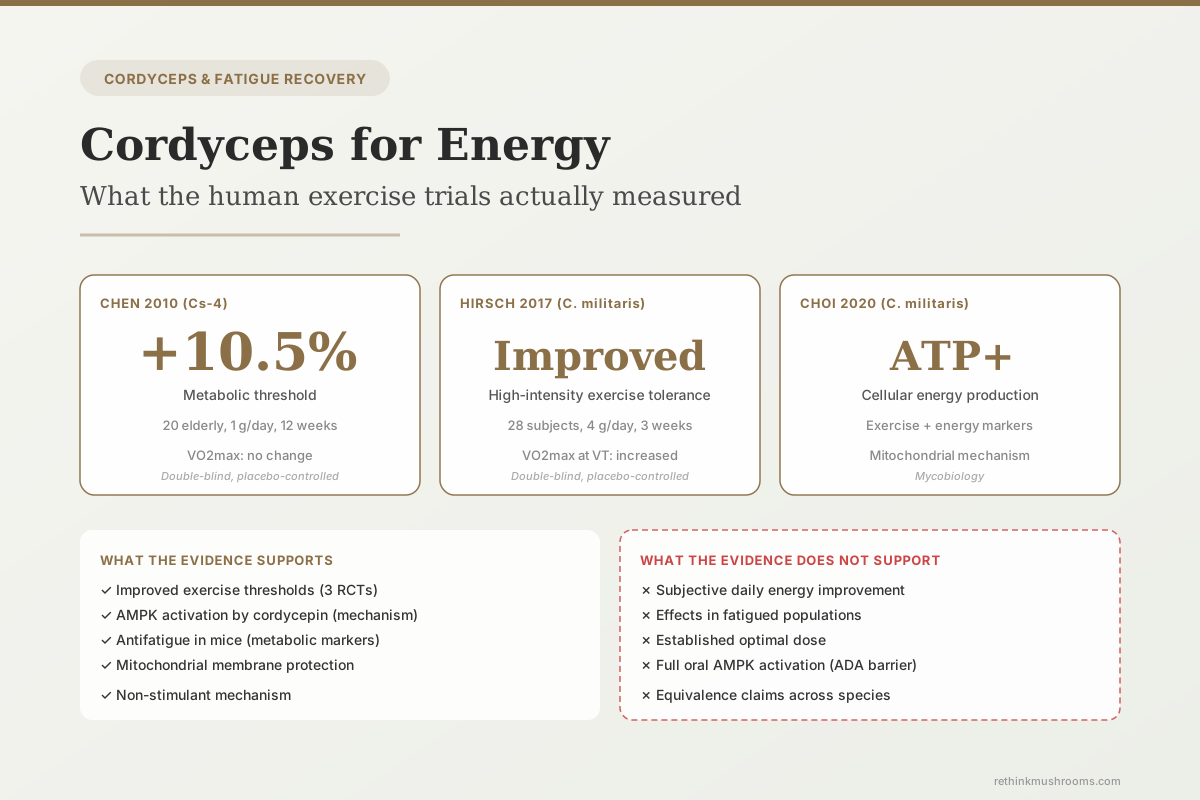
Three placebo-controlled human trials have tested cordyceps preparations on exercise performance endpoints: Cs-4 in healthy elderly (Chen 2010), Cordyceps militaris in young adults (Hirsch 2017), and C. militaris on cellular energy markers (Choi 2020). Results include improved metabolic thresholds, exercise tolerance, and ATP-related markers.
Chen 2010, Hirsch 2017, Choi 2020
+10.5%
metabolic threshold increase after 12 weeks Cs-4 (Chen 2010)
AMPK pathway
cordycepin acts as AMP mimetic to activate cellular energy sensing (Hawley 2020)
Non-stimulant
mechanism targets ATP production, not CNS alertness
Chen 2010, Hirsch 2017, Choi 2020
 View as image ↗
The claim that cordyceps boosts energy is one of the oldest and most widely repeated in the functional mushroom market. The traditional Tibetan and Chinese use of Cordyceps sinensis centered on vitality and respiratory endurance. The modern supplement market positions cordyceps as a natural energy enhancer, often as an alternative to caffeine. The evidence base supporting this claim includes a well-characterized molecular mechanism (AMPK activation), several human exercise performance trials, and extensive preclinical antifatigue data. The evidence does not support the claim at the same level of certainty that it supports, for example, the immune effects of mushroom polysaccharides. This article examines each layer of the energy evidence separately. For how cordyceps differs mechanistically from stimulants, see cordyceps for burnout: mitochondrial energy vs. stimulant-based recovery. For the molecular detail on bioactive compounds, see cordyceps bioactive compounds: cordycepin, adenosine, and polysaccharides.
Key Takeaways
- Hawley et al. (2020) demonstrated that cordycepin enters cells via adenosine transporters, is phosphorylated to cordycepin monophosphate, and activates AMPK as an AMP mimetic, triggering mitochondrial biogenesis and fatty acid oxidation (Cell Chemical Biology)
- Chen et al. (2010) tested Cs-4 at ~1 g/day for 12 weeks in 20 healthy elderly subjects and reported a 10.5% metabolic threshold increase and 8.5% ventilatory threshold increase without VO2max change, indicating improved oxidative efficiency at submaximal intensities (Journal of Alternative and Complementary Medicine)
- Hirsch et al. (2017) tested Cordyceps militaris at 4 g/day in 28 subjects and reported improved high-intensity exercise tolerance after both single-dose and 3-week supplementation, with increased VO2max at ventilatory threshold (Journal of Dietary Supplements)
- Choi et al. (2020) reported that Cordyceps militaris improved exercise performance in association with promoted cellular energy production, supporting the mitochondrial mechanism for exercise-related energy benefits (Mycobiology)
- Song et al. (2015) showed that C. militaris fruit body extract extended forced swimming time in mice with reduced blood lactate, reduced ammonia, preserved hepatic glycogen, and increased antioxidant enzyme activity in dose-dependent fashion (Evidence-Based Complementary and Alternative Medicine)
- Li et al. (2010) demonstrated that C. militaris polysaccharides protected mitochondrial membrane potential and reduced ROS in senescent cells, with dose-dependent anti-aging effects in a D-galactose mouse model (American Journal of Chinese Medicine)
Evidence Hierarchy
Cordyceps & Energy — An Upside-Down Evidence Pyramid
A normal evidence pyramid is widest at the bottom (mechanisms) and narrows to a single, decisive human trial at the top. Here it is inverted: the molecular and animal tiers are deep and coherent, human exercise trials add real physiological data, but the tier that would settle the everyday claim — a controlled trial of perceived daily energy in fatigued people — is empty. Bar width reflects how much direct evidence exists at each tier, not the size of any effect.
Controlled trial — subjective daily energy in fatigued people
gapDoes not yet exist
The evidence that would actually guide someone taking cordyceps to feel less tired — a controlled trial measuring perceived daily energy in people with fatigue complaints — has never been run. Every human trial to date used healthy subjects and physiological exercise endpoints
Human exercise trials (healthy, physiological endpoints)
evidenceChen 2010 · Hirsch 2017 · Choi 2020
Three placebo-controlled trials measured exercise-related energy: Cs-4 at ~1 g/day for 12 weeks raised the metabolic threshold 10.5% in healthy elderly (Chen 2010), C. militaris at 4 g/day improved high-intensity exercise tolerance (Hirsch 2017), and C. militaris improved cellular energy markers alongside performance (Choi 2020) — real, but exercise capacity in healthy people, not daily-life fatigue
Preclinical antifatigue (whole animal)
evidenceSong 2015
C. militaris extract extended forced-swim time to exhaustion in mice dose-dependently, with lower blood lactate and ammonia, preserved hepatic glycogen, and higher SOD, catalase, and GPx activity — a coherent aerobic-efficiency signature that matches the human threshold data (Song 2015)
Cellular & molecular mechanism
evidenceHawley 2020 · Li 2010
The deepest, cleanest tier: cordycepin enters cells, is phosphorylated to cordycepin monophosphate, and activates AMPK as an AMP mimetic — driving mitochondrial biogenesis and fatty-acid oxidation (Hawley 2020) — while C. militaris polysaccharides preserve mitochondrial membrane potential and cut ROS in senescent cells (Li 2010)
How to read it: the bars grow wider toward the bottom because the mechanistic and animal literature is deep and converges on a single story — AMPK-driven mitochondrial efficiency. The human exercise trials are real but measure physiological capacity in healthy people, not how tired someone feels at work. The gap at the top, not the quality of the mechanisms, is the honest limit of the cordyceps-energy claim.
Sources: Hawley 2020 [1]; Chen 2010 [2]; Hirsch 2017 [3]; Choi 2020 [4]; Song 2015 [5]; Li 2010 [6]. The mechanistic and preclinical tiers are cell-culture and mouse work; the human tier is three exercise trials in healthy subjects. Bar widths are illustrative of evidence depth per tier, not quantitative effect sizes.
The Molecular Basis: AMPK Activation
The most concrete molecular mechanism linking cordyceps to energy is the AMPK pathway characterized by Hawley et al. (2020).[1] AMPK (AMP-activated protein kinase) is the cell's master energy sensor. When cellular energy drops (rising AMP-to-ATP ratio), AMPK activates pathways that restore energy balance: mitochondrial biogenesis through PGC-1alpha, fatty acid oxidation through ACC phosphorylation, glucose uptake through GLUT4 translocation, and damaged mitochondria clearance through ULK1-mediated mitophagy.
Cordycepin (3'-deoxyadenosine) enters cells through ENT1/ENT2 adenosine transporters and is phosphorylated by adenosine kinase to cordycepin monophosphate (CoMP). CoMP allosterically activates AMPK by mimicking AMP at the gamma subunit binding site. This activation is abolished by blocking adenosine transporters or adenosine kinase, confirming that intracellular phosphorylation is required.
The AMPK mechanism is not a stimulant pathway. It does not increase alertness perception, trigger catecholamine release, or suppress adenosine-mediated sleep signalling. It improves the cell's ability to produce and manage energy. The distinction is pharmacologically fundamental: a stimulant makes you feel energized without changing ATP production, while an AMPK activator improves ATP production without directly changing how you feel. For the detailed ATP pathway, see cordyceps and ATP: how it boosts cellular energy. For the mitochondrial detail, see cordyceps and mitochondrial function.
The practical caveat is bioavailability. Cordycepin is rapidly deaminated by adenosine deaminase (ADA) in vivo, limiting how much active compound reaches intracellular targets after oral supplementation. The AMPK activation demonstrated in cell culture may not be fully replicated by taking a cordyceps capsule. This is the single most important qualifier on the energy claim.
Human Exercise Trials
Cs-4 in Healthy Elderly
Chen et al. (2010) conducted a double-blind placebo-controlled trial of Cs-4 (a standardized Cordyceps sinensis fermentation product) at approximately 1 g/day for 12 weeks in 20 healthy elderly subjects aged 50-75.[2] After supplementation, metabolic threshold (the exercise intensity at which anaerobic metabolism supplements aerobic) increased by 10.5%. Ventilatory threshold increased by 8.5%. VO2max did not change.
This pattern tells a specific story. The threshold improvements mean that aerobic (mitochondrial) energy production sustained higher workloads before the body needed to recruit anaerobic glycolysis. The unchanged VO2max means the absolute ceiling of oxygen processing did not increase. Cordyceps improved efficiency within the existing system rather than expanding system capacity. For daily energy and fatigue, efficiency is the more relevant parameter: it determines how hard routine activities feel relative to maximum capacity.
C. militaris in Young Adults
Hirsch et al. (2017) tested Cordyceps militaris at 4 g/day in a randomized double-blind placebo-controlled trial of 28 subjects.[3] The study measured exercise tolerance during high-intensity interval protocols after acute (single-dose) and chronic (3-week) supplementation. After chronic supplementation, C. militaris improved tolerance to high-intensity exercise and increased VO2max at ventilatory threshold. The higher dose (4 g vs. 1 g) and shorter duration (3 weeks vs. 12 weeks) compared with Chen et al. suggests a dose-response relationship, though the different species (C. militaris vs. Cs-4 fermentation product), different populations (young vs. elderly), and different exercise protocols limit direct comparison.
C. militaris and Cellular Energy Markers
Choi et al. (2020), published in Mycobiology, reported that C. militaris improved exercise performance in association with cellular energy production markers.[4] The study connected exercise performance outcomes to direct measures of cellular energy status, providing the bridge between the AMPK mechanism characterized in cell culture and the functional exercise improvements measured in the other human trials.
What the Trials Do Not Show
None of the human trials measured subjective energy levels during daily activities. None recruited people with fatigue complaints, chronic fatigue syndrome, or self-reported low energy. None measured cognitive energy or motivational outcomes. The exercise protocols measure physiological capacity under controlled conditions, which correlates with but does not directly predict subjective daily energy perception. The translation from "improved metabolic threshold on a cycle ergometer" to "less tired at work" is plausible but unverified.
The Preclinical Antifatigue Data
Song et al. (2015) provided the most comprehensive preclinical antifatigue assessment using a forced swimming model in mice.[5] C. militaris fruit body extract produced dose-dependent extensions of swimming time to exhaustion. The metabolic markers revealed the mechanism: reduced blood lactate (less anaerobic spillover), reduced blood ammonia (less protein catabolism for energy), preserved hepatic glycogen (better fuel management), and increased tissue SOD, catalase, and GPx activity (enhanced antioxidant defense protecting mitochondria during exertion).
This metabolic profile is consistent with the human threshold data. Better aerobic efficiency means less reliance on anaerobic glycolysis (lower lactate), less catabolism of amino acids for emergency fuel (lower ammonia), and slower depletion of glycogen reserves (better fuel sparing). The antioxidant enzyme upregulation protects the mitochondria that are doing the extra work.
Li et al. (2010) added the cellular protection component.[6] C. militaris polysaccharides preserved mitochondrial membrane potential and reduced reactive oxygen species in senescent cells. In a D-galactose aging mouse model, polysaccharide treatment showed dose-dependent anti-aging effects including enhanced antioxidant enzyme activity. This matters for energy because mitochondrial membrane integrity determines how efficiently the electron transport chain converts substrate to ATP. A mitochondrion with degraded membrane potential produces less ATP and more ROS per unit of fuel consumed, creating a vicious cycle of declining energy output and increasing oxidative damage.
The Polysaccharide Energy Contribution
The energy discussion typically centers on cordycepin and AMPK, but C. militaris polysaccharides contribute through a separate mechanism. Li et al. (2010) showed that polysaccharides from cultivated C. militaris fruiting bodies preserved mitochondrial membrane potential in cells exposed to oxidative stress, reduced intracellular ROS, and upregulated SOD, catalase, and glutathione peroxidase.[6] In the D-galactose mouse aging model, these effects were dose-dependent and correlated with anti-aging markers.
Mitochondrial membrane potential is a direct determinant of ATP production efficiency. The proton gradient across the inner mitochondrial membrane drives ATP synthase; when that gradient dissipates (through oxidative damage, uncoupling, or membrane lipid peroxidation), each unit of substrate produces less ATP. A compound that preserves membrane potential is preserving the energetic efficiency of existing mitochondria.
Polysaccharides are large molecules that do not require systemic absorption to exert their antioxidant effects. They interact with gut-associated immune cells and may reduce systemic inflammatory burden, which indirectly protects mitochondrial function. This means the polysaccharide component of a whole cordyceps supplement contributes to energy through a different pathway than cordycepin, and one that may be more pharmacologically accessible after oral dosing. The clinical trial preparations (Cs-4, C. militaris whole extract) deliver both bioactive classes, and the observed exercise improvements may reflect the combined action of cordycepin-AMPK activation and polysaccharide-mediated mitochondrial protection.
Cordyceps vs. Other Natural Energy Compounds
Cordyceps occupies a distinct pharmacological niche among natural energy supplements. Caffeine blocks adenosine receptors for perceived alertness. Creatine increases phosphocreatine stores for short-burst power (see cordyceps and creatine phosphate). CoQ10 functions as an electron carrier in the respiratory chain. B vitamins are coenzymes in energy metabolism. Cordyceps, through AMPK activation, operates at a regulatory level above these individual pathway components: it modulates the master switch that controls mitochondrial biogenesis, fuel selection, and cellular energy homeostasis.
This regulatory-level mechanism could theoretically compound with cofactor-level supplements (CoQ10, B vitamins) rather than competing with them. The exercise threshold improvements seen in human trials are consistent with what AMPK activation would produce: better oxidative efficiency through improved mitochondrial function, not a boost to any single metabolic step. For combination approaches, see mushroom stacks for energy and recovery.
What the Evidence Supports and What It Does Not
The evidence supports the claim that cordyceps improves exercise-related energy endpoints in healthy people. Three human trials show improved metabolic thresholds, exercise tolerance, or cellular energy markers. The AMPK mechanism is well-characterized. The preclinical antifatigue data is consistent with the human exercise data. The polysaccharide fraction provides an independent pathway (mitochondrial membrane protection) that complements the cordycepin-AMPK pathway.
The evidence does not support the claim that cordyceps reliably increases subjective daily energy. No trial has measured perceived energy in daily life. No trial has recruited fatigued populations. The bioavailability problem means the AMPK pathway may not be fully engaged by oral supplementation at standard doses. The effective human dose is not established: the two best trials used different species (Cs-4 vs. C. militaris) at different doses (1 g vs. 4 g) for different durations (12 weeks vs. 3 weeks). For the fatigue-specific clinical picture, see cordyceps for fatigue: clinical evidence on energy levels.
The Bottom Line
Cordyceps has a well-characterized energy mechanism (AMPK activation via cordycepin) supported by three human exercise trials showing improved metabolic thresholds, exercise tolerance, and cellular energy markers, plus preclinical antifatigue data showing reduced lactate, preserved glycogen, and enhanced antioxidant enzymes in mice. The mechanism operates through mitochondrial efficiency improvement rather than CNS stimulation. The evidence gaps are specific: no trials in fatigued populations, no subjective energy measurements, oral cordycepin bioavailability limited by adenosine deaminase, and no established optimal dose. The energy claim is supported for exercise-related endpoints in healthy people but unverified for daily perceived energy.
Frequently Asked Questions
Sources & References
- 1RTHM-00618·Hawley, Simon A et al. (2020). “Mechanism of Activation of AMPK by Cordycepin..” Cell chemical biology.Study breakdown →PubMed →↩
- 2RTHM-00176·Chen, Steve et al. (2010). “Effect of Cs-4 (Cordyceps sinensis) on exercise performance in healthy older subjects: a double-blind, placebo-controlled trial..” Journal of alternative and complementary medicine (New York.Study breakdown →PubMed →↩
- 3RTHM-00473·Hirsch, Katie R et al. (2017). “Cordyceps militaris Improves Tolerance to High-Intensity Exercise After Acute and Chronic Supplementation..” Journal of dietary supplements.Study breakdown →PubMed →↩
- 4RTHM-00613·Choi, Eunhyun et al. (2020). “Beneficial Effect of Cordyceps militaris on Exercise Performance via Promoting Cellular Energy Production..” Mycobiology.Study breakdown →PubMed →↩
- 5RTHM-00401·Song, Jingjing et al. (2015). “Studies on the Antifatigue Activities of Cordyceps militaris Fruit Body Extract in Mouse Model..” Evidence-based complementary and alternative medicine : eCAM.Study breakdown →PubMed →↩
- 6RTHM-00191·Li, Xing-Tai et al. (2010). “Protective effects on mitochondria and anti-aging activity of polysaccharides from cultivated fruiting bodies of Cordyceps militaris..” The American journal of Chinese medicine.Study breakdown →PubMed →↩