Cordyceps & Fatigue Recovery
10.5% metabolic threshold increase
Chen et al. (2010) showed a 10.5% improvement in metabolic threshold in healthy elderly subjects after 12 weeks of Cs-4 supplementation in a double-blind placebo-controlled trial, suggesting improved mitochondrial oxidative efficiency at submaximal workloads rather than a stimulant-type CNS activation.
Chen et al., Journal of Alternative and Complementary Medicine, 2010
AMPK activation
cordycepin acts as AMP mimetic via intracellular phosphorylation (Hawley 2020)
Forced swim +70%
C. militaris extended time to exhaustion in mice (Song 2015)
No CNS stimulation
mechanism targets mitochondria, not dopamine or norepinephrine
Chen et al., Journal of Alternative and Complementary Medicine, 2010
 View as image ↗
Burnout and chronic fatigue are increasingly common complaints, and the supplement market responds with two fundamentally different approaches: stimulants that mask fatigue by activating the central nervous system, and adaptogens or metabolic compounds that attempt to address underlying energy production. Cordyceps falls into the second category. Its primary researched mechanism is not CNS stimulation but mitochondrial energy optimization through AMPK activation, antioxidant protection of mitochondrial membranes, and respiratory chain efficiency improvement. The distinction matters because stimulants like caffeine produce immediate energy perception but can worsen burnout over time by depleting catecholamine reserves and disrupting sleep architecture, while a mitochondrial mechanism would theoretically address the energy deficit at a cellular level without those downstream costs. The research supporting this distinction is a mix of well-characterized molecular mechanisms, animal antifatigue models, and a small number of human exercise trials. For the detailed mitochondrial picture, see cordyceps and mitochondrial function. For the broader adaptogenic context, see adaptogenic mushrooms for stress.
Key Takeaways
- Hawley et al. (2020) established that cordycepin activates AMPK through intracellular phosphorylation to cordycepin monophosphate, triggering mitochondrial biogenesis, fatty acid oxidation, and autophagy through a metabolic sensing pathway entirely distinct from stimulant mechanisms (Cell Chemical Biology)
- Song et al. (2015) tested Cordyceps militaris fruit body extract in mice and reported extended forced swimming time, reduced blood lactate and ammonia accumulation, preserved hepatic glycogen, and increased tissue antioxidant enzyme activity in a dose-dependent manner (Evidence-Based Complementary and Alternative Medicine)
- Hirsch et al. (2017) tested Cordyceps militaris at 4 g/day in a double-blind RCT of 28 subjects and reported improved tolerance to high-intensity exercise after both acute (single dose) and chronic (3-week) supplementation, with increased VO2max at ventilatory threshold (Journal of Dietary Supplements)
- Chen et al. (2010) showed 10.5% metabolic threshold improvement and 8.5% ventilatory threshold improvement in 20 healthy elderly subjects after 12 weeks of Cs-4 supplementation, without VO2max change, consistent with improved oxidative efficiency rather than stimulant-type performance enhancement (Journal of Alternative and Complementary Medicine)
- Panossian (2009) reviewed adaptogens in fatigue and identified stress-protective activity through modulation of the HPA axis, HSP70 expression, and nitric oxide signalling, providing the broader framework for non-stimulant fatigue interventions including cordyceps (Current Clinical Pharmacology)
- Phull et al. (2022) catalogued Cordyceps militaris anti-inflammatory NF-kB suppression and antioxidant activity as reproducible effects that converge on mitochondrial protection, reducing the inflammatory component of burnout-related energy depletion (Microorganisms)
Two Different Approaches to Fatigue
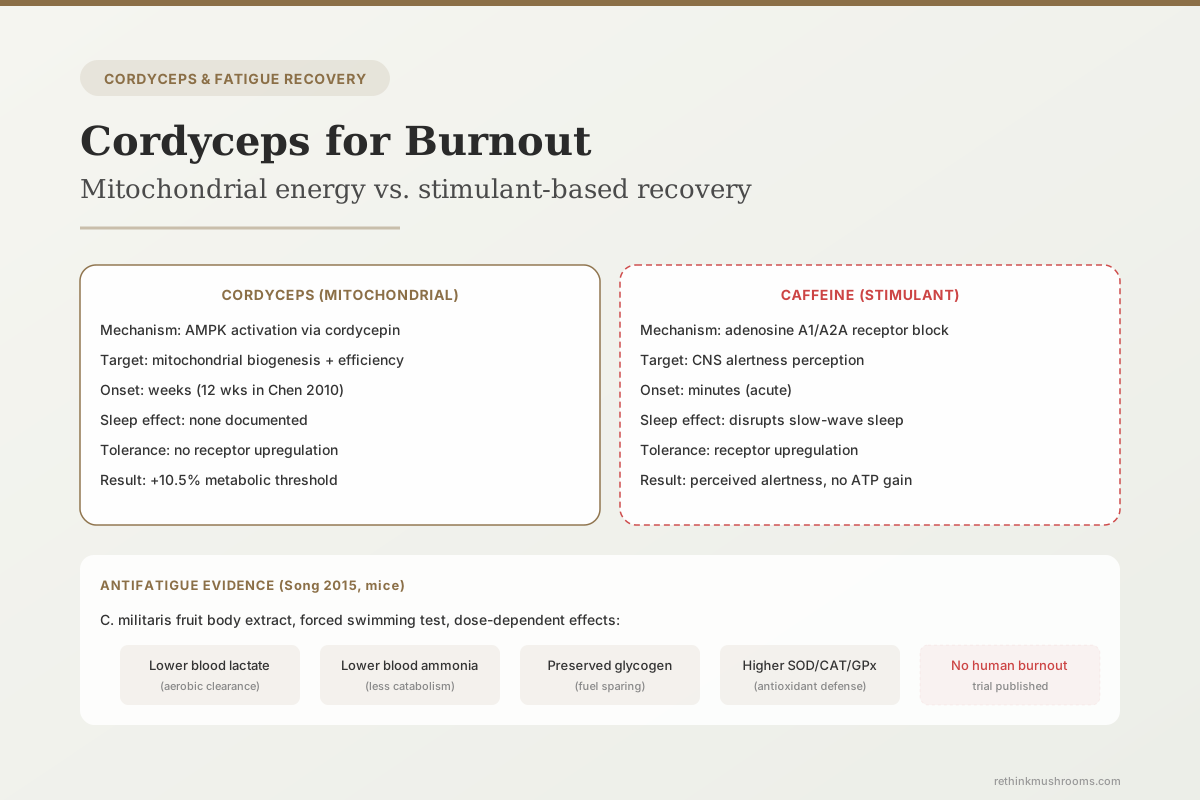
Caffeine, the most widely used anti-fatigue compound globally, works by blocking adenosine A1 and A2A receptors in the brain. When adenosine accumulates during wakefulness, it signals drowsiness by binding these receptors. Caffeine blocks that signal, producing alertness without actually restoring cellular energy. It also triggers catecholamine release (dopamine, norepinephrine, epinephrine), which creates the perception of energy and improves reaction time and concentration.
The cost of this approach becomes apparent in burnout states. Chronic caffeine use upregulates adenosine receptor expression (tolerance), depletes catecholamine precursors, disrupts slow-wave sleep (which is when mitochondrial repair and cellular cleanup occur), and creates a dependency cycle where withdrawal produces worse fatigue than baseline. The energy perception is real but borrowed: caffeine does not produce ATP or repair mitochondria.
Cordyceps operates through a categorically different mechanism. Its primary bioactive for energy, cordycepin, activates AMPK, the enzyme that senses cellular energy status and triggers mitochondrial biogenesis, fatty acid oxidation, and autophagy.[1] This is a metabolic pathway, not a neural one. It does not block adenosine receptors (in fact, cordycepin is an adenosine analog that could theoretically engage them). It does not trigger catecholamine release. It does not suppress sleep drive. The theoretical appeal for burnout is that it addresses energy production rather than energy perception.
The Preclinical Antifatigue Evidence
Song et al. (2015), published in Evidence-Based Complementary and Alternative Medicine, provided the most comprehensive preclinical antifatigue assessment of Cordyceps militaris.[2] Mice received C. militaris fruit body extract at multiple dose levels and were subjected to the forced swimming test, the standard rodent fatigue model. C. militaris-treated mice showed significantly extended time to exhaustion compared with controls.
The mechanistic measurements were specific to metabolic fatigue markers rather than CNS activation. Blood lactate accumulation (a marker of anaerobic glycolysis exceeding mitochondrial clearance capacity) was reduced. Blood ammonia (a marker of amino acid catabolism during energy deficit) was reduced. Hepatic glycogen stores (the primary fuel reserve for sustained physical activity) were better preserved. Tissue superoxide dismutase (SOD), catalase, and glutathione peroxidase (GPx) activities were increased, indicating enhanced antioxidant defense. All effects were dose-dependent.
This profile, reduced lactate, reduced ammonia, preserved glycogen, enhanced antioxidant enzymes, is consistent with improved mitochondrial oxidative capacity allowing aerobic metabolism to sustain higher workloads for longer before anaerobic pathways become necessary. It is not the profile of a stimulant, which would show increased catecholamines and heart rate without changes in metabolic fuel utilization.
The Human Exercise Evidence
Hirsch et al. (2017), published in the Journal of Dietary Supplements, tested C. militaris at 4 g/day in a double-blind randomized placebo-controlled trial of 28 subjects.[3] The study measured exercise tolerance during high-intensity interval protocols after both acute (single dose before exercise) and chronic (3-week supplementation) periods. After chronic supplementation, C. militaris improved tolerance to high-intensity exercise with increased VO2max at ventilatory threshold compared with placebo.
Chen et al. (2010) tested Cs-4 (a Cordyceps sinensis fermentation product) at approximately 1 g/day for 12 weeks in 20 healthy elderly subjects aged 50-75.[4] Metabolic threshold increased by 10.5% and ventilatory threshold by 8.5%, while VO2max did not change. This finding is specifically relevant to burnout because the threshold improvements reflect improved efficiency at submaximal workloads, the type of sustained moderate effort that characterizes daily functioning and work capacity. The unchanged VO2max confirms this is not a stimulant effect pushing peak performance higher, but an efficiency effect allowing sustained effort to feel easier.
A separate randomized double-blind placebo-controlled trial of 37 healthy elderly Chinese subjects, using 3 g/day of Cs-4 for 6 weeks, reported that VO2max increased from 1.88 to 2.00 L/min (P = 0.050) and anaerobic threshold increased from 1.15 to 1.30 L/min (P = 0.012) in the cordyceps group, with no change in placebo. This second trial showed a VO2max effect at a higher dose and shorter duration than Chen et al., suggesting dose-response relationship may exist.
The practical translation to burnout is indirect but mechanistically coherent. A person in burnout is not operating at VO2max; they are struggling with sustained moderate-intensity cognitive and physical demands. A compound that improves metabolic threshold, the point at which aerobic metabolism can no longer keep up with energy demand, would make those submaximal activities more sustainable. Whether 12 weeks of Cs-4 at 1 g/day produces a subjectively meaningful reduction in perceived fatigue during daily activities has not been directly tested in a burnout population.
The Adaptogen Framework
Panossian (2009) reviewed the broader evidence for adaptogens in fatigue, providing the theoretical framework within which cordyceps operates.[5] The review identified several molecular mechanisms shared across adaptogens including modulation of the hypothalamic-pituitary-adrenal (HPA) axis stress response, induction of heat shock protein Hsp70 (which protects cells during stress), and regulation of nitric oxide signalling. Adaptogens were characterized as compounds that increase nonspecific resistance to stress rather than stimulating or sedating the central nervous system.
Cordyceps fits this framework through its AMPK activation (cellular energy homeostasis), its polysaccharide-mediated antioxidant effects (cellular stress protection), and the exercise threshold improvements in human trials (functional energy capacity without stimulant signature). The adaptogen concept is not a specific molecular mechanism but a pharmacological category: compounds that widen the zone in which the organism can function under stress without depleting reserves.
Phull et al. (2022) added the anti-inflammatory dimension.[6] NF-kB suppression and TNF-alpha reduction are reproducible findings for Cordyceps militaris across inflammatory disease models. This matters for burnout because chronic stress produces low-grade systemic inflammation that impairs mitochondrial function, disrupts sleep, and contributes to the fatigue cycle. A compound that reduces this inflammatory burden while simultaneously improving mitochondrial efficiency is targeting two interconnected components of the burnout phenotype. For the inflammation connection, see cordyceps and inflammation: anti-inflammatory mechanisms.
The Inflammation-Fatigue Connection
A growing body of evidence links chronic low-grade inflammation to subjective fatigue and burnout. Proinflammatory cytokines including IL-6, TNF-alpha, and IL-1beta cross the blood-brain barrier and alter neurotransmitter metabolism, reducing serotonin and dopamine availability in ways that produce the motivational deficit, cognitive fog, and physical exhaustion characteristic of burnout. This "sickness behavior" response is an evolved adaptation to acute infection, but in chronic stress states it persists without resolution, creating a self-reinforcing cycle of inflammation, mitochondrial dysfunction, and fatigue.
Phull et al. (2022) documented that Cordyceps militaris suppresses NF-kB activation and reduces TNF-alpha production across multiple inflammatory disease models.[6] If oral cordyceps supplementation can measurably reduce systemic inflammatory markers in a burnout population, it would be addressing one of the upstream drivers of fatigue rather than masking the downstream symptom. This is mechanistically distinct from both stimulants (which override the fatigue signal) and classical anti-inflammatory drugs (which suppress inflammation without improving mitochondrial function).
The combination of AMPK-driven mitochondrial improvement and NF-kB-mediated inflammation reduction is the strongest theoretical case for cordyceps in burnout: it targets both the energy production deficit and the inflammatory driver simultaneously. Whether the effect sizes achieved by oral supplementation at standard doses are clinically meaningful in a real burnout population is untested.
Why the Burnout Gap Remains Open
The cordyceps burnout thesis is mechanistically plausible and supported by the correct type of preclinical and exercise data. AMPK activation targets energy production. Antioxidant protection preserves mitochondrial function under stress. Metabolic threshold improvements demonstrate functional energy gains without stimulant characteristics. Anti-inflammatory effects address the inflammatory component of chronic fatigue.
What is missing is a clinical trial directly testing cordyceps in people with burnout, chronic fatigue, or occupational exhaustion. The exercise trials use healthy subjects performing acute exercise protocols, not people with sustained energy deficits performing daily activities. The mouse antifatigue studies use physical exhaustion models, not chronic stress-fatigue models. The adaptogen review provides framework but not cordyceps-specific burnout evidence. No published trial has measured subjective fatigue scales, work capacity, or recovery time in a burnout population taking cordyceps.
The distinction from stimulants is real in the mechanistic data. The question of whether that distinction translates to meaningful clinical benefits for someone in burnout, compared with caffeine or compared with nothing, remains open. For the fatigue-specific data, see cordyceps for fatigue: clinical evidence on energy levels. For the energy supplement stack context, see mushroom stacks for energy and recovery and cordyceps for energy: fighting fatigue without stimulants.
The Bottom Line
Cordyceps differs from stimulants at a fundamental mechanistic level: it activates AMPK to improve mitochondrial energy production rather than blocking adenosine receptors or triggering catecholamine release. Preclinical data shows extended time to exhaustion, reduced lactate and ammonia accumulation, and preserved glycogen stores in mice (Song 2015). Human trials show improved metabolic and ventilatory thresholds without VO2max changes (Chen 2010) and improved high-intensity exercise tolerance (Hirsch 2017). The anti-inflammatory and antioxidant effects add a second axis of burnout-relevant activity. No clinical trial has directly tested cordyceps in a burnout population, leaving the translation from mechanistic plausibility to clinical relevance as the primary evidence gap.
Frequently Asked Questions
Sources & References
- 1RTHM-00618·Hawley, Simon A et al. (2020). “Mechanism of Activation of AMPK by Cordycepin..” Cell chemical biology.Study breakdown →PubMed →↩
- 2RTHM-00401·Song, Jingjing et al. (2015). “Studies on the Antifatigue Activities of Cordyceps militaris Fruit Body Extract in Mouse Model..” Evidence-based complementary and alternative medicine : eCAM.Study breakdown →PubMed →↩
- 3RTHM-00473·Hirsch, Katie R et al. (2017). “Cordyceps militaris Improves Tolerance to High-Intensity Exercise After Acute and Chronic Supplementation..” Journal of dietary supplements.Study breakdown →PubMed →↩
- 4RTHM-00176·Chen, Steve et al. (2010). “Effect of Cs-4 (Cordyceps sinensis) on exercise performance in healthy older subjects: a double-blind, placebo-controlled trial..” Journal of alternative and complementary medicine (New York.Study breakdown →PubMed →↩
- 5RTHM-00168·Panossian, Alexander et al. (2009). “Evidence-based efficacy of adaptogens in fatigue, and molecular mechanisms related to their stress-protective activity..” Current clinical pharmacology.Study breakdown →PubMed →↩
- 6RTHM-00790·Phull, Abdul-Rehman et al. (2022). “Cordyceps militaris as a Bio Functional Food Source: Pharmacological Potential, Anti-Inflammatory Actions and Related Molecular Mechanisms..” Microorganisms.Study breakdown →PubMed →↩