Mushrooms & Parkinson's Disease
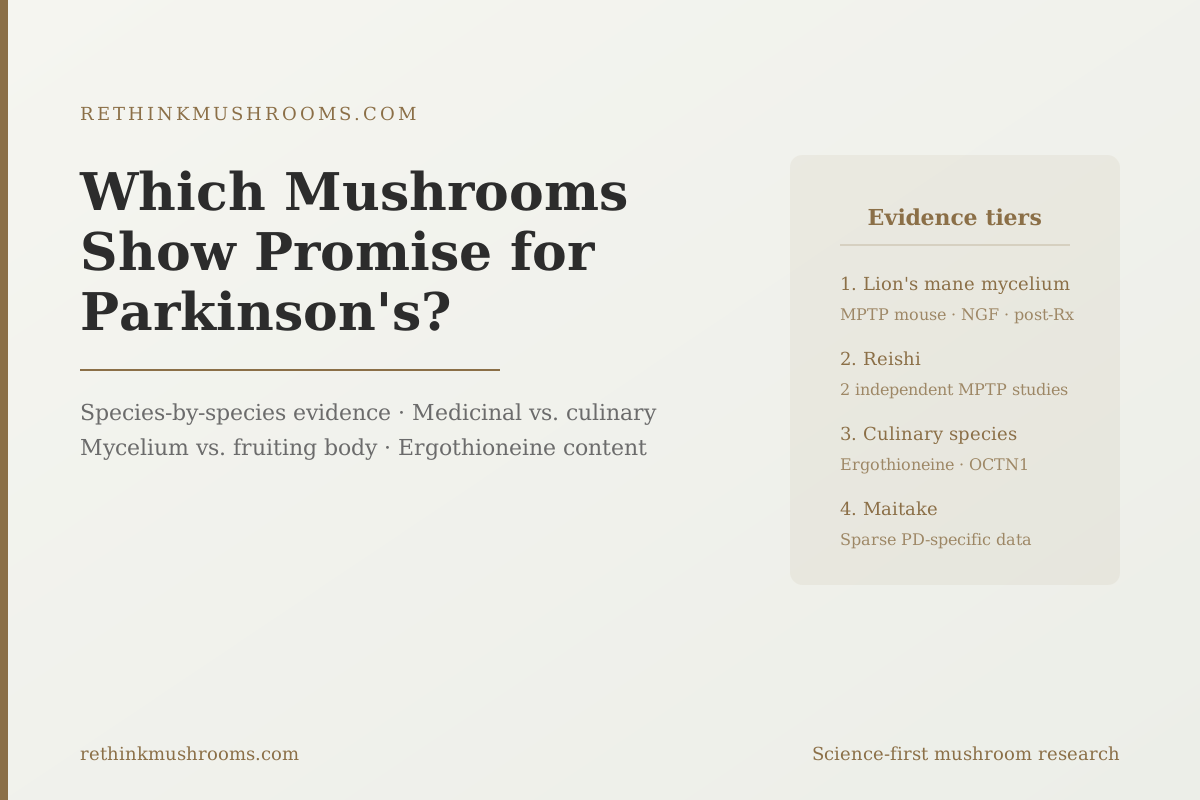
4 evidence tiers
Lion's mane mycelium, reishi, ergothioneine-rich culinary mushrooms, and maitake each have different types and strengths of Parkinson's disease evidence — and the distinctions matter for making sense of the research.
He et al., Molecules, 2022 / Bäumer et al., Antioxidants, 2025
Mycelium, not fruiting body
erinacine A — the key lion's mane compound in MPTP studies — is concentrated in mycelium, not the fruiting body most supplements use
King oyster
highest ergothioneine content per gram among common culinary mushrooms, validated by Tng 2025 multi-model study
No human PD trial
all evidence for all species is preclinical — animal models or cell culture — as of 2026
He et al., Molecules, 2022 / Bäumer et al., Antioxidants, 2025
 View as image ↗
Not all mushrooms have the same evidence for Parkinson's disease, and not all evidence for the same mushroom is the same quality. The question "which mushrooms are good for Parkinson's?" is answerable, but only with the kind of distinctions that don't appear in supplement marketing — like whether the evidence applies to the fruiting body or the mycelium, whether the relevant compound is found in all mushroom species or just one, and what "evidence" actually means in a field where every study so far is preclinical. This is the practical reference guide within the broader pillar on mushrooms and brain health, drawing on the full research base assembled in this cluster.
The short answer first, then the detail: for mechanism-specific neuroprotection, lion's mane mycelium and reishi have the most direct preclinical Parkinson's data. For dietary prevention via ergothioneine, culinary species like king oyster, shiitake, and button mushrooms are the most accessible and possibly the most relevant at the population level. These are different strategies with different evidence bases, and the distinction matters.
Key Takeaways
- Lion's mane has the most studied Parkinson's evidence, specifically for erinacine A-enriched mycelium in MPTP mouse models — not standard fruiting body products
- Erinacine A protected dopaminergic neurons in MPTP models both before and after injury (Lee 2020 post-treatment), which is more clinically relevant than pre-treatment-only evidence
- Reishi (Ganoderma lucidum) has two independent MPTP datasets: mitochondrial regulation (Ren 2019) and anti-neuroinflammation (Ren 2022)
- Culinary mushrooms — king oyster, shiitake, button — contain ergothioneine in amounts that raise plasma levels measurably, and ergothioneine has multi-model evidence for dopaminergic neuroprotection
- Maitake has limited Parkinson's-specific data; its relevance in this context is primarily as an ergothioneine source
- No mushroom has human clinical trial evidence for Parkinson's disease
First: Understanding What Type of Evidence This Is
Every study discussed in this cluster is preclinical. That means animal models (usually MPTP mouse models), cell cultures, or Drosophila experiments. No randomized controlled trial has given any mushroom species or mushroom-derived compound to human Parkinson's disease patients and measured neurological outcomes.
This boundary matters because the mainstream coverage of this research tends to collapse it: "lion's mane may help Parkinson's" is often stated as if the evidence comes from human trials. It doesn't. The honest framing — which the research itself supports — is: "certain mushroom compounds protect dopaminergic neurons in laboratory models of Parkinson's disease, and population data links lower mushroom consumption to higher neurodegeneration risk."
A 2015 review by Ds et al. in Evidence-Based Complementary and Alternative Medicine surveyed the neuroprotective properties of culinary-medicinal mushrooms across the research available at the time, establishing that multiple species showed relevant properties via antioxidant, anti-inflammatory, and neurotrophic mechanisms.[1] The decade since has sharpened and deepened that picture. He et al.'s 2022 review in Molecules is the most comprehensive current synthesis, mapping specific compounds from multiple species against specific mechanisms across multiple neurodegenerative diseases.[2]
With that framing set, here is the species-by-species breakdown.
Lion's Mane: The Most Studied, With a Critical Caveat
Hericium erinaceus — lion's mane — has the largest body of Parkinson's-specific preclinical evidence, concentrated around a compound called erinacine A.
Li et al.'s 2018 systematic review documented that erinacine A-enriched H. erinaceus mycelia improved dopaminergic lesions and reduced oxidative stress in the striatum and substantia nigra of MPTP-treated mice, via NGF (nerve growth factor) stimulation and direct neuroprotective effects.[3] The review confirmed that erinacine A crosses the blood-brain barrier — a prerequisite for oral supplementation to be relevant.
Lee et al.'s 2020 experiment added an important refinement: erinacine A still attenuated MPTP-induced neurotoxicity when given as a post-treatment — after the MPTP exposure, not before.[4] This matters because pre-treatment experimental designs (where the protective compound is given before the toxic insult) have limited clinical relevance; Parkinson's patients don't get pre-dosed before disease onset. Post-treatment data is more realistic.
Bäumer et al.'s 2025 narrative review in Antioxidants is the most comprehensive current synthesis of lion's mane neuroprotective research.[5] It covers the MPTP data, NGF stimulation pathway, antioxidant properties (including ergothioneine content in lion's mane), and anti-neuroinflammatory activity, while being explicit about the clinical evidence gap.
The Mycelium vs. Fruiting Body Distinction
This is the practical issue that matters most for anyone evaluating lion's mane supplements in the context of Parkinson's research.
Erinacines are concentrated in the mycelium — the root-like, thread-like network from which the fruiting body grows. Hericenones, a related class of neuroprotective compounds, are concentrated in the fruiting body. The MPTP preclinical studies used erinacine-enriched mycelium preparations specifically.
Most commercial lion's mane supplements use fruiting body extract, because fruiting bodies are easier to grow at scale and make visually identifiable products. These products do contain hericenones and some erinacines, but not at the concentrations present in mycelium-focused preparations. The preclinical Parkinson's data — the erinacine A MPTP evidence from Li 2018 and Lee 2020 — applies specifically to mycelium preparations, not to fruiting body extracts.
For anyone buying lion's mane with brain health in mind: look for mycelium-based or dual-extract products that specify erinacine content, not just fruiting body powder. Most products don't disclose this; the absence of that specification is informative.
Reishi: Two Independent Studies, Two Different Mechanisms
Ganoderma lucidum — reishi — is the second species with direct MPTP Parkinson's mouse data, and it comes from two independent studies that took different mechanistic approaches.
Ren et al., published in Frontiers in Aging Neuroscience in 2019, found that reishi extract significantly improved locomotor performance and increased tyrosine hydroxylase expression in the substantia nigra pars compacta of MPTP-treated mice.[6] Tyrosine hydroxylase is the enzyme that synthesizes the dopamine precursor L-DOPA — more of it means more surviving, functional dopaminergic neurons. The mechanism involved AMPK/mTOR and PINK1/Parkin pathways, which regulate mitochondrial quality control and the clearance of damaged mitochondria — a process called autophagy, which is disrupted in Parkinson's disease.
Ren et al.'s 2022 paper in Nutrients took the neuroinflammation angle on the same model.[7] Microglial cells are the brain's immune system; when activated by injury like MPTP exposure, they release inflammatory signals that amplify dopaminergic neuron death. The 2022 study found reishi extract significantly suppressed this microglial activation and improved motor function and nigrostriatal dopaminergic function.
Two independent papers, two distinct mechanisms — mitochondrial regulation and anti-neuroinflammation — arriving at the same protective outcome in MPTP mice. This is more robust than a single study because it shows the protective effect is not dependent on any single molecular target.
Reishi does not have the same consumer recognition as lion's mane for brain health, but its Parkinson's-specific evidence base is actually comparably strong in the animal model literature.
Culinary Mushrooms: Why Ergothioneine Content Matters
This is the part the supplement industry has largely missed. The Parkinson's case for culinary mushrooms — king oyster, shiitake, button, cremini, portobello — is not about erinacines or ganoderic acids. It is about ergothioneine.
Ergothioneine is found in all edible mushroom species. It enters dopaminergic neurons via the OCTN1 transporter — a dedicated uptake mechanism expressed in the substantia nigra — where it functions as an antioxidant and metal chelator. Parkinson's disease patients consistently show lower plasma ergothioneine than healthy controls. And in 2025, Tng et al. validated ergothioneine's protective effects across Drosophila, mouse, and human LRRK2 G2019S patient-derived dopaminergic neurons simultaneously.[8]
King oyster mushrooms (Pleurotus eryngii) have the highest ergothioneine content per gram among common culinary species. Shiitake (Lentinula edodes) and button/cremini/portobello (Agaricus bisporus variants) are widely available and contain meaningful amounts. Porcini (Boletus edulis) is exceptional for ergothioneine but less commonly consumed.
The dietary relevance of this is different from the medicinal extract angle. Eating culinary mushrooms regularly is accessible, inexpensive, and raises plasma ergothioneine measurably. For a population-level neurodegeneration prevention strategy, ergothioneine from culinary mushrooms may be more realistic than erinacine A from mycelium preparations.
The mechanistic detail on how ergothioneine protects dopaminergic neurons via OCTN1 is in Mushroom Compounds and Dopaminergic Neuron Protection. For the full epidemiological story connecting population ergothioneine levels to Parkinson's risk, see Ergothioneine and Parkinson's Disease Risk: Evidence Review.
Maitake: Under Investigation, Sparse PD-Specific Data
Maitake (Grifola frondosa) is included in broad surveys of neuroprotective mushrooms — the Ds 2015 review mentions it alongside lion's mane, reishi, and shiitake as having neurotrophic properties.[1] Its beta-glucan polysaccharides have immunomodulatory effects that are relevant to neuroinflammation broadly.
Maitake's Parkinson's-specific evidence is sparse. The strongest argument for including it in a Parkinson's-focused mushroom rotation is as an ergothioneine source, not for any compound specific to the species. It does not have the equivalent of lion's mane's erinacine A MPTP data or reishi's two-study MPTP dataset.
Including maitake for neurological reasons is reasonable given its ergothioneine content and general anti-inflammatory properties, but the case for it is not as specifically supported as lion's mane or reishi in the PD literature.
What a Parkinson's-Focused Mushroom Strategy Actually Looks Like
Based on the research, here is what the evidence supports — and what it doesn't.
For regular dietary intake: Eating 3 or more servings per week of ergothioneine-rich culinary mushrooms — king oyster, shiitake, button — is the most practical dietary strategy supported by the available evidence. This is consistent with the Singapore cohort data linking mushroom consumption to lower neurodegeneration risk, with the finding that PD patients have lower plasma ergothioneine, and with the multi-model animal evidence showing ergothioneine protects dopaminergic neurons.
For supplement investigation: If exploring medicinal mushroom supplements specifically for Parkinson's, the evidence points to erinacine A-enriched lion's mane mycelium and reishi extract. The specific caveat with lion's mane: look for mycelium-based preparations or dual-extract products that specify erinacine content, not standard fruiting body powder.
What the evidence does not support: treating Parkinson's disease with mushroom supplements, replacing prescribed medications, or claiming proven efficacy. No human trial has established any of this.
For a cross-disease perspective on how these same species apply to Alzheimer's disease research, see Cross-Species Mushroom Research in Alzheimer's: Lion's Mane, Reishi, and Cordyceps. For practical guidance on species selection for brain health broadly, see Best Mushrooms for Brain Health in Older Adults.
The most important overall summary: the Parkinson's-focused mushroom research divides cleanly into two strategies — medicinal extracts (lion's mane mycelium, reishi) for mechanism-specific neuroprotection preclinically, and culinary ergothioneine-rich species for population-level dietary exposure. Neither has human trial evidence. Both have a mechanistic and epidemiological case worth taking seriously. For the full context of how these findings fit together, see Mushrooms and Parkinson's Disease: Neuroprotective Research and Mushrooms and Parkinson's: Ergothioneine Deficiency and Dopaminergic Protection.
The Bottom Line
The Parkinson's-focused mushroom evidence divides by strategy: lion's mane mycelium (erinacine A) and reishi have the most direct MPTP mouse model evidence for dopaminergic neuroprotection, while ergothioneine-rich culinary mushrooms (king oyster, shiitake, button) represent the most accessible dietary source of the compound that Parkinson's patients are most consistently depleted of. No species has human clinical trial evidence for Parkinson's disease, and the mycelium vs. fruiting body distinction for lion's mane is essential context for evaluating supplement options.
Frequently Asked Questions
Sources & References
- 1. Source details for this reference are not yet available.
- 2. Source details for this reference are not yet available.
- 3RTHM-00973·Li, I-Chen et al. (2018). “Neurohealth Properties of Hericium erinaceus Mycelia Enriched with Erinacines..” Behavioural neurology.Study breakdown →PubMed →↩
- 4RTHM-01229·Lee, Kam-Fai et al. (2020). “Post-Treatment with Erinacine A, a Derived Diterpenoid of H. erinaceus, Attenuates Neurotoxicity in MPTP Model of Parkinson's Disease..” Antioxidants (Basel.Study breakdown →PubMed →↩
- 5. Source details for this reference are not yet available.
- 6RTHM-01118·Ren, Zhi-Li et al. (2019). “Ganoderma lucidum extract ameliorates MPTP-induced parkinsonism and protects dopaminergic neurons from oxidative stress via regulating mitochondrial function, autophagy, and apoptosis..” Acta pharmacologica Sinica.Study breakdown →PubMed →↩
- 7RTHM-01609·Ren, Zhili et al. (2022). “Ganoderma lucidum Modulates Inflammatory Responses following 1-Methyl-4-Phenyl-1,2,3,6-Tetrahydropyridine (MPTP) Administration in Mice..” Nutrients.Study breakdown →PubMed →↩
- 8RTHM-02195·Tng, Teddy J W et al. (2025). “Ergothioneine Treatment Ameliorates the Pathological Phenotypes of Parkinson's Disease Models..” Journal of neurochemistry.Study breakdown →PubMed →↩