Agaritine Safety
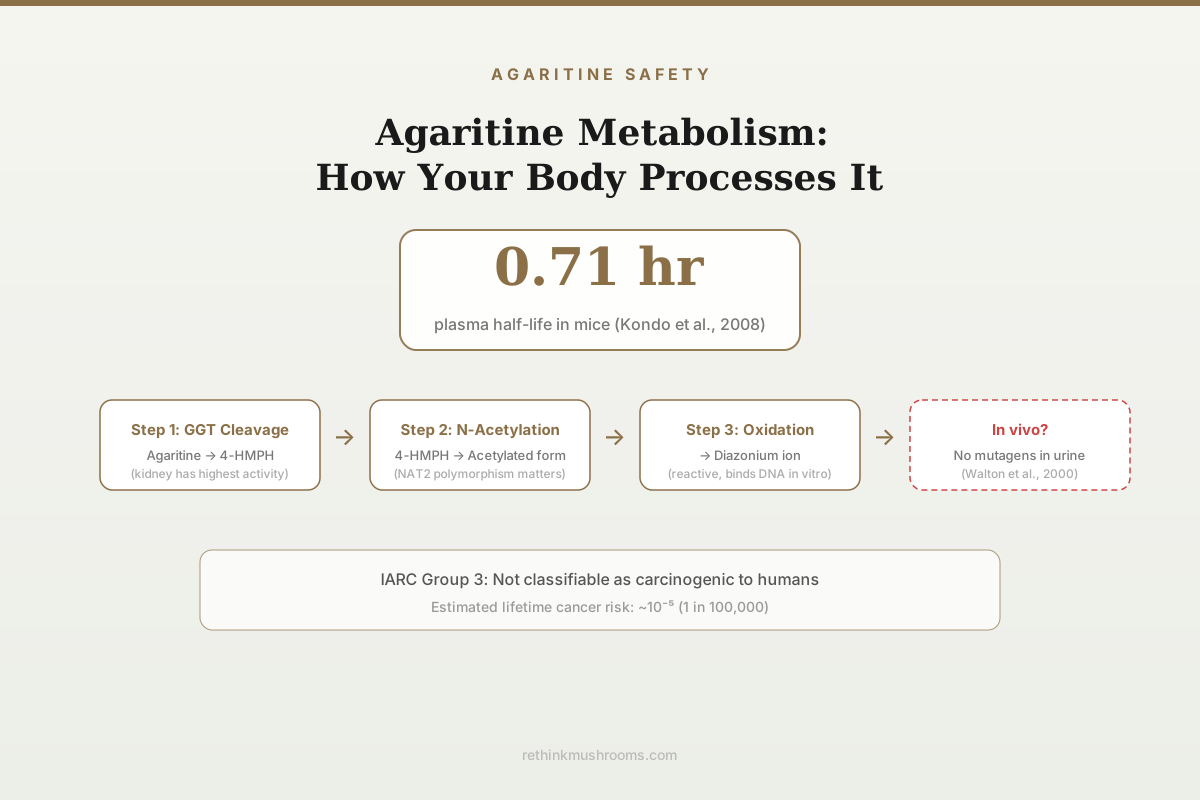
0.71 hour half-life
In mice given 40 mg/kg agaritine, plasma concentration peaked at 20 minutes and fell below detection within 100 minutes, with a half-life of 0.71 hours.
Kondo et al., Food and Chemical Toxicology, 2008
GGT cleavage first
gamma-glutamyl transpeptidase removes glutamyl group
IARC Group 3
not classifiable as carcinogenic to humans
10⁻⁵ lifetime risk
estimated cancer risk from dietary mushroom agaritine
Kondo et al., Food and Chemical Toxicology, 2008
 View as image ↗
Agaritine is a glutamyl hydrazine found in all Agaricus mushrooms, from common button mushrooms to medicinal species like Agaricus blazei. When you eat these mushrooms, your body metabolizes agaritine through a specific enzymatic pathway that produces reactive intermediates capable of binding to DNA and proteins in laboratory conditions. Whether this metabolic activation produces meaningful cancer risk in humans has been debated for over 40 years, and the answer depends heavily on the distinction between what happens in a test tube and what happens in a living body. For a broader look at whether agaritine in Agaricus blazei is dangerous, see our dedicated overview.
The International Agency for Research on Cancer classifies agaritine as Group 3: not classifiable as to its carcinogenicity in humans. This classification reflects the gap between laboratory mutagenicity data and the absence of any demonstrated cancer risk from eating mushrooms. Understanding the metabolic pathway explains why this gap exists.
Key Takeaways
- Agaritine plasma half-life in mice is 0.71 hours, with peak concentration of 0.37 micrograms per milliliter at 20 minutes after a 40 mg/kg dose (Kondo et al., 2008)
- Gamma-glutamyl transpeptidase (GGT) cleaves agaritine to 4-(hydroxymethyl)phenylhydrazine as the first metabolic step; kidney tissue has the highest GGT activity (Walton et al., 1997)
- Agaritine and its metabolites induced mutations in Salmonella typhimurium strains TA104 and TA100, but only with enzymatic activation (Friederich et al., 1986)
- No mutagens or promutagens were detected in urine of rats or mice after agaritine administration (Walton et al., 2000)
- The estimated cumulative lifetime cancer risk from dietary agaritine is approximately 10 to the negative 5th power, roughly 1 additional cancer per 100,000 people (Shephard et al., 1995)
- In mice, most radioactive-labeled agaritine was excreted within 24 hours, split between urine and feces (Walton et al., 2000)
Step 1: Absorption From the Gut
Agaritine is absorbed rapidly from the gastrointestinal tract. Kondo et al. (2008) administered 40 mg/kg agaritine to mice by oral gavage and tracked plasma levels using liquid chromatography-tandem mass spectrometry (LC-MS/MS). Agaritine appeared in plasma within minutes, reached a peak concentration of 0.37 micrograms per milliliter at approximately 20 minutes (0.33 hours), and returned to basal levels within 100 minutes.[1]
The plasma half-life was 0.71 hours. For comparison, caffeine has a half-life of 3 to 5 hours in humans. Agaritine moves through the bloodstream and out again rapidly, which limits the duration of exposure to any reactive metabolites produced during processing.
Walton et al. (2000) used radiolabeled agaritine (carbon-14 labeled) in rats and mice to track total body distribution. In both species, agaritine was rapidly absorbed, with higher blood levels in mice than rats. Most radioactivity was excreted within the first 24 hours: in rats, roughly equally split between urine and feces; in mice, more was excreted in urine.[2]
No human pharmacokinetic studies have been published. The animal data suggests rapid absorption and clearance, but human gut transit times, enzyme activity levels, and metabolic rates differ from rodents. Human N-acetyltransferase activity varies substantially between individuals due to genetic polymorphisms (the NAT2 fast/slow acetylator phenotype), which could alter the relative production of acetylated versus free hydrazine metabolites. Whether fast or slow acetylators process dietary agaritine differently has not been studied.
Step 2: GGT Cleavage to Free Hydrazine
The first metabolic step is enzymatic removal of the glutamyl group by gamma-glutamyl transpeptidase (GGT). This converts agaritine to 4-(hydroxymethyl)phenylhydrazine (4-HMPH), the free hydrazine form. GGT is expressed in multiple tissues, with the highest activity in the kidney.[3]
Walton et al. (1997) demonstrated that hepatic microsomes, which have very low GGT activity, did not significantly activate agaritine to mutagenic products. Kidney homogenates, with high GGT activity, did produce mutagenic metabolites from agaritine. This tissue-specific activation is important: the organ most capable of activating agaritine is the kidney, not the liver where most drug metabolism occurs.
The GGT cleavage step also occurs within the mushroom itself before consumption. Walton et al. (2001) showed that whole mushroom homogenate metabolizes agaritine through both GGT and mushroom tyrosinase. When you blend or damage fresh mushroom tissue, these endogenous enzymes begin breaking down agaritine before it reaches your gut.[4]
Step 3: N-Acetylation
The free hydrazine (4-HMPH) can be acetylated by N-acetyltransferase to form N-acetyl-4-(hydroxymethyl)phenylhydrazine. This acetylated form is more stable than the free hydrazine but is itself a known tumorigenic compound. Toth (1993) assessed the carcinogenic potency of this metabolite and calculated that the estimated cancer risk from dietary mushroom agaritine was approximately 10 to the negative 5th power over a lifetime, translating to roughly 1 additional cancer per 100,000 people who consume mushrooms regularly.[5]
For context, the U.S. EPA considers a lifetime cancer risk below 10 to the negative 6th power (1 in a million) as negligible. The estimated agaritine risk of 10 to the negative 5th power is above this threshold but below the 10 to the negative 4th power level that typically triggers regulatory action. This calculation assumed maximum lifetime mushroom consumption and did not account for the reduction of agaritine by cooking, which destroys a substantial fraction of the compound.
Step 4: Oxidation to the Diazonium Ion
The critical activation step converts the hydrazine metabolite to a reactive diazonium ion through oxidation. This diazonium ion is the species capable of binding covalently to DNA and proteins. Walton et al. (1997) showed that agaritine-derived reactive intermediates bound covalently to proteins in vitro and induced mutations in the Ames test using Salmonella typhimurium strain TA104.[3]
Walton et al. (1997, separate publication) further characterized the enzymatic systems capable of this bioactivation. Both mammalian enzymes and fungal tyrosinase can convert agaritine metabolites to mutagenic products. The mammalian enzyme system required both microsomal enzymes and cofactors (NADPH), while mushroom tyrosinase alone was sufficient for activation.[6]
Friederich et al. (1986) had earlier established the mutagenic activity of agaritine and its derivatives using the Ames test. Agaritine itself showed weak mutagenicity, but the derivative 4-HMPH and its diazonium product were more potent. The mutagenicity required metabolic activation by either S9 liver fraction or mushroom extract, meaning agaritine itself is a pro-mutagen rather than a direct mutagen.[7]
Why Laboratory Mutagenicity Does Not Equal Human Cancer Risk
The metabolic pathway described above produces reactive intermediates that damage DNA in test tubes and bacterial assays. The question is whether this happens at biologically meaningful levels in living humans.
Rapid Clearance Limits Exposure
The 0.71-hour half-life means that agaritine and its metabolites are present in blood for a very short window. Kondo et al. (2006) developed an LC-MS/MS method to track agaritine in mice and found that tissue concentrations dropped rapidly after peak absorption, with most of the compound cleared before the metabolic activation pathways could generate large quantities of reactive intermediates.[8]
No Urinary Mutagens Detected
Walton et al. (2000) tested urine from rats and mice given agaritine for mutagenic activity using the Ames test. No mutagens or promutagens were detected in the urine of either species. If reactive metabolites were being formed and circulating systemically at meaningful concentrations, some mutagenic activity would be expected in the urine. The negative result suggests that the metabolic activation pathway, while demonstrable in vitro, does not produce circulating mutagenic metabolites at doses achievable through dietary consumption.[2]
The lacI Transgenic Mouse Study
Shephard et al. (1995) conducted the most direct test of in vivo genotoxicity. They fed agaritine to lacI transgenic mice, a strain engineered to detect mutations in a specific reporter gene across multiple tissues. After chronic agaritine exposure, mutation frequencies in the stomach, liver, and kidney were not elevated above background levels. The authors concluded that the genotoxicity of agaritine observed in bacterial assays was not recapitulated in the mammalian system at dietary-relevant doses.[9]
This study is the strongest evidence against clinically meaningful genotoxicity from dietary agaritine. The transgenic mouse model is designed specifically to detect the kind of mutations that hydrazine compounds would produce, and it found none at dietary-relevant doses across three target organs (stomach, liver, kidney) over a chronic exposure period. The sensitivity of the lacI system for detecting low-frequency mutations makes this negative result particularly informative.
Agaritine Degrades Before You Eat It
Hajslova et al. (2002) measured agaritine stability under various storage and processing conditions. Agaritine content in fresh mushrooms decreased during storage at room temperature, refrigeration, and especially during thermal processing. Boiling reduced agaritine levels substantially, and even storage at 4 degrees Celsius for several days reduced content.[10]
This means the agaritine dose from cooked mushrooms is substantially lower than the dose used in laboratory mutagenicity studies, which typically use purified agaritine at concentrations far exceeding dietary exposure. The question of how different agaritine levels compare between Agaricus blazei and button mushrooms is relevant here because species vary in baseline content. For related safety context, see the broader agaritine controversy.
What Remains Unknown
Despite decades of research, several gaps persist:
No human pharmacokinetic data. All absorption and clearance data comes from rats and mice. Human GGT activity, N-acetyltransferase polymorphisms (which vary widely between individuals), and kidney enzyme levels could produce different metabolic profiles than rodent models predict.
Persistent oxidative DNA-damage markers in humans have not been measured. Kondo et al. (2008) found that while plasma agaritine cleared rapidly in mice, the urinary oxidative DNA-damage marker 8-OHdG remained abnormal for up to 11 days after a single administration.[1] Whether a similar pattern occurs in humans at dietary doses is unknown.
Chronic low-dose exposure is unstudied. Most people who eat mushrooms do so repeatedly over decades. The combination of rapid clearance with a prolonged urinary oxidative-marker signal in mice raises theoretical questions about cumulative effects that no study has directly addressed. Epidemiological data from populations with high mushroom consumption (Japan, parts of Europe) has not identified elevated cancer rates associated with Agaricus intake, but no study has been specifically designed to detect a risk of this magnitude. The Agaricus blazei safety profile covers the broader safety data from clinical trials, but those trials did not specifically measure agaritine metabolites.
The Bottom Line
Agaritine from Agaricus mushrooms is absorbed rapidly, reaches peak plasma concentration within 20 minutes in mice, and is cleared with a half-life of 0.71 hours. The metabolic pathway proceeds through GGT cleavage, N-acetylation, and oxidation to a reactive diazonium ion capable of binding DNA. This pathway produces mutagenic intermediates in bacterial assays and in vitro systems. In vivo, however, no urinary mutagens were detected in exposed rodents, and a transgenic mouse model found no elevation in mutation frequencies at dietary-relevant doses. The IARC classifies agaritine as Group 3 (not classifiable as carcinogenic to humans), and the estimated lifetime cancer risk from dietary mushroom agaritine is approximately 1 in 100,000.
Frequently Asked Questions
Sources & References
- 1RTHM-00139·Kondo, Kazunari et al. (2008). “The metabolisms of agaritine, a mushroom hydrazine in mice..” Food and chemical toxicology : an international journal published for the British Industrial Biological Research Association.Study breakdown →PubMed →↩
- 2RTHM-00033·Walton, K et al. (2000). “Fate of the mushroom hydrazine agaritine in the rat and mouse..” Nutrition and cancer.Study breakdown →PubMed →↩
- 3RTHM-00022·Walton, K et al. (1997). “Bioactivation of the mushroom hydrazine, agaritine, to intermediates that bind covalently to proteins and induce mutations in the Ames test..” Carcinogenesis.Study breakdown →PubMed →↩
- 4RTHM-00040·Walton, K et al. (2001). “The metabolism and bioactivation of agaritine and of other mushroom hydrazines by whole mushroom homogenate and by mushroom tyrosinase..” Toxicology.Study breakdown →PubMed →↩
- 5RTHM-00014·Toth, B et al. (1993). “Agaricus bisporus: an assessment of its carcinogenic potency..” Mycopathologia.Study breakdown →PubMed →↩
- 6RTHM-00023·Walton, K et al. (1997). “Bioactivation of mushroom hydrazines to mutagenic products by mammalian and fungal enzymes..” Mutation research.Study breakdown →PubMed →↩
- 7RTHM-00006·Friederich, U et al. (1986). “The mutagenic activity of agaritine--a constituent of the cultivated mushroom Agaricus bisporus--and its derivatives detected with the Salmonella/mammalian microsome assay (Ames Test)..” Zeitschrift fur Lebensmittel-Untersuchung und -Forschung.Study breakdown →PubMed →↩
- 8RTHM-00104·Kondo, Kazunari et al. (2006). “Analysis of agaritine in mushrooms and in agaritine-administered mice using liquid chromatography-tandem mass spectrometry..” Journal of chromatography. B.Study breakdown →PubMed →↩
- 9RTHM-00018·Shephard, S E et al. (1995). “Genotoxicity of agaritine in the lacI transgenic mouse mutation assay: evaluation of the health risk of mushroom consumption..” Food and chemical toxicology : an international journal published for the British Industrial Biological Research Association.Study breakdown →PubMed →↩
- 10RTHM-00045·Hajslová, J et al. (2002). “Stability of agaritine - a natural toxicant of Agaricus mushrooms..” Food additives and contaminants.Study breakdown →PubMed →↩