Agaritine Safety
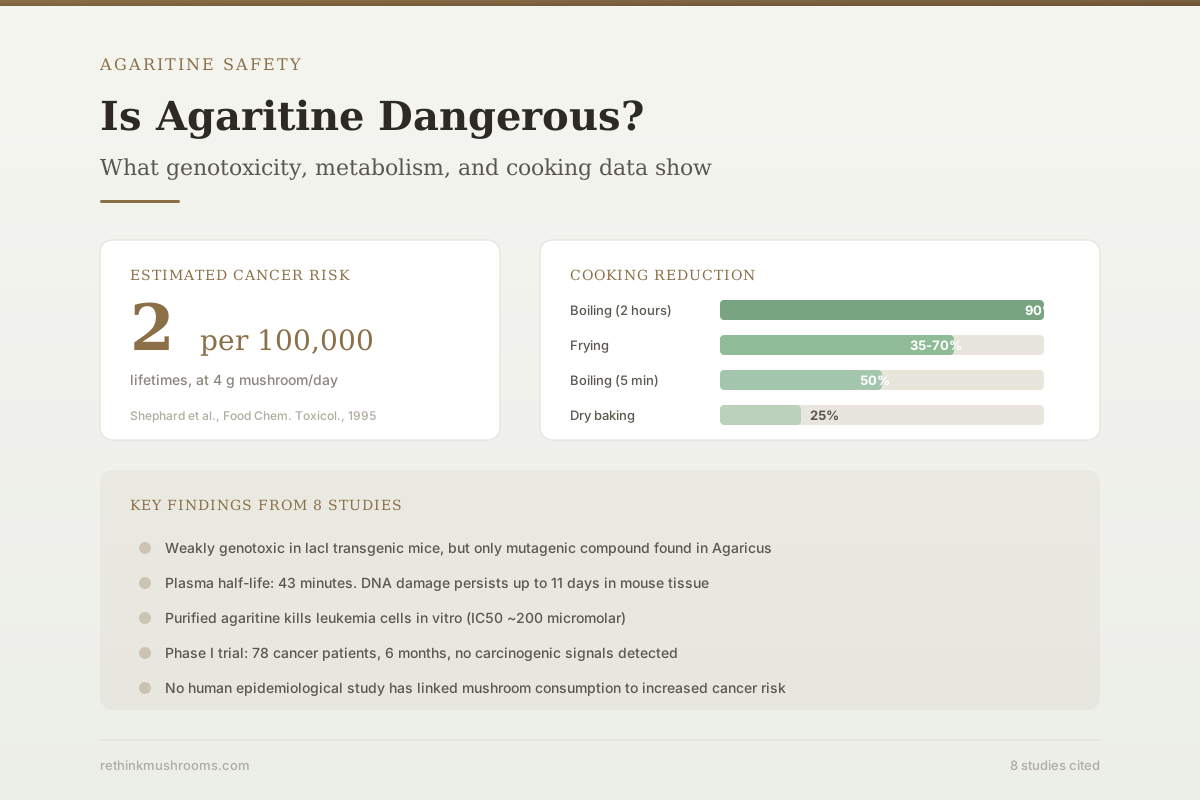
2 per 100,000
The estimated lifetime cancer risk from agaritine in mushrooms consumed at average Swiss intake (4 g/day) was calculated at roughly 2 additional cases per 100,000 lifetimes.
Shephard et al., Food and Chemical Toxicology, 1995
Hydrazine Compound
structural class that includes known carcinogens
90% Reduction
achievable through cooking and processing
Anti-Tumor Activity
purified agaritine kills leukemia cells in vitro
Shephard et al., Food and Chemical Toxicology, 1995
 View as image ↗
Agaritine is a naturally occurring hydrazine derivative found in all Agaricus species, including the common button mushroom (A. bisporus), portobello (also A. bisporus), and the medicinal mushroom Agaricus blazei Murill. Its chemical structure contains a hydrazine group, the same functional moiety found in known carcinogens like hydrazine itself and dimethylhydrazine. This structural similarity is what triggered concern decades ago. The actual evidence, spanning genotoxicity assays, metabolic studies, cooking degradation measurements, and epidemiological observation, paints a more nuanced picture. Agaritine is weakly genotoxic in some test systems, rapidly metabolized and cleared from the body, substantially reduced by cooking, and has never been linked to cancer in any human study. In a paradox that makes the compound more interesting than dangerous, purified agaritine has shown anti-tumor activity against leukemia cells in laboratory studies. The broader controversy over whether agaritine is a carcinogen or harmless continues, but the data available today tips heavily toward safety at normal consumption levels.
Key Takeaways
- The estimated lifetime cancer risk from agaritine at average mushroom consumption (4 g/day) is approximately 2 additional cases per 100,000 lifetimes, based on mutagenicity data extrapolated to carcinogenic potency (Shephard et al., Food and Chemical Toxicology, 1995)
- Agaritine is rapidly cleared from plasma with a half-life of 0.71 hours after oral administration, though DNA damage in mouse tissues persisted up to 11 days after a single dose (Walton et al., Toxicology, 2001)
- Cooking reduces agaritine content by 25-70% depending on method: frying achieves 35-70% reduction, boiling extracts 50% into water within 5 minutes, and canning reduces content 10-fold (Schulzova & Hajslova, Food Additives and Contaminants, 2002)
- Agaritine content in Agaricus blazei products ranged from 0.72 to 7.10 mg/g dry weight, with hot water extracts retaining 40-50% of initial agaritine even after 30-120 minutes at 120 degrees C (Nagaoka et al., Chemical and Pharmaceutical Bulletin, 2006)
- Purified agaritine from A. blazei induced apoptosis in human leukemic U937 cells with an IC50 of approximately 200 micromolar, killing cancer cells through mitochondrial membrane depolarization (Endo et al., Biochimica et Biophysica Acta, 2010)
- A Phase I clinical trial of ABM extract in 78 cancer survivors over 6 months found no evidence of carcinogenic effects, with adverse events in 12% of participants being limited to GI symptoms (Ohno et al., Evidence-Based CAM, 2011)
What Agaritine Is and Why It Raised Concerns
Agaritine (beta-N-[gamma-L(+)-glutamyl]-4-hydroxymethylphenylhydrazine) is a naturally occurring amino acid derivative unique to the Agaricus genus. It is not found in other medicinal mushroom genera like Ganoderma (reishi), Lentinula (shiitake), or Hericium (lion's mane).
The concern stems from its hydrazine moiety. Hydrazine itself is a Group 2B carcinogen (possibly carcinogenic to humans) according to IARC. Several synthetic hydrazine derivatives are proven carcinogens in animal models. Because agaritine contains a substituted hydrazine group, researchers in the 1980s and 1990s tested it for mutagenicity and genotoxicity to determine whether it posed a risk to mushroom consumers.
The compound was first isolated in the 1960s, and concerns escalated after early Ames test results showed mutagenic activity for agaritine derivatives.[2] However, agaritine itself did not activate the umu gene of Salmonella in standard genotoxicity assays, and subsequent testing revealed that the genotoxic potential was weaker than initially feared. A comprehensive 2017 review by Da Silva de Souza and colleagues characterized the evidence as showing "benefits and controversies" rather than clear-cut danger.[8]
The Genotoxicity Evidence
The most rigorous genotoxicity study of agaritine was published by Shephard and colleagues in 1995 using the lacI transgenic mouse mutation assay.[1] This assay detects mutations in a bacterial gene (lacI) integrated into the mouse genome, providing a direct measure of in vivo mutagenic potential.
The key findings:
- Agaritine was weakly genotoxic in vivo
- No genotoxic activity other than that attributable to agaritine was detected in A. bisporus extracts, meaning agaritine is the only meaningful genotoxic compound in the mushroom
- Using a quantitative correlation between lacI test mutagenicity and carcinogenic potency, the researchers estimated that average Swiss mushroom consumption (4 g/day) would contribute approximately 2 additional cancer cases per 100,000 lifetimes
To put that number in perspective: the background lifetime cancer risk is roughly 40,000 per 100,000 people. An additional 2 per 100,000 represents a 0.005% increase. This is within the range of risk from many common foods containing natural mutagens, including coffee (cafestol), celery (psoralens), and grilled meat (heterocyclic amines).
The limitation of this estimate is that it extrapolates from mouse data to human risk using mathematical modeling. No epidemiological study has ever detected an increase in cancer among heavy mushroom consumers, though such studies would need very large populations to detect a risk this small.
How the Body Processes Agaritine
Walton and colleagues mapped agaritine's metabolic fate in 2001, studying both its breakdown by mushroom enzymes (tyrosinase) and its fate in mammalian systems.[2]
Inside the mushroom itself, tyrosinase converts agaritine into 4-hydroxymethylphenylhydrazine (HMPH) and then into reactive diazonium intermediates. These intermediates are the actual genotoxic species. The question for human safety is whether this conversion happens inside the human body after mushroom consumption.
Pharmacokinetic data shows that agaritine is rapidly absorbed and eliminated:
- Peak plasma concentration occurs at approximately 20 minutes after oral administration
- Plasma half-life is 0.71 hours (about 43 minutes)
- The compound is cleared rapidly, suggesting efficient metabolic processing
However, one concerning finding from the Walton study was that while agaritine disappeared quickly from plasma, DNA damage (measured by the comet assay) persisted in mouse tissues for up to 11 days after a single dose. This disconnect between rapid plasma clearance and prolonged DNA effects suggests that agaritine or its metabolites interact with DNA before being eliminated. Whether this transient DNA damage has functional consequences at dietary doses remains unknown.
The detailed metabolism pathway in humans is covered in a separate article.
Agaritine Content in ABM Products
Nagaoka and colleagues developed an HPLC method to measure agaritine and its derivatives specifically in Agaricus blazei products.[6] Their findings reveal wide variation:
- Fresh ABM contained 0.72 mg/g agaritine (dry weight basis)
- Commercially processed ABM products ranged from 0.72 to 7.10 mg/g dry weight
- Hot water extracts retained 40-50% of initial agaritine even after 30-120 minutes at 120 degrees C
- Ethanol fractionation effectively removed agaritine from extracts
This last point is significant for supplement consumers. Hot water extraction, the standard method for producing ABM beta-glucan supplements, does not fully eliminate agaritine. If agaritine removal is a priority, ethanol fractionation is more effective. Some ABM extract products use dual extraction (hot water plus ethanol), which would be expected to have lower agaritine content than hot water-only extracts.
The comparison of agaritine levels between A. blazei and common button mushrooms shows that ABM generally contains higher concentrations than A. bisporus, though both are well within the range that epidemiological data suggests is safe.
How Cooking and Processing Reduce Agaritine
Schulzova and Hajslova published the most comprehensive study of household processing effects on agaritine in 2002.[4] They tested multiple cooking methods on cultivated Agaricus mushrooms:
| Processing Method | Agaritine Reduction |
|---|---|
| Refrigerated storage (10 days) | 25-50% |
| Freezing | Up to 75% |
| Boiling (5 minutes) | 50% extracted into water |
| Boiling (2 hours, sauce-making) | 90% total reduction |
| Frying in oil or butter | 35-70% |
| Dry baking (pizza-style) | ~25% |
| Canning | 90% (10-fold reduction) |
These numbers are consistent with a separate stability study by Hajslova and colleagues, which found that agaritine decomposes significantly between harvest and sale due to enzyme-mediated degradation at ambient temperatures.[3] By the time a consumer buys fresh mushrooms from a store, a meaningful fraction of the original agaritine has already degraded.
The practical takeaway: cooking virtually any way reduces agaritine exposure. The highest-risk scenario would be consuming large quantities of raw, freshly harvested ABM, which is not how most people use this mushroom. For the full evidence on how cooking destroys agaritine, see the dedicated article.
The Anti-Tumor Paradox
In a finding that complicates the "agaritine is dangerous" narrative, Endo and colleagues demonstrated in 2010 that purified agaritine from A. blazei kills human leukemia cells in culture.[5]
Working with the U937 leukemic cell line, they found:
- Agaritine induced apoptosis (programmed cell death) in leukemia cells with an IC50 of approximately 200 micromolar
- The mechanism involved mitochondrial membrane depolarization, a hallmark of intrinsic apoptotic pathway activation
- Agaritine activated caspases, the proteases that execute cell death
- The effect was selective: concentrations that killed leukemia cells were less toxic to normal cells
This does not mean agaritine treats leukemia. The concentrations used (200 micromolar) are far higher than plasma levels achievable through mushroom consumption. But it does mean that the same chemical properties that make agaritine weakly genotoxic (its reactive hydrazine group) may also give it anti-cancer activity at higher concentrations. Many chemotherapy drugs are genotoxic by design.
This paradox is relevant to the ongoing Agaricus blazei cancer research, where ABM extracts containing agaritine have shown anti-tumor effects in both animal and human studies.
Clinical Safety Data
The most relevant human safety data comes from the Ohno 2011 Phase I trial, which gave ABM extract to 78 cancer survivors for 6 months at doses up to 5.4 g daily.[7] This is the longest controlled exposure study of ABM in humans.
Key safety outcomes:
- Adverse events occurred in 9 patients (12%), primarily nausea and diarrhea
- One patient developed liver dysfunction attributed to a food allergy
- No adverse events showed a dose-dependent pattern
- Laboratory parameters remained normal across all dose levels
- No cancers developed during the 6-month observation period
A 6-month observation window cannot detect carcinogenic effects, which typically require years to decades of exposure to manifest. But the absence of precancerous markers, liver toxicity signals, or dose-dependent adverse events is consistent with the low-risk profile suggested by the Shephard estimate.
For the full ABM safety profile including non-agaritine concerns like drug-induced liver injury, see the safety article. For potential drug interactions related to ABM consumption, see the dedicated article.
Putting the Risk in Context
The question "Is agaritine dangerous?" requires context. At dietary doses from normal mushroom consumption or standard supplement use:
- The compound is weakly genotoxic but estimated to add only 2 cancer cases per 100,000 lifetimes at average consumption
- It is rapidly cleared from the body (half-life under 1 hour)
- Cooking reduces exposure by 25-90% depending on method
- Ethanol-fractionated extracts contain less agaritine than hot water extracts
- No human epidemiological study has linked mushroom consumption to increased cancer risk
- The only clinical trial monitoring ABM safety over 6 months found no concerning signals
The compound is not harmless in the strict toxicological sense. It is genotoxic in some assays and produces persistent DNA damage in mouse models. But the risk it poses at real-world exposure levels appears to be negligible compared to the background cancer risk from other dietary and environmental sources. The bioactive compound profile of ABM includes both agaritine and the beta-glucans responsible for its documented immune benefits, and the evidence suggests the latter substantially outweighs the former in terms of health impact.
The Bottom Line
Agaritine is a hydrazine-containing compound found naturally in all Agaricus mushrooms, including A. blazei. The most rigorous genotoxicity study estimated it adds roughly 2 cancer cases per 100,000 lifetimes at average mushroom intake. The compound is rapidly metabolized (plasma half-life 43 minutes), substantially reduced by cooking (25-90%), and has never been linked to cancer in any human study. A Phase I trial of ABM extract in 78 cancer patients over 6 months found no safety concerns related to agaritine exposure. In a paradoxical twist, purified agaritine kills leukemia cells in vitro through mitochondrial-mediated apoptosis, suggesting the same reactive chemistry that makes it weakly mutagenic may also have anti-cancer properties at higher concentrations.
Frequently Asked Questions
Sources & References
- 1RTHM-00018·Shephard, S E et al. (1995). “Genotoxicity of agaritine in the lacI transgenic mouse mutation assay: evaluation of the health risk of mushroom consumption..” Food and chemical toxicology : an international journal published for the British Industrial Biological Research Association.Study breakdown →PubMed →↩
- 2RTHM-00040·Walton, K et al. (2001). “The metabolism and bioactivation of agaritine and of other mushroom hydrazines by whole mushroom homogenate and by mushroom tyrosinase..” Toxicology.Study breakdown →PubMed →↩
- 3RTHM-00045·Hajslová, J et al. (2002). “Stability of agaritine - a natural toxicant of Agaricus mushrooms..” Food additives and contaminants.Study breakdown →PubMed →↩
- 4RTHM-00049·Schulzová, V et al. (2002). “Influence of storage and household processing on the agaritine content of the cultivated Agaricus mushroom..” Food additives and contaminants.Study breakdown →PubMed →↩
- 5RTHM-00180·Endo, Masahiro et al. (2010). “Agaritine purified from Agaricus blazei Murrill exerts anti-tumor activity against leukemic cells..” Biochimica et biophysica acta.Study breakdown →PubMed →↩
- 6RTHM-00106·Nagaokaa, Megumi Hamano et al. (2006). “Measurement of a genotoxic hydrazine, agaritine, and its derivatives by HPLC with fluorescence derivatization in the agaricus mushroom and its products..” Chemical & pharmaceutical bulletin.Study breakdown →PubMed →↩
- 7RTHM-00229·Ohno, Satoshi et al. (2011). “Phase I Clinical Study of the Dietary Supplement, Agaricus blazei Murill, in Cancer Patients in Remission..” Evidence-based complementary and alternative medicine : eCAM.Study breakdown →PubMed →↩
- 8RTHM-00468·da Silva de Souza, Aline Cristine et al. (2017). “Agaricus blazei Bioactive Compounds and their Effects on Human Health: Benefits and Controversies..” Current pharmaceutical design.Study breakdown →PubMed →↩