Agaritine Safety
6-16x lower
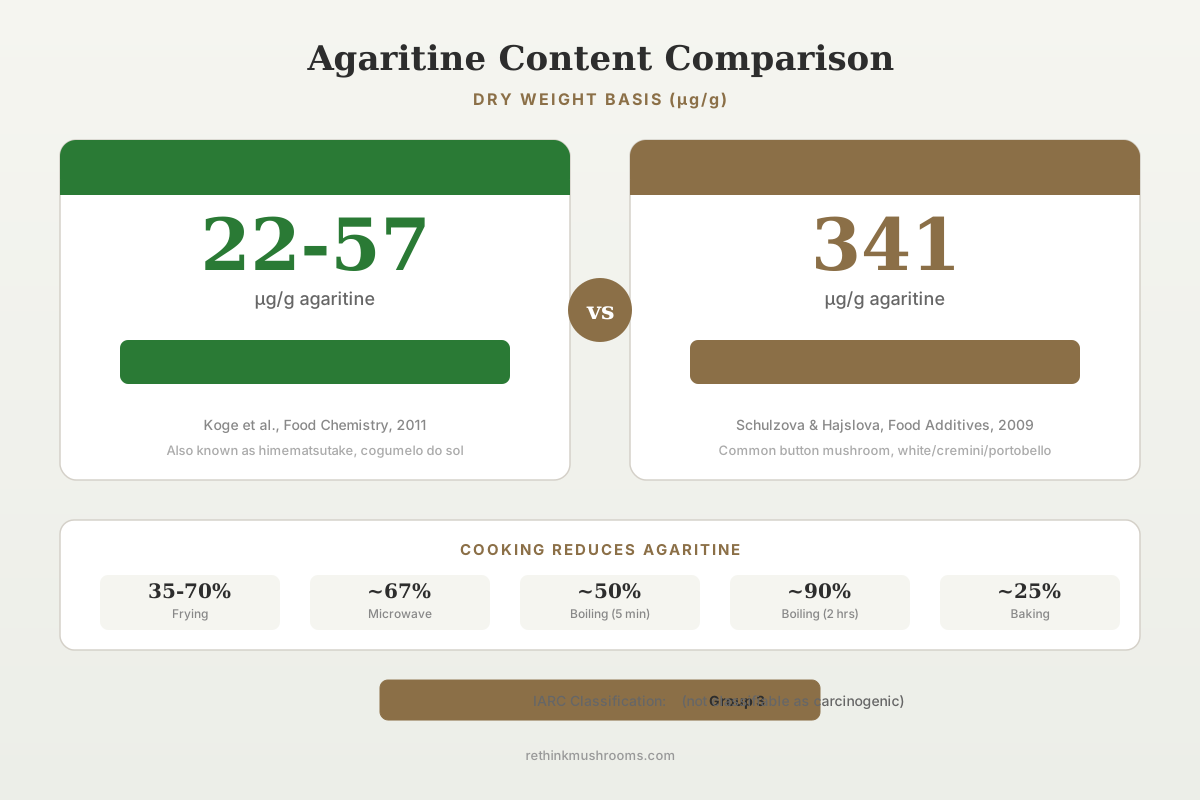
Agaricus blazei contains 22-57 μg/g agaritine on a dry weight basis, roughly 6-16 times less than the 341 μg/g measured in Agaricus bisporus (button mushroom).
Koge et al., Food Chemistry, 2011; Schulzova & Hajslova, Food Additives & Contaminants, 2009
22-57 μg/g
agaritine in A. blazei (dry weight)
200-500 mg/kg
agaritine in A. bisporus (fresh weight)
35-70%
reduction from frying in oil or butter
Koge et al., Food Chemistry, 2011; Schulzova & Hajslova, Food Additives & Contaminants, 2009
 View as image ↗
Agaritine is a phenylhydrazine derivative found in every Agaricus species ever tested, from the button mushrooms sold in every grocery store to the medicinal Agaricus blazei cultivated in Brazil and Japan. The compound has been the subject of safety debates since the 1960s, when researchers first identified its hydrazine structure and began testing whether it posed a cancer risk. The answer, after six decades of research, is more nuanced than either the safety claims or the scare headlines suggest. What the data shows clearly is that A. blazei contains substantially less agaritine than the common button mushroom, that cooking dramatically reduces whatever agaritine is present, and that IARC classifies agaritine as Group 3: not classifiable as to its carcinogenicity in humans.[1]
Key Takeaways
- A. blazei contains 22-57 μg/g agaritine on a dry weight basis, compared to 341 μg/g in A. bisporus, making it 6-16 times lower (Koge et al., 2011)
- Among 53 wild Agaricus species tested, agaritine ranged from near zero to 10,000 mg/kg fresh weight, with A. bisporus in the moderate range at 200-500 mg/kg (Schulzova and Hajslova, 2009)
- Frying in oil or butter reduces agaritine content by 35-70%; boiling extracts approximately 50% into the cooking liquid within 5 minutes (Schulzova et al., 2002)
- Pure agaritine decomposes exponentially at 120 degrees C, but agaritine in mushroom water extracts is partially heat-stable, with 20-50% remaining after 120 minutes at 120 degrees C (Hajslova et al., 2002)
- IARC classifies agaritine as Group 3 (not classifiable as carcinogenic to humans); feeding studies using mushrooms have not shown toxicological effects at normal consumption levels
- The lacI transgenic mouse assay estimated that mushroom consumption at 4 g/day would increase cancer risk by about 3 per 100,000 lifetimes, below regulatory concern thresholds (Shephard et al., 1995)
What agaritine is
Agaritine (beta-N-[gamma-L(+)-glutamyl]-4-hydroxymethylphenylhydrazine) is an amino acid derivative unique to the genus Agaricus. It occurs naturally in the fruiting bodies of all Agaricus species, produced as a secondary metabolite during mushroom growth.[1]
The safety concern centers on its hydrazine backbone. Hydrazines as a chemical class include known carcinogens and mutagens. Agaritine itself is not directly genotoxic, but its metabolic breakdown product, 4-hydroxymethylbenzenediazonium ion, can form DNA adducts in vitro.[4] The question has always been whether this chemical potential translates into actual risk at the concentrations found in food mushrooms.
IARC reviewed the evidence and placed agaritine in Group 3: "not classifiable as to its carcinogenicity to humans." This means the available evidence was insufficient to determine whether agaritine causes cancer in humans, not that it has been proven safe.[1] The broader safety profile of A. blazei encompasses other concerns beyond agaritine, but agaritine dominates the public discussion.
Agaritine levels across Agaricus species
The most comprehensive survey of agaritine across the genus comes from Schulzova and Hajslova (2009), who analyzed 53 wild Agaricus species collected from nature in the Czech Republic between 1998 and 2001.[1]
The variation was enormous:
- Highest: A. elvensis contained up to 10,000 mg/kg fresh weight
- High (>1,000 mg/kg): 24 of 53 species exceeded this level
- Moderate (100-1,000 mg/kg): 20 species fell in this range
- Low (<100 mg/kg): 9 species, including A. blazei, contained less than 100 mg/kg
- A. bisporus (button mushroom): 200-500 mg/kg fresh weight, placing it in the moderate range
This means the common button mushroom consumed worldwide by the hundreds of millions of people annually falls squarely in the middle of the agaritine distribution for the genus. It is neither the highest nor the lowest. And A. blazei sits below it.
A. blazei: quantified levels
Koge et al. (2011) measured agaritine specifically in A. blazei (sold commercially as a health food in Japan) and found concentrations of 22-57 μg/g on a dry weight basis. For comparison, A. bisporus measured 341 μg/g in the same analytical framework.[2]
This means A. blazei contains roughly 6 to 16 times less agaritine than the button mushroom, depending on the specific batch. The lower bound (22 μg/g) represents a 15.5-fold reduction compared to A. bisporus; the upper bound (57 μg/g) represents a 6-fold reduction.
The Firenzuoli et al. (2008) review identified agaritine as "the main safety concern" for A. blazei supplements, but this characterization reflected the state of knowledge at the time.[5] The quantitative data from Koge et al. (2011), published three years later, showed that A. blazei actually contains far less agaritine than the common mushroom that billions of people consume without concern.
An additional factor: within A. blazei itself, agaritine content varies by strain, growing conditions, and harvest timing. Commercial A. blazei spawns in Brazil are often genetically narrow (potentially clones of a single Japanese import), which means the 22-57 μg/g range may represent a limited subset of the species' full variation. Wild-type A. blazei populations from different regions could produce different agaritine profiles, but this has not been systematically studied.
Epidemiological context
Japan and Brazil, the two countries with the highest A. blazei consumption, have not reported agaritine-linked health effects in their population data. Japan's Ministry of Health has not restricted A. blazei sales on safety grounds, despite decades of widespread use as a health food. Brazil, where A. blazei (known as cogumelo do sol) has been commercially cultivated since the 1970s, similarly has no reported agaritine-associated toxicity in its regulatory records.
This epidemiological silence is not proof of safety. Population-level cancer effects from a low-potency compound consumed at low doses would be virtually impossible to detect against background cancer rates. But it does establish that catastrophic harm is not occurring. The contrast with genuinely dangerous food contaminants, which produce detectable effects in exposed populations, is relevant.
How cooking and processing affect agaritine
Agaritine is not stable. It degrades during storage, cooking, and processing, meaning that the levels measured in fresh or dried mushrooms are upper bounds for what anyone actually ingests.
Storage degradation. Schulzova et al. (2002) tracked agaritine levels in stored A. bisporus and found progressive degradation over time, even at refrigerator temperatures. The rate was similar between 4 degrees C and 22 degrees C, but faster under acidic conditions.[3]
Cooking methods. The same research group documented the effects of household cooking:[3]
| Cooking Method | Agaritine Reduction |
|---|---|
| Boiling (5 minutes) | ~50% extracted into water, 20-25% degraded in mushroom |
| Boiling (2 hours) | ~90% reduction in solid mushroom |
| Dry baking | ~25% reduction |
| Frying in oil or butter | 35-70% reduction |
| Deep frying | 35-70% reduction |
| Microwave processing | ~67% reduction (to one-third of original) |
Heat stability in extracts. Hajslova et al. (2002) found that pure agaritine in water solution decomposed exponentially at 120 degrees C. However, agaritine within Agaricus mushroom water extracts was partially heat-stable, with 20-50% remaining after 120 minutes at 120 degrees C.[2] This means the mushroom matrix itself provides some protective effect against thermal degradation.
For A. blazei specifically, Koge et al. (2011) demonstrated that ethanol fractionation could remove agaritine from water extracts, which is relevant for supplement manufacturers producing concentrated A. blazei products.[2]
The practical implication: by the time an A. blazei product reaches a consumer, multiple degradation steps have already occurred. Drying, hot water extraction, and encapsulation each reduce agaritine. A consumer taking an A. blazei extract capsule is exposed to a fraction of the already-low agaritine present in the raw dried mushroom. The cumulative reduction from raw mushroom to finished supplement product has not been precisely quantified in a single end-to-end study, but each individual processing step is documented to reduce levels. For details on how cooking specifically destroys agaritine, see our dedicated article on thermal degradation.
The carcinogenicity evidence
The question of whether agaritine causes cancer has been studied from multiple angles, and the results are contradictory.
Mouse bladder implantation. The earliest alarming result came from Hashida et al. (1990), who implanted paraffin pellets containing agaritine directly into mouse bladders. The carcinoma rate was 50% for synthesized agaritine, versus 5.4% for paraffin controls. This study is frequently cited as evidence of agaritine's danger, but the method (direct bladder implantation of a pure compound) does not model oral mushroom consumption.[1]
Subcutaneous injection. When agaritine was administered by subcutaneous injection in mice, no carcinogenic effect was observed. This contradicted the bladder implantation result and raised questions about route-dependent effects.
Transgenic mouse assay. Shephard et al. (1995) used the lacI transgenic mouse mutation assay, a more sophisticated model, to estimate the genotoxic risk from mushroom consumption. They calculated that eating approximately 4 g of mushroom per day over a lifetime would increase cancer risk by about 3 cases per 100,000 lifetimes.[4] This level falls below the threshold of regulatory concern in most jurisdictions.
Feeding studies. Multiple feeding studies using whole mushrooms and mushroom extracts in rats and mice have found no evidence of carcinogenic effects from agaritine at dietary-relevant doses. These studies model actual human exposure far better than bladder implantation experiments.[1]
The pattern is clear: when agaritine is delivered in its natural food matrix (mushrooms), at concentrations reflecting dietary exposure, and via the oral route, carcinogenic effects have not been demonstrated. When pure, synthesized agaritine is delivered at high concentrations directly to target tissues via non-oral routes, effects can be induced. The relevance of the latter scenario to mushroom consumption is minimal.
What this means for A. blazei specifically
For someone evaluating the safety of A. blazei supplements, the agaritine data provides three relevant data points:
First, A. blazei contains 6-16 times less agaritine than the button mushroom that is consumed globally without restriction. If agaritine in A. bisporus were a significant health concern, regulatory agencies would have acted on it decades ago. They have not.
Second, cooking and processing substantially reduce agaritine. A. blazei is typically consumed as a dried powder, hot water extract, or supplement capsule, not raw. Each of these forms involves processing steps that degrade agaritine.
Third, the IARC Group 3 classification and the Shephard et al. (1995) risk estimate both point in the same direction: agaritine from dietary mushroom consumption does not appear to pose a meaningful cancer risk at normal intake levels.
This does not mean agaritine is proven harmless. The compound has genuine genotoxic potential in laboratory settings. Its metabolite forms DNA adducts. The IARC classification means "insufficient evidence," not "evidence of safety." But the gap between the laboratory chemistry and the epidemiological reality, where populations that eat the most mushrooms show no elevated cancer rates, is large enough to place agaritine concerns in proper context.
The question of whether agaritine is dangerous in A. blazei has a more complete treatment in our dedicated safety article. The metabolism pathway through which the human body processes agaritine is covered in a separate piece.
The Bottom Line
A. blazei contains 22-57 μg/g agaritine, roughly 6-16 times less than the 341 μg/g measured in common button mushrooms. Cooking reduces agaritine by 25-70% depending on the method, and the compound degrades further during storage. IARC classifies agaritine as Group 3 (not classifiable as carcinogenic to humans), and feeding studies have not demonstrated carcinogenic effects at dietary-relevant doses. The available evidence does not support treating agaritine as a significant safety concern for normal mushroom consumption.
Frequently Asked Questions
Sources & References
- 1RTHM-00169·Schulzova, V et al. (2009). “Agaritine content of 53 Agaricus species collected from nature..” Food additives & contaminants. Part A.Study breakdown →PubMed →↩
- 2RTHM-00045·Hajslová, J et al. (2002). “Stability of agaritine - a natural toxicant of Agaricus mushrooms..” Food additives and contaminants.Study breakdown →PubMed →↩
- 3RTHM-00049·Schulzová, V et al. (2002). “Influence of storage and household processing on the agaritine content of the cultivated Agaricus mushroom..” Food additives and contaminants.Study breakdown →PubMed →↩
- 4RTHM-00018·Shephard, S E et al. (1995). “Genotoxicity of agaritine in the lacI transgenic mouse mutation assay: evaluation of the health risk of mushroom consumption..” Food and chemical toxicology : an international journal published for the British Industrial Biological Research Association.Study breakdown →PubMed →↩
- 5RTHM-00131·Firenzuoli, F et al. (2008). “The Medicinal Mushroom Agaricus blazei Murrill: Review of Literature and Pharmaco-Toxicological Problems..” Evidence-based complementary and alternative medicine : eCAM.Study breakdown →PubMed →↩